
.jpeg)
.jpeg)
.jpeg)
.jpeg)

Buddha-tastic framed Canvas That'll Chill Your Walls (91x61cm)
You may also like

Moolwan Buddhist Monastery Sunset Canvas Wall Art Painting (91x61cm) – Radiating Sunset Composition with Directional Visual Energy
When You Can Picture the Wall But Not the Art
You know exactly which wall needs something. You've measured it. You've stood in front of it imagining what might work. But every time you browse canvas art online, you hit the same problem: you can see the product photos, but you can't see it on your wall. Will the colors work with your cream paint? Will the subject feel too busy against your existing furniture? Will it look dramatic enough from across the room, or will it just... disappear?
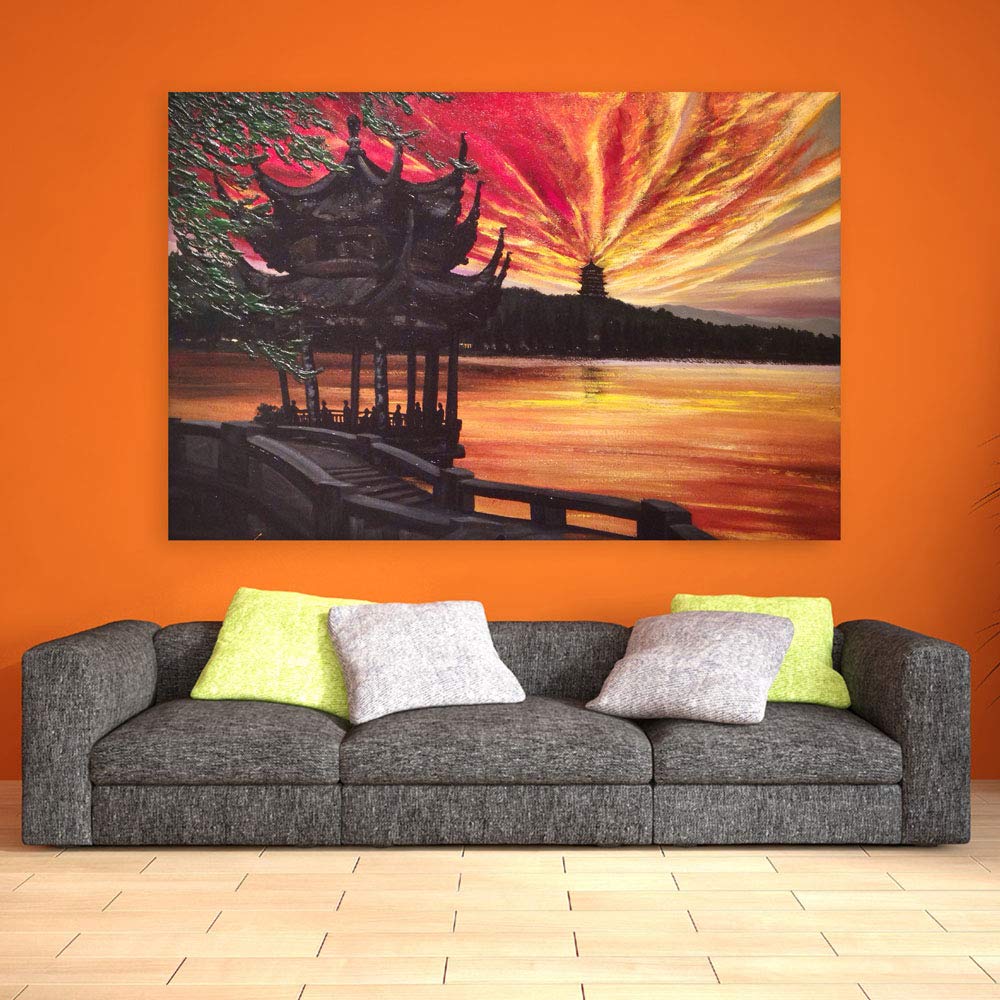
This Buddhist monastery sunset canvas resolves that visualization problem through one specific design decision: the composition radiates outward from a central point. The silhouetted pavilion anchors the left side while the sky explodes in magentas, oranges, and golds toward the edges. From your doorway, your eye catches the warm burst first. Up close, you notice the architectural details—the curved pagoda roofline, the figures on the walkway, the distant temple across the water. It reads at multiple distances because the visual weight is distributed deliberately, not randomly.
Why 91cm Width Works on 8-10ft Walls (And What Changes If You Go Larger)
At 91cm wide, this canvas covers approximately 30% of a 10-foot wall or 38% of an 8-foot wall. That's the range where art becomes a focal point without overwhelming the wall's negative space.
Above a 6-foot sofa (180cm), this canvas sits comfortably within the furniture's visual footprint—you'll have roughly 45cm of sofa extending past each edge of the canvas, which creates balanced framing. Above a 7-foot sofa, you're still within the 60-75% width guideline. Above an 8-foot sofa, consider whether you want the canvas to be a contained accent or if you need to size up to 120cm for proportional presence.
Viewing distance matters here: from 8-10 feet away (typical living room seating), the radiating sunset effect reads clearly. The silhouette registers as a cohesive shape, and the color gradient creates depth. If your seating is closer than 6 feet, you'll appreciate the textural brushstroke details in the sky more than the overall composition.
The 61cm height works for standard 8-foot ceilings with 20-25cm clearance above a sofa. If you have 10-foot ceilings, the canvas won't feel undersized—the horizontal orientation and warm color intensity give it visual weight that reads larger than its physical dimensions.
What These Colors Look Like on Cream Walls (Morning vs LED)
The palette here is almost entirely warm: magenta, coral, burnt orange, golden yellow, amber. The only cool element is the blue-gray at the sky's upper edge and the black silhouettes. This warm dominance means the canvas behaves predictably against common Indian wall colors.
Against cream or off-white walls, the sunset colors appear vibrant without clashing. Morning light cools the magentas slightly toward purple; afternoon sun intensifies the oranges and golds. Under warm LED lighting (3000K, standard in most Indian homes), the entire piece glows—the amber water reflections pick up the artificial warmth and appear richer.
Against peach walls (common builder paint choice), the coral and orange tones in the canvas will harmonize rather than compete. Against light yellow walls, the golden sections blend while the magentas provide contrast.
The silhouette design is the safety net here: regardless of wall color, the black pavilion and treeline create separation between the canvas and the wall. You're not relying on subtle color differences to make the art pop—the dark shapes do that work automatically.
With brown or beige sofas and wooden furniture (most Indian living rooms), the amber and golden tones in the lower half of the canvas echo those warm neutrals. The canvas looks like it belongs with your existing furniture rather than fighting against it.
Installation in Indian Walls (Concrete vs Drywall)
At 400 grams, this canvas is lighter than most 90cm pieces. Standard picture hooks rated for 1kg will hold it securely, with significant safety margin.
For concrete walls (common in buildings older than 2010): use the included 6mm concrete anchors. Drill 35mm deep, tap in the anchor, screw in the hook. The low weight means you can use a single center hook if your wall anchor placement is accurate.
For drywall (common in newer apartments and gypsum partitions): plastic expansion anchors work fine. Two anchors spaced 50cm apart distribute the load, though at this weight, even one properly installed anchor is sufficient.
The rolled delivery format means you'll attach D-ring hangers to the frame's back before hanging. This takes 5 minutes with a screwdriver. Position the D-rings about 10cm from the top edge of the frame, centered on each vertical stretcher bar.
In rentals, the 6mm anchor holes fill completely with wall putty. Sand smooth after 30 minutes of drying, touch up with matching paint. Your deposit isn't at risk from holes this small—they're smaller than the holes left by standard picture nails.
Why Canvas Works Where Fabric Tapestries Fail
Fabric tapestries seem like an easier solution—no drilling, just hang from a rod or clips. But in Indian conditions, the trade-offs become obvious within months.
Tapestries absorb humidity. During monsoon season, the fabric holds moisture, creating that slightly musty smell near the wall. The bottom edge doesn't hang flat—it curls or waves depending on air currents from fans and AC. Dust embeds in the weave and doesn't wipe clean; you need to wash the tapestry periodically, which risks color bleeding and shrinkage.
Canvas with moisture-resistant coating doesn't absorb atmospheric humidity. The surface wipes clean with a dry cloth. The stretched frame keeps the canvas taut regardless of temperature or humidity fluctuations. Three monsoon seasons from now, this canvas will look identical to day one. A fabric tapestry of the same scene would show visible wear, dust accumulation, and likely some warping.
The visual presence differs too. Tapestries have a soft, folksy aesthetic—they announce themselves as fabric. Canvas reads as intentional art. If you want your living room to feel curated rather than decorated, canvas delivers that perception in a way tapestries can't replicate.
What This Will Actually Feel Like in Your Room
From your doorway, the first thing you'll register is warmth—the sunset colors pull your eye across the room. The silhouette creates enough contrast that the canvas doesn't blend into the wall; it asserts itself as a deliberate focal point.
From your sofa, looking up at the canvas at a slight angle, the compositional flow becomes more apparent. The sky radiates from behind the pavilion, the water reflects the warmth below, and the green foliage in the corner provides visual relief from the intensity of the sunset palette.
This canvas works best as a solo piece above seating rather than as part of a gallery wall. The radiating composition and warm color saturation would compete with adjacent art. Give it negative space on either side, and let it anchor the wall by itself.
If you have other Buddhist or Asian-themed décor in the room (a Buddha statue, meditation corner, imported furniture), this canvas connects to that aesthetic without being overtly religious—it's more landscape than spiritual iconography. If your room is otherwise contemporary Indian, the sunset warmth and architectural subject still fit; monastery and temple silhouettes read as culturally neutral "travel" or "landscape" themes.
Moolwan Design Note
The silhouette-forward composition was selected specifically because it creates wall-color flexibility—the black shapes separate the warm sunset from whatever paint color sits behind it, eliminating the color-matching anxiety that stops most canvas purchases.
Moolwan Quality Standard
Designed for Indian apartments and lighting conditions. Packed for long-distance Indian transit. Quality checked before dispatch. Printed to resist humidity-related color fading. Ships from West Bengal.
Moolwan Fit Guidance for Indian Homes
At 91x61cm, this fits above 6-7 foot sofas with ideal proportions. For 8-foot sofas, position slightly off-center if you have a floor lamp at one end, or center it if the sofa stands alone.
Quick Specifications
| Specification | Detail |
|---|---|
| Product | Moolwan Buddhist Monastery Sunset Canvas Wall Art Painting (91x61cm) |
| Brand | Moolwan |
| Category | Canvas Wall Art Painting |
| Collection | Buddha Wall Art Collection |
| Dimensions | 91cm (W) x 61cm (H) x 2cm (D) |
| Weight | 400 grams |
| Material & Construction | 340 GSM pure cotton canvas, eco-solvent UV-resistant inks, kiln-dried pinewood frame |
| Colors | Magenta, coral, burnt orange, golden yellow, amber, black silhouettes, green foliage accents |
| Best For | Living room walls 8-12 feet wide, above 6-7 foot sofas, meditation spaces, bedrooms |
| Ships From | West Bengal |
Frequently Asked Questions
Will 91cm look too small above my 8-foot sofa?
At 91cm, the canvas will be approximately 50% of your 8-foot sofa's width—within acceptable range but on the smaller side. If your living room seating distance is more than 10 feet from the wall, consider whether you want a more commanding presence (120cm) or a contained accent piece (this 91cm). The warm sunset colors and high contrast silhouettes help this canvas read larger than its physical dimensions.
How will the magenta and orange tones look under my warm LED lights?
Warm LED lighting (2700K-3000K, standard in most Indian homes) intensifies the amber and golden tones while keeping the magentas rich. The canvas will appear warmer and more saturated in the evening than in daylight, which typically suits living room usage patterns—you'll see it most under artificial light.
Can I hang this with Command strips instead of drilling?
At 400 grams, Command strips rated for 1-2kg will hold this canvas. However, canvas art hangs more securely from D-ring hangers on wall anchors—the rigid connection prevents shifting over time. If you're in a rental with strict no-drilling policies, Command strips work as a temporary solution; otherwise, the small anchor holes are easily patched when you move.
Will the colors fade if my wall gets afternoon sun?
The eco-solvent inks used on this canvas include UV inhibitors designed for fade resistance. Direct afternoon sun for 3-4 hours daily won't cause visible color shift within the first several years of ownership. In coastal cities with high salt air, keep the canvas on an interior wall rather than directly adjacent to sea-facing windows.
Does the monastery theme work in a non-spiritual room?
The subject reads as landscape/travel art rather than religious iconography. The pavilion and distant pagoda are architectural elements against a dramatic sunset—similar to how Santorini sunset photos don't require Greek Orthodox décor to fit a room. This works in contemporary Indian living rooms without any supporting Buddhist or Asian-themed elements.
Product Snapshot
| Attribute | Detail |
|---|---|
| Brand | Moolwan |
| Product | Moolwan Buddhist Monastery Sunset Canvas Wall Art Painting (91x61cm) |
| Category | Canvas Wall Art Painting |
| Collection | Buddha Wall Art Collection |
| Theme/Type | Buddhist monastery silhouette, sunset landscape |
| Best For | 8-12ft living room walls, above 6-7ft sofas, meditation corners |
| Primary Differentiator | Radiating sunset composition that creates directional visual energy from center |
| Secondary Differentiators | Silhouette-dominant design works with any wall color; warm-to-cool gradient shifts appearance throughout day |
| Material & Construction | 340 GSM cotton canvas, eco-solvent UV-resistant inks, kiln-dried pinewood frame, moisture-resistant coating |
| Care Instructions | Dust with dry microfiber cloth every 2-3 weeks; avoid water or cleaning chemicals |
| Ships From | West Bengal |
| Packing | Long-distance transit ready |
| Quality Check | Before dispatch |