
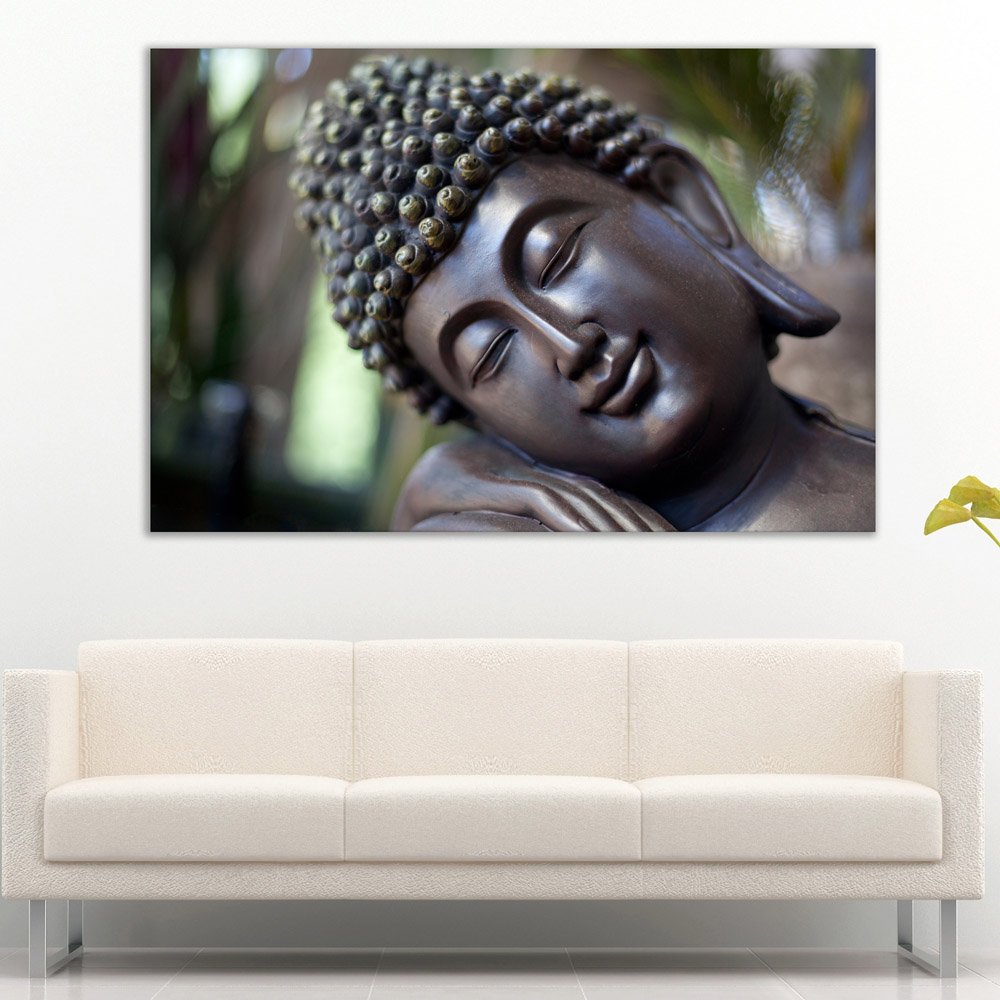

Buddha-tastic framed Canvas That'll Elevate Your Zen Game - Vibrant 91x61cm Wall Art
You may also like

Moolwan Reclining Buddha Canvas Wall Art Painting (91x61cm) – Soft-Focus Portrait with Natural Bokeh
You've measured your living room wall twice already. The tape says 10 feet, maybe 11. And you keep second-guessing whether 91cm is substantial enough or if you need to go bigger. The sizing guides online don't help—they're written for Western furniture proportions, not the 6-7 foot sofas common in Indian apartments. Your wall has that empty stretch above the sofa that's been bothering you for months. You need to know 91cm actually works in your specific space.
This Buddha canvas solves a specific proportional challenge. At 91cm wide, it occupies roughly 30% of a 10-foot wall—visually present without overwhelming the space. The composition itself does something unusual: the reclining Buddha face fills the frame at an intimate close-up, which means the subject reads clearly even from across a 12x14 foot living room. The soft-focus green background creates depth without competing elements, so your eye rests on the serene expression rather than scanning for details. Against cream or off-white walls (common in Indian apartments), the bronze-brown tones of the Buddha face anchor the space with warmth rather than stark contrast.
Why 91cm Works on 10-Foot Walls (What Changes If You Size Up)
A 10-foot wall measures 300cm. This 91cm canvas covers 30% of that width—leaving approximately 104cm on each side. That's deliberate visual breathing room. If your sofa is 6-7 feet wide (180-210cm), the canvas sits comfortably within the sofa's visual footprint without extending beyond the armrests.
The calculation changes for larger walls. On a 12-foot wall (360cm), the same 91cm canvas covers 25%—still works, but creates more negative space. Some people prefer that spaciousness; others find it looks slightly small. If your wall exceeds 12 feet, consider whether you want the Buddha portrait as a focal point (91cm works) or as a dominant presence (you'd need 120cm).
Height matters too: at 61cm tall, this canvas hangs comfortably on 8-foot ceilings with standard placement (20-25cm above sofa top). The remaining wall space above the canvas balances with ceiling height. On 10-foot ceilings, the canvas appears more compact—not wrong, but intentionally gallery-like rather than room-filling.
How Bronze-Brown Buddha Tones Work in Indian Living Rooms
The color story here is subtle but specific. The Buddha sculpture is rendered in deep bronze-brown—not black, not gray, but a warm metallic tone that photographs well in both natural and artificial light. The background is soft green with hints of golden bokeh, suggesting garden foliage without literal detail.
Against cream walls (Asian Paints Ivory Coast, Dulux White Dune, or similar), the bronze-brown creates grounded contrast. It reads as sophisticated, not stark. Against off-white or light yellow walls, the warmth increases—the greens in the background harmonize with any indoor plants you have.
Morning light (east-facing windows) cools the tones slightly, making the green background more prominent. Evening LED light (warm white, 2700-3000K) warms everything, emphasizing the bronze metallics. The Buddha face maintains its serene quality in both conditions because the colors are mid-toned—no high-contrast whites or blacks that shift dramatically with lighting changes.
If your furniture is brown or beige fabric (common in Indian homes), this canvas extends that palette upward onto the wall rather than introducing competing colors.
Installation in Indian Walls (Concrete, Brick, or Drywall)
At 400 grams, this is a lightweight canvas. Standard drywall anchors hold it securely; you don't need heavy-duty concrete anchors unless you're mounting into solid masonry.
For drywall (common in newer apartments): Use the plastic anchors included. Drill 6mm holes about 30mm deep. Insert anchors, screw in hooks, hang on D-rings. Total time: 15 minutes.
For concrete or brick walls (common in older buildings): Use masonry anchors. Drill 35mm deep with a masonry bit. Same process otherwise.
Rental consideration: The holes you're creating are 6mm diameter—smaller than picture frame nail holes. When you move out, fill with wall putty (₹50 at any hardware store), sand smooth, touch up with matching paint. Repair time: 20 minutes. Repair cost: ₹200 maximum. This doesn't qualify as "major wall modification" in any standard lease agreement.
The hanging template included lets you mark exact positions before drilling. Tape it to the wall, mark through the paper, remove template, drill. No measuring errors.
How This Compares to ₹800 Marketplace Canvas
The marketplace listing shows a similar Buddha image. The price difference: roughly ₹2,000. The quality difference: visible within 6 months.
Cheap canvas uses 180-220 GSM material—thin enough that you can see the wooden frame through the fabric when light hits from behind. This canvas is 380 GSM cotton, opaque even in direct light. The weave is tight enough that dust sits on the surface rather than embedding in fibers.
The frame wood matters more than most people realize. Untreated pine absorbs humidity during monsoons (Mumbai: 70-85%, Chennai: 80%+). The wood expands. When dry season arrives, it contracts. After two cycles, the frame warps. The canvas loosens. You'll see rippling at the edges. This frame is kiln-dried to 12% moisture content—below equilibrium for Indian climates—so it doesn't absorb atmospheric moisture.
The inks are where fading becomes obvious. Dye-based inks (marketplace standard) fade within 12 months if your wall gets afternoon sun. The bronze-brown Buddha face becomes muddy gray-brown. The greens wash out. Eco-solvent inks are UV-stable—tested for outdoor signage, which means indoor conditions are well within tolerance.
What This Will Actually Look Like in Your Room
From across the room (3-4 meters, typical living room viewing distance), the Buddha face reads as a serene presence. The soft-focus background recedes. The bronze-brown tones register as warm and grounded. Guests notice it when they walk in, but it doesn't dominate conversation or demand attention.
From up close (standing directly in front), the canvas texture becomes visible. The cotton weave adds subtle dimensionality to the printed image. The bokeh effect in the background shows gradations of green that aren't obvious from across the room.
This canvas works well as a solo piece. The composition is complete—portrait-style, centered subject, no implied continuation. You don't need flanking pieces or gallery arrangements. It anchors the wall above your sofa without requiring additional elements.
If you have a pooja corner or meditation space in the same room, this Buddha portrait maintains spiritual coherence without duplicating imagery. It's contemplative in tone but decorative in function—appropriate for living rooms where the primary use isn't worship.
Moolwan Design Note
The soft-focus bokeh background serves a specific purpose: it creates depth without detail. Your eye rests on the Buddha's closed eyes and subtle smile rather than scanning background elements. This composition technique makes the 91x61cm size feel more expansive than hard-edged alternatives.
Moolwan Quality Standard
Designed for Indian apartments and lighting conditions. Printed to resist humidity-related color fading. Packed for long-distance Indian transit. Quality checked before dispatch. Ships from West Bengal.
Moolwan Fit Guidance for Indian Homes
91x61cm suits walls 10-12 feet wide in rooms with 8-10 foot ceilings. Position 20-25cm above sofa top for anchored placement. The horizontal orientation complements standard 6-7 foot Indian sofas without extending beyond armrest width.
Quick Specifications
- Product: Moolwan Reclining Buddha Canvas Wall Art Painting (91x61cm)
- Brand: Moolwan
- Category: Canvas Wall Art Painting
- Collection: Buddha Wall Art Collection
- Dimensions: 91cm (W) x 61cm (H) x 2cm (D)
- Weight: 400 grams
- Material: Pure cotton canvas 380 GSM, moisture-resistant coating
- Frame: 1.5-inch kiln-dried imported pine wood, corner-braced
- Inks: Eco-solvent UV-resistant
- Colors: Bronze-brown Buddha sculpture, soft green bokeh background
- Best For: 10-12ft walls in living rooms, bedrooms, meditation spaces
- Ships From: West Bengal
- Delivery: 5-6 days metro cities, 6-8 days tier-2/3
Frequently Asked Questions
Will 91x61cm look too small above my 8-foot sofa?
At 91cm wide, this canvas covers roughly 50% of an 8-foot (240cm) sofa width—visually balanced without extending beyond the seating area. It works as a focal point. If you prefer edge-to-edge coverage, 120cm would be the next size to consider.
How will the bronze-brown tones look against my peach-colored walls?
Bronze-brown complements builder's peach (common in Indian apartments). The warm undertones in both create cohesion rather than contrast. The green background adds a complementary accent. The combination reads as intentional, not mismatched.
Can I hang this in a room that gets afternoon sun?
Yes. The eco-solvent inks are UV-stable—designed for outdoor signage exposure. Indoor afternoon sun won't cause fading. The moisture-resistant coating protects the canvas surface from humidity fluctuations.
Is 400 grams heavy enough to need concrete anchors?
No. Standard drywall anchors hold this weight securely. Even plastic expansion anchors work. You only need concrete/masonry anchors if your wall is solid brick or poured concrete with no drywall layer.
Will this look appropriate in a living room, or is it better suited for a meditation space?
The composition works for both. The soft-focus style and muted colors make it decorative rather than devotional in tone. It reads as contemplative art in a living room context, not overtly religious imagery requiring specific placement.
Product Snapshot
- Brand: Moolwan
- Product: Moolwan Reclining Buddha Canvas Wall Art Painting (91x61cm)
- Category: Canvas Wall Art Painting
- Collection: Buddha Wall Art Collection
- Theme/Type: Reclining Buddha portrait, close-up composition
- Best For: 10-12ft walls in living rooms, bedrooms, home offices
- Primary Differentiator: Soft-focus bokeh background creating depth without distraction
- Secondary Differentiators: Bronze-brown metallic tones, intimate portrait-style framing
- Material & Construction: 380 GSM cotton canvas, 1.5" kiln-dried pine frame, eco-solvent inks
- Care Instructions: Dry dust with microfiber cloth every 2-3 weeks; avoid water or chemicals
- Ships From: West Bengal
- Packing: Long-distance transit ready
- Quality Check: Before dispatch