

Buddha-tastic Multi-Frame Framed Wall Art That'll Namaste Your Space
You may also like

Moolwan 4-Panel Buddha Under Bodhi Vinyl Wall Art on MDF (84x54cm) – Bodhi Leaf Canopy Framing Meditative Serenity
When You Can Picture the Wall But Not the Art on It
You've measured your living room wall three times. You know it's somewhere between 10 and 12 feet. You know your sofa sits against it—probably a brown or beige fabric three-seater, maybe 7 feet wide. You've scrolled through dozens of Buddha paintings, and they all blur together: same golden tones, same generic meditation pose, same forgettable compositions that look fine in thumbnails but you can't actually visualize on your specific wall, above your specific sofa, in your specific lighting.
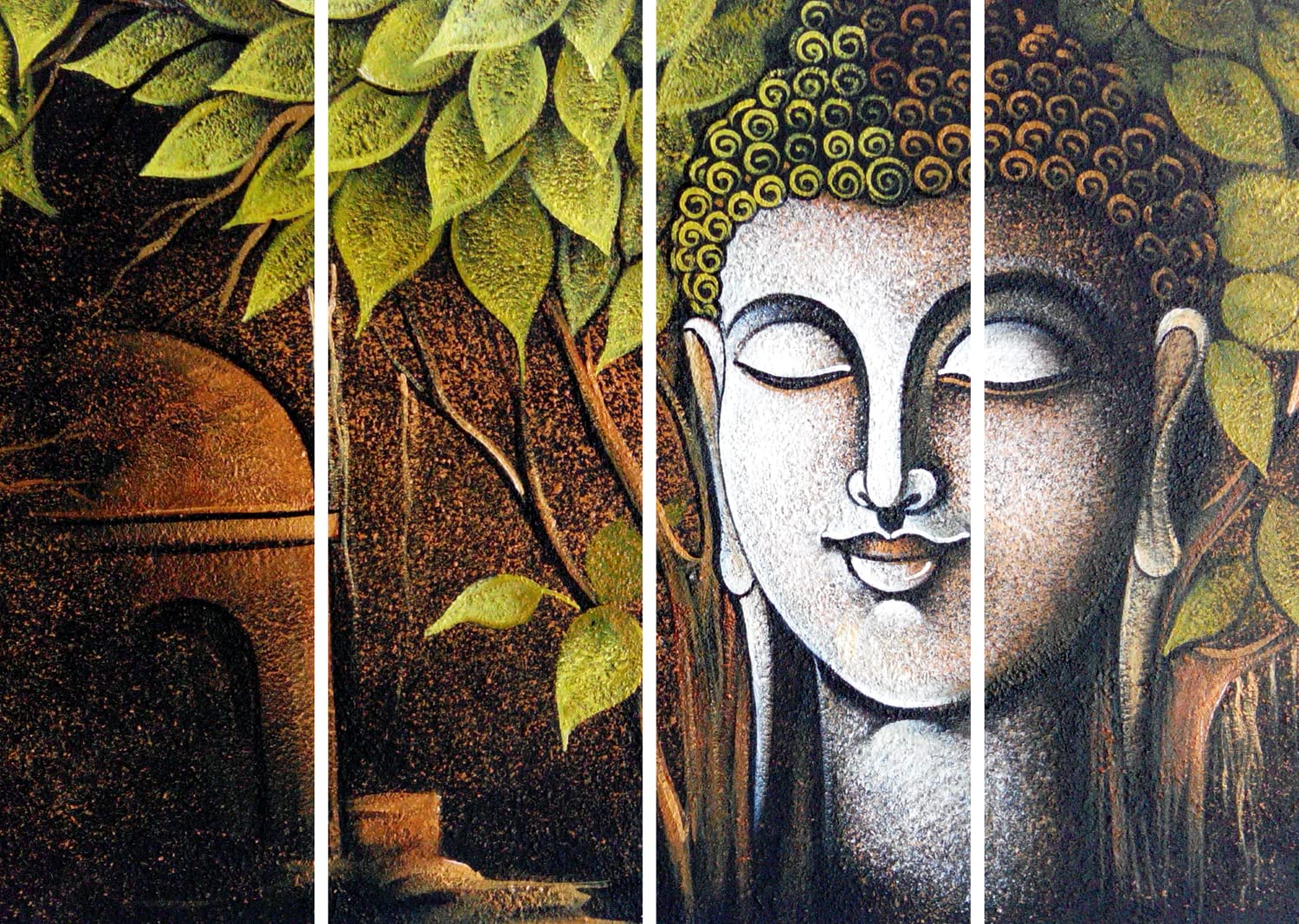
This 4-panel Buddha piece solves that visualization problem because of one compositional choice you won't find in typical Buddha art: the Bodhi leaves form a natural canopy across the top third of the artwork, cascading downward to frame Buddha's face. Your eye enters through the bronze archway on the left, travels across the leaves, settles on the closed-eye expression, then rests in the textured earth tones below. When you look at your wall right now and try to imagine art there, this composition gives you something specific to picture—a visual anchor, not a generic rectangle.
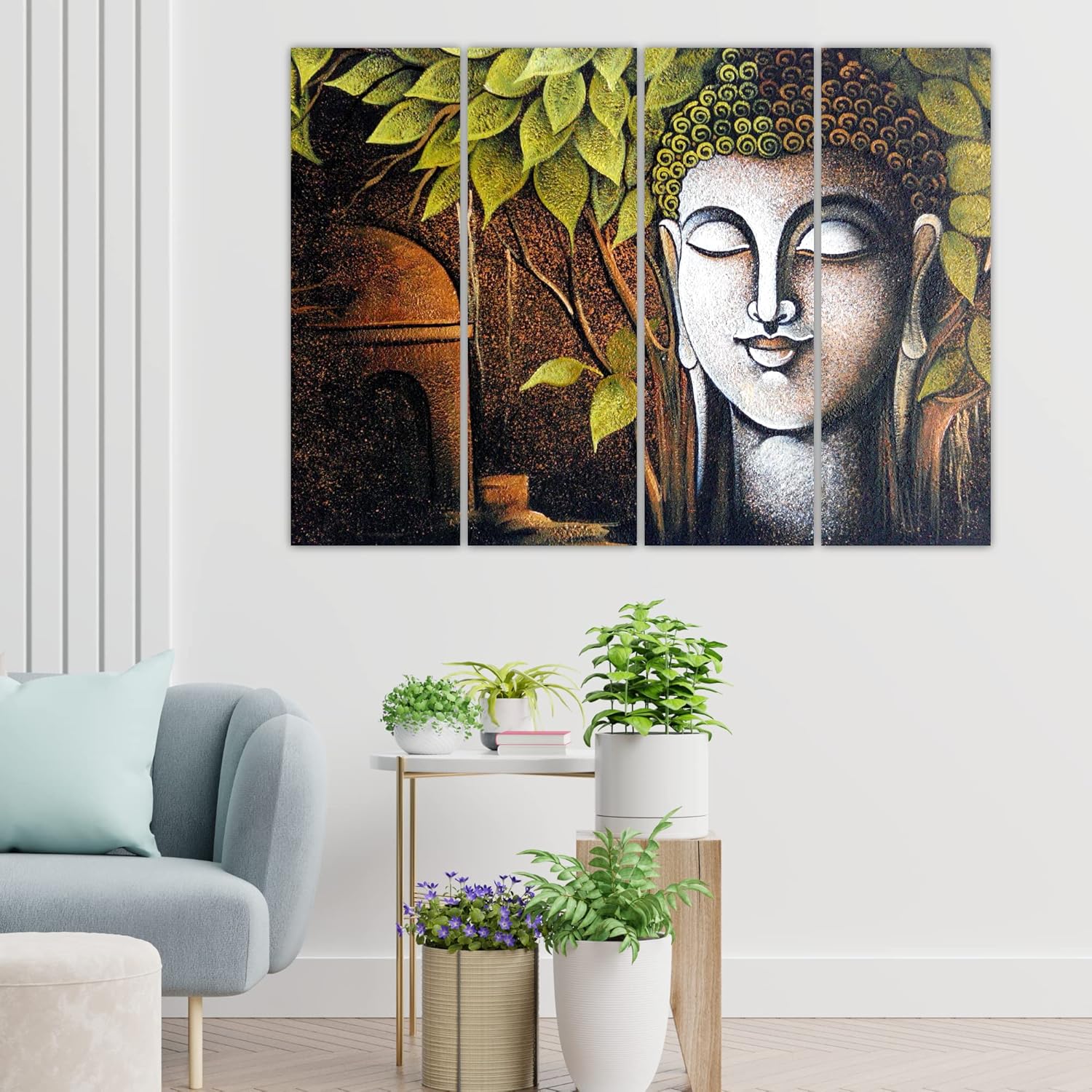
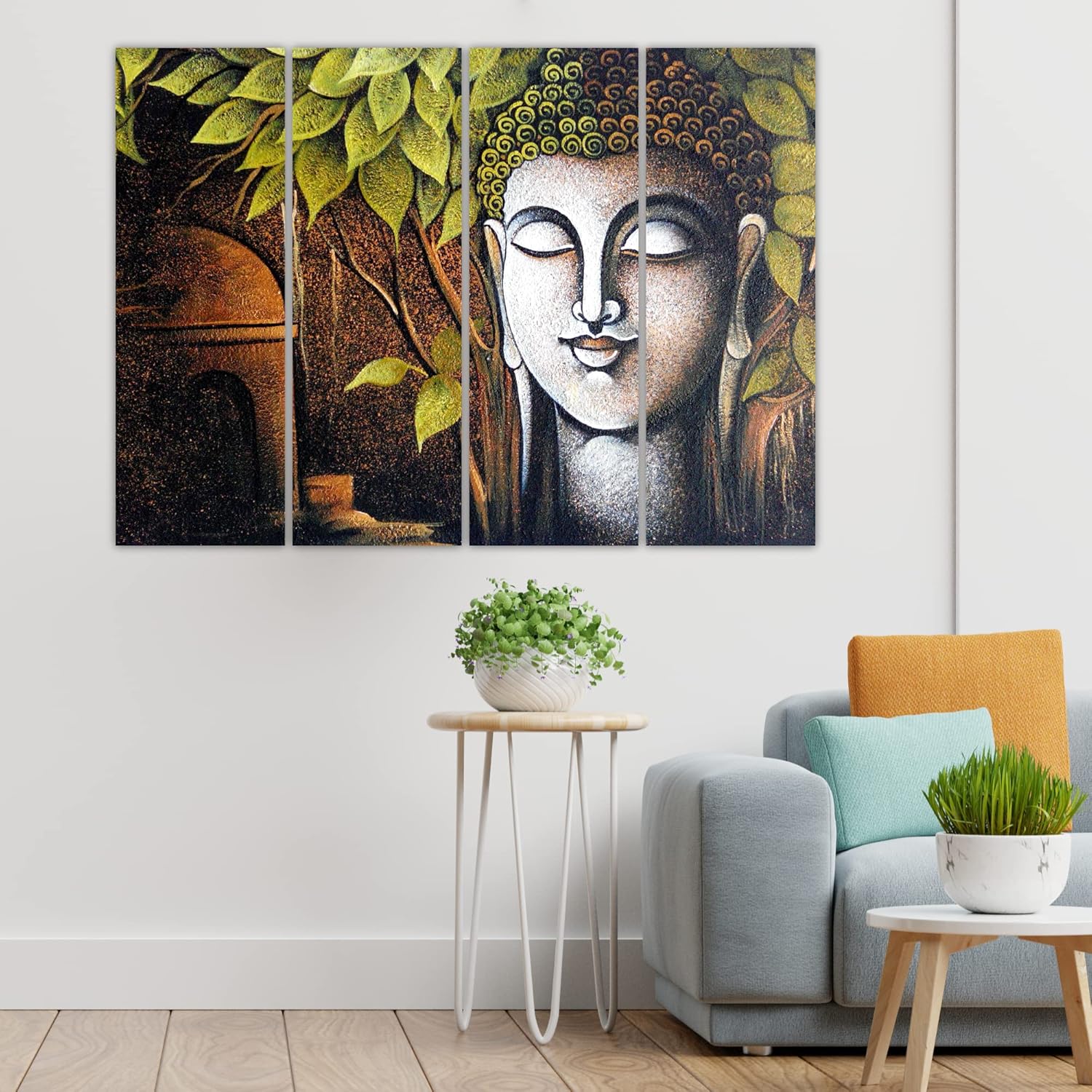
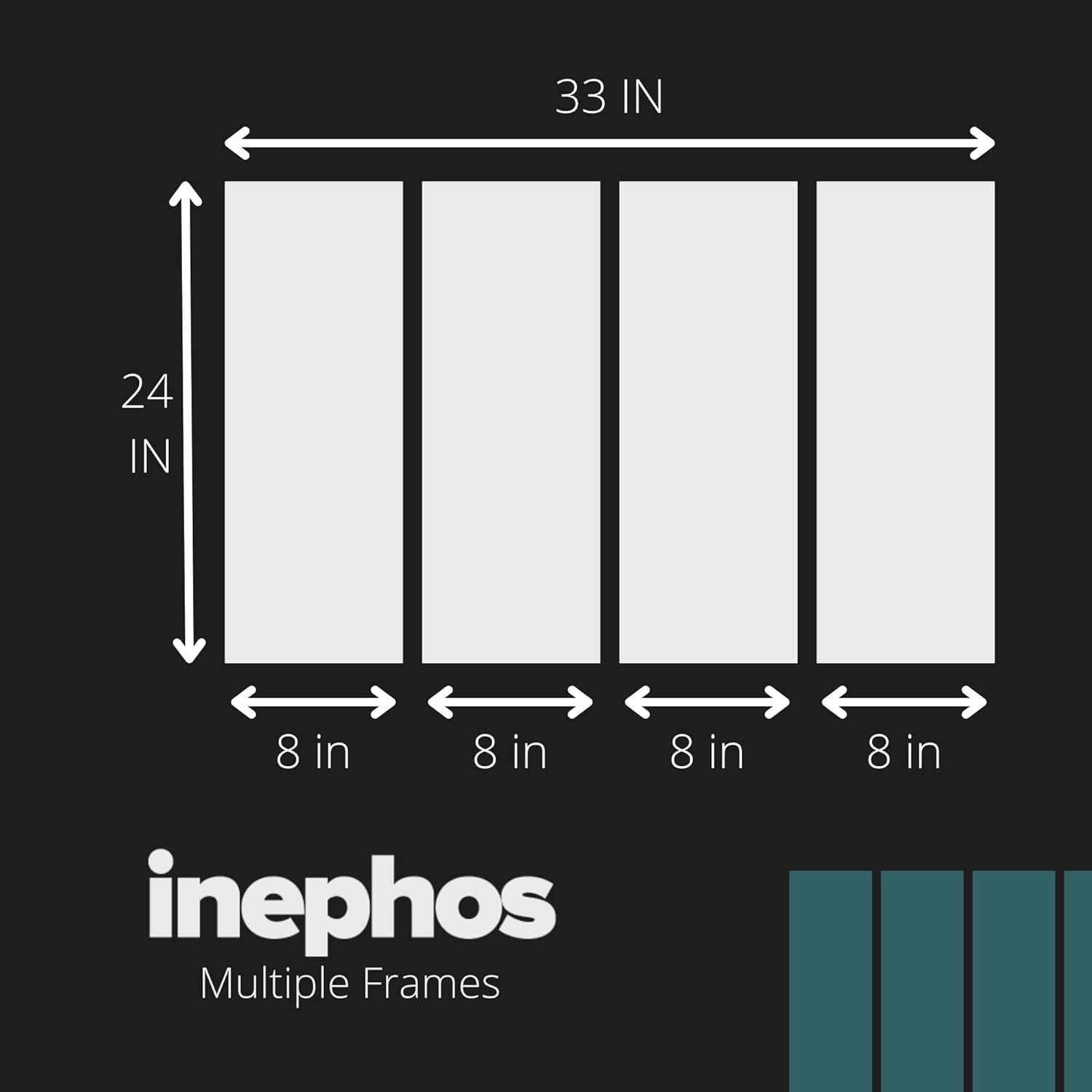
At 84cm wide, this covers roughly 55-60% of an 8-foot sofa's width—the exact proportion that reads as intentional rather than undersized or overwhelming.
Why 84cm Width Works on 10-12ft Walls (And What Changes If You Size Up)
The math here is straightforward. Your wall is probably 300-360cm wide. This piece at 84cm occupies roughly 23-28% of that wall width—enough to establish a focal point without dominating the entire visual field.
Above a 200-220cm sofa, 84cm lands in the 38-42% coverage range. That's slightly below the 50-75% recommendation in most guides, which actually works better for multi-panel art. The visual weight of four distinct frames reads larger than a single 84cm canvas would. The white gaps between panels add perceived width without adding actual width.
Viewing distance matters: from across a 12-foot living room, the four panels read as one cohesive image. From the sofa (2-3 feet away), each panel becomes individually appreciable—you notice the texture in the Bodhi leaves, the stippled effect on Buddha's face, the bronze gradient on the stupa silhouette.
If your wall is narrower (8-9 feet) or your sofa smaller (6 feet), this 84cm width becomes more dominant—probably 60-70% of your seating area. That still works for Buddha art, which benefits from visual presence, but you'd want it centered precisely rather than offset.
What These Bronze-Earth Tones Look Like on Cream Walls (Morning vs LED)
The palette here isn't the typical gold-and-saffron Buddha art you've seen everywhere. This uses oxidized bronze, deep chocolate brown, sage-olive green, and a cool gray-white for Buddha's face. These are earth tones, not metallic tones.
On cream or off-white walls (what 80% of Indian apartments have): the bronze-brown background disappears into the wall color during daylight, making the green Bodhi leaves and gray Buddha face pop forward. At night under warm LED (3000K, which most Indian homes use), the entire piece warms up—the browns deepen, the greens become more olive than sage, and the overall effect feels more intimate.
Against light yellow walls: the bronze tones harmonize almost too well—you might lose some contrast. Consider positioning where the piece gets direct light for at least part of the day.
Against colored accent walls (terracotta, forest green, navy): this palette holds its own. The four-panel structure creates enough visual separation that the art doesn't get absorbed into the wall color.
The gray-white Buddha face stays neutral across all lighting conditions—it's the visual anchor that doesn't shift warm or cool depending on time of day.
Installation in Indian Walls (Concrete vs Drywall)
Four panels means eight hanging points—two per panel for level stability. This sounds complicated but actually makes leveling easier than single heavy pieces: if one panel sits slightly off, you adjust just that panel without rehanging everything.
For concrete walls (most buildings constructed before 2010): use the included 6mm masonry anchors. Drill 35mm deep, tap in anchors, screw hooks. The combined weight of all four panels is approximately 3kg, so each anchor bears less than 400 grams of shear force—well within concrete anchor capacity.
For drywall (newer apartments, especially in Bangalore and Gurgaon high-rises): plastic wall anchors work fine at this weight. The key is spacing: panels should sit 2-3cm apart to maintain the visual separation without looking disconnected.
The practical installation sequence: hang the two center panels first (panels 2 and 3 where Buddha's face spans across), verify they're level, then hang the outer panels using the center ones as reference. Total time: 25-30 minutes for all four, assuming you measure once rather than drilling, checking, re-drilling.
Rental consideration: eight small anchor holes (6mm each) fill with standard wall putty in under 10 minutes. These are smaller than the holes left by curtain rod brackets.
This vs. Macrame Wall Hangings (Honest Comparison)
Macrame wall hangings have become the default "spiritual corner" solution in Indian apartments—you see them in every HomeCenter and Instagram home decor account. Here's what happens with macrame over time versus MDF panel art:
Macrame collects dust in the woven fibers. Within 3-4 months in dusty cities (Delhi, Mumbai during construction season, anywhere near a main road), the cotton or jute darkens. You can't wipe it clean—you have to take it down, shake it out, ideally wash it, let it dry completely to prevent mold, rehang it. Most people don't bother after the first cleaning attempt.
Macrame doesn't hold its shape in humidity. The fibers absorb moisture, stretch, and the geometric patterns sag. What looked taut and intentional in October looks droopy by August.
Macrame creates "craft project" aesthetic rather than "curated home" aesthetic. There's a visual weight difference between handmade bohemian and finished art piece. Macrame reads as the former; framed panel art reads as the latter.
This Buddha MDF piece: wipe with dry cloth monthly, splash-proof surface means accidental contact with wet hands doesn't leave marks, the rigid panels maintain exact shape regardless of humidity. The trade-off is macrame feels "softer" and more textural from close range—but most wall art is viewed from across the room, where texture doesn't register and overall composition matters more.
What This Will Actually Feel Like in Your Room
From the doorway (first impression when guests enter): the four-panel structure draws the eye immediately because of the visual rhythm—dark panel, leafy panel, face panel, dark panel. This reads as "statement piece" rather than "something hanging on the wall."
From the sofa: the Bodhi leaves become more detailed. You notice the vein patterns, the way some leaves curl at the edges. The stippled texture on Buddha's face suggests stone sculpture rather than flat printing. The bronze stupa in the left panel becomes identifiable as a stupa rather than abstract shape.
Visual weight: this piece anchors the wall without dominating adjacent furniture. If you have a wooden side table or a brass lamp nearby, the earth tones echo rather than compete. If you have a mostly gray/white modern setup, the warm browns add the accent color your room might be missing.
Solo vs. adjacent decor: this works best as the single large piece on its wall. Adding small frames nearby creates visual clutter—the four-panel structure already provides rhythm. If you want to build out the meditation corner, add floor elements (cushions, small plants) rather than wall elements.
Moolwan Design Note
The Bodhi leaf canopy wasn't incidental—it creates an architectural frame within the frame. Your eye follows the leaf line downward to Buddha's closed eyes, then rests in the bronze-earth lower portion. This guided viewing path is why the piece feels composed rather than cropped.
Moolwan Quality Standard
Designed for Indian apartments and lighting conditions. Printed to resist humidity-related color fading. Packed for long-distance Indian transit. Quality checked before dispatch. Ships from West Bengal.
Moolwan Fit Guidance for Indian Homes
At 84cm wide, this fits walls behind 6-8 foot sofas without overwhelming smaller furniture. The horizontal orientation works above seating; avoid vertical spaces like narrow hallways where the 54cm height would feel compressed.
Quick Specifications
| Specification | Detail |
|---|---|
| Product | Moolwan 4-Panel Buddha Under Bodhi Vinyl Wall Art on MDF (84x54cm) |
| Brand | Moolwan |
| Category | Vinyl Wall Art on MDF |
| Collection | Buddha Wall Art Collection |
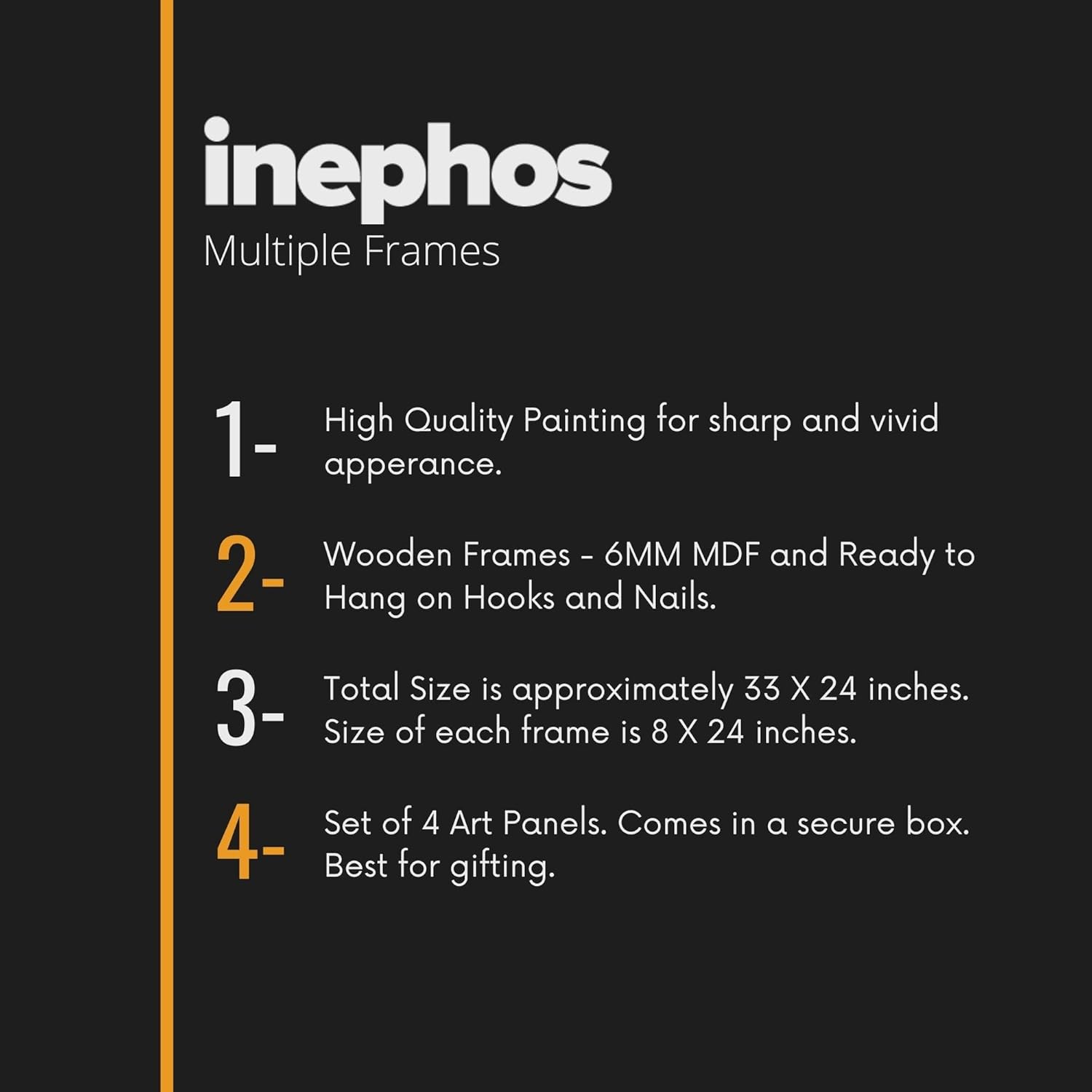
| Dimensions | 84cm (W) × 54cm (H) × 0.6cm (D) |
| Weight | Approximately 3 kg (all panels) |
| Panel Count | 4 panels |
| Material | Splash-proof vinyl print on MDF with matte laminated finish |
| Frame | Wooden MDF with scratch-resistant surface |
| Colors | Bronze brown, oxidized copper, sage green, olive, gray-white, chocolate brown |
| Best For | Living room walls 10-12ft wide, above 6-8ft sofas, meditation corners, entryways |
| Ships From | West Bengal |
Frequently Asked Questions
Will 84cm width look too small above my 8-foot sofa?
At 84cm, the piece covers roughly 40% of an 8-foot (240cm) sofa width. For single-panel art, that might read slightly undersized. For 4-panel art, the visual rhythm of multiple frames adds perceived width—the piece reads closer to 50-55% coverage because of the white gaps between panels.
How do the bronze-brown tones look under yellow LED lighting?
Yellow-tinted LEDs (2700K) make the browns richer and the greens more golden-olive. If your room already runs warm (yellow walls, lots of wood furniture), the piece integrates seamlessly. If you want more contrast, switch to 4000K neutral white bulbs—the gray Buddha face will pop more against the warmer background tones.
Can I hang this in a bathroom or kitchen where there's moisture?
The splash-proof vinyl surface handles occasional water contact and high humidity, but prolonged direct moisture exposure (steam from cooking, shower condensation) isn't recommended. The MDF backing can absorb moisture from behind in consistently humid environments. Best placement: living areas, bedrooms, covered balconies—anywhere without direct water or constant steam.
How do I align four panels evenly without professional help?
Hang the two center panels first (panels 2 and 3, where Buddha's face spans). Use a level app on your phone to verify horizontal alignment. Once center panels are set, hang outer panels using the inner edges as reference—match the top edges and maintain consistent 2-3cm gaps. The key is getting the first two perfect; the outer panels follow easily.
Will the colors fade near my east-facing window?
The vinyl print uses UV-resistant inks tested for sun exposure. East-facing windows get 2-4 hours of direct morning sun, which is within acceptable limits. West-facing windows with harsh afternoon sun are more challenging—if you're placing near a west window, consider positioning where the piece gets indirect rather than direct beam exposure.
Product Snapshot
| Attribute | Detail |
|---|---|
| Brand | Moolwan |
| Product | Moolwan 4-Panel Buddha Under Bodhi Vinyl Wall Art on MDF (84x54cm) |
| Category | Vinyl Wall Art on MDF |
| Collection | Buddha Wall Art Collection |
| Theme/Type | Buddha with Bodhi tree, spiritual/meditative |
| Best For | 10-12ft living room walls, above 6-8ft sofas, meditation spaces, entryways |
| Primary Differentiator | Bodhi leaf canopy framing composition |
| Secondary Differentiators | Textured bronze-earth tonal palette; meditative closed-eye expression with half-smile |
| Material & Construction | Splash-proof vinyl print on MDF, matte laminated wooden frame, scratch-resistant finish |
| Care Instructions | Dust with dry microfiber cloth; wipe splash marks with slightly damp cloth; avoid chemical cleaners |
| Ships From | West Bengal |
| Packing | Long-distance transit ready |
| Quality Check | Before dispatch |