
Buddha-tastic Multi-Frame Wall Art That'll Zen Your Space - 150x76cm Framed
You may also like

Moolwan 5-Panel Buddha Vinyl Wall Art on MDF (127x76cm) – Monochromatic Stone-Texture Portrait
You keep opening this page, trying to mentally place this on your wall. But it's impossible to know for certain, isn't it? 127cm looks substantial in product photos, but your living room wall has that window on one side, the TV unit below, maybe a floor lamp nearby. You need to know this works in your specific space—not just in styled mockups with perfect lighting and nothing else competing for attention.
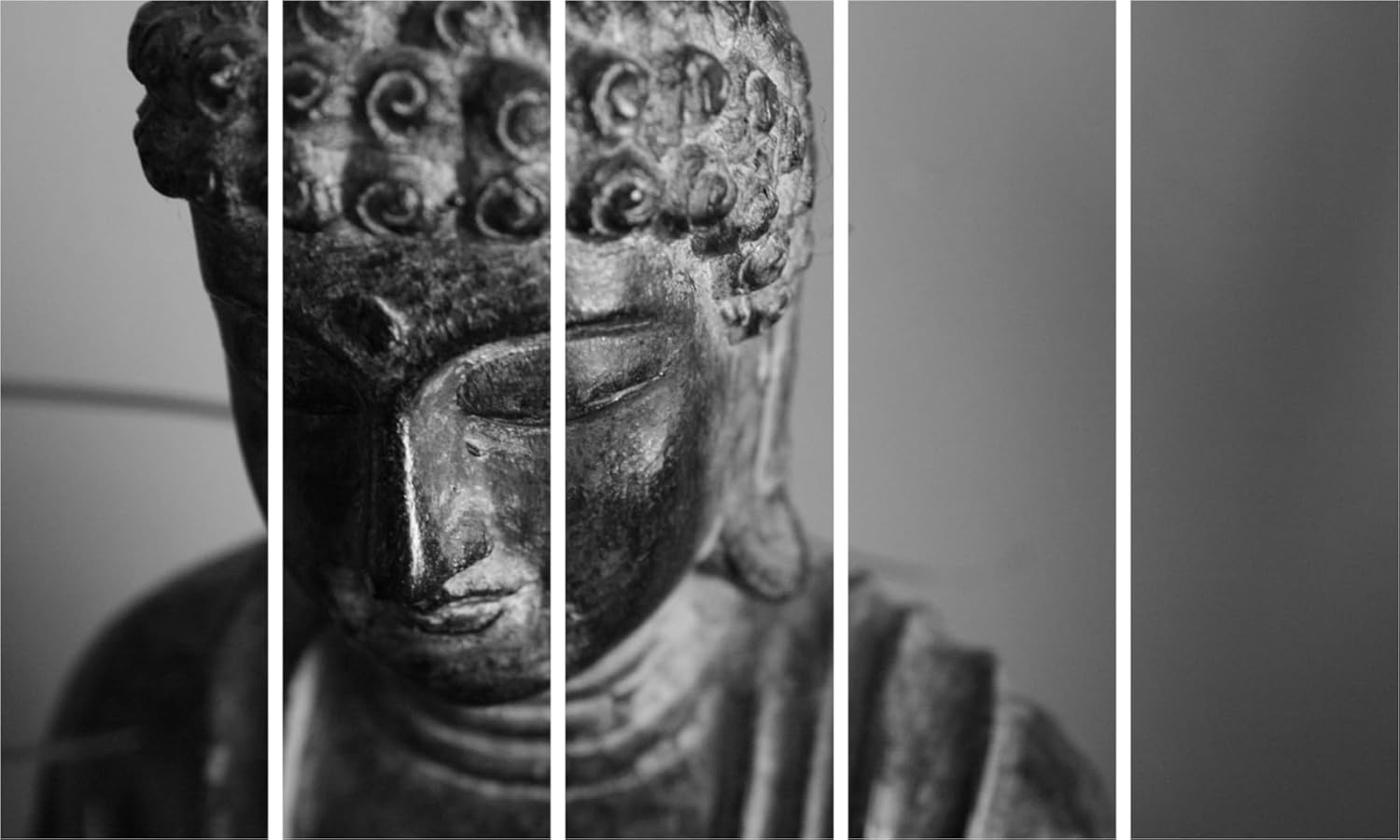
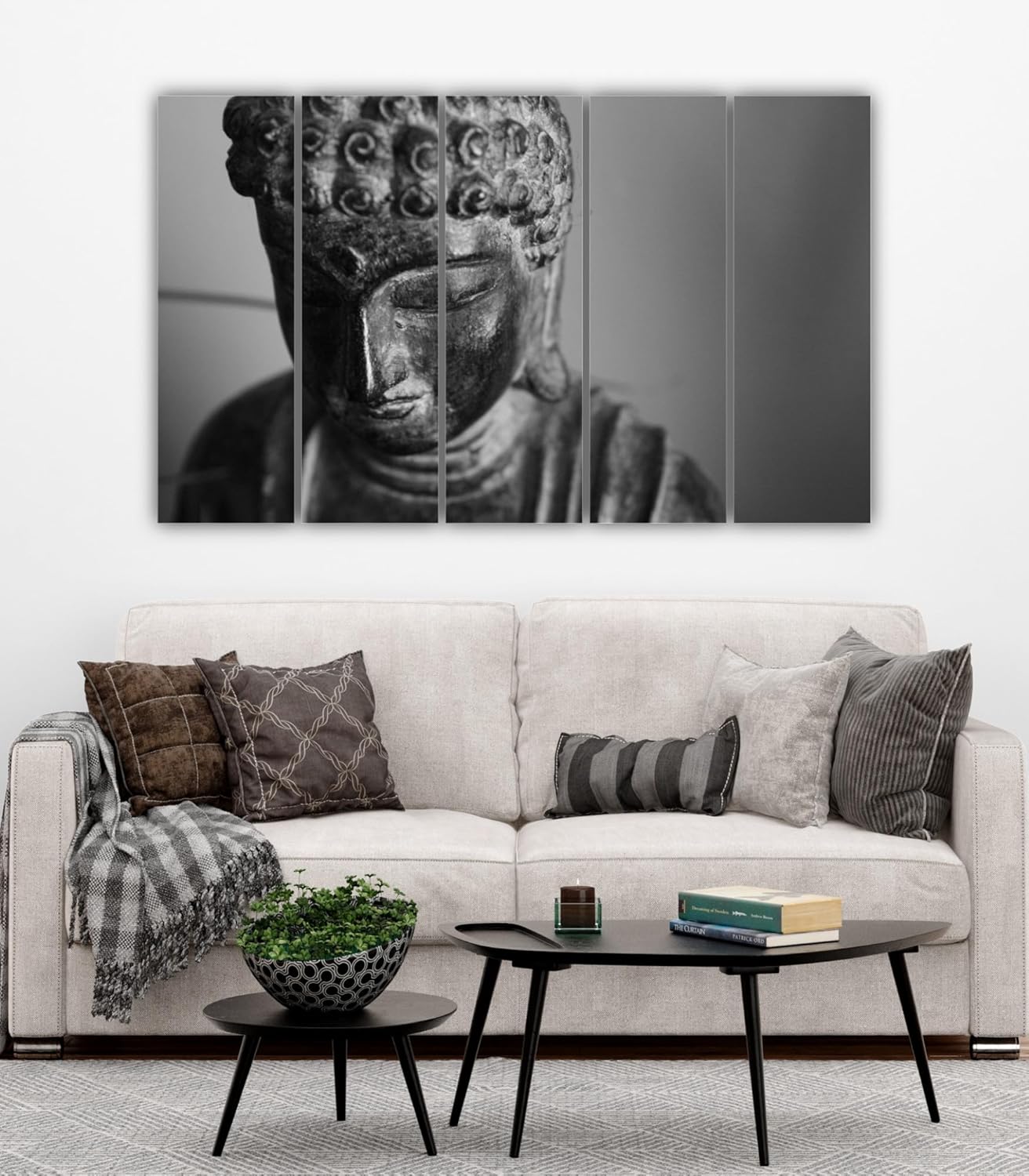
Here's what 127cm actually means on your wall: if your wall is 10 feet (300cm), this Buddha panel set covers about 42% of the horizontal space. That leaves roughly 86cm of wall visible on each side—enough breathing room that it anchors the space without crowding it. The composition itself helps: the Buddha's face concentrates on the left three panels, while the right two panels fade into soft gray. Your eye rests on the sculpture, then releases into calm negative space. This isn't a piece that fights with everything else in your room.
The monochromatic palette—charcoal gray through soft stone tones—does something most Buddha wall art doesn't: it integrates instead of demanding. Against cream walls, it reads as subtle and substantial. Against white walls, the gray tones warm the space. Against colored walls (sage, light blue, even that builder's peach), it doesn't clash because there's no color to compete with. This is why grayscale works in Indian homes where wall colors vary and you can't always control the exact shade your landlord painted.
Why 127cm Works on 10-12 Foot Walls (And What Changes If You Size Up or Down)
The math matters because mistakes show. On a 10-foot wall (300cm), 127cm gives you 42% coverage—substantial presence without domination. On a 12-foot wall (360cm), coverage drops to 35%, which still anchors the space but feels more gallery-like, more room to breathe around it.
If your wall is smaller—say 8 feet (240cm)—this same 127cm width covers 53%. That's getting into statement-piece territory. The Buddha's face would feel closer, more intimate. Whether that works depends on whether you want the room to feel contemplative or simply decorated.
Above an 8-foot sofa, 127cm falls into the ideal 60-70% ratio. Above a 6-foot sofa, it's slightly wider at 70%—still proportional, but the sofa won't anchor the artwork as firmly. If your sofa sits away from the wall (most do in Indian living rooms), the visual gap between sofa back and artwork stretches that relationship further. Consider whether you have 20-25cm clear above the sofa for mounting, or if cushions and headrests eat into that space.
The 5-panel format spreads the image across 127cm total width with small gaps between panels. Those gaps (typically 2-3cm each) create rhythm—your eye moves across the Buddha's face in stages rather than absorbing it all at once. This pacing suits the subject: meditation isn't rushed.
What This Grayscale Actually Looks Like Against Indian Wall Colors
Monochromatic art behaves differently than color. It doesn't compete with your existing palette—it converts light and shadow into texture. Here's what that means in practice:
Against cream or off-white walls (the most common in Indian apartments): the charcoal tones of the Buddha sculpture create depth without heaviness. Morning light will lift the grays toward silver. Evening warm LED (3000K, standard in most Indian homes) will push the tones slightly warmer, more stone-like. Neither shift feels wrong—grayscale adapts.
Against builder's peach or light yellow: these wall colors typically make cool-toned art look disconnected. Grayscale sidesteps the problem entirely. There's no blue to clash with peach, no green to fight yellow. The neutral gray reads as intentionally coordinated rather than accidentally mismatched.
With brown or beige sofas and wooden furniture: the stone-texture quality of this Buddha image echoes natural materials. It sits comfortably above wooden coffee tables and fabric sofas because nothing in the palette fights for attention. If you have brass lamps or warm metal accents, the warm LED light ties everything together.
The sculptural close-up—Buddha's curled hair, the smooth stone of the face, the weathered texture—reads as dimensional even on flat MDF panels. From across the room, your eye perceives depth. Up close, the vinyl print holds detail. This is the advantage of monochromatic imagery: without color distracting, texture becomes the subject.
Installation in Indian Walls (Concrete, Brick, or Drywall)
Five panels means five mounting points—or more precisely, ten if each panel hangs from two D-ring hangers. The weight distribution actually works in your favor: 3kg spread across five panels means each panel carries roughly 600g. Standard wall anchors handle this easily.
For concrete walls (common in older Indian buildings): use the included concrete anchors with a 6mm masonry bit. Drill 35mm deep, tap in anchors, screw in hooks. The small 6mm holes are smaller than what a curtain rod requires. When you move out, fill with wall putty (₹50 at any hardware store), let dry, sand smooth, touch up with paint if needed. Your deposit stays intact.
For drywall or plaster over brick (common in newer apartments): plastic drywall anchors work. Same 6mm holes, 30mm deep. The lightweight panels don't stress the anchors.
The critical step: getting all five panels level and evenly spaced. Use the hanging template. Tape it to the wall at your chosen height (20-25cm above sofa if mounting above seating, eye level in hallways). Mark all mounting points before drilling. Measure the gap between panels (2-3cm is standard) and verify consistency. A bubble level costs ₹150 and saves you from that maddening slight-tilt that you'll notice every time you walk into the room.
Alignment takes longer than drilling. Budget 20-25 minutes for all five panels, including the inevitable adjustment when panel three looks slightly lower than panels two and four.
How This Compares to Fabric Tapestries You Might Be Considering
Fabric Buddha tapestries are everywhere—₹500-800 for a large one, colorful mandalas, easy to hang with a rod or clips. If you've looked at those and wondered whether this is worth the difference, here's the honest comparison.
Tapestries drape. They don't sit flat. In Indian humidity (70-85% during monsoons), fabric absorbs moisture and hangs differently. The colors on printed fabric fade faster than splash-proof vinyl—UV exposure and washing both degrade the dyes. After 12-18 months, that vibrant mandala looks washed out. After two monsoons, the fabric itself may develop that slightly musty smell.
The visual presence differs fundamentally: tapestries read as soft, bohemian, temporary. This 5-panel vinyl on MDF reads as installed, intentional, permanent. Guests perceive the difference instantly—it's the difference between something you hung on the wall and something you mounted on the wall.
The monochromatic stone-texture Buddha also avoids the "too colorful for my space" problem. Many Buddha tapestries use intense oranges, golds, and reds that work in photos but clash with neutral Indian interiors. Grayscale doesn't fight your existing colors. It complements by contrast: soft gray against cream, depth against flatness.
What This Will Actually Feel Like in Your Room
From across the room—say, standing in your doorway looking at the living room wall—the Buddha face registers as a calm presence. The grayscale doesn't jump out. It settles. The left-weighted composition means your eye lands on the face first, then drifts right into negative space. It's contemplative without demanding meditation.
From your sofa directly below, the perspective shifts. You're looking slightly up at the sculpture's closed eyes. The serene expression reads differently at this angle—less art-on-wall, more quiet presence above you. Whether that feels comfortable depends on your relationship with the imagery. For homes where Buddha represents calm or spiritual practice, this viewing angle feels intentional. For purely decorative purposes, it's simply peaceful.
In morning light, the grayscale lifts. The highlights on the Buddha's forehead and nose catch light; the shadows in the curled hair deepen. The dimensional quality of the sculptural image becomes more pronounced.
In evening warm LED light, the entire piece warms slightly. The charcoal tones shift toward brown-gray. The effect is softer, less dramatic. This is when the stone-texture quality feels most natural—like actual stone sculpture catching lamplight.
The intentional negative space on the right two panels means you don't need to worry about what hangs beside this piece. It has its own built-in breathing room. A floor lamp to the right won't crowd the composition. A window on that side won't compete. The image completes itself.
Moolwan Design Note
The close-up sculptural framing crops the Buddha to face and upper shoulders—an intimate portrait rather than a full figure. The curled hair detail (ushnisha) provides texture contrast against the smooth stone face. The grayscale treatment strips away the color distractions common in Buddha art, letting form and shadow carry the visual weight. This is temple-sculpture aesthetic translated to wall art.
Moolwan Quality Standard
Splash-proof vinyl print on MDF construction. Designed for Indian apartments and lighting conditions. Packed for long-distance Indian transit. Quality checked before dispatch. Ships from West Bengal.
Moolwan Fit Guidance for Indian Homes
127cm width suits 10-12 foot walls above 6-8 foot sofas. The horizontal format and left-weighted composition work above seating or along hallway walls. Monochromatic palette integrates with any wall color without competing. Avoid mounting above very narrow furniture (less than 100cm)—the panel set will visually overpower.
Quick Specifications
- Product: Moolwan 5-Panel Buddha Vinyl Wall Art on MDF (127x76cm)
- Brand: Moolwan
- Category: Vinyl Wall Art on MDF
- Collection: Buddha Wall Art Collection
- Dimensions: 127cm W x 76cm H x 0.6cm D (total assembled width)
- Weight: 3,000 grams (600g per panel average)
- Panel Count: 5 panels
- Material & Construction: Splash-proof vinyl print on MDF
- Colors: Monochromatic grayscale—charcoal gray, medium gray, light gray, neutral background
- Best For: 10-12 foot living room walls above 6-8 foot sofas, hallway feature walls, meditation or yoga spaces
- Ships From: West Bengal
- Packing: Long-distance transit ready
Frequently Asked Questions
Will 127cm look proportional above my 6-foot sofa?
At 127cm, this panel set is approximately 70% of a 6-foot (180cm) sofa's width—within the ideal 60-75% ratio. If your sofa sits 15-20cm away from the wall, the visual relationship loosens slightly but remains proportional. Mount 20-25cm above the sofa back for anchored positioning.
How does grayscale look against cream walls in warm LED lighting?
Grayscale shifts slightly warmer under standard warm LED (3000K). Against cream walls, this means the charcoal tones read as stone-gray rather than cool-gray. The effect is natural—like weathered stone sculpture. In morning daylight, the same grays appear cooler and more defined.
How do I align all five panels evenly?
Use the included hanging template—tape it at your chosen height, mark all mounting points, verify gaps between panels (2-3cm standard) are consistent. A bubble level helps ensure horizontal alignment. Budget 20-25 minutes for complete installation including adjustments.
Will the vinyl print handle monsoon humidity?
The splash-proof vinyl surface doesn't absorb moisture. During 70-85% humidity monsoons, the MDF backing and vinyl face remain dimensionally stable. No rippling or warping issues that plague unprotected canvas or fabric in Indian climates.
Do the panel gaps affect the Buddha's face?
The gaps fall between panels—the Buddha's face spans the left three panels with gaps creating visual rhythm, not disruption. The right two panels transition to soft gray background, so no facial features are interrupted. The composition is designed for multi-panel format.
Product Snapshot
- Brand: Moolwan
- Product: Moolwan 5-Panel Buddha Vinyl Wall Art on MDF (127x76cm)
- Category: Vinyl Wall Art on MDF
- Collection: Buddha Wall Art Collection
- Theme/Type: Buddha sculptural portrait, monochromatic
- Best For: 10-12 foot walls in living rooms, hallways, meditation spaces; above 6-8 foot sofas
- Primary Differentiator: Monochromatic stone-texture depth emphasizing sculptural form without color competition
- Secondary Differentiators: Left-weighted composition with intentional negative space; intimate close-up portrait framing
- Material & Construction: Splash-proof vinyl print on MDF (5 panels)
- Care Instructions: Dust with dry microfiber cloth; avoid water and cleaning chemicals
- Ships From: West Bengal
- Packing: Long-distance transit ready
- Quality Check: Before dispatch