
.jpg)
.jpg)
Buddha-tiful 4-Panel Framed Wall Art That'll Kick Stress to the Curb
You may also like

Moolwan 4-Panel Buddha with Lotus Vinyl Wall Art on MDF (85x55cm) – Pink Lotus Warmth Against Golden Serenity
You keep opening this page, trying to mentally place this on your living room wall. But it's impossible to know for sure, isn't it? 85cm looks substantial in the product photo, but your wall has that AC vent on the right, a switchboard below, and your sofa sits slightly away from the wall. You need to know this works in your specific space—not just in styled mockups where everything aligns perfectly and the walls are impossibly white.
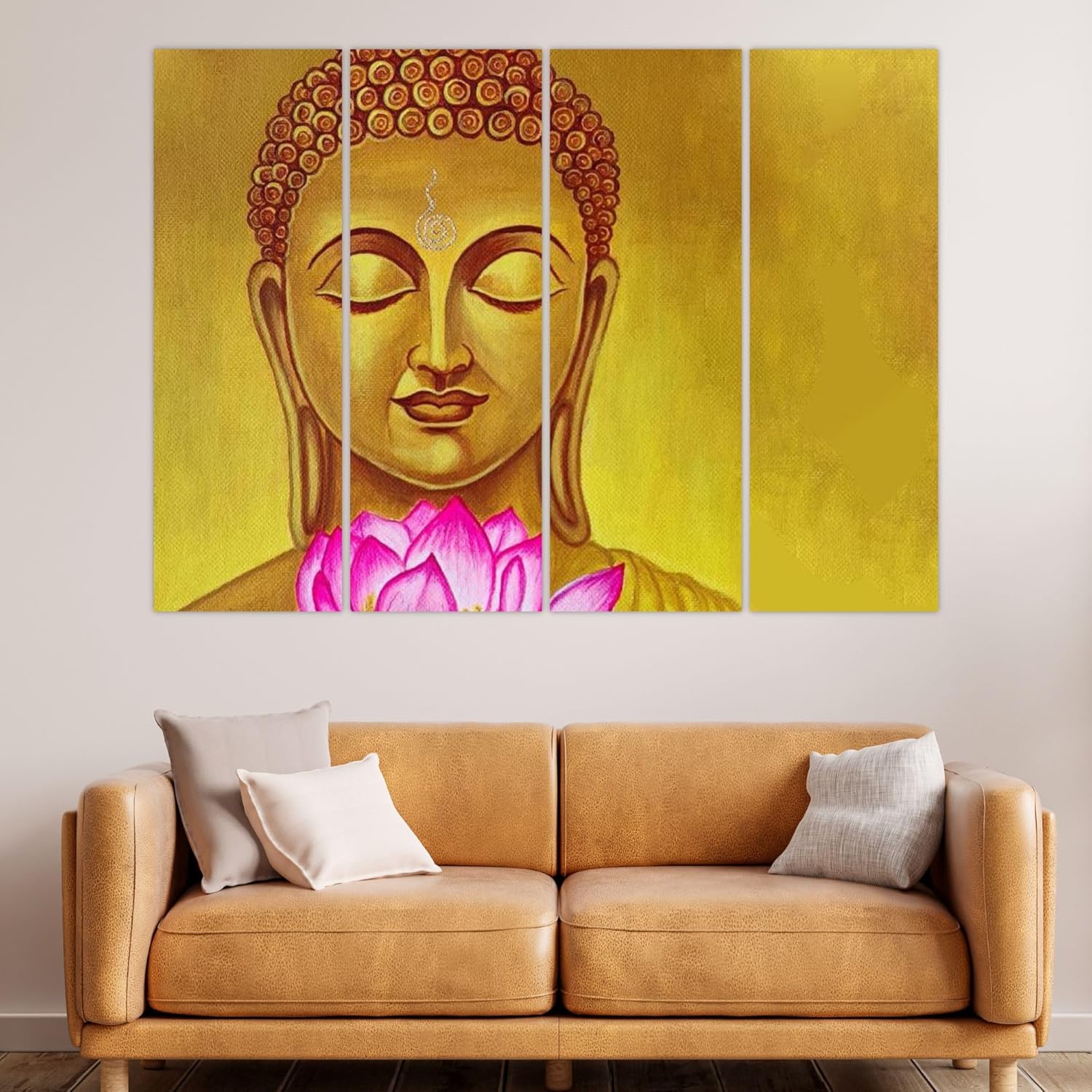
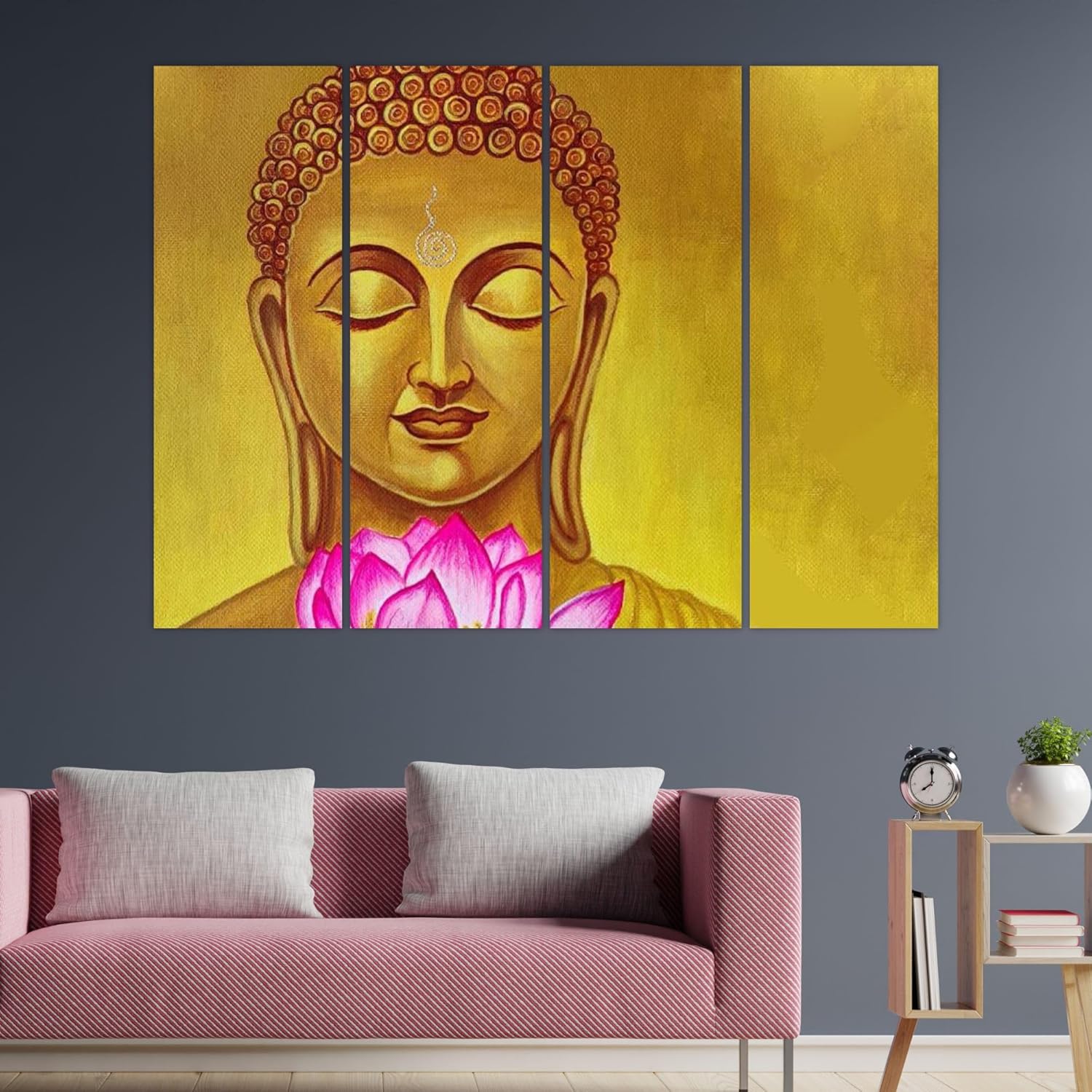
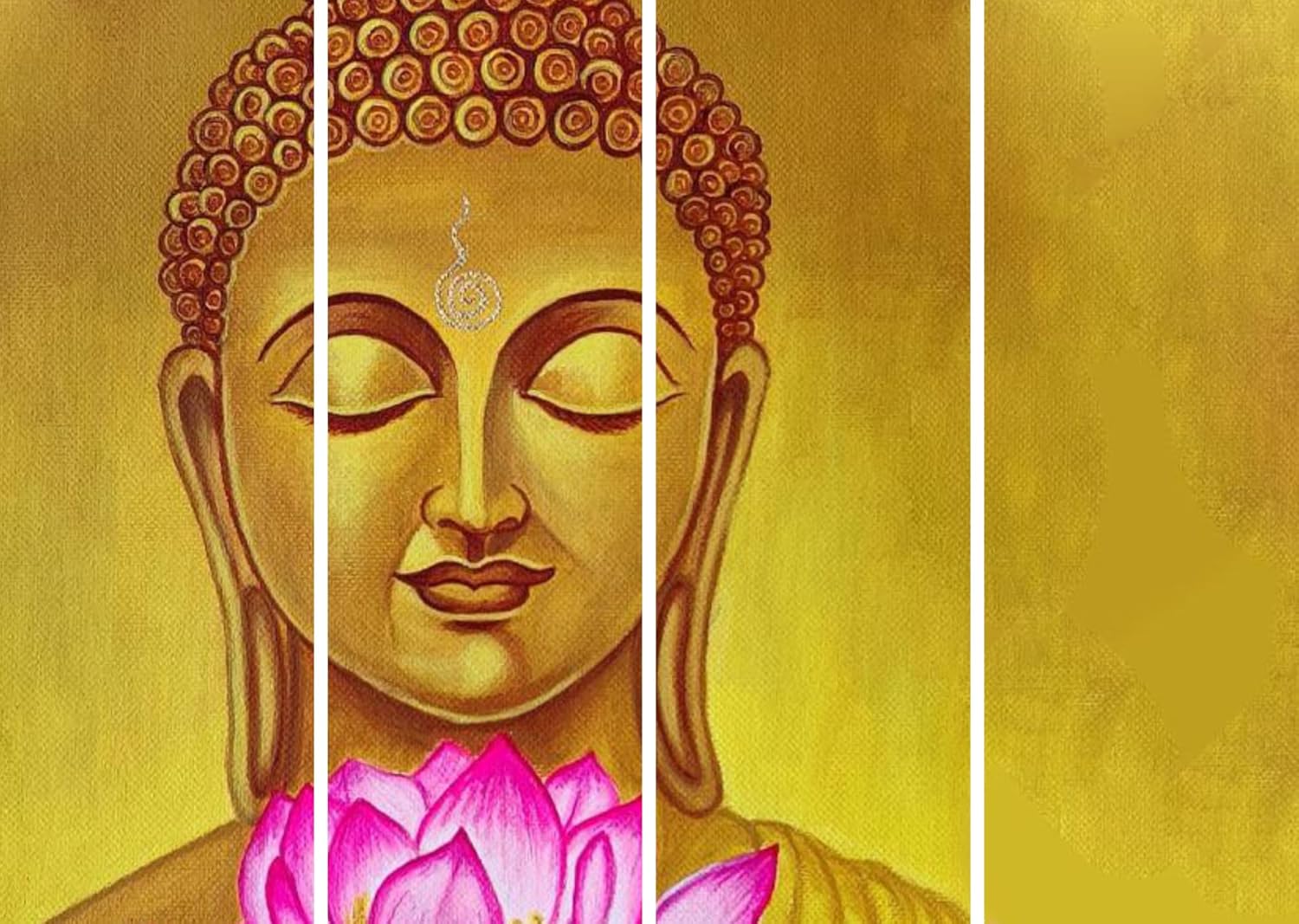
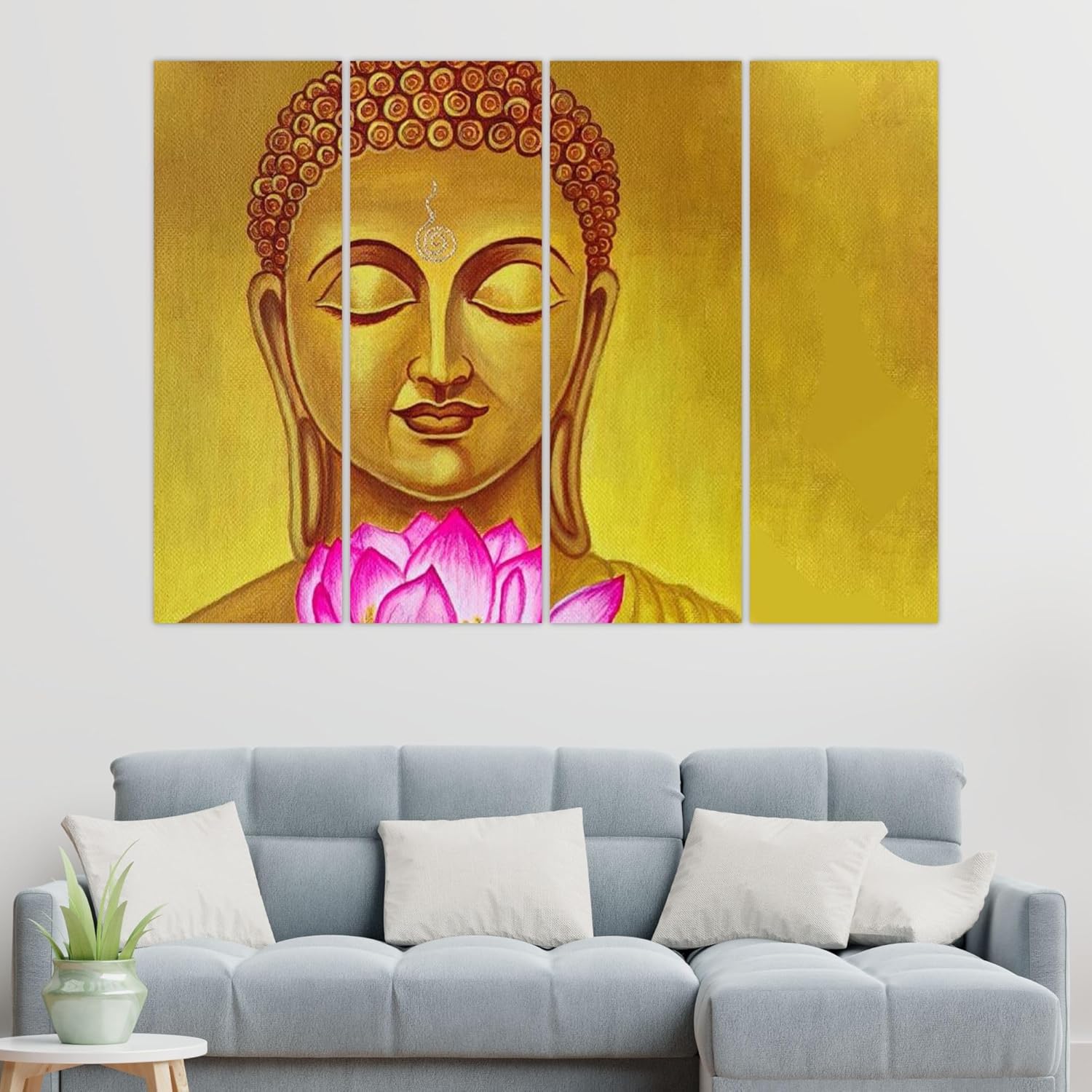
Here's what you're actually looking at: a close-cropped Buddha face that spans almost the entire 85cm width, with a vibrant pink lotus positioned where the chest would be. The golden-ochre background isn't flat—it has visible texture gradation, lighter toward the outer panels, creating depth without competing with the central face. The burgundy-brown spiral curls frame the composition. The silver urna (the spiral between the eyebrows) draws the eye to center. This isn't a full-figure Buddha disappearing into negative space. This is a face that holds visual weight across all four panels.
The pink lotus is the unexpected element. Most Buddha art leans entirely into earth tones—browns, golds, greens. This piece introduces a warm pink that reads as spiritual (lotus symbolism) while also functioning as a color anchor that prevents the golden palette from feeling monotone. Against cream walls, that pink becomes the element guests notice second, after the face itself.
Why 85cm Works on 10-Foot Walls (and What Happens If You Go Smaller)
Your living room wall is probably 10-12 feet wide. At 85cm (roughly 2.8 feet), this piece covers approximately 23-28% of a 10-foot wall. That leaves 107cm of wall space on each side if centered—enough breathing room that the Buddha doesn't feel cramped, but not so much space that the panels look lost.
Above a 6-foot sofa (180cm), 85cm width means the canvas sits within the sofa's visual footprint with slight margin on each side. The proportions work because the 4-panel format creates horizontal emphasis that echoes sofa width without matching it exactly—which would look staged.
If you went smaller—say 60cm width—the Buddha face would feel like it's floating above your sofa rather than anchoring the wall. The pink lotus would lose its warmth impact because it would be physically smaller than a cushion pillow below it. At 85cm, the lotus is roughly 20-25cm across, which registers as intentional décor rather than a small accent.
The 55cm height matters too. At 20-25cm above your sofa top, the bottom edge sits at roughly 95-100cm from floor level (assuming standard Indian sofa height). The Buddha's chin aligns approximately with average seated eye level, which creates that subtle sense of being looked over with benevolence rather than looked down upon.
What These Golden-Ochre Tones Look Like Against Indian Walls (Morning vs Evening)
The dominant color here is a warm golden-ochre—somewhere between mustard and antique brass. This isn't an accident. It echoes the brass lamps, pooja vessels, and door handles already present in most Indian homes. On cream walls (the most common Indian apartment wall color), this palette reads as coherent rather than statement-making.
In morning light from east-facing windows, the golden tones warm up further. The pink lotus deepens to almost salmon. The burgundy curls gain definition. This is when the textured background shows most clearly—you'll notice gradation you might miss under flat evening lighting.
Under warm LED light (3000K, standard in most Indian living rooms), the ochre stabilizes. The pink lotus becomes the brightest element in the composition. The Buddha face takes on a lamp-lit quality that feels appropriate for the subject matter. Evening guests see this version—serene, warm, cohesive with the room's overall lighting.
What this doesn't do: it doesn't pop against colored walls. If your walls are yellow (common builder's paint), the golden background competes. Against sage green, it works but feels less intentional. This piece is designed for neutral walls—cream, off-white, light gray—where the warmth adds to the room rather than fighting existing undertones.
Installation on Indian Walls (Concrete and Rental Realities)
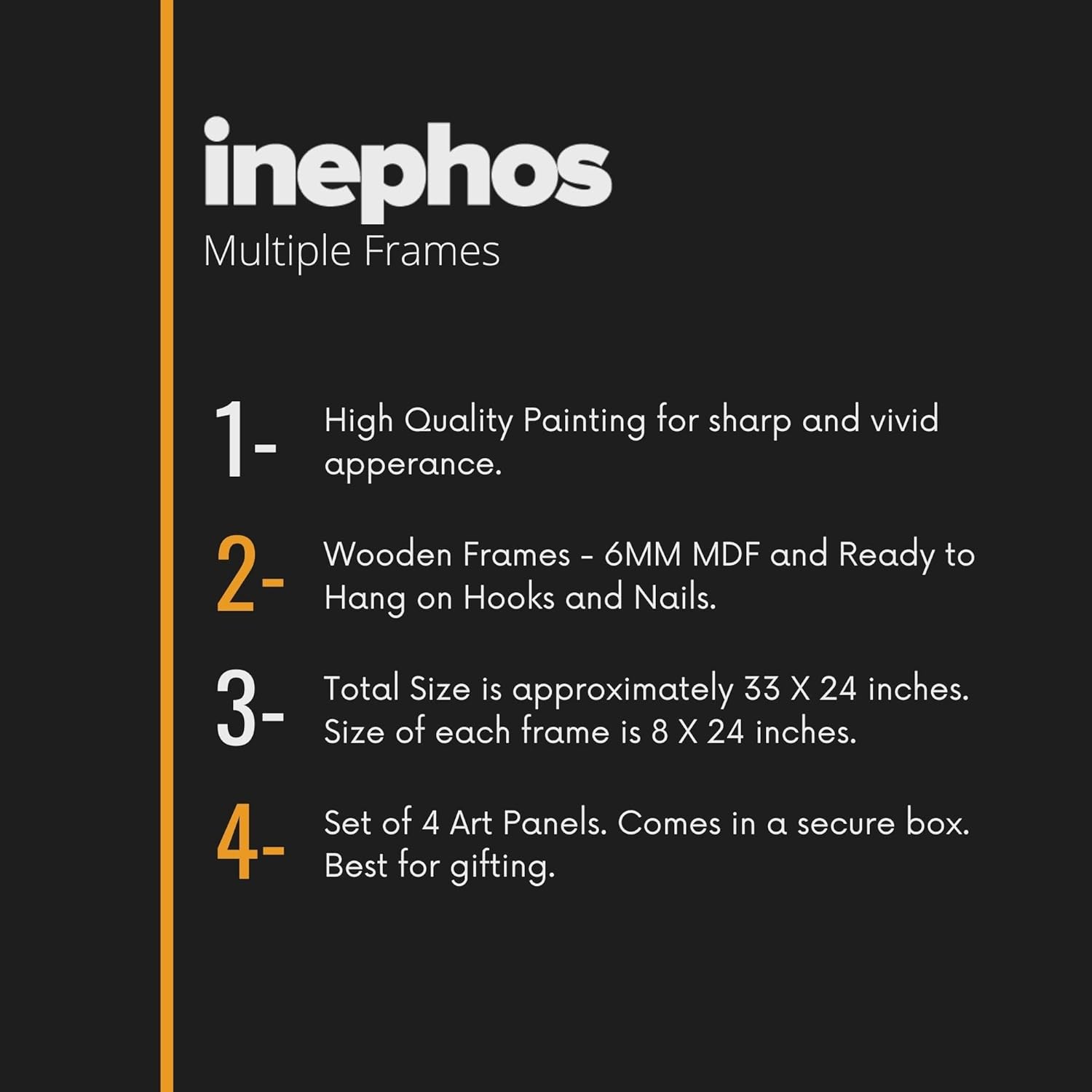
Four panels means four separate mounting points—but this is simpler than it sounds. Each panel has D-ring hangers on the back, and the total weight of 3kg distributes across four hooks. Individual panel weight is under 800 grams, which means even basic wall anchors hold securely.
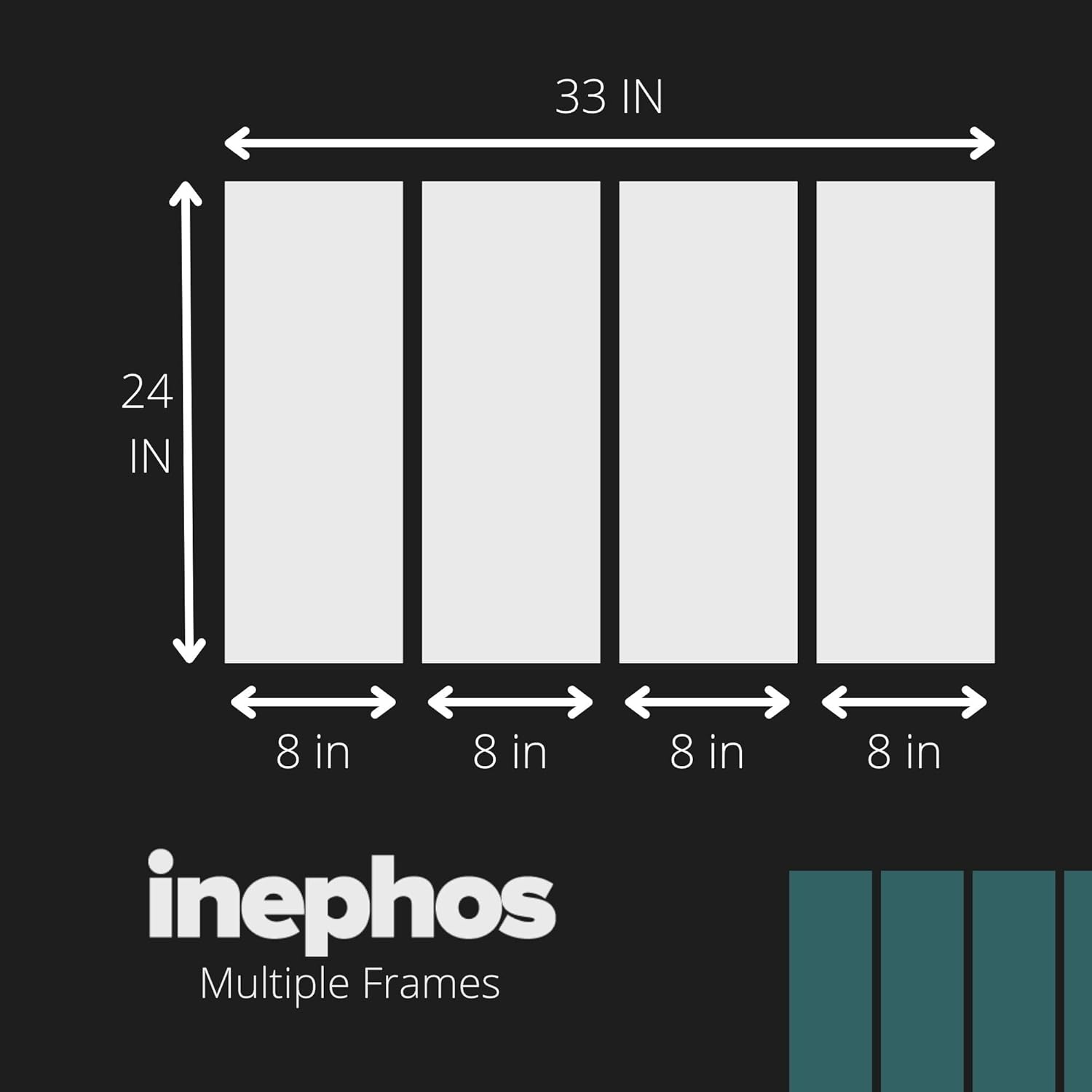
For concrete walls (most Indian apartments), you're drilling four 6mm holes. The provided template shows exact spacing—the white gaps between panels should be consistent (typically 2-3cm) for the Buddha face to align correctly across all four frames. Measure once using the template, mark your holes, drill, insert anchors, hang. Total time: 20-25 minutes including the part where you step back three times to check alignment.
Rental concern: eight small holes (two per panel) filled with wall putty when you move out. Cost: under ₹100. Time: 15 minutes. Your ₹50,000 deposit is safe.
The splash-proof vinyl surface means you can hang this in a meditation corner near a bathroom-adjacent wall without humidity concerns. The MDF backing won't warp from moisture migration through shared walls. This isn't permission to hang it in a bathroom with direct steam exposure—but the room next to a bathroom, the corner near the kitchen, the space that gets slightly humid during monsoons? This handles it.
How This Compares to Fabric Tapestries (The Honest Trade-Off)
You've probably seen fabric Buddha tapestries for ₹400-800 on marketplace sites. They photograph beautifully—soft, textile-rich, bohemian. Here's what they don't show you:
Fabric wrinkles. By month three, you're seeing fold lines where the tapestry bunched while stored or shipped. You iron it once. The wrinkles come back. Eventually you stop noticing because you've accepted them, but guests notice.
Fabric catches dust. The weave traps particles. In Indian cities—Mumbai's coastal salt dust, Delhi's winter smog, Bangalore's construction debris—your tapestry needs cleaning within 2-3 months. Washing risks color bleeding. Professional cleaning costs nearly what the tapestry cost.
Fabric fades unevenly. The sections near windows fade faster than protected areas. Within a year, you have visible color variation—sometimes described as "character," usually meaning "I'm planning to replace this."
Vinyl on MDF stays flat. Dust sits on the surface rather than embedding in fibers—a dry microfiber cloth removes it in 30 seconds. The splash-proof coating means the surface is sealed; humidity doesn't affect it. The colors remain consistent because the inks are UV-resistant and the surface doesn't absorb environmental particles.
The trade-off: tapestries have textile warmth. They move slightly in air currents. They feel handcrafted even when they're mass-produced. This vinyl piece is permanent—it doesn't shift, doesn't drape, doesn't soften corners. That permanence is either exactly what you want (clean, intentional, low-maintenance) or slightly less romantic than fabric.
What This Will Actually Feel Like in Your Room
From the doorway, you see the Buddha face first. The closed eyes and gentle expression read from 3-4 meters away. The pink lotus registers as a warm spot in the lower third of the composition. The 4-panel format is visible but not distracting—the white gaps create rhythm without fragmenting the image.
Walking toward the sofa, you notice the textured background. The ochre isn't flat; there's visible depth from how the print captures the original painting's brushwork. The spiral curls have dimension—they're not just brown shapes but patterned circles with highlight variation.
Sitting on the sofa, looking up at an angle, the Buddha face dominates your field of vision. The pink lotus sits just above your sightline. The expression feels benevolent from below—the downcast eyes and slight smile work spatially from a seated position.
This piece works alone. It doesn't need a gallery wall arrangement, doesn't require flanking décor, doesn't benefit from adjacent frames. The 4-panel format creates enough visual complexity that additional wall elements would compete rather than complement. If anything, simpler décor elsewhere in the room (solid cushions, minimal side tables) lets this hold attention without fighting for it.
Moolwan Design Note
The close-crop composition places Buddha's face at maximum scale within 85cm—most Buddha art includes full torso or distant perspective, reducing facial detail to decorative suggestion. This piece makes the expression central, which is why the closed eyes and slight smile remain readable from across a 12x14 foot room.
Moolwan Quality Standard
Designed for Indian apartments and lighting conditions. Printed to resist humidity-related color fading. Splash-proof vinyl on MDF construction handles monsoon conditions without warping. Quality checked before dispatch. Packed for long-distance transit. Ships from West Bengal.
Moolwan Fit Guidance for Indian Homes
At 85x55cm, this fits 10-12 foot living room walls above 6-7 foot sofas. The golden-ochre palette complements cream and off-white walls. Position 20-25cm above sofa top, centered or offset toward room's primary viewing angle.
Quick Specifications
- Product: Moolwan 4-Panel Buddha with Lotus Vinyl Wall Art on MDF (85x55cm)
- Brand: Moolwan
- Category: Vinyl Wall Art on MDF
- Collection: Buddha Wall Art Collection
- Dimensions: 85cm W × 55cm H × 2cm D
- Weight: 3000 grams
- Material: Splash-proof vinyl print on MDF panels
- Colors: Golden-ochre background, burgundy-brown spiral curls, pink lotus, silver-white urna
- Panel Count: 4 panels with consistent gap spacing
- Best For: Living room walls 10-12 feet wide, above 6-7 foot sofas, cream/off-white wall colors
- Ships From: West Bengal
- Delivery: 5-6 days to metros, 6-8 days to tier-2/3 cities
Frequently Asked Questions
Will 85cm look proportional above my 6-foot sofa?
Yes. At 85cm width, the canvas covers roughly 47% of a 6-foot (180cm) sofa's span, leaving balanced negative space on each side. This ratio prevents the art from looking either cramped (too wide) or floating (too narrow) relative to your seating.
How do the golden-ochre tones look under warm LED lighting?
The ochre stabilizes and deepens under 3000K LED light. The pink lotus becomes the brightest element in the composition, while the Buddha face takes on a warm, lamp-lit quality appropriate for evening viewing. The colors don't shift orange or muddy—they maintain their painted quality.
Do I need to align all four panels precisely?
Yes, but the included template makes this straightforward. The Buddha's face spans multiple panels, so misalignment of more than 3-4mm becomes visible as discontinuity in the facial features. Mark all four positions before drilling any holes, and verify horizontal level before committing.
Will the splash-proof surface handle monsoon humidity?
The vinyl surface is sealed against moisture penetration—humidity sits on the surface rather than absorbing into the material. The MDF backing is treated to resist swelling. In normal indoor conditions (not direct steam or water exposure), this handles 70-85% humidity through multiple monsoon seasons without warping or color change.
Can I hang this in a meditation room adjacent to a bathroom?
Yes. The splash-proof construction specifically handles humidity migration through shared walls. The sealed MDF and vinyl surface prevent moisture absorption from ambient humidity. This doesn't mean shower-adjacent or outdoor-exposed, but a meditation corner that shares a wall with bathroom—that's fine.
Product Snapshot
- Brand: Moolwan
- Product: Moolwan 4-Panel Buddha with Lotus Vinyl Wall Art on MDF (85x55cm)
- Category: Vinyl Wall Art on MDF
- Collection: Buddha Wall Art Collection
- Theme/Type: Buddha with Lotus – Meditative Spiritual Art
- Best For: 10-12 foot living room walls above 6-7 foot sofas; meditation corners; entryways
- Primary Differentiator: Pink lotus creates warmth contrast against golden-ochre palette
- Secondary Differentiators: Close-crop Buddha face fills horizontal span; Golden-ochre echoes Indian brass décor
- Material & Construction: Splash-proof vinyl print on MDF with D-ring hangers
- Care Instructions: Dry dust with microfiber cloth; no water or cleaning chemicals needed
- Ships From: West Bengal
- Packing: Long-distance transit ready with corner protection
- Quality Check: Individual inspection before dispatch