
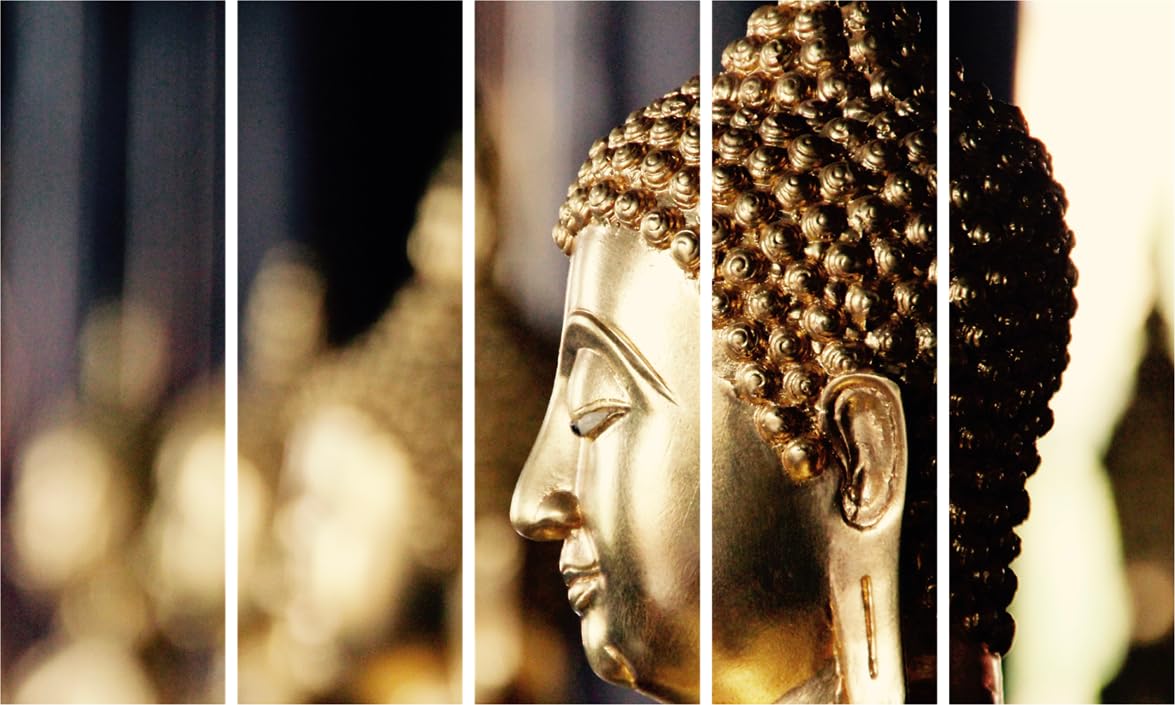
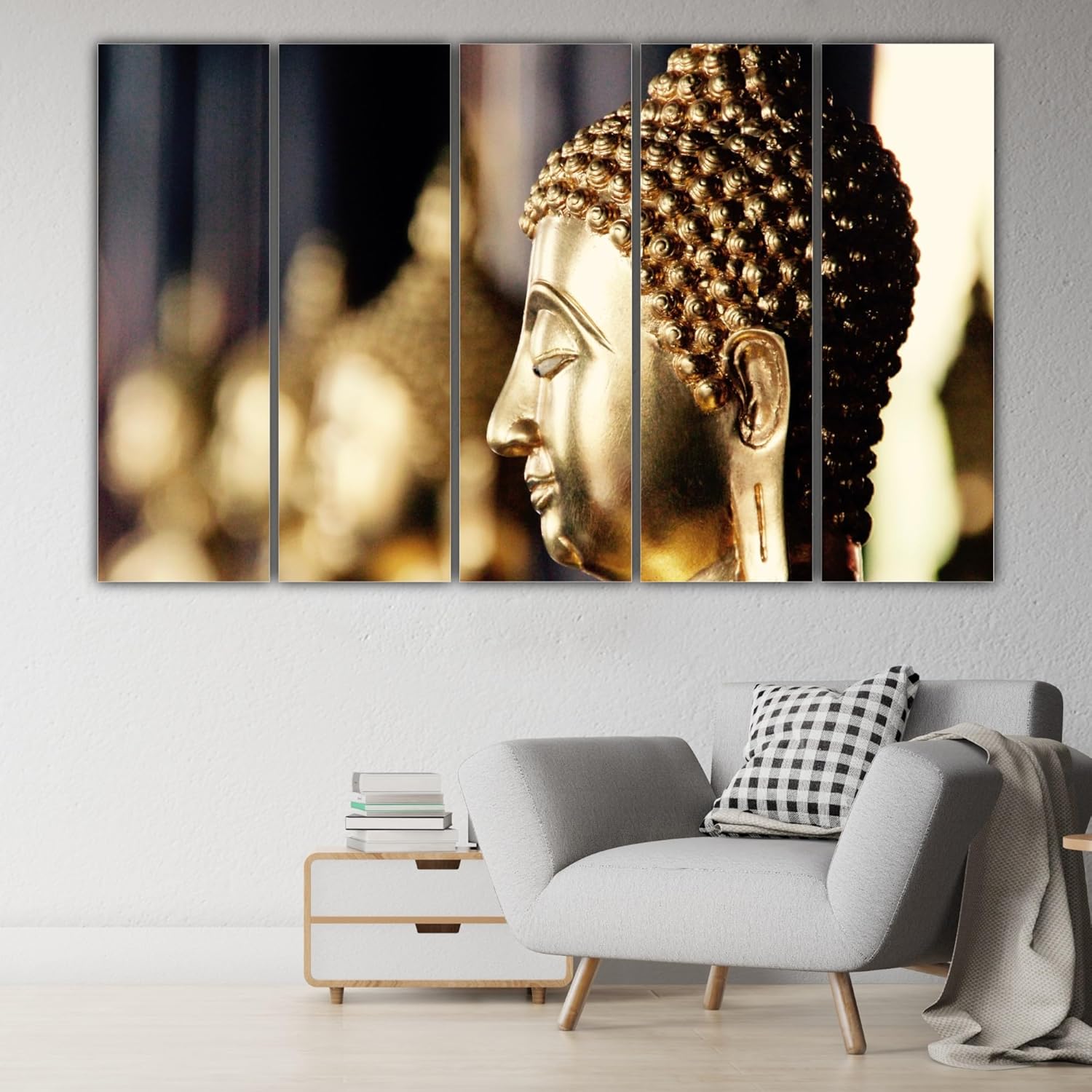
Buddha-tiful 5-Panel Framed Wall Art That'll Have Your Stress Packing Its Bags (127x76cm)
You may also like

Moolwan 5-Panel Golden Buddha Canvas Wall Art Painting (127x76cm) - Zen Multi-Frame Spiritual Art
You've measured your living room wall three times. Maybe four. The tape measure says 360cm, but you're still not confident because the sofa stretches wide beneath it and the ceiling feels higher than the standard 9 feet. Every guide says something different, and none account for Indian wall colors or furniture proportions. You keep second-guessing: is 127cm actually right for your space?
Here's the spatial clarity you need. At 127cm wide, this 5-panel Buddha artwork covers roughly 35% of a standard 12-foot wall—the visual sweet spot where art commands attention without overwhelming. You'll have approximately 116cm of breathing room on each side, which means this piece centers naturally above a 7-foot sofa with comfortable negative space framing it.
The golden Buddha profile spans across five individually framed panels, each contributing to a continuous sacred image. The deep blue-black background creates depth that pushes the gold tones forward, making the artwork appear to float on cream or off-white walls common in Indian homes. Against builder's peach or light yellow walls, the warm gold tones harmonize rather than clash—an advantage over cooler blue or green artwork that can look disconnected.
The Visual Math: How 127cm Fits 12ft Walls in Indian Living Rooms
Wall coverage matters more than most people realize. Too small, and art looks like an afterthought—a poster someone stuck up as a placeholder. Too large, and it overwhelms, making the room feel cramped.
At 127cm width on a 360cm (12ft) wall, you're looking at 35% coverage. Interior stylists typically recommend 25-40% for primary living spaces. This Buddha piece sits comfortably in that range. For reference, if your wall is 10 feet, coverage increases to approximately 42%—still proportional, though you'd have less negative space (roughly 76cm on each side). On a 14-foot wall, coverage drops to about 30%, which works well if you have additional elements like wall sconces or plants flanking the art.
The 76cm height matters too. Standard ceiling height in Indian apartments is 9-10 feet. Hanging this piece with its center at eye level (roughly 150cm from the floor) positions the top edge about 188cm up—leaving substantial visual space between the art and ceiling, preventing that cramped, overstuffed look.
What Gold and Deep Blue Will Actually Look Like Against Your Walls
Photography lies. You know this. That perfect cream wall in the product mockup isn't your wall with its slightly yellowed paint or the builder's standard off-white that leans beige in certain light.
Here's what happens in reality: the gold tones in this Buddha artwork contain warm amber undertones. Against pure white walls, they appear more yellow. Against cream walls (which most Indian homes have), the gold looks richer and more intentional. Against light yellow or peach walls, the bronze-gold palette feels harmonious rather than competing for attention.
The deep blue-black background absorbs light rather than reflecting it, which means this piece works in both naturally lit rooms and spaces with warm LED downlights. Morning sunlight will emphasize the golden shimmer; evening artificial light will deepen the shadows and create a more dramatic, contemplative effect.
If you have brown or beige fabric sofas—common in Indian living rooms—the earthy gold tones create cohesion. The artwork extends the warmth of wooden furniture rather than introducing a completely new color family.
Rental-Friendly Mounting: Hanging Without Losing Your Deposit
Three nail holes per panel. That's the reality. Fifteen small nail holes total, each roughly 2mm diameter—the kind that can be filled with basic wall putty for ₹50 before you move out.
Each panel weighs approximately 600 grams (the total 3kg divided across five pieces). Standard picture hooks rated for 1kg hold these comfortably with margin. You won't need heavy-duty anchors or wall plugs. A basic hammer, a measuring tape, and fifteen minutes on a Saturday morning will complete the installation.
The 0.6cm depth means each frame sits nearly flush against the wall. There's no awkward gap where dust accumulates or where the frame tilts forward over time. The lightweight build also reduces stress on mounting hardware—these won't pull away from the wall during monsoon humidity when walls can release moisture.
Spacing between panels matters. Standard practice is 2-3cm gaps—enough to define each panel as distinct while maintaining visual continuity. For this Buddha piece, you'll want the panels close enough that the facial profile reads as unified across frames. Tighter spacing (1.5-2cm) typically works better for portrait-oriented subjects like this.
How This Compares to Smaller or Larger Sizes You've Been Considering
If you've been eyeing 90-100cm pieces, here's the honest trade-off: smaller artwork creates more negative space, which can feel intentional in minimalist setups but often reads as undersized in typical Indian living rooms where furniture is substantial. A 90cm piece on a 12ft wall covers only 25%—technically acceptable but visually cautious.
Going larger—say, 150cm—pushes coverage to 42% on a 12ft wall. This works in dedicated media rooms or larger living spaces, but in a standard 12x14ft room, it can dominate to the point where the room feels like it exists to display the art rather than the art complementing the space.
The 127cm sizing occupies middle ground. It's substantial enough to anchor a seating area, visible enough to make guests notice, but not so dominant that it becomes the only thing in the room.
Compared to marketplace canvas available for ₹800-1,200, the difference lies in framing quality and print resolution. Cheaper alternatives typically use MDF frames prone to warping in humid conditions and lower-resolution prints that pixelate when viewed up close. This piece uses kiln-dried pinewood frames (12% moisture content to prevent warping) and UV-resistant eco-solvent inks that maintain color fidelity for years.
Setting Realistic Expectations: Colors, Viewing Distance, and Your Space
From across a 12x14ft room (approximately 4-5 meters viewing distance), the five panels merge into a single cohesive image. The Buddha's profile reads as continuous, and fine details like the curled hair texture become subtle rather than dominant. This is the intended experience—spiritual art meant to evoke calm rather than demand close inspection.
At 2 meters—standing in front of the sofa—individual panel divisions become apparent, and you can appreciate print detail. The golden texture of the Buddha's face shows dimensional quality, and the blurred background Buddha figures add depth.
Color temperature will shift throughout the day. North-facing rooms in India receive cooler, diffused light, which will emphasize blue undertones in the background. South or west-facing rooms with afternoon sun will warm the golds significantly. Neither is wrong—the artwork was designed with this variation in mind. However, if your room receives minimal natural light and relies on cool-white LEDs, the golden tones may appear slightly muted compared to product photos taken under warm studio lighting.
Quick Specifications
- Brand: Moolwan
- Type: 5-Panel Framed Canvas Wall Art Painting
- Subject: Golden Buddha Profile, Zen Spiritual Art
- Dimensions: 127cm (W) x 76cm (H) x 0.6cm (D)
- Weight: 3 kg (approximately 600g per panel)
- Colors: Gold, bronze, cream, deep blue-black
- Canvas: 340 GSM cotton with moisture-resistant coating
- Frame: 1.5" kiln-dried pinewood (12% moisture)
- Inks: Eco-solvent UV-resistant
- Ideal for: 10-14ft walls, living rooms, meditation spaces, bedrooms, offices
- Delivery: 5-6 days (metro), 6-8 days (tier-2/3 cities)