
Buddha-tiful 5-Panel Framed Wall Art to Banish Bad Vibes
You may also like

Moolwan 5-Panel Buddha Canvas Wall Art Painting (127x76cm) - Meditation Multi-Frame Spiritual Décor
Three weekends of browsing. Forty-seven saved items. Twelve open tabs. And you're still here because every time you get close to buying, the same question stops you: will this look proportional on my wall, or will it overwhelm the space? You're not indecisive—you're careful. Because once this is on your living room wall, you'll see it daily. Your mother-in-law will see it when she visits. Your friends will notice it immediately when they walk in. It needs to be right.
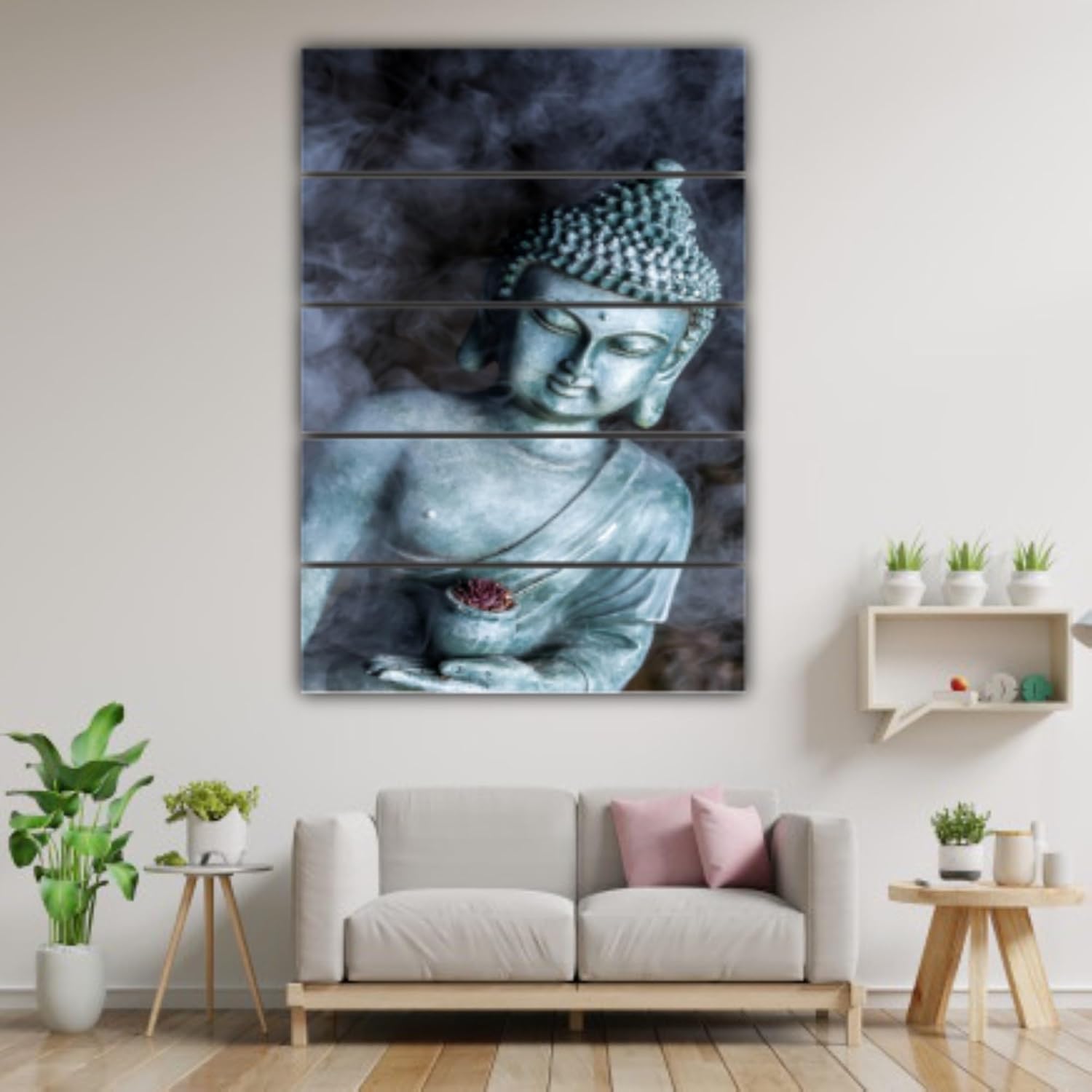
This 127cm 5-panel Buddha canvas sits in that exact proportional sweet spot for Indian living rooms. It's large enough to anchor a 12-foot wall without competing with your furniture, yet measured enough that it won't dominate a room where you're already managing a 7-foot sofa, a wooden coffee table, and possibly a pooja shelf. The 76cm height means it fits the standard 8-10 foot ceiling heights in metro apartments and independent houses alike, creating vertical breathing room rather than ceiling-to-art compression.
The teal and grey tones aren't accidental design choices—they're calibrated for the cream, off-white, and light yellow walls that define 80% of Indian homes. The oxidized teal of the Buddha statue reads as sophisticated against builder's standard walls, while the dark atmospheric background creates depth without the harshness of pure black. If your living room has wooden furniture—which it probably does—the grey tones in the stone texture bridge the warmth of your teakwood or sheesham pieces with the coolness of the spiritual subject.
Why 127cm Works on 12-Foot Walls (and What Happens If You Go Smaller or Bigger)
Your living room wall is probably 360cm (12 feet) wide. This 127cm canvas covers approximately 35% of that wall space. That leaves 116cm on each side—enough clearance that the art doesn't crowd your curtain rod on one end or bump into your wall-mounted TV on the other. It's proportional, not maximal.
If you go smaller—say, 90cm or 100cm—on that same 12-foot wall, you end up with an awkward "postage stamp" effect. The art looks tentative, like you weren't confident in your choice. Your wall expanse overwhelms the canvas, and guests' eyes wander to the empty space rather than the art itself. You'd need to flank it with side décor or plants to fill the void, which defeats the purpose of a statement piece.
If you go larger—160cm or 180cm—you're now covering 45-50% of the wall, which starts to feel aggressive in a room where you also have a sofa, curtains, and possibly a floor lamp. The art dominates not through presence but through sheer scale, and it competes with every other element in the room. In a 12x14 foot living room, which is standard for 2-3 BHK flats, that coverage ratio tips from "focal point" to "only point."
127cm is proportional coverage. It's the largest size that still feels intentional rather than compensatory.
What These Colors Will Actually Look Like (Morning vs. Evening Light)
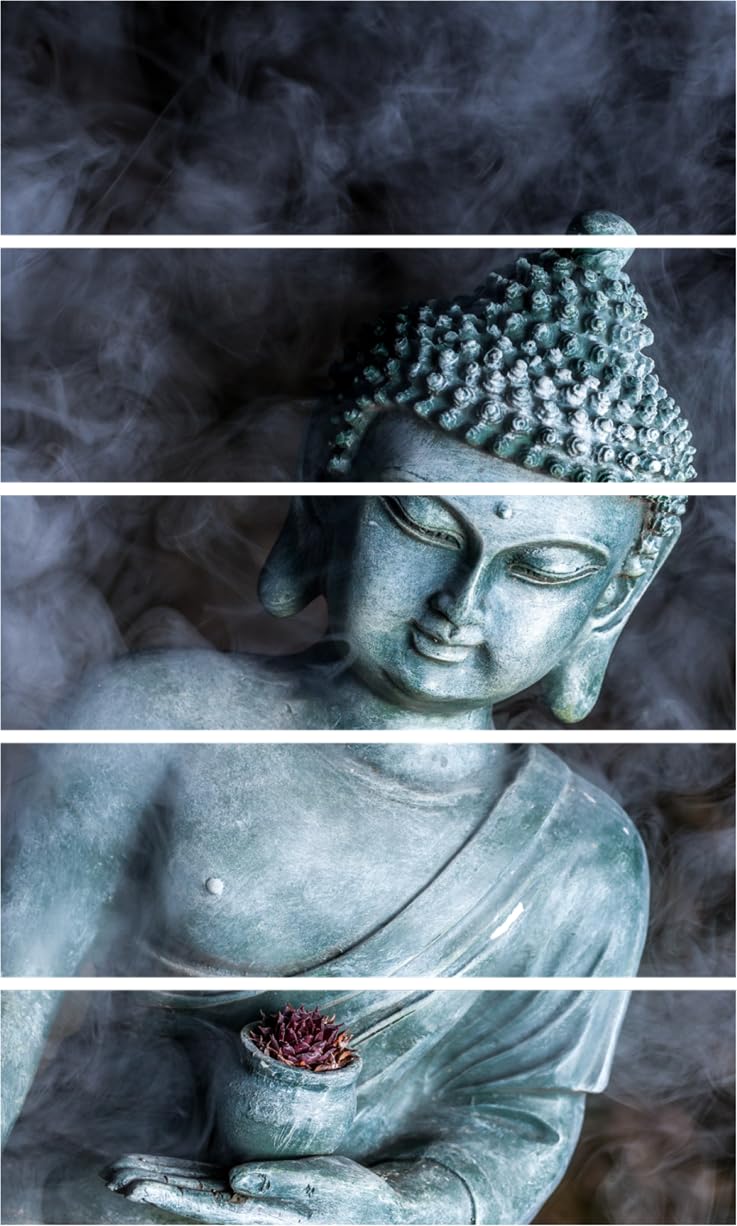
The teal patina of the Buddha statue is cool-toned, which means it recedes visually under warm lighting. In morning sunlight—say, 8-10 AM when natural light pours through your living room window—the teal reads vibrant, almost turquoise, with strong contrast against the dark background. The atmospheric smoke in the upper panels glows subtly, creating layered depth.
By evening, under warm LED bulbs (which most Indian homes use at 2700-3000K color temperature), the teal mutes into a sage-grey. It doesn't lose impact—it just shifts from "vibrant" to "meditative." The dark background merges with the room's lower evening light levels, so the Buddha's face and the lotus flower in the lower panel become the primary focal points. This isn't a flaw; it's adaptive presence. The art doesn't demand the same visual energy at 9 PM when you're winding down as it does at 9 AM when you're energized.
If your walls are the standard cream or off-white, the dark background creates a visual "frame" effect even before the physical frame. The canvas doesn't bleed into the wall—it anchors distinctly. If your walls lean yellow (builder's peach, common in older apartments), the teal's blue undertones neutralize the warmth, preventing the room from feeling monotone.
Installation Takes 15 Minutes (Even If You're Not Handy)
This is five separate panels, not one heavy block. Each panel weighs approximately 600 grams (the total is 3kg), which means you're hanging five lightweight pieces rather than wrestling with one unwieldy 3kg slab. The frame is 1.5-inch pinewood with pre-installed sawtooth hangers on the back of each panel.
You'll need five nails or picture hooks rated for 1kg each. Measure once, mark your wall with a pencil where the top edge of each panel will sit (keeping them level with each other), then hammer in five nails. Hang each panel on its hook, adjust for micro-alignment, step back. Fifteen minutes, start to finish.
If you're renting and worried about your ₹50,000 deposit, use 3M Command picture hanging strips rated for 2kg per strip. Two strips per panel. They remove cleanly without paint damage when you move out. Yes, they cost ₹800-1000 for a set, but they're reusable and landlord-approved.
The panels are designed to hang with minimal gap between them—about 1-2cm spacing is standard, which your eye reads as a unified piece rather than five separate artworks. If you want more spacing (some people prefer 5cm gaps for a "sectioned" look), the visual math still works because the Buddha's progression—head to torso to lotus—creates narrative continuity.
How This Compares to Single-Panel Canvas You've Been Considering
You've probably looked at single-panel Buddha canvas at 120cm or 140cm. They're simpler to install—one nail, one piece, done. But here's what you give up: visual dynamism. A single-panel canvas is a photograph. This 5-panel composition is a story told vertically. Your eye travels from the atmospheric smoke in the top panel, down through the textured crown, to the serene face in the center panel, then to the robes and lotus. It creates viewing time—people linger on it longer because there's sequential narrative.
Single-panel canvas also tends to look "flat" on large walls because there's no dimensional break. This 5-panel design creates horizontal lines (the panel divisions) that add geometric structure. It breaks up the wall's expanse visually, which is particularly useful if your living room wall is a long uninterrupted surface.
The trade-off? Installation time. Single-panel is five minutes. This is fifteen. But you're not buying art for ease of installation—you're buying it because you want something that commands presence and creates visual interest for the next 8-10 years. Fifteen minutes is a reasonable investment.
Setting Realistic Expectations: Colors, Lighting, and Your Space
This is printed on 340 GSM cotton canvas with eco-solvent UV-resistant inks, which means the colors won't fade noticeably in the first 5-7 years even if your living room gets direct afternoon sunlight. But "won't fade" doesn't mean "won't shift." All canvas art shifts slightly as the canvas material settles and as ambient humidity (hello, monsoons) expands and contracts the fibers. Expect the teal to mellow by 5-10% after the first year. This isn't degradation—it's maturation.
The moisture-resistant coating means this can hang in rooms where you occasionally run a humidifier or in Bangalore/Mumbai homes where monsoon humidity hits 85%. It won't warp, buckle, or develop moisture spots. But "moisture-resistant" is not "waterproof." Don't hang this directly above a kitchen stove or in a bathroom where steam hits it daily. It's living room and bedroom-rated, not wet room-rated.
The Buddha's face is the most detailed panel, with visible texture in the stone and subtle shading on the eyelids and lips. From 6-8 feet away (your typical sofa-to-wall viewing distance), you'll see this detail clearly. From 12 feet away (standing at the opposite end of the room), it reads as a cohesive portrait rather than granular texture. Design your furniture layout accordingly—this art rewards closer viewing but doesn't require it.
Quick Specifications
• Dimensions: 127cm (W) x 76cm (H) x 0.6cm (D) per complete set
• Panel Count: 5 individual panels
• Weight: 3kg total (approx. 600g per panel)
• Material: 340 GSM cotton canvas, moisture-resistant coating
• Frame: 1.5" kiln-dried pinewood (12% moisture content)
• Inks: Eco-solvent, UV-resistant
• Mounting: Pre-installed sawtooth hangers (nails or Command strips compatible)
• Ideal Wall Size: 10-12 feet (305-360cm)
• Ideal Room Size: 12x14 ft living rooms, 10x12 ft bedrooms
• Color Palette: Teal/turquoise, grey, dark charcoal, oxidized stone tones
• Subject: Buddha in meditation with lotus, atmospheric background
• Price: ₹3,496
• Delivery: 5-6 days metro cities, 6-8 days tier-2/3 towns
• Ideal Wall Color: Cream, off-white, light yellow, builder's peach
• Lighting: Works under warm LEDs (2700-3000K) and natural daylight
• Maintenance: Dry dust with microfiber cloth; no water cleaning