
Buddha-tiful 5-Panel Framed Wall Art to Bless Your Walls
You may also like

Buddha 5-Panel Canvas Wall Art Painting (127x76cm) - Bamboo Nature & Meditation Wall Decor
THE SPECIFIC FIT RECOGNITION
You might have browsed dozens of Buddha paintings by now. Some felt too overtly spiritual—all Buddha, no subtlety, the kind your mother-in-law might question if it's "too much" for the living room. Some felt too small—60cm looked like an accent piece, not a focal point, lost on your 12-foot wall. You probably kept coming back to this one—127cm with those bamboo panels on the left—because it feels balanced. Spiritual, but not preachy. Peaceful, but not boring. But you're still wondering: will this actually work on my wall, and more importantly, will my family think it fits?
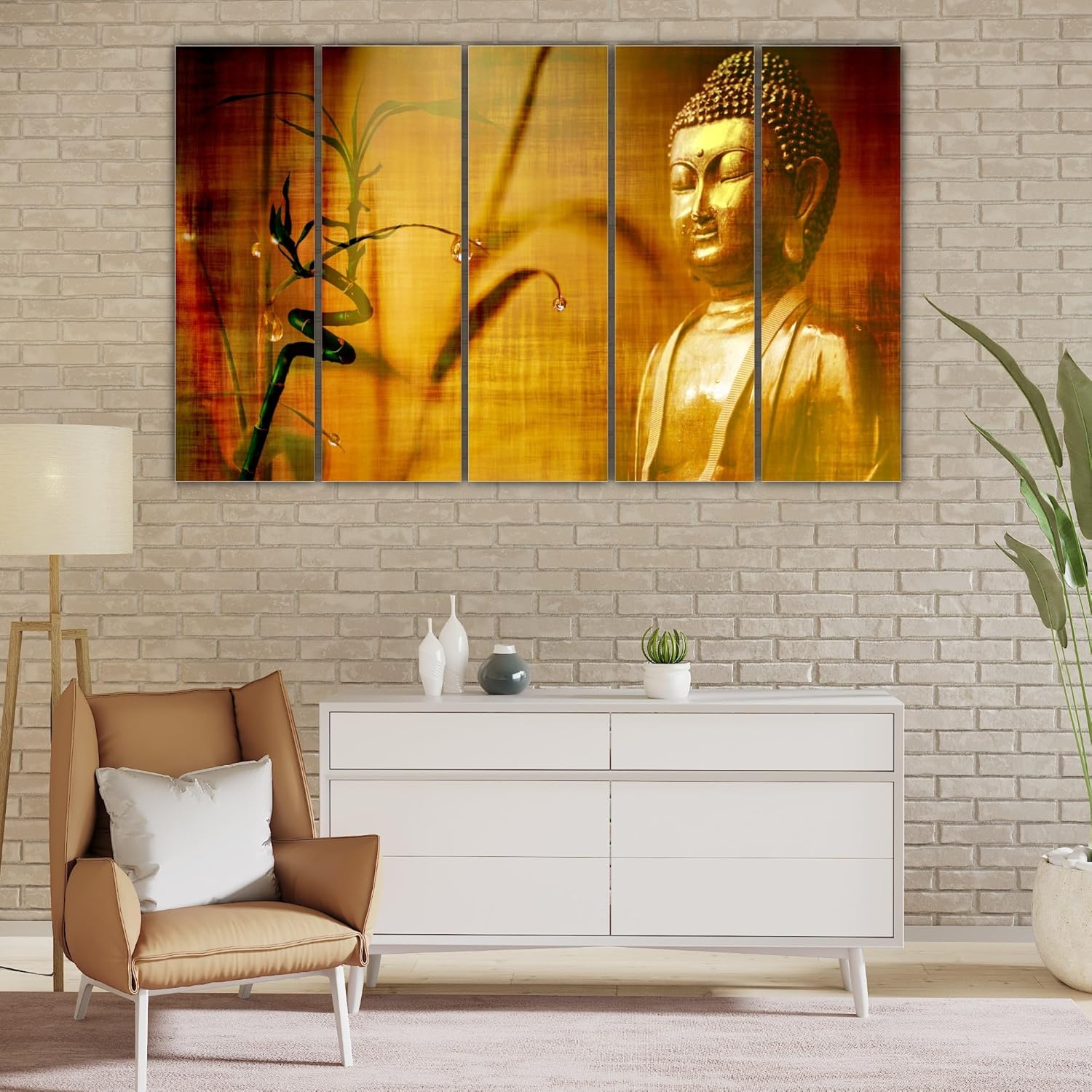
Here's why this is the one: 127cm covers about one-third of a standard 12-foot (360cm) living room wall—leaving 115cm of breathing room on each side. This creates visual balance without overwhelming the room. Your wall probably has other elements—maybe a window 4 feet away, maybe side tables flanking your sofa, maybe that floor lamp in the corner. The 127cm width works with these elements instead of competing with them. And at 76cm tall, this fits comfortably under 8-10 foot ceilings without reaching awkwardly toward the ceiling line.
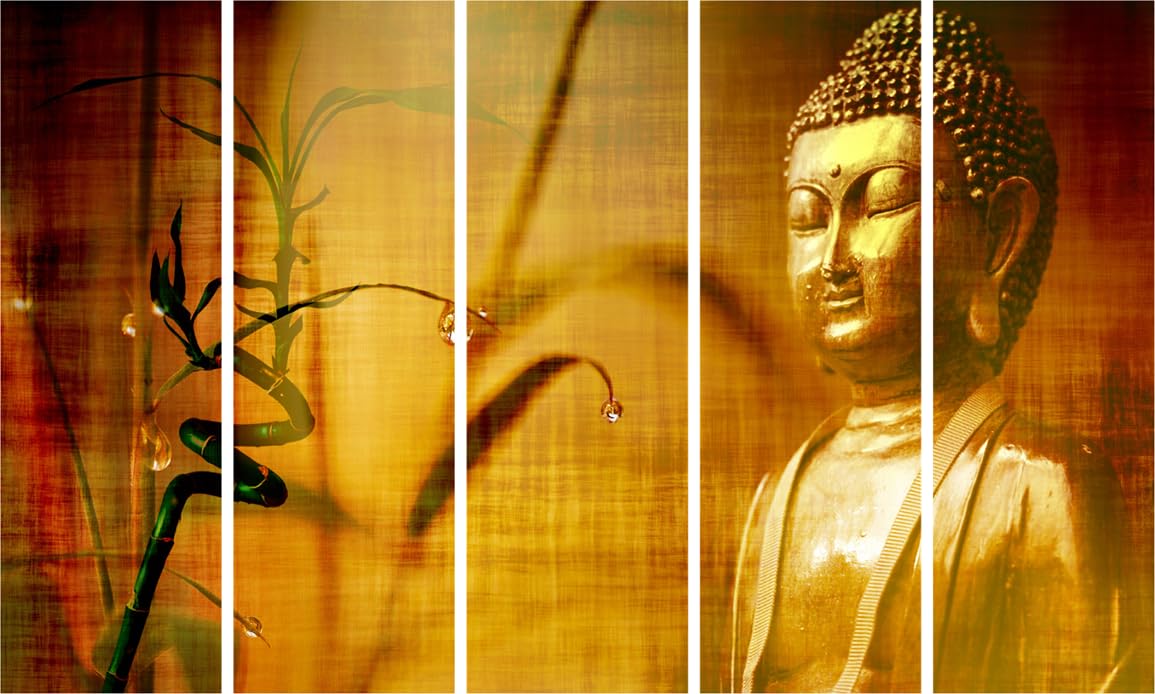
The five-panel layout does something clever: the left two panels show bamboo stalks and water droplets (pure nature, universally acceptable), the middle panel creates atmospheric transition, and the right two panels reveal the Buddha figure. This progression means it reads as "peaceful art with spiritual elements" rather than "Buddha statue on your wall." Your mother-in-law sees bamboo and serenity first. The spiritual depth reveals itself on closer viewing.
And the colors—warm golden amber with rust brown undertones—these aren't the cool metallic golds that look garish against cream walls. These are aged golds. Golds with enough brown warmth that they read as vintage, contemplative, grounded. Your living room walls are probably cream, off-white, or that light yellow shade many Indian apartments have. Your sofa is probably brown or beige fabric. This canvas will feel like it belongs in that warm color palette, not like you imported a temple aesthetic into your home.
DIMENSIONAL MATHEMATICS - WALL FIT REALITY
Why 127cm Works on 12-Foot Living Room Walls (and What Happens If You Go Smaller or Bigger)
Your living room wall is probably 10 to 12 feet wide (300-360cm in most Indian 2BHK and 3BHK apartments). The ceiling is probably 8 to 10 feet high. Here's the visual math:
127cm canvas on a 12-foot (360cm) wall:
116cm of space on the left side
116cm of space on the right side
Coverage ratio: Canvas covers 35% of wall width
Effect: Anchored, intentional, balanced—not floating, not overwhelming
Now consider your furniture arrangement:
Your sofa is probably 6-8 feet (180-240cm) wide, sitting 6-12 inches from the wall
Hanging height: 20-25cm above sofa top puts canvas center at 140-160cm from floor (perfect eye level from 8 feet away)
Side elements: You probably have a side table (18-24 inches wide), floor lamp, or window within 3-4 feet of sofa edge
The 127cm width spans the sofa zone without crowding your side furniture
If you went with 90cm instead:
25% wall coverage—looks like an accent piece, not a focal point
On a 12 ft wall with an 8 ft sofa, you'll have 135cm of empty space on each side
Effect: Your eye constantly notices all that empty wall around the small canvas
Specific problem: The spiritual significance gets diminished when the art looks undersized
If you went with 150cm instead:
42% wall coverage—works if you have a completely blank wall
But if you have a window 4 feet from your sofa edge, or a side table and floor lamp, the 150cm width will feel tight
Effect: Makes the room feel fuller, but crowds your existing layout
Specific problem: An oversized Buddha can feel imposing rather than peaceful
The 127cm is the Goldilocks size: fills the wall without dominating it, creates presence without overwhelming the room, leaves space for your furniture to coexist comfortably.
And at 76cm tall, this sits proportionally under 8-10 foot ceilings. From your sofa (8-10 feet away), you see the full composition—bamboo flowing into Buddha. Walk up close, you see the canvas texture, the distressed vintage finish, the serene expression detail. Both viewing distances matter—and this size works for both.
The five-panel layout creates another visual benefit: instead of one 127cm rectangle, you get five 24cm panels with 2cm gaps. This creates rhythm—your eye travels left to right, from nature elements through atmosphere to spiritual figure. The progression makes your wall (and your room) feel intentional, curated, like someone who thinks about design lives here.
THE COLOR & DESIGN PSYCHOLOGY - WHY THESE SPECIFIC TONES WORK
Warm Golden Amber vs. Cool Metallic Gold (and Why It Matters Against Cream Walls)
You've probably seen Buddha art before. Temple golds. Bright metallic finishes. Colors that look stunning in a meditation center but garish in your living room with its cream walls and brown sofa.
This canvas uses a completely different color strategy: warm golden amber with rust brown undertones and a distressed vintage finish.
Here's why that matters:
Against cream or off-white walls (most common in Indian homes):
Cool metallic golds create harsh contrast—they sit ON the wall, separate, like a foreign element
Warm amber golds blend INTO the wall—they feel like they're part of your existing color scheme
The rust brown undertones echo wooden furniture (coffee tables, TV units, side tables)
Effect: Looks intentional, not imported
Against light yellow walls (common in older apartments):
Warm golds complement yellow without competing
The brown undertones ground the composition
Creates a cohesive earth-tone palette
Effect: Rich without being overwhelming
Against peach walls (builder-grade apartments):
Golden amber shares the warm base with peach
Doesn't clash the way cool blues or purples would
Creates subtle harmony
Effect: Sophisticated, pulled-together
The bamboo element changes everything:
Those left two panels—bamboo stalks in silhouette, water droplets catching light—these aren't just decorative. They're strategic. When guests first see this canvas, they see nature art. Bamboo is culturally neutral. Peaceful. Universally acceptable.
The Buddha figure reveals itself on the right panels, but by then, the bamboo has already established the tone: this is contemplative, peaceful, meditative. Not religious iconography. Not a statement piece that demands family discussions.
The vintage distressed texture matters too:
The canvas has a deliberately aged look—subtle texture variations, slightly faded edges, an antique patina. This makes it feel like discovered art, something with history and meaning, rather than fresh-printed commercial decoration.
In morning light (east-facing windows): The golden tones glow softly. The bamboo silhouettes create depth. It's calming, meditative.
In afternoon light (west-facing windows): The warm ambers intensify. The Buddha figure becomes more prominent. The vintage texture adds dimension.
In evening LED light (warm white, 3000K): Everything coheres. The golds deepen. The browns warm up. The canvas looks rich, substantial, intentional.
With brown or beige sofas (most Indian furniture): Perfect complement. The warm earth tones echo your furniture without matching it exactly—creates cohesion without being matchy-matchy.
With wooden furniture (coffee tables, side tables, TV units): The bamboo and brown tones create a natural connection. Feels organic, not forced.
INSTALLATION REALITY - RENTAL APARTMENTS & FAMILY APPROVAL
The Practical Stuff: Drilling, Hanging, and the "Is This Too Spiritual?" Conversation
You're probably in a rental. Your deposit is ₹50,000 and you'd like it back. So when you think about hanging a 3kg Buddha canvas, two anxieties hit simultaneously: "Will drilling damage my wall?" and "Will my family think this is too much?"
Wall installation first:
Canvas art requires 2-3 small anchor holes (6mm diameter, 30-40mm deep). When you move out, you fill them with wall putty (₹50 at any hardware store), sand smooth, touch up with paint. Total repair: ₹200 and 20 minutes. Your landlord will never notice.
What you need:
For drywall (modern apartments):
Plastic wall anchors (included)
6mm drill bit
Drill 30mm deep, insert anchors, screw in hooks
Installation time: 15 minutes
For concrete (older buildings):
Concrete anchors (included)
6mm masonry bit
Drill 35mm deep, tap in anchors, screw in hooks
Installation time: 20 minutes
The hanging template (included) shows you exactly where to drill. You tape it to your wall, mark two points, remove template, drill. No measuring errors, no second-guessing.
The family approval conversation:
Here's the reality: spiritual art in living rooms can be sensitive. Your mother-in-law might have opinions. Your spouse might worry it's "too religious" for a shared space.
This canvas gives you conversation options:
Option 1 - Lead with nature: "I found this beautiful bamboo nature art. The peaceful tones work perfectly with our walls." The Buddha element is visible but not the primary description.
Option 2 - Lead with meditation/wellness: "It's meditation-inspired art—supposed to create calm energy in the room." Frames it as wellness, not religion.
Option 3 - Lead with aesthetics: "The vintage golden tones match our furniture perfectly. And I love the five-panel layout—makes the wall look wider."
All three are honest. All three are true. You choose based on your family dynamics.
And if you want to test placement first? Use painter's tape to mark the 127cm x 76cm rectangle on your wall. Live with it for two days. See how it feels. See what family members say when they walk by. Then drill with confidence.
Weight distribution note: At 3kg spread across 127cm width, this hangs securely on two anchor points. The 1.5-inch frame depth means it sits slightly away from the wall—creates subtle shadow that adds dimension. From 8 feet away (your sofa distance), this shadow makes the canvas look more substantial, more gallery-quality.
THE QUALITY QUESTION - WHY ₹2,496 ISN'T OVERPRICED
What You're Actually Paying For (vs. Marketplace ₹800 Buddha Prints)
You've seen Buddha canvas prints on marketplace sites for ₹800 to ₹1,200. So why spend ₹2,496 here?
Because you're not comparing the same product. You're comparing a photograph of a canvas to actual canvas that will hang on your wall for 3-5 years without fading, warping, or looking cheap.
The material difference:
Cheap canvas: 180-220 GSM—thin enough to see the wooden frame through it if there's backlighting. Sags within 6 months. Corners pucker after one monsoon season.
Quality canvas (340 GSM cotton): Actual substance. Dense weave. Stays drum-tight on the frame. When afternoon sun hits it from the window, colors stay opaque. The vintage texture you see in product photos? It's actually there when it arrives—not printed flatly on thin material.
The ink difference:
Marketplace prints: Standard inkjet with dye-based inks. These fade visibly within 6-12 months in rooms with morning or afternoon sun. Your golden ambers will shift to washed-out yellows. The rich browns will turn muddy gray.
Eco-solvent inks (what Moolwan uses): UV-resistant, chemically stable. Designed for outdoor signage—tested to withstand direct sunlight without color shift. Two years from now, your Buddha canvas will still have those warm amber tones. The bamboo silhouettes will still be crisp black, not faded gray.
The frame difference:
Cheap frames: 0.75-inch or 1-inch stretcher bars. They warp in Mumbai's 70-85% monsoon humidity, in Bangalore's temperature swings, in Delhi's seasonal extremes. Within 3-6 months, you'll see ripples forming. The canvas loosens. Corners pull away from staples.
Kiln-dried 1.5-inch pinewood frames: The wood is dried to 12% moisture content before assembly—below the 14-18% equilibrium for Indian climates. This prevents warping. The canvas is stretched using pneumatic tools (even tension across entire surface), not hand-stapled. Three years from now, your canvas will still be tight, flat, professional-looking.
The moisture-resistance difference:
Cheap canvas absorbs atmospheric moisture during monsoons. Expands when wet, contracts when dry. After two monsoon cycles, permanent rippling appears.
Moisture-resistant polymer coating: Seals the canvas surface. Water vapor can't penetrate fibers. During monsoons, condensation beads up and evaporates instead of soaking in. This isn't marketing—you can test it. Water drops should sit on the surface, not darken the canvas.
The ₹2,496 vs ₹800 decision:
₹800 canvas: Looks good for 6-8 months. Starts fading by month 9. Shows warping after first monsoon. You'll replace it within 18 months because it looks tired, cheap, obviously deteriorating.
₹2,496 canvas: Looks the same in Year 3 as Day 1. Survives multiple monsoons without warping. The vintage finish is actual texture, not printed effect that wears off. This is the difference between temporary wall covering and actual art.
Walk into any home with cheap marketplace Buddha prints. Look closely. You'll see: wavy canvas surface, faded patches (especially near windows), corners pulling loose, overall sense of "this looked better when new."
Now look at quality canvas art. Flat surface. Consistent colors. Tight corners. Looks intentional, permanent, like someone invested in their space.
The price difference is the difference between something you're still happy with in three years and something you're replacing next year because it's embarrassing.
THE COMPARISON - WHAT YOU'VE ALREADY LOOKED AT
Buddha Canvas You've Probably Browsed (and Why You're Still Searching)
Single-panel 60cm Buddha face (₹1,200-₹1,800):
Wall coverage: 17% of a 12 ft wall
What happened: Looked tiny on your wall. More like an accent piece than a focal point. The spiritual significance got lost in all that empty space.
Missing: The bamboo nature element. It's all Buddha face, which feels more religious than meditative.
Three-panel 90cm Buddha meditation scene (₹1,800-₹2,200):
Wall coverage: 25% of a 12 ft wall
What happened: Better size, but still felt undersized. And the meditation pose was very explicitly spiritual—you worried about family acceptance.
Missing: The nature-to-spiritual progression that makes this more versatile.
Large single-panel 150cm temple Buddha (₹3,500-₹4,800):
Wall coverage: 42% of a 12 ft wall
What happened: Too big if you have side furniture. And too temple-like—very ornate, very religious, not subtle at all.
Missing: The vintage understated aesthetic. That one screamed "I bought spiritual art," not "I curated peaceful ambiance."
Abstract meditation circles/chakras (₹2,000-₹3,000):
What happened: Too modern, too geometric. Didn't feel grounded. Your family would definitely ask "what is that supposed to be?"
Missing: The recognizable peaceful imagery. Bamboo and Buddha are universally understood as calm, meditative.
This 127cm five-panel Buddha with bamboo (₹2,496):
Wall coverage: 35% of a 12 ft wall—balanced, intentional
Has the nature element (bamboo) that makes it versatile, not just spiritual
Has the vintage warm tones that work with cream walls and brown furniture
Has the progression layout (nature → atmosphere → spiritual) that creates visual story
Size works above 6-8 ft sofas without overwhelming side furniture
Price reflects actual quality that survives Indian climate and looks good in Year 3
You kept coming back to this one because subconsciously, you recognized it solved all the problems the others had. Too small, too overtly religious, wrong colors, too modern—this one threads the needle. Spiritual enough to feel meaningful, subtle enough to avoid family debates, sized right for your actual wall, colored right for your actual furniture.
REALISTIC EXPECTATIONS - WHAT THIS WILL ACTUALLY LOOK LIKE
In Your Actual Home, With Your Actual Lighting and Furniture
Product photos are styled. Perfect lighting. Blank walls. Coordinated everything. Your home isn't that. So here's what this canvas will actually look like in real conditions:
In morning light (east-facing windows): The golden ambers glow softly. The bamboo silhouettes create depth against the warm background. The Buddha figure has subtle presence—visible but not dominating. It's calming. If this is in your bedroom, it's a gentle way to start the day. In your living room, it creates peaceful morning energy.
In afternoon light (west-facing windows): Colors warm up significantly. The golden tones intensify—the canvas looks richer, more saturated. The vintage texture becomes more visible (you can see the distressed finish). The Buddha figure becomes more prominent. This is when the canvas has maximum visual impact. Guests who visit in afternoon light will notice it immediately.
In evening/artificial light (warm white LED, 3000K): Everything coheres beautifully. The warm LED light complements the warm canvas tones. The golds deepen without looking garish. The browns warm up. The bamboo silhouettes create elegant negative space. This is when the canvas looks most expensive, most intentional. Evening is when most guests see your home—and this is when it looks its best.
Against cream walls (most common): Perfect neutral backdrop. The warm golds pop without clashing. The canvas becomes the focal point naturally. The vintage finish reads as sophisticated, not loud.
Against off-white walls: Similar to cream—clean backdrop lets the canvas shine. The earth tones feel grounded, not floating randomly.
Against light yellow walls (older apartments): Creates warm cohesive palette. The golden tones complement without competing. Feels pulled-together, intentional.
Above brown fabric sofa: Natural complement. The warm earth tones echo your furniture without being matchy-matchy. The bamboo element connects to the organic feel of natural fabric. Looks like you planned this combination.
Above beige fabric sofa: Works beautifully. The golden ambers add richness without overwhelming the neutral palette. Creates subtle luxury feel.
With wooden coffee table, side tables, TV unit: The bamboo imagery and brown undertones create visual conversation with your wooden furniture. Feels organic, cohesive. Like everything in the room was chosen to work together.
With existing floor lamp, side table, window nearby: The 127cm width accounts for these elements. Doesn't crowd them. Doesn't compete with them. Works as part of the overall wall composition, not fighting for dominance.
The texture detail up close: When you (or curious guests) walk up to the canvas, you'll see the vintage distressed finish is actual texture variation, not just printed effect. The canvas weave is visible. It feels and looks like quality art, not poster-quality print.
The five-panel gaps: The 2cm gaps between panels create visual rhythm, but they're subtle enough not to fragment the image. From 8 feet away (sofa distance), you see cohesive composition. Up close, you appreciate the multi-panel craftsmanship.
THE SPIRITUAL ART DECISION - FAMILY, GUESTS, AND PERSONAL MEANING
Why Buddha Art Works in Modern Indian Homes (Even When You're Not Buddhist)
Here's the conversation nobody's having honestly: you're drawn to this canvas, but you're also slightly anxious about it. Will your family think it's appropriate? Will guests think you're trying too hard to be spiritual? Will your Hindu parents-in-law be uncomfortable with Buddhist imagery in the living room?
These are valid concerns. Spiritual art in shared family spaces can be complicated in Indian households.
Here's the reality:
Buddha imagery has become culturally universal in India—associated with peace, meditation, and wellness rather than specific religious practice. Unlike explicitly Hindu deity paintings (Krishna, Ganesha) that carry ritual significance, Buddha art reads as "contemplative" and "peaceful" to most Indian families.
The bamboo element helps significantly. When family members first see this, they register: nature art, peaceful tones, meditative vibe. The Buddha figure is clear but not confrontational. It's contemplative, not devotional.
Placement matters for family dynamics:
Living room: Works well because it's presented as decor, not devotion. The aesthetic choice is primary, spiritual element is secondary. Most families accept this easily.
Bedroom: Perfect placement if you want the spiritual significance more personal, less public. Your private space, your contemplative choice.
Meditation/yoga room: Obvious fit. No family questions. It's purpose-appropriate.
Not recommended for dining area: Mixing spiritual imagery with eating spaces can make some traditional family members uncomfortable.
The guest reaction test:
Most guests in Indian homes will read this as: "They have good taste. They value peaceful energy. They're thoughtful about their space." Very few will read it as religious statement.
If a guest does comment, the bamboo gives you easy response: "I loved the nature elements—the bamboo and that vintage peaceful feel."
Personal meaning vs. family acceptance:
You might be drawn to this for meditation practice, for stress relief, for the philosophical resonance of Buddhist teachings, or simply because you find the imagery calming. All valid.
But you also live with family—spouse, children, parents, in-laws. The beauty of this particular canvas is that it accommodates both your personal meaning AND their comfort level.
The left-to-right progression (bamboo → atmosphere → Buddha) means different people can take different meanings:
Your mother-in-law sees: Nature art with peaceful tones
Your spouse sees: Meditation-inspired wellness decor
You see: Daily reminder of mindfulness and inner peace
Your children see: The pretty golden picture with bamboo
All interpretations are valid. The canvas holds space for multiple meanings.
If you're worried about being "too spiritual":
This canvas is subtle enough. The vintage muted tones, the bamboo nature element, the contemplative (not devotional) pose—it's spiritual-adjacent, not spiritual-primary.
Compare to: Temple-style ornate Buddha, bright gold religious iconography, explicit meditation poses with chakra symbols. Those make statements. This makes space for peace.
WHAT YOU'RE ACTUALLY DECIDING RIGHT NOW
The Empty Wall Has Been Empty Long Enough
You've been researching canvas wall art for weeks. You've compared sizes, read reviews, saved dozens of options, opened countless browser tabs. You've measured your wall multiple times. You've imagined different pieces hanging there.
And you keep coming back to this one.
Not because it's perfect—nothing is. But because it solves the specific problems you kept encountering:
✓ Size is right: 127cm fits your 12 ft wall without overwhelming your side furniture ✓ Colors work: Warm golden ambers complement your cream walls and brown sofa
✓ Family-appropriate: Bamboo nature elements make it versatile, not just spiritual ✓ Quality justified: ₹2,496 buys materials that survive monsoons and look good in Year 3 ✓ Subtle enough: Spiritual significance without family debates
The research phase is done. You know what size you need. You know this is quality canvas that will survive Indian climate. You know installation is straightforward (15 minutes, rental-friendly). You know the price is fair for what you're getting.
The decision isn't whether to buy canvas wall art. You've already decided that—that's why you're still here.
The decision is whether you're ready to stop researching and start living with a wall that finally feels complete.
Your living room has been waiting. That empty wall has been empty long enough.
The canvas that solves all your concerns is right here. The price is ₹2,496. Shipping takes 5 days. Installation takes 15 minutes.
What are you waiting for?
QUICK SPECS & PRACTICAL DETAILS
Buddha 5-Panel Canvas Wall Art Painting - Complete Specifications
Dimensions:
Total size: 127cm (W) x 76cm (H) x 1.5cm (D)
Panel configuration: Five panels of approximately 24cm width each with 2cm gaps
Frame depth: 1.5 inches (sits slightly away from wall, creates shadow depth)
Weight: 3kg (requires 2 anchor points for secure hanging)
Materials:
Canvas: 340 GSM 100% cotton with moisture-resistant polymer coating
Frame: 1.5-inch kiln-dried pinewood (12% moisture content—prevents warping)
Inks: Eco-solvent UV-resistant printing (no fading in direct sunlight)
Finish: Vintage distressed texture (aged aesthetic, not flat print)
Design Elements:
Left panels: Bamboo stalks in silhouette, water droplets, nature imagery
Center panel: Atmospheric transition, warm golden tones
Right panels: Buddha figure in contemplative standing pose with serene expression
Color palette: Golden amber, rust brown, warm beige, distressed vintage finish
Visual flow: Nature-to-spiritual progression (left to right narrative)
Climate Appropriateness:
Tested for: 70-85% humidity (monsoon conditions)
Temperature range: 5°C to 45°C (Delhi winters to summers)
Moisture resistance: Polymer coating prevents canvas expansion/contraction
UV resistance: Eco-solvent inks maintain color consistency in direct sunlight
Frame stability: Kiln-dried wood won't warp through seasonal changes
Installation Included:
Concrete wall anchors (for older buildings)
Drywall anchors (for modern apartments)
D-ring hangers (pre-attached to frame)
Paper hanging template (shows exact drill points)
Installation time: 15-20 minutes, no professional required
Hole size: 6mm diameter, 30-40mm deep (easily patchable when moving)
Fits These Spaces:
Primary: 12 ft living room walls (35% coverage—balanced, intentional)
Works above: 6-8 ft sofas with 20-25cm clearance above cushion top
Room types: Living rooms, bedrooms, meditation rooms, home offices
Ceiling height: 8-10 ft standard Indian apartment ceilings
Wall colors: Cream, off-white, light yellow, peach (warm neutral tones)
Works With This Furniture:
Brown or beige fabric sofas (earth tones complement)
Wooden coffee tables, side tables, TV units (bamboo element connects)
Floor lamps, side tables within 3-4 ft of sofa edge (127cm width accommodates)
Existing window placement (doesn't require blank wall)
Price & Value:
Price: ₹2,496
Category: Mid-range quality (not marketplace cheap, not luxury premium)
Longevity: 3-5 years with consistent appearance (vs. 8-12 months for cheap canvas)
Cost per year: ₹499-₹832 (quality investment amortized over lifespan)
Shipping & Delivery:
Delivery time: 5-6 days metro cities, 6-8 days tier-2/3 cities
Packaging: Triple-layer (bubble wrap + corner protectors + outer carton)
Tracking: Provided within 24 hours of order
COD: Available across India
Unboxing requirement: Video unboxing recommended for damage claim protection
Replacement Policy:
Full replacement for: Manufacturing defects, shipping damage, frame issues
Requires: Unboxing video showing damage
Replacement ships: 2-3 days after approved claim
Not covered: Size perception (subjective), color on uncalibrated screens, damage after installation
Maintenance:
Cleaning: Dry microfiber cloth every 2-3 weeks
Don't use: Water, cleaning chemicals, furniture polish
Moisture-resistant coating means: Dust sits on surface, wipes away cleanly
No special care needed—just occasional dusting
Who This Canvas Is For: ✓ You have a 12 ft living room wall that feels empty ✓ You want spiritual/peaceful energy without family debates
✓ Your walls are cream/off-white/light yellow (warm neutral tones) ✓ Your sofa is brown or beige (6-8 ft wide) ✓ You're in a rental and need installation that's deposit-safe ✓ You want quality that survives monsoons and looks good in Year 3 ✓ You value subtle sophistication over loud statement pieces
Who This Canvas Isn't For: ✗ You have a small 8 ft wall (127cm will overwhelm it—go with 90cm) ✗ You want explicitly religious devotional art (this is contemplative, not devotional) ✗ Your walls are dark colors or cool-toned (warm golds won't complement) ✗ You prefer modern minimalist or geometric abstract (this is nature-spiritual) ✗ You need something for outdoor/covered balcony (this is indoor-only)
THE WALL THAT'S BEEN WAITING
That wall in your living room—the one behind your sofa—has been empty since you moved in. Maybe that was six months ago. Maybe two years ago.
You've lived with it long enough to know: it's not going to fill itself.
This Buddha 5-panel canvas (127x76cm, ₹2,496, warm golden ambers with bamboo) is sized for your 12 ft wall, colored for your cream walls and brown sofa, subtle enough for family acceptance, quality enough to still look good in three years.
The research is done. The measurements are confirmed. The anxieties have been addressed.
Your wall is ready. The canvas is ready.
Are you?
Price: ₹2,496
Delivery: 5-6 days
Installation: 15 minutes
Lifespan: 3-5 years of consistent quality
Your empty wall has been empty long enough.
Moolwan - Canvas Wall Art Paintings manufactured in-house for Indian homes. Not marketplace resellers. Not imported stock. Quality materials tested for Indian climate conditions. Sized for Indian furniture proportions. Designed for spaces where real families actually live.