
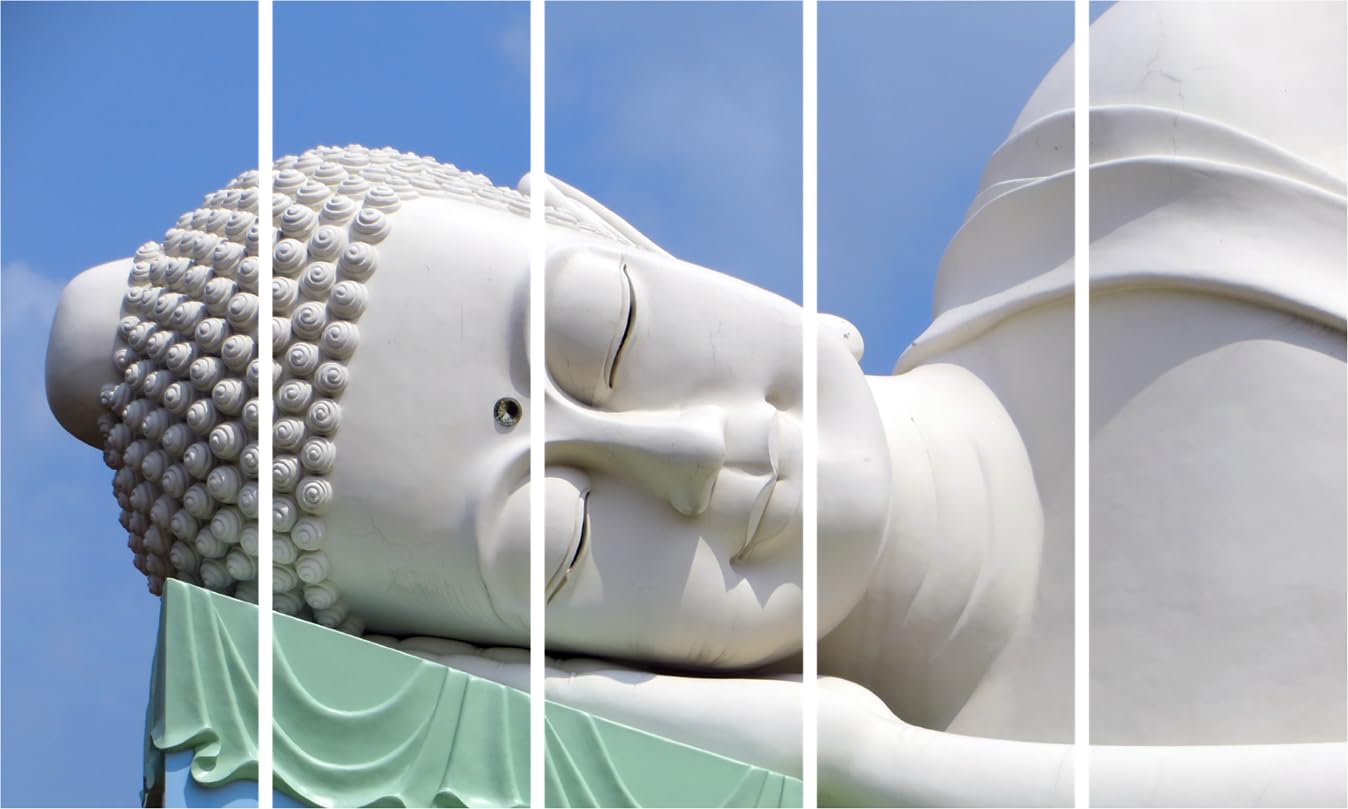
Buddha-tiful 5-Panel Framed Wall Art to Kick Stress Out (150x76cm)
You may also like

Moolwan 5-Panel Reclining Buddha Canvas Wall Art Painting (150x76cm) - Serene Multi-Frame Spiritual Art
You might have browsed dozens of Buddha wall art pieces by now. Some were too small—lost above your sofa like an afterthought. Some were too ornate—busy gold frames competing with your furniture. You probably kept coming back to this size range—around 150cm—because intuitively, it feels right for the wall space you've measured. But you want to be sure before spending ₹3,500+ on something you'll see every single day.
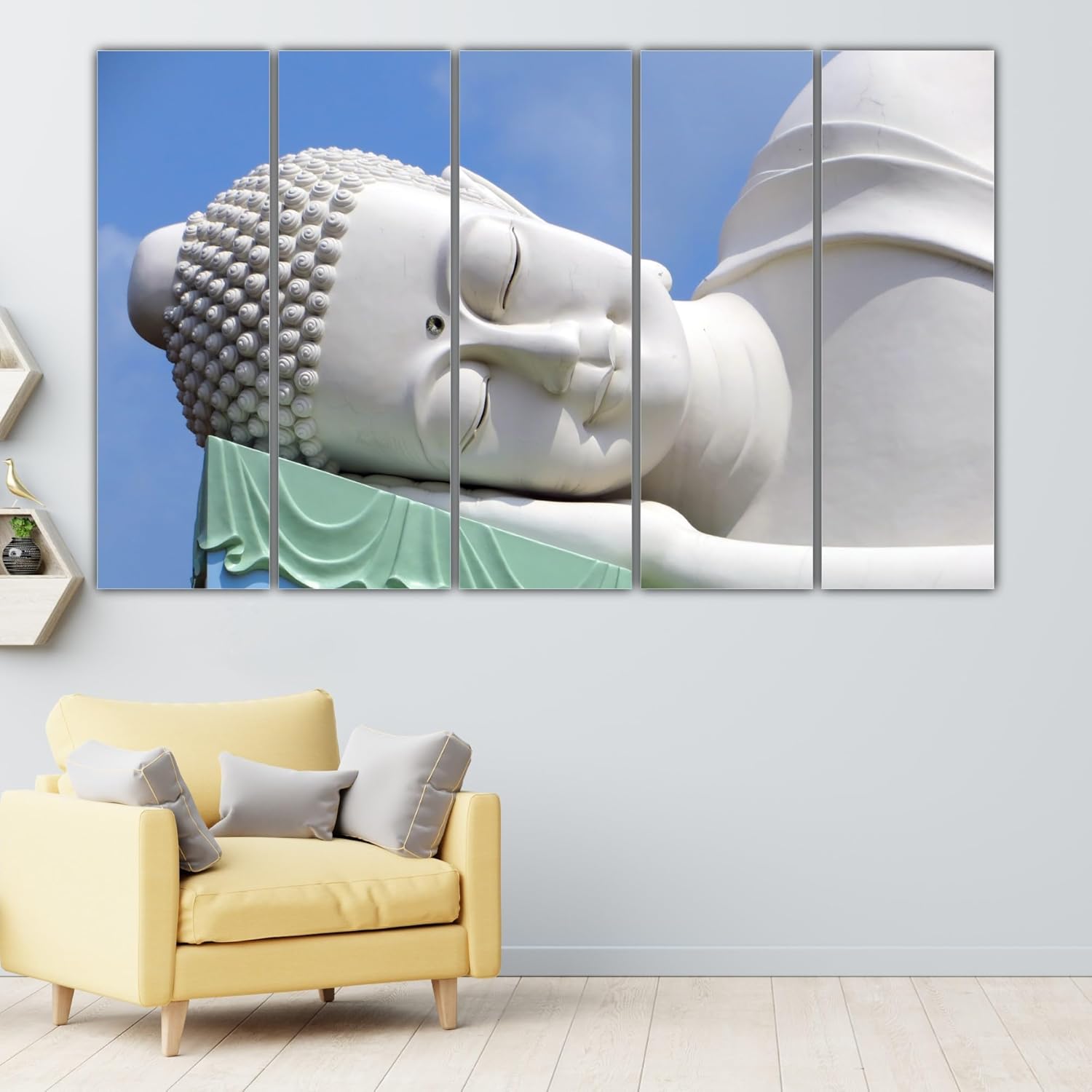
Here's what makes this particular piece different: It's not a generic meditating Buddha cropped to fit a frame. This is the reclining Buddha—the Parinirvana pose—captured in a photograph of an actual statue against a clear sky. The five panels create visual depth without the busy fragmentation that makes some multi-panel art feel cluttered. At 150cm wide, it covers roughly 42% of a standard 12-foot Indian living room wall—enough presence to anchor the room, enough breathing space on either side to look intentional rather than cramped.
Why 150cm Works on 12-Foot Walls (and What Happens If You Go Smaller or Bigger)
Your living room wall is probably around 12 feet (360cm) wide. Here's the visual math:
With this 150cm piece centered:
- Left wall space: 105cm
- Right wall space: 105cm
- Coverage: 42% of wall width
This matters because 40-45% coverage is the visual sweet spot for large wall art. Go smaller—say 120cm—and the art floats awkwardly, looking like you couldn't afford larger. Go bigger—say 180cm—and you lose the breathing room that makes art feel curated rather than crammed.
At 76cm tall, this sits comfortably above a standard 85cm-high sofa back with 15-20cm gap, leaving clearance below your ceiling (assuming 9-10 foot ceilings typical in Indian apartments). The proportions work whether you're mounting above a 6-foot loveseat or an 8-foot sectional.
The Color Reality: How Sky Blue and Cream Look Against Indian Walls
Your walls are probably cream, off-white, or that builder's beige that comes standard in most Indian flats. Good news: the colour palette here works with all of them.
The sky blue dominates the piece—a clear, saturated azure that reads as calming rather than cold. The Buddha statue is white/cream, which means it won't clash with your wall colour but will stand distinct from it. The mint green draping at the base adds a subtle accent without demanding attention.
Morning light (east-facing windows): The blue will appear brighter, more vibrant. Afternoon and evening: The blue deepens, becomes more contemplative. Under warm LED bulbs typical in Indian homes, the sky blue shifts slightly teal—still pleasing, just warmer.
This isn't a piece with multiple competing colours. It's essentially a two-tone composition (blue and cream) with green accent. That simplicity means it won't fight with your existing cushions, curtains, or the inevitable wooden coffee table.
Installation Takes 15 Minutes (Even If You've Never Hung Art Before)
Each of the five panels weighs roughly 600 grams. The total 3kg weight distributed across five hanging points means no single point bears significant load. This matters for:
Rental apartments: You're probably worried about your ₹50,000-1,00,000 security deposit. Five small nail holes are easier to fill than the heavy-duty anchors some single-piece art requires. Use 1-inch nails or adhesive hooks rated for 1kg each—both leave minimal wall damage.
Brick walls (common in older Indian buildings): Small masonry nails work fine. No need for a drill.
Gypsum/drywall (newer constructions): Standard picture hooks hold easily. The 0.6cm depth means panels sit nearly flush against the wall—no awkward tilting forward.
Panel spacing: Maintain 2-3cm gaps between panels (as shown in the product image). This creates the continuous-image effect while allowing each panel its visual identity.
How This Compares to What Else You've Probably Considered
Vs. single-panel Buddha art (same size):
Multi-panel creates visual interest that single canvas can't. The eye moves across the five sections, spending more time with the piece. Single panels at this size often look like oversized posters.
Vs. ornate framed Buddha prints:
Traditional framed Buddha art often comes with gold/bronze frames that fight modern Indian interiors. This frameless canvas approach lets the image speak without decorative competition.
Vs. cheaper marketplace canvas (₹800-1,200):
Those are typically 200 GSM canvas with digital prints that fade within 2-3 years, especially in humid Mumbai/Chennai summers or near windows. Moolwan uses 340 GSM cotton canvas with UV-resistant inks designed to handle the 70-85% humidity of Indian monsoons. The price difference reflects material that lasts 15-20 years, not 2-3.
Vs. smaller sizes (120cm, 100cm):
On a 12-foot wall, 120cm gives you 33% coverage—technically acceptable, but it'll look like you're being cautious rather than intentional. If your wall is under 10 feet, consider smaller. Otherwise, 150cm is the investment that looks like you meant it.
What This Will Actually Look Like in Your Space (Setting Realistic Expectations)
This is a photograph of a statue, not a painting. The texture is photographic—you'll see the subtle grain of the actual stone, the curves of the spiral hair curls (ushnisha), the peaceful expression captured in morning light. It's realistic, not stylized.
In a meditation corner: The horizontal repose of the reclining Buddha suits spaces meant for calm. The imagery depicts the Buddha entering Parinirvana—spiritual liberation—which carries contemplative weight if that matters to your practice.
In a living room: It functions as serene, sophisticated décor without requiring spiritual context. Guests will notice it. The scale makes it a conversation piece, the subject makes it appropriate across religious backgrounds (Buddha imagery is widely accepted as cultural/artistic rather than exclusively religious in most Indian contexts).
What it won't do: This won't add warmth to a room that needs warm colours. If your space feels cold and you're trying to warm it up, the dominant blue palette here won't help. It adds calm, not cosiness.
Viewing distance: From 8-10 feet (typical sofa-to-wall distance in Indian living rooms), the five panels read as a continuous image. Closer than 6 feet, you'll see individual panel edges. This is normal for multi-panel art.
Quick Specifications
- Dimensions: 150cm (W) × 76cm (H) × 0.6cm (D)
- Weight: 3 kg total (approximately 600g per panel)
- Panel Count: 5 panels
- Material: 340 GSM cotton canvas, kiln-dried pinewood frame
- Print: UV-resistant eco-solvent inks
- Subject: Reclining Buddha (Parinirvana pose) statue photograph
- Colours: Sky blue, white/cream, mint green
- Best For: 10-14 ft walls, living rooms, meditation spaces, office lobbies
- Delivery: 5-6 days (metro), 6-8 days (tier-2/3 cities)