
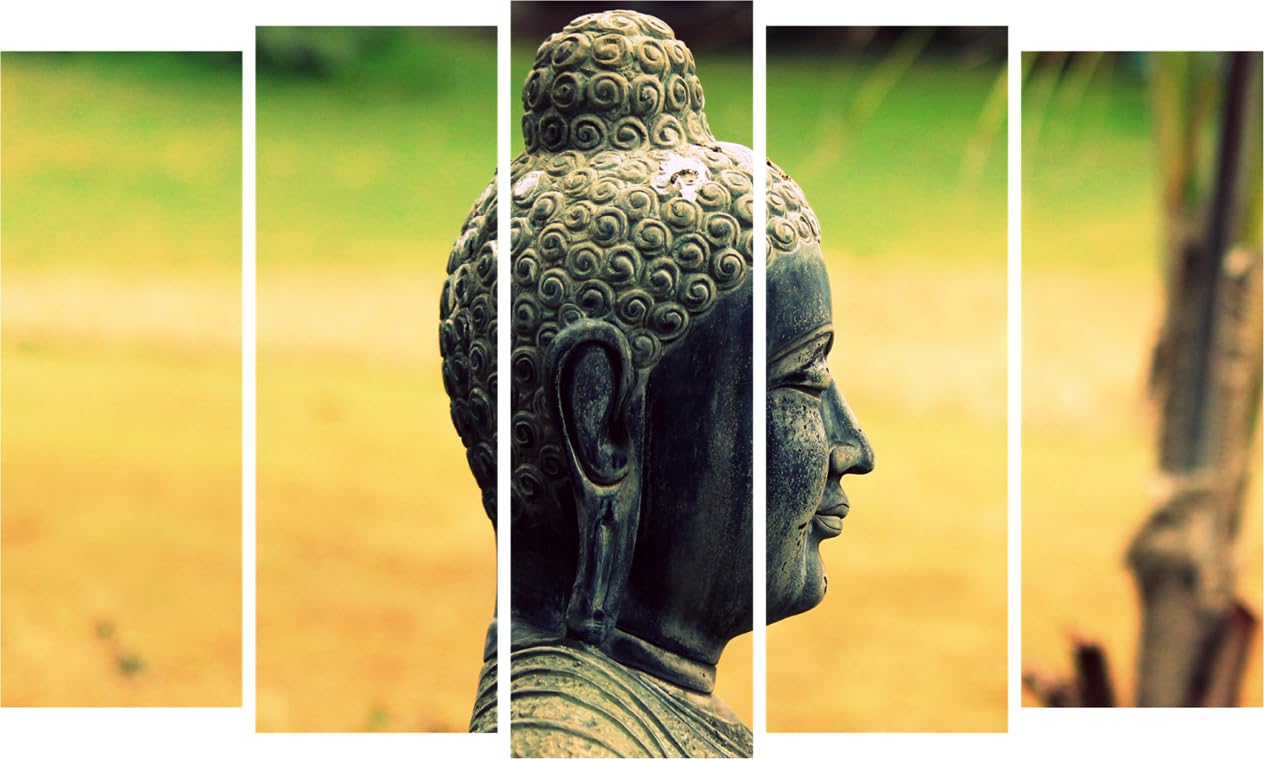
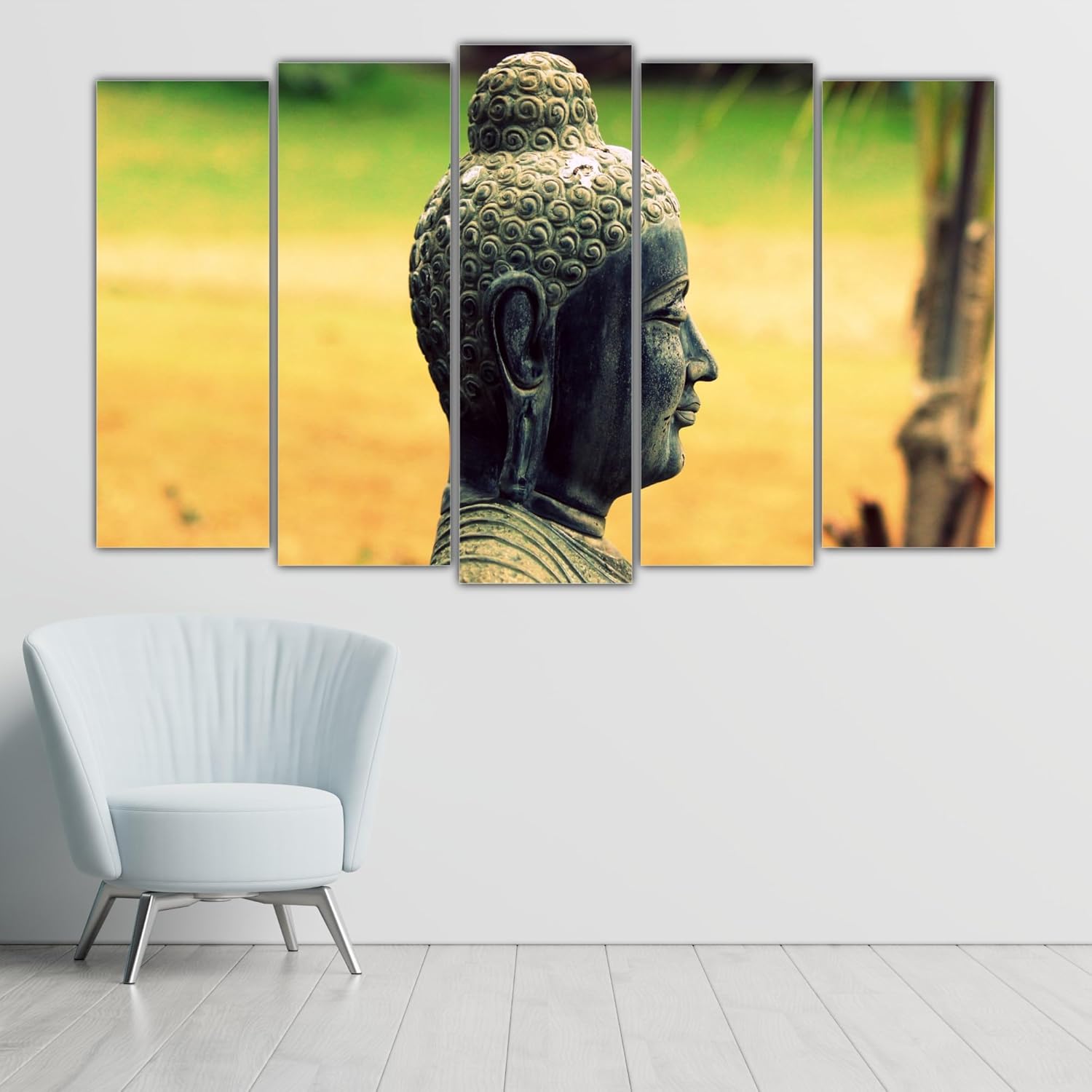
Buddha-tiful 5-Panel Framed Wall Art to Zen Your Space (150x76cm)
You may also like

Moolwan 5-Panel Buddha Canvas Wall Art Painting (150x76cm) - Serene Profile Multi-Frame Spiritual Art
You might have browsed dozens of Buddha wall art pieces by now. Some were too small—lost above your sofa like an afterthought. Some were too large—overwhelming your wall like a gallery mistake. You probably kept coming back to something around 150cm—because intuitively, it feels right for your living room. But you want to be sure.
This 5-panel Buddha profile spans 150cm in total width and 76cm in height. For a standard 12-foot (360cm) Indian living room wall, that's roughly 42% coverage—enough presence to anchor your space without overwhelming it. The teal-green Buddha head against the soft golden-yellow background creates depth that works with the cream and off-white walls common in most Indian homes.
Why 150cm Works on 12-Foot Walls (and What Happens If You Go Smaller or Bigger)
Your wall is probably around 360cm (12 feet). This 150cm canvas covers about 42% of that width, leaving approximately 105cm of breathing room on each side. That's the visual balance interior designers call "comfortable dominance"—the art commands attention without crowding.
If you went smaller—say 120cm—you'd have 120cm gaps on each side. On a 12ft wall, that starts feeling sparse, especially above a 6-8 foot sofa. The art recedes instead of anchoring.
If you went larger—say 180cm—you'd have only 90cm per side. For some walls, that works. But if you have windows, a doorway, or a bookshelf nearby, 180cm might feel cramped.
At 150cm, you're in the range that works across most Indian living room configurations without requiring precise furniture choreography.
The Color Science: How Teal and Gold Look Against Cream Walls
The Buddha statue appears in deep teal—a colour that shifts between blue-green depending on your lighting. The background softens into golden-yellow and natural green tones, like a garden scene in morning light.
Against cream or off-white walls (the default in most builder flats), this colour combination creates what designers call "grounded contrast." The warm gold tones connect with wooden furniture, brown sofas, and brass accents common in Indian homes. The teal provides the visual anchor—cool enough to feel calming, deep enough to feel intentional.
In morning natural light, the golden tones warm up. Under evening LEDs (especially warm white bulbs common in Indian homes), the teal deepens while the gold mellows. Neither shift is dramatic—the palette is designed for Indian lighting conditions.
Rental-Friendly Mounting: How to Hang Without Losing Your Deposit
Each of the 5 panels weighs approximately 600g—light enough for standard wall plugs. You'll need 5 mounting points, but the total weight (3kg) is less than a single heavy photo frame.
For renters worried about deposit deductions: this requires 5 small holes, not 5 large ones. Standard wall filler (₹50 from any hardware store) covers these completely during move-out. Most rental inspectors won't notice filled 6mm holes under normal lighting.
Installation takes 15-20 minutes. The panels are numbered on the back. Measure 8-12 inches above your sofa or furniture, mark your center point, space each panel 2-3cm apart. A basic level helps but isn't essential—your eye can judge this spacing.
How This Compares to Single-Panel Buddha Art You've Been Considering
Single-panel Buddha pieces at this size exist. They're sometimes cheaper. But here's the visual difference: a 5-panel split creates perceived movement across your wall. Your eye travels across the panels, registering the Buddha's profile as a journey, not a static image.
Single panels feel like framed posters. Multi-panels feel like art installations. At the same 150x76cm dimensions, multi-panel commands more visual attention without being physically larger.
The trade-off: multi-panel requires more precise hanging. If you're confident with a measuring tape (or patient with trial and error), the visual payoff is significant.
What This Will Look Like in Your Living Room (Not Just Styled Photos)
Here's what the product photos can't show you: how this looks at 3pm with afternoon sun slanting through your window, or at 8pm under your ceiling light.
The splash-proof coating has a subtle sheen—not glossy, not matte. In direct light, you might notice gentle reflection. This isn't a defect; it's the moisture-resistant surface that lets you hang this in semi-outdoor areas like covered balconies.
Viewing distance matters. From 6-10 feet (where you'd typically sit on your sofa), the panel gaps become invisible—your brain composites the image. Up close, you'll notice the separations. This is intentional—multi-panel art is designed for room-distance viewing.
The Buddha profile faces right. In most Indian homes, that means positioning the art so the Buddha "looks into" the room, not toward the wall edge. Place it accordingly when choosing your wall.
Quick Specifications
- Dimensions: 150cm (W) x 76cm (H) across 5 panels
- Weight: 3kg total (approximately 600g per panel)
- Material: 340 GSM cotton canvas on 1.5" kiln-dried pinewood frame
- Coating: Splash-proof, suitable for covered outdoor areas
- Inks: Eco-solvent, UV-resistant
- Subject: Buddha profile (side view) with garden background
- Colour Palette: Teal Buddha, golden-yellow and green background
- Delivery: 5-6 days metro, 6-8 days tier-2/3 cities
- Brand: Moolwan