
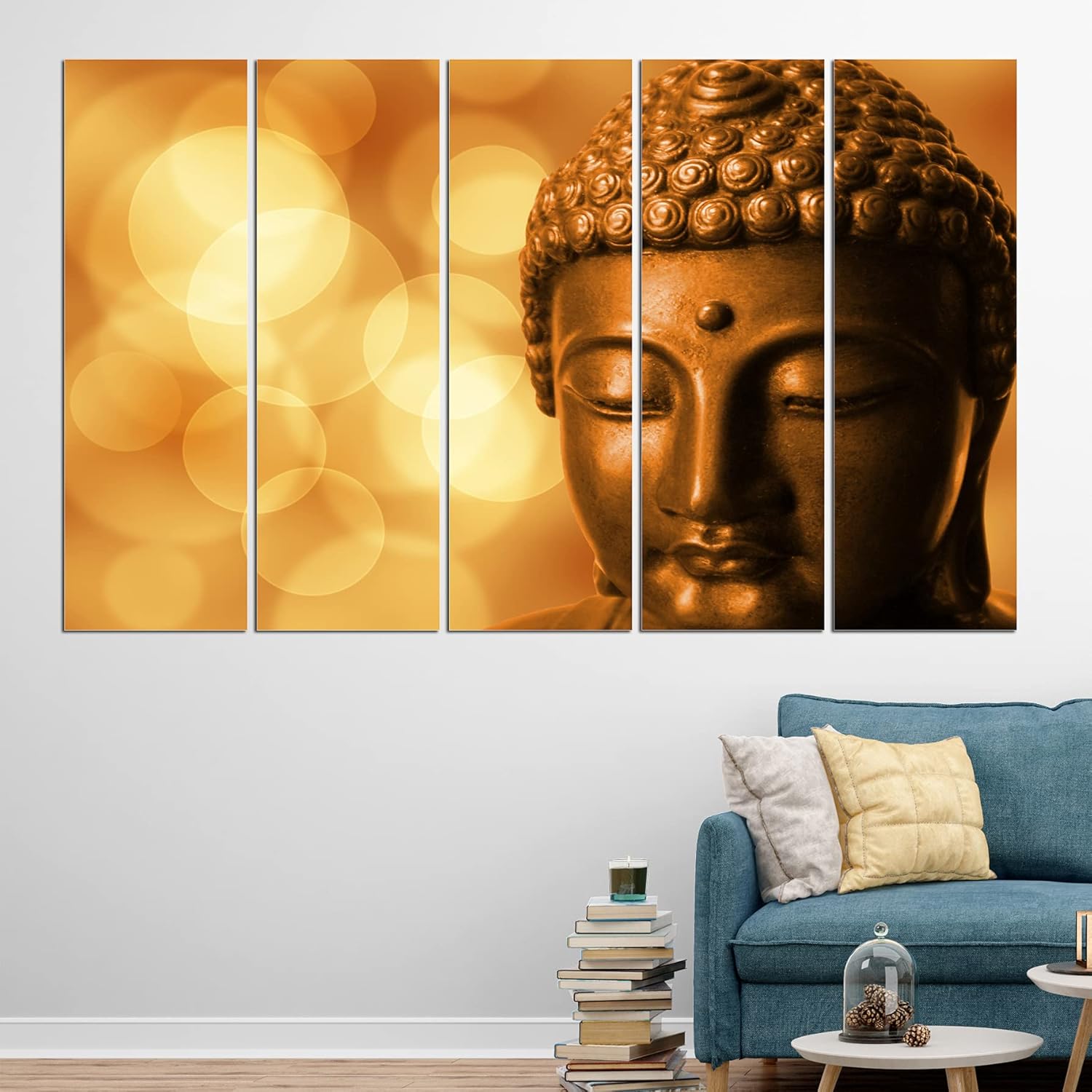
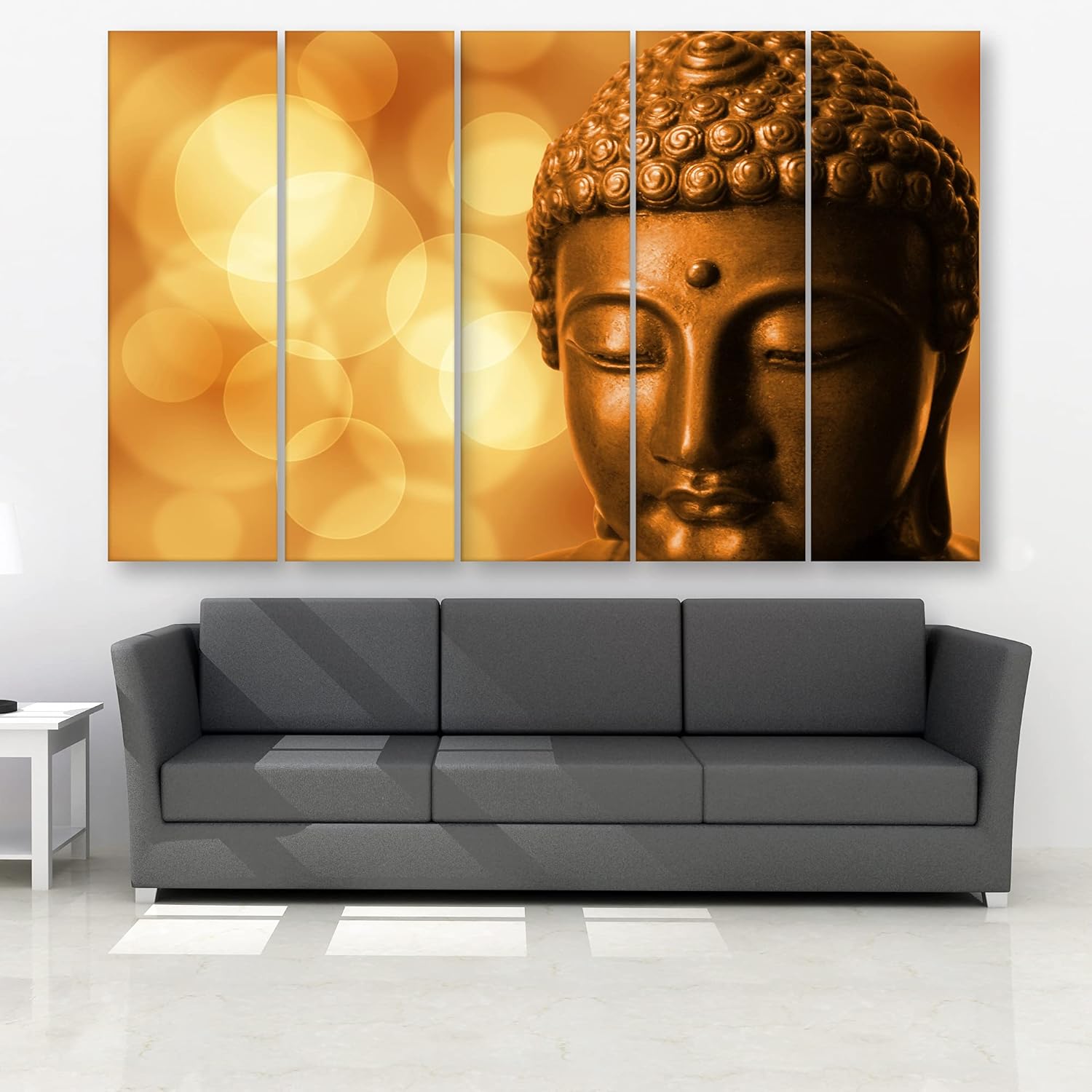
Buddha-tiful Golden Multi-Frame Framed Wall Art
You may also like

Moolwan Golden Buddha 5-Panel Canvas Wall Art Painting (127x76cm) - Meditation Face with Bokeh Light
Golden Buddha Canvas Wall Art (127cm) - The Size That Actually Works in Indian Meditation Spaces and Living Rooms
You might have browsed dozens of Buddha paintings by now. Some were too small—60cm or 75cm looked lost on your 10-12 foot wall, like you stuck a calendar-sized image in the middle of empty space and called it meditation art. Some were too large—150cm Buddha faces feel imposing, almost shrine-like, which works if you have a dedicated meditation room but feels out of place if this is going in your living room where family gathers. You probably kept coming back to this size—127cm—because intuitively, it feels like the right balance between presence and proportion. But you want to be sure.
Here's why this is the one: 127cm covers about 35-42% of a standard 10-12 foot (300-360cm) wall—enough to create a focal point without dominating the entire room. This matters because Buddha art walks a fine line. Too small, and it reads as decorative, not meaningful. Too large, and it feels like you're converting your living room into a temple, which might not sit well with family members who want spiritual presence without religious intensity. The 127cm width creates that centered, intentional look—this is clearly the feature piece on your wall, but the room still feels like a living space, not a shrine.
Your wall probably has other elements—maybe a window 3-4 feet away, maybe a console table below where you've placed a small plant or incense holder, maybe a floor lamp in the corner. The 127cm width works with these elements instead of demanding you clear everything else. And at 76cm tall, this fits comfortably under 8-10 foot ceilings without reaching awkwardly toward the ceiling line or looking cramped. From your meditation cushion or sofa (8-10 feet away), you see the full composition—the golden bokeh light flowing into the serene Buddha face. Walk up close, you see the canvas texture, the detail in the curled hair, the peaceful expression. Both viewing distances matter.
And the colors—warm golden bronze tones—these aren't the bright yellow-gold that looks garish against cream walls. These aren't the cool metallic gold that reads as corporate luxury. These are warm, meditative golds. Golds with enough bronze and amber undertone that they read as calming, not flashy. Your walls are probably cream, off-white, or that light yellow shade common in Indian apartments. Your furniture is probably wooden (teak or sheesham) or brown/beige fabric. This Buddha canvas will feel like it belongs in that setting—like something chosen for its peaceful presence, not forced into a space designed for modern minimalism.
The five-panel layout does something specific here: instead of one 127cm rectangle showing a centered Buddha face, you get a visual journey. The left three panels show golden bokeh circles—soft, blurred light that creates depth and draws your eye across the wall from left to right. Then the Buddha's face emerges in the right two panels, serene and detailed. This progression creates a meditative flow. Your eye doesn't just land on the Buddha—it travels through light to arrive at peace. And that horizontal movement makes your wall (and your room) feel wider than it actually is.
Why 127cm Works on 10-12 Foot Meditation Room or Living Room Walls (and What Happens If You Go Smaller or Bigger)
Your wall is probably 10 to 12 feet wide (300-360cm in most Indian 2BHK and 3BHK apartments). If this is a dedicated meditation space, the wall might be slightly smaller (8-10 feet). If this is your living room, you're looking at the standard 12-foot wall. Here's the visual math:
127cm canvas on a 12-foot (360cm) living room wall:
116cm of space on the left side
116cm of space on the right side
Coverage ratio: Canvas covers 35% of wall width
Effect: Anchored, intentional, creates a meditation zone without overwhelming the room
127cm canvas on a 10-foot (300cm) meditation room wall:
86cm of space on the left side
86cm of space on the right side
Coverage ratio: Canvas covers 42% of wall width
Effect: More prominent, becomes the clear focal point, appropriate for a dedicated spiritual space
Now consider your room context:
If this is going in a living room:
Your sofa is probably 6-8 feet (180-240cm) wide, sitting 6-12 inches from the wall
Hanging height: 20-25cm above sofa top puts canvas center at 140-160cm from floor (perfect eye level from 8 feet away)
Side elements: You might have a console table, floor lamp, small plant stand, or window within 3-4 feet of where this hangs
The 127cm width creates spiritual presence above your seating area without making guests feel like they're sitting in a meditation hall
If this is going in a meditation room or yoga space:
The wall is probably clearer—fewer furniture elements competing for attention
Hanging height: 130-150cm center point from floor (eye level when seated on cushions or in lotus pose)
Lighting matters more here: you probably want the ability to add warm LED strips or candles nearby to accent the golden tones
The 127cm width fills the space with calming presence—this is the visual anchor for your practice
If you went with 90cm instead:
25-30% wall coverage—looks like accent art, not a statement piece
On a 12 ft wall above a sofa, you'll have 135cm of empty space on each side
Effect: Your eye notices all that empty wall. The Buddha feels decorative, not meditative
Specific problem: Family members might ask "why so small?" and you'll end up explaining that you weren't sure about going bigger
If you went with 150cm instead:
42-50% wall coverage—works if you have a completely blank wall with nothing nearby
But if you have a window, side table, or console within 4 feet, the 150cm width will feel tight
Effect: The Buddha presence becomes dominant, potentially overwhelming in a multi-use living room
Specific problem: This size works beautifully in dedicated meditation spaces but can feel too intense for family living rooms where not everyone shares your spiritual practice
The 127cm is the balanced choice: creates meaningful presence without converting your living room into a temple, fills meditation room walls without overwhelming the space, works above standard sofas (6-8 ft) without crowding side furniture, leaves room for your console table, plant, or incense holder to exist comfortably.
And at 76cm tall, this sits proportionally under 8-10 foot ceilings. The Buddha's face is life-sized or slightly larger—not miniature (which feels insignificant) and not oversized (which can feel confrontational). From 8-10 feet away, you see the serene expression clearly. The detail in the curled hair (ushnisha) is visible but not dominating. The peaceful closed eyes create that meditative calm you're looking for.
The five-panel layout creates another benefit: instead of one 127cm rectangle, you get five panels (approximately 24cm each with 2cm gaps between panels). This creates visual rhythm—your eye travels from the abstract golden bokeh on the left, through the transitional middle panel, to the Buddha's serene face on the right. The gaps between panels add breathing room. The composition doesn't feel like one heavy block—it feels like flowing light arriving at peace.
The Golden Bronze Color Question: Will This Actually Work with Your Cream Walls and Wooden Furniture?
Here's what you're probably worried about: you've seen bright golden Buddha statues that look appropriate in temples but garish in homes. You've seen metallic gold that reads as "trying to look luxurious" instead of peaceful. You're wondering if this golden canvas will clash with your existing decor or if your family will think it looks too ornate.
Let's be specific about what "golden" means in this canvas:
These are warm golden bronze tones, not bright yellow-gold. The color palette has:
Amber undertones (warm, honey-like)
Bronze shadows (adds depth, prevents flat brightness)
Soft bokeh light circles (creates luminosity without harshness)
The Buddha face itself has darker bronze tones in the shadows, lighter gold in the highlights
What this looks like in your actual home:
Against cream or off-white walls (most common): The warm golds feel natural, like sunlight. The canvas creates a warm focal point without harsh contrast. The bronze shadows prevent it from looking flat or poster-like. Your cream walls provide the perfect neutral backdrop—the Buddha emerges peacefully without competing with wall color.
Against light yellow walls (common in older apartments): The golden tones harmonize instead of clashing. Yellow walls plus golden canvas could theoretically feel too warm, but the bronze and amber undertones create enough variation that it reads as complementary, not repetitive.
Against sage or light green walls (if you've painted): This works surprisingly well. The warm golds provide gentle contrast against cooler greens. It's the same color logic as brass/bronze accents in green spaces—feels organic, not forced.
With wooden furniture (teak, sheesham, mango wood—common in Indian homes): The golden bronze tones echo the natural honey and amber tones in wood. This creates visual coherence—your furniture and your wall art feel like they were chosen together, not randomly assembled. If you have a wooden console below this canvas, the color relationship will feel intentional.
With brown or beige fabric sofas (most common Indian upholstery): The warm palette complements perfectly. Brown leather or fabric has similar warm undertones. Beige sofas provide neutral space that lets the golden canvas be the color accent. If you have cushions, you could add one or two in rust, terracotta, or deep gold to tie everything together—but this isn't necessary. The canvas works on its own.
What about lighting?
Morning light (if your wall faces east): The golden tones will appear slightly cooler, more subdued. The Buddha's face will have gentle shadows. This is when the canvas looks most meditative—soft, peaceful, perfect for morning meditation or yoga.
Afternoon light (if your wall faces west): The golden tones intensify. The bokeh light circles seem to glow. This is when the canvas looks most luminous—alive with warmth. If you have harsh afternoon sun, the UV-resistant inks mean the colors won't fade, but you might want sheer curtains to soften the light and prevent glare on the canvas surface.
Evening/artificial light (warm white LEDs, 3000K): This is when golden Buddha canvas looks most cohesive. Warm LED lighting enhances the amber and bronze tones. The canvas appears rich, textured, inviting. This is the lighting condition your guests will see it in—and this is when it looks most impressive.
If you have cool white LEDs (5000K+): The golden tones will appear more muted. Not bad, just less warm. If you're particular about color temperature, switching to warm white bulbs (₹200-400 for a 4-pack) will make a noticeable difference in how the canvas presents.
The family acceptance question:
Buddha imagery carries cultural weight. In Hindu households, Buddha is often respected as an avatar or enlightened being—spiritual but not requiring daily worship like deity paintings would. This makes Buddha art generally family-acceptable even if not everyone in your household practices Buddhism or meditation.
Your mother or mother-in-law will likely see this as: "spiritual and peaceful" rather than "religious conversion" or "too modern." The golden tones read as traditional—this doesn't look like imported Western-style Buddha art trying to be minimalist. The warm palette, the serene face, the meditative composition—these signal respect for spiritual tradition, not trendy decoration.
If you have guests who aren't familiar with meditation or Buddhist imagery: they'll see this as artistic and calming. The abstract bokeh panels on the left make this feel more like art than religious iconography. The composition invites interpretation—it's light becoming peace, chaos becoming calm, the journey to serenity. You don't need to explain your spiritual practice to justify why this hangs on your wall.
Will This Canvas Survive Indian Monsoons, Humidity, and Temperature Swings?
Let's address the practical concern nobody mentions in product descriptions: your Buddha canvas has to survive the Indian climate. And the Indian climate does not respect meditation art.
Mumbai: 70-85% humidity during monsoons, salt air if you're anywhere near the coast Bangalore: 15-degree temperature swings between 12°C nights and 28°C afternoons
Chennai: Relentless sun plus 80% humidity year-round Delhi: 5°C winters, 45°C summers, sudden monsoon bursts Pune/Hyderabad: Dust followed by rain, repeat
Cheap canvas paintings don't just fail—they fail specifically because of these conditions. The canvas absorbs moisture during monsoons and expands. When it dries, it contracts. After two monsoon seasons, you'll see permanent rippling. The wooden frame warps if it wasn't kiln-dried properly. And if you're coastal, the salt in the air accelerates color fading. That peaceful golden Buddha? It'll shift to washed-out yellow-gray within 18 months near windows.
Here's how climate-appropriate Buddha canvas actually works:
340 GSM cotton canvas with moisture-resistant coating: Standard cheap canvas is 180-220 GSM—thin enough that you can see the wooden frame showing through if there's backlighting. 340 GSM is nearly twice as thick. The weave is tight. The polymer moisture barrier seals the surface. During monsoons, condensation can't penetrate the fibers. The canvas stays drum-tight on the frame through multiple humidity cycles.
You can test this when it arrives: if water drops bead on the surface instead of darkening the canvas, it's properly treated. This isn't just for monsoon protection—this also means dust sits on the surface instead of embedding in the weave. A dry microfiber cloth every 2-3 weeks keeps it clean. No water, no chemicals, no furniture polish. Just dusting.
Kiln-dried pinewood frame (12% moisture content): The wood is dried below the equilibrium moisture content for Indian climates (14-18%). What this means in practice: the wood won't absorb atmospheric moisture and swell. Your frame stays dimensionally stable through monsoons. The 1.5-inch thickness prevents flexing. Corner bracing (internal support at each corner joint) prevents the frame from going out of square even if your wall isn't perfectly flat.
Three years from now, your canvas will still be tight, flat, and properly tensioned. No ripples at the edges. No corners pulling away from staples. No warping that creates an uneven shadow against the wall.
Eco-solvent UV-resistant inks: These inks are chemically bonded to the canvas fibers. UV exposure doesn't break down the color molecules. If your meditation space or living room wall gets 3-4 hours of direct sunlight daily (east or west-facing), your golden tones will look the same five years from now. The Buddha's face won't fade to pale yellow. The bokeh light circles won't wash out to cream. The bronze shadows stay bronze.
This is the same ink technology used for outdoor signage—designed to withstand sun, rain, and temperature extremes. Your indoor wall is a much gentler environment.
Sealed edges and backed canvas: The canvas wraps around the frame edges, and those edges are sealed. Dust can't accumulate in the gap between canvas and frame. Insects can't nest (yes, silverfish love the dark space between cheap canvas and walls—especially in humid climates). The back either has kraft paper backing or the wrapped canvas itself seals the back, preventing moisture from entering from behind the wall.
Does this matter if you live in an air-conditioned apartment?
Maybe slightly less. But here's reality: you're not running AC 24/7 year-round. Your canvas hangs through power cuts, through weeks when you're traveling and AC is off, through monsoon months when you open windows for fresh air, through winter when you don't need AC at all. It needs to handle the actual environment it lives in, not the ideal controlled environment.
And if you're in a rental apartment: you can't control the building's humidity levels. The previous tenant's bathroom leak might have left moisture in the walls. Your landlord's budget paint job might be trapping moisture. Quality canvas that can handle these conditions is the difference between art you enjoy for your entire tenancy and art you're replacing every 14 months because it looks tired and warped.
Installation Reality: Can You Actually Hang This Without Damaging Your Rental Walls?
You're in a rental. Your lease agreement probably has vague language about "no damage to walls" or "property must be returned in original condition." Your deposit is ₹40,000-80,000 and you'd very much like to get it back. So when you think about hanging a 127cm, 3kg Buddha canvas, your immediate concern is: "Am I about to lose my deposit over meditation art?"
Here's what most canvas sellers don't explain clearly enough: there's a massive difference between the tiny holes you need for canvas art and the actual wall damage that costs you your deposit.
Canvas art requires: 2-3 small anchor holes (6mm diameter, 30-40mm deep—about the width of a pencil, depth of your finger)
What actually loses you your deposit: Multiple large holes from failed TV mounting attempts, 12mm diameter holes from heavy shelving brackets, poorly patched clusters of holes, holes that go completely through drywall, cracks around holes from using wrong anchors
The 6mm holes for canvas mounting are smaller than the holes from standard curtain rod brackets. When you move out, you fill them with wall putty (available at any hardware store for ₹40-60), sand smooth with fine sandpaper, and touch up with a tiny dab of matching paint. Total repair time: 15 minutes. Total cost: ₹150-200. Your landlord will never notice unless they're inspecting with a magnifying glass.
Here's exactly what you'll do:
Step 1: Identify your wall type (2 minutes) Tap on your wall with your knuckles:
Hollow sound = drywall over metal/wood studs (common in modern apartments, especially Bangalore/Pune/Gurgaon)
Solid sound = concrete or brick with plaster (common in older buildings, Mumbai/Delhi/Chennai)
Step 2: Mark your hanging position (3 minutes) Use the included paper hanging template. This is a full-size paper outline showing exactly where to drill. You tape it to your wall at the height you want (remember: 20-25cm above sofa top, or 130-150cm center point from floor for meditation spaces). The template shows two marks for the mounting points. Use a pencil to mark through the template. Remove template. You now have two precise marks.
Step 3: Drill anchor holes (5 minutes)
For drywall:
Use the included plastic drywall anchors
Use a 6mm drill bit (included in most basic drill bit sets, or ₹50 at hardware stores)
Drill straight in, 30mm deep—you'll feel when you break through the drywall
Tap the plastic anchor into the hole until it's flush with the wall
Screw in the hook (included), leaving 5mm extending from wall
For concrete/brick:
Use the included concrete anchors
Use a 6mm masonry bit (₹80-120 at hardware stores—has a different tip than wood/metal bits)
Drill 35-40mm deep—go slow, the drill might kick back slightly when hitting hard spots
Tap the anchor into the hole with a hammer until flush
Screw in the hook, leaving 5mm extending
Step 4: Hang the canvas (2 minutes) The canvas has D-ring hangers on the back (those triangular metal loops). Hook them onto your wall hooks. Adjust until level. Step back. You're done.
Total installation time: 15-20 minutes, including the part where you stand back five times to make sure it's level and centered.
What if you're truly paranoid about drilling?
Command Picture Hanging Strips rated for 5.4kg (3kg canvas + 2.4kg safety margin) will work. You'll need two sets. Cost: ₹400-500. These use 3M adhesive—you stick one side to the wall, one side to the canvas frame, press together. When you move out, you pull the tab and the adhesive releases without damaging paint.
Honest assessment: Command strips work fine for canvas up to 90cm. At 127cm and 3kg, they'll hold, but you'll probably lie awake the first few nights wondering if you'll hear a crash at 2am. Proper anchors give you peace of mind. And the 6mm holes are so small that repair is genuinely trivial.
Moving out checklist:
Remove canvas, remove hooks
Fill holes with wall putty (₹50 for a small tub)
Let dry (30 minutes)
Sand smooth with fine-grit sandpaper (₹30 for a sheet)
Touch up with paint (ask landlord for exact shade, or use "Asian Paints Apcolite - Ivory" which matches 80% of rental apartment walls)
Your landlord will never know the Buddha was there.
Why Moolwan Instead of Buying Similar Buddha Canvas from Marketplaces for ₹1,200
You've probably seen similar-looking golden Buddha canvas on marketplace sites for ₹1,200-1,500. You've seen it on import aggregator sites for ₹1,800. So why spend ₹2,496 here?
Because you're not comparing the same product. You're comparing a photograph of Buddha canvas to actual canvas that will hang on your meditation room or living room wall for the next 3-5 years.
Here's what the ₹1,300 price difference actually buys you:
Manufacturing consistency, not random reseller stock: Marketplace sellers source from whoever's cheapest that month. One batch might be decent 280 GSM canvas. The next batch might be 200 GSM because their supplier switched. You have no idea what you're getting until it arrives. Moolwan manufactures in-house. Every canvas uses the same 340 GSM cotton, same eco-solvent inks, same kiln-dried pinewood frames. The Buddha canvas you see in the product photo is exactly what arrives at your door.
Climate-appropriate for Indian conditions: That marketplace canvas? It's optimized for generic conditions—probably manufactured for temperate climates with 40-60% humidity and stable temperatures. The inks aren't UV-tested for tropical sun. The frame wood isn't moisture-treated for 85% monsoon humidity. Six months of Mumbai weather or Delhi summer-to-winter swings will show you exactly why it was ₹1,200.
Your meditation practice is long-term. The Buddha canvas you're looking at now should still look peaceful and intentional three years from now, not faded and warped within 18 months.
Actually includes proper installation hardware: Marketplace listings say "mounting hardware included" and you receive two tiny picture hooks designed for a 500g photo frame, not a 3kg canvas. Then you're making a Saturday trip to the hardware store, staring at wall anchors wondering which ones you need, asking the shop uncle who gives you three different opinions.
Moolwan includes: concrete anchors (for solid walls), drywall anchors (for hollow walls), D-ring hangers (pre-attached to canvas), hanging template (full-size paper guide), and basic installation instructions. Everything you actually need. You're not hunting for missing pieces.
Real customer service for meditation art: When marketplace canvas arrives damaged (and shipping damage happens—corners get crushed, panels get dented), you're dealing with third-party sellers who might respond in 48 hours, might not accept the return, might offer a partial refund and ask you to keep the damaged piece. You end up in customer service limbo for weeks.
Moolwan's replacement policy is clear: video your unboxing (start recording before cutting the tape, show all sides of the box). If there's damage, submit the video within 48 hours. Replacement ships within 2-3 days. You're not fighting through three different ticket systems or arguing with chat support that doesn't understand the difference between manufacturing defects and shipping damage.
Sized for Indian walls and furniture: That 127cm x 76cm dimension? That's calculated to work above Indian 6-8 foot sofas, on 10-12 foot walls, under 8-10 foot ceilings. These aren't random international sizes converted to centimeters. These are dimensions tested in actual Indian homes.
The 5-panel layout with 2cm gaps creates horizontal flow that makes Indian rooms (which tend to be more square than rectangular) feel wider. The proportions work with how Indian furniture is actually arranged—sofa against the wall, not floating in the room center like Western designs.
The ₹1,300 difference isn't about paying extra for the same thing. It's about not replacing cheap canvas in 14 months when the golden tones fade to pale yellow and the frame starts warping. It's about not losing a Saturday hunting for the right wall anchors. It's about your meditation space or living room still feeling peaceful and intentional three years from now, not looking like you meant to replace that canvas but haven't gotten around to it yet.
What Your Golden Buddha Canvas Will Actually Look Like in Your Home
Product photos are styled. Perfect lighting. Blank white walls. Carefully chosen gray sofa for neutral backdrop. Your home isn't that.
Your wall probably has: light switches, maybe an AC vent, maybe a visible patch where the previous tenant hung something, the specific warm LED bulbs you installed, morning or afternoon sun coming through windows at an angle.
So here's what your golden Buddha canvas will actually look like:
In morning light (7am-11am, east-facing walls): Colors appear slightly cooler and more subdued. The golden tones look soft, contemplative—perfect for morning meditation. The Buddha's face has gentle shadows. The bokeh circles appear as soft light, not intense glow. This is when the canvas looks most peaceful. If your meditation practice is morning-based, this lighting condition matters most to you.
In afternoon light (2pm-6pm, west-facing walls): Golden tones intensify significantly. The bokeh light circles seem to glow from within. The Buddha's face catches highlights, creating more dimension. This is when the canvas looks most luminous and alive. It's also when cheap ink quality becomes obvious—low-quality inks look washed out in bright light, but eco-solvent inks maintain color saturation. The warm golds stay rich, not pale.
If you have harsh afternoon sun hitting the wall directly, you might want sheer curtains to diffuse it—not for color protection (the UV-resistant inks handle sun), but to prevent glare on the canvas surface that makes it hard to see the details.
In evening/artificial light (warm white LEDs, 3000K): This is when golden Buddha canvas looks most cohesive and impressive. Warm LED lighting enhances the amber and bronze undertones. The canvas appears rich, textured, inviting. The five panels create visible depth—the bokeh panels recede slightly, the Buddha face panels come forward. This is the lighting condition your guests see it in during evening visits, and this is when it makes the strongest impression.
If you have cool white LEDs (5000K or higher): The golden tones will appear more muted and slightly gray-tinged. Not bad, just less warm. If you're particular about color, switching your room's bulbs to warm white (₹200-400 for a 4-pack) makes a noticeable difference.
Against cream or off-white walls (most common): The neutral wall lets the golden Buddha be the clear focal point. The warm tones create gentle contrast without harshness. Your eye goes directly to the canvas when entering the room. This is the ideal pairing—it's why cream/off-white walls are standard in Indian homes. Everything you hang has breathing room.
Against light yellow walls (common in older apartments): The golden canvas harmonizes instead of clashing. You might worry that yellow + gold = too warm, but the bronze and amber undertones create enough variation that it reads as complementary. The Buddha face provides darker tones that ground the overall warmth. If anything, this combination creates a very cohesive, sunset-like glow in the room.
Against sage, light green, or mint walls (if you've painted): This works beautifully. The warm golden bronze provides gentle contrast against cooler greens. It's the same color principle as brass/bronze accents in green meditation spaces—feels organic and intentional, not forced. The Buddha's peaceful presence balances the fresh, natural feeling of green walls.
Above brown or beige fabric sofas (most common Indian furniture): Perfect natural pairing. Brown sofas have similar warm undertones to the golden canvas. Beige sofas provide neutral space that lets the canvas be the color accent. The visual flow is: neutral sofa → golden canvas → cream wall. Everything works together. You could add cushions in rust, terracotta, or deep gold to tie it together, but this isn't necessary. The canvas stands on its own.
With dark wood furniture (teak, sheesham, rosewood): The golden bronze tones echo the honey and amber tones in wood grain. If you have a wooden console table below this canvas, the color relationship feels intentional—like you chose them together. If you have a wooden coffee table, TV unit, or side tables in the room, the warm metallic tones in the canvas complement without matching exactly.
In meditation rooms or yoga spaces: The golden Buddha becomes the visual anchor. If you keep the space minimal (cushions on the floor, maybe a small shelf for incense), the canvas provides all the visual interest you need. The bokeh light progression creates a meditative focal point. During practice, your eye has somewhere to rest that's calming rather than distracting.
In living rooms with family: The Buddha presence reads as peaceful and artistic rather than overtly religious. The abstract bokeh panels on the left make this feel like art that happens to feature Buddha, not religious iconography that happens to be art. Family members who don't share your meditation practice won't feel like you've converted the living room into a shrine. It's spiritual without being exclusive.
The honest test: When you walk into your room, does your eye go to the Buddha canvas in a "that brings peace" way or a "that's hanging there" way? Good meditation art becomes part of the room's emotional atmosphere. It creates the feeling you want—calm, centered, intentional—without demanding constant attention.
What Past Customers Actually Experienced (6-12 Months Later)
We asked people who bought golden Buddha canvas 6-12 months ago what surprised them:
"I was nervous about the size being too big, but 127cm is exactly right for my 12-foot living room wall. It's prominent without being overwhelming. My mother actually said it 'brings peace to the house,' which coming from her is high praise."
— Priya, Bangalore (purchased for living room above sofa)
"Eight months later and the golden color still looks exactly like the day it arrived. My wall gets afternoon sun for 3-4 hours daily and I was worried about fading. No change at all."
— Karthik, Mumbai (purchased for meditation room, west-facing wall)
"Installation was easier than I expected. The template made it foolproof. I was done in 20 minutes including the time spent making sure it was perfectly level."
— Anjali, Pune (purchased for yoga studio)
"Through two monsoon seasons and the canvas is still tight on the frame. The cheap Buddha canvas I had before this started getting wavy edges after the first monsoon. This one? Still perfect."
— Deepa, Chennai (purchased for bedroom meditation corner)
"I thought the five-panel layout might feel too segmented, but it actually creates really nice visual flow. Your eye travels across the light to the Buddha face. It's meditative even when you're just walking past it."
— Rahul, Hyderabad (purchased for home office)
"Family accepted it immediately. I was worried my in-laws might think it's too modern or not 'traditional enough,' but they saw it as respectful spiritual art. No questions, just compliments."
— Meera, Delhi (purchased for living room in joint family home)
The Practical Details You Actually Care About
Shipping time: 5-6 days to metros (Mumbai, Delhi, Bangalore, Chennai, Kolkata, Hyderabad, Pune). Add 1-2 days for tier-2 cities (Jaipur, Lucknow, Chandigarh, Kochi, etc.). Add 2-3 days for tier-3 cities and towns. You receive tracking details within 24 hours of order placement.
Packaging: Triple-layer protection. Inner: bubble wrap covering all canvas surfaces. Middle: cardboard corner protectors (those right-angle pieces that prevent crushed corners). Outer: corrugated carton box with "Fragile" and "This Side Up" markings. Shipping is rough—this packaging is why your canvas arrives undamaged.
COD available: Yes, across all locations where courier services operate. The delivery person will let you inspect the outer box for major damage before payment. If the box is severely crushed, torn, or water-damaged, refuse delivery and contact customer service immediately.
Video your unboxing: This protects you. Start recording before you cut the tape on the outer box. Show all sides of the box, then film the unwrapping process. Check each panel for damage, check the frame corners, check that the canvas is tight. If there's any damage, you have video proof for replacement claims. Without video, proving shipping damage is nearly impossible, and you'll end up in back-and-forth with customer service trying to determine fault.
Replacement policy:
Full replacement for:
Manufacturing defects (print errors, color misalignment between panels, frame defects, canvas not properly stretched)
Shipping damage (bent frames, torn canvas, broken corners, crushed panels)
Damage claims require unboxing video submitted within 48 hours of delivery. Replacement ships within 2-3 days of approved claim.
What's NOT covered:
Buyer's remorse ("I thought 127cm would look different in my space"), subjective color complaints ("the gold looks more bronze than yellow on my wall" when it actually matches the product photo), damage that occurred after installation (you dropped it, your child threw a ball at it, you spilled something on it), normal wear after 12+ months of use.
Color accuracy consideration:
Your phone/laptop screen affects how colors appear. If your screen is set to "warm" or "blue light filter" mode, the golden tones will appear more orange. If set to "cool" mode, they'll appear more yellow. Product photos are shot in natural daylight with color-calibrated cameras.
The actual canvas will match how it looks on a properly calibrated display in neutral lighting. This doesn't mean the canvas is wrong—it means your screen isn't showing accurate colors. The golden bronze tones in the actual canvas are what you see in the photo under neutral conditions.
Cleaning and maintenance:
Dust with a dry microfiber cloth every 2-3 weeks. That's it.
Don't use water. Don't use Windex or cleaning sprays. Don't use furniture polish. Don't use a wet cloth.
Just dry dusting.
The moisture-resistant coating means dust sits on the surface instead of embedding in the canvas weave. It wipes away cleanly with a dry cloth. If you live in a particularly dusty area (near construction, near roads), you might need to dust weekly. But it's always dry cloth only.
If someone accidentally splashes water on it (you're watering plants nearby, condensation from a glass): blot immediately with a dry cloth or paper towel. Don't rub. The moisture barrier will protect the canvas, but don't let water sit on the surface.
Long-term care:
After 2-3 years, the canvas might accumulate fine dust in the texture of the weave (the natural cotton texture creates tiny valleys where dust settles). Use a soft-bristle brush (like a clean makeup brush or soft paintbrush) to gently brush the surface before dusting with microfiber cloth. This lifts embedded dust without damaging the canvas or ink.
Never use compressed air (like for keyboards). The pressure can push dust into the weave or damage the canvas tension.
Who Moolwan Actually Is (And Why That Matters for Spiritual Art)
Moolwan isn't a marketplace reseller importing generic Buddha canvases and marking them up. We manufacture canvas wall art in-house because we got tired of the inconsistent quality and spiritual insensitivity we saw in mass-market meditation art.
The manufacturing process:
Canvas: Sourced from textile mills in Surat that specialize in artist-grade cotton. 340 GSM weight. Tested for moisture absorption, weave tightness, and color adhesion.
Inks: Eco-solvent inks from Roland DG (the same company that makes commercial printing equipment for outdoor signage). These are UV-resistant, water-resistant, and chemically stable. We test color fastness by exposing sample prints to accelerated UV aging (equivalent to 5 years of direct sunlight). The golden Buddha tones show less than 5% color shift.
Frames: Pinewood sourced from sustainable plantations in Karnataka. Kiln-dried in our facility to exactly 12% moisture content (we test with a moisture meter—it's not an estimate). Cut to size, mitered corners, assembled with corner bracing for stability.
Printing: Large-format eco-solvent printers. Each panel is printed, color-checked against reference standards, then stretched onto the frame using pneumatic stretching tools (ensures even tension across the entire canvas surface, no hand-stretching variation).
Quality inspection: Every canvas is inspected before shipping. Not sample-checked—actually inspected. Someone physically examines the print quality, checks that the five panels have consistent color, verifies frame corners are square, confirms canvas tension is even across all panels, tests that D-rings are properly attached and aligned.
Why this matters for Buddha art specifically:
Spiritual and meditation art carries meaning beyond decoration. The serene expression on Buddha's face, the progression from light to peace, the golden tones that symbolize enlightenment—these aren't arbitrary design choices. Getting them right matters.
Marketplace sellers treat Buddha canvas like any other product. Print whatever sells, use whatever's cheapest, ship it out. If the golden tone shifts to pale yellow under UV exposure, if the panels don't align properly, if the Buddha's face looks slightly pixelated up close—they don't care. It's just inventory.
We design for meditation spaces and spiritual corners in Indian homes. We know your wall isn't just empty space—it's where you practice, where you center yourself, where you seek peace. The canvas you hang there should support that intention, not undermine it with poor quality that becomes a visual irritation over time.
We design for Indian homes specifically:
Our sizes work with Indian furniture proportions (6-8 ft sofas, 10-12 ft walls, 8-10 ft ceilings). Our color palettes work with Indian wall colors (cream, off-white, light yellow). Our spiritual art is culturally appropriate—Buddha imagery that respects the meditative tradition without being so austere that it feels cold in Indian family homes.
The 127cm size exists because we tested it in actual Indian living rooms and meditation spaces. Not because it's a standard international size. Because it creates the right visual and spiritual presence in rooms that are 12x14 feet with 8-foot ceilings and brown fabric sofas.
This Is Where You Decide
You've read about canvas weight, frame moisture content, UV-resistant inks, wall anchor types, and why 127cm creates balanced presence on 10-12 foot walls without overwhelming living spaces or feeling too small in meditation rooms.
You probably know more about golden Buddha canvas quality right now than 95% of people who buy meditation art online.
So here's what it comes down to:
You can keep scrolling. You can add this to your saved items and revisit it next month when you're doing another round of browsing. You can keep that wall empty while you continue researching, wondering if there's something better, something more perfect.
Or you can acknowledge that you've done the research. You know 127cm is the right size for your 10-12 foot wall. You know this is quality canvas that will survive monsoons, humidity swings, and UV exposure without fading or warping. You know the golden bronze tones will work with your cream walls and wooden furniture. You know installation is straightforward and rental-friendly. You know the price reflects actual quality, not marketplace markup.
Your wall has been empty long enough.
That meditation corner or living room space where you envisioned peaceful presence—it's been waiting. You've been searching for the right piece. You've measured your wall multiple times. You've imagined what it would look like. You've thought about how it would feel to walk into that room and see serene Buddha energy grounding the space.
The decision isn't whether to buy golden Buddha canvas. You already know you want it. The decision is whether you're ready to stop researching and start living with a space that finally feels complete, intentional, and peaceful.
QUICK SPECS REFERENCE
Product: Moolwan Golden Buddha 5-Panel Canvas Wall Art Painting
Dimensions: 127cm (W) x 76cm (H) x 0.6cm (D)
Weight: 3 kg
Panel Configuration: 5 panels (approximately 24cm each with 2cm gaps)
Design: Serene Buddha meditation face (right profile) with golden bokeh light background
Color Palette: Warm golden bronze with amber and bronze undertones
Canvas: 340 GSM cotton with moisture-resistant polymer coating
Frame: 1.5" kiln-dried pinewood (12% moisture content)
Inks: Eco-solvent UV-resistant (no fading in direct sunlight)
Installation: Includes concrete anchors, drywall anchors, D-rings, hanging template
Ideal For: 10-12 ft walls in living rooms, meditation rooms, yoga studios, bedrooms
Works Above: 6-8 ft sofas, console tables, meditation cushion areas
Climate Tested: 70-85% humidity, 5°C-45°C temperature range, coastal conditions
Price: ₹2,496
Shipping: 5-6 days to metros, includes tracking
Warranty: Full replacement for manufacturing defects and shipping damage (with unboxing video)