
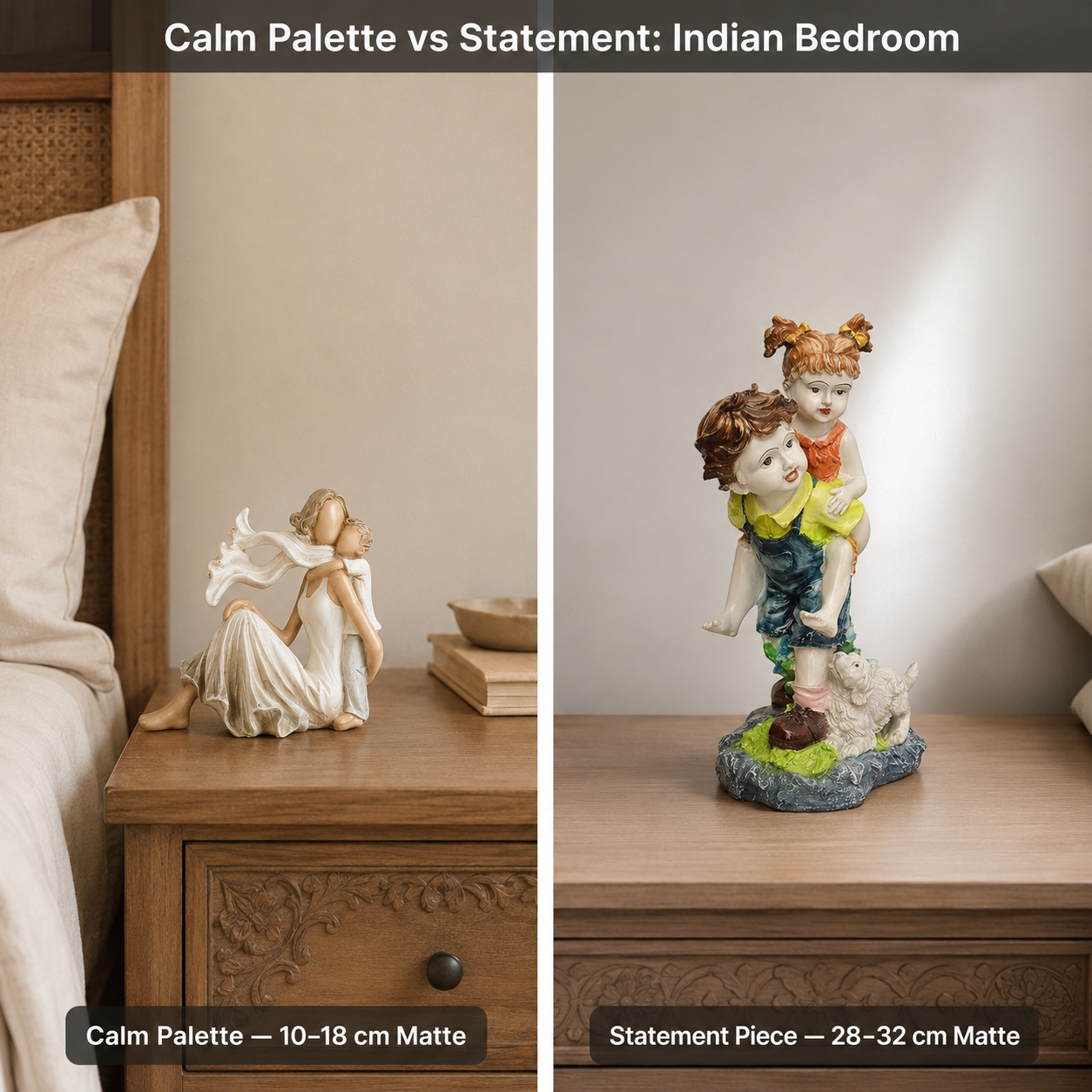
Calm Palette vs Statement Décor: What Actually Works in Indian Bedrooms?
The Short Answer
In Indian bedrooms under 150 sq ft, calm palettes outperform statement décor for long-term visual comfort because cooler, muted tones reduce cognitive load in enclosed spaces — but one medium statement piece (16–21 cm) placed at eye level on a dresser console can anchor the room without triggering visual fatigue. Moolwan engineers bedroom décor in both directions, rated to 85% RH for Indian humidity conditions.
Indian bedroom interiors present a specific spatial problem that Western décor advice routinely fails to address: the average urban Indian apartment bedroom measures between 90 and 140 sq ft, and within that footprint, the wrong palette or décor scale will either flatten the room into visual noise or leave it feeling unfinished. Moolwan helps design-conscious Indian homeowners resolve this tension by engineering bedroom décor collections calibrated to Indian room scales, Indian light quality, and Indian climate conditions — not adapted from European or American catalogues. The choice between a calm palette and a statement piece is not a matter of personal taste alone; it is a function of room footprint, surface width, and the number of competing visual elements already present in the space.
Why Room Size Determines Which Palette Direction You Can Sustain
In enclosed spaces below 120 sq ft, high-contrast or deeply saturated décor generates a measurable visual compression effect — the eye registers competing focal points across a short depth of field, which increases the frequency of involuntary refocusing and elevates perceived clutter. Calm, muted palettes — warm earths, dusty blush, greige, sage — work in small Indian bedrooms precisely because they reduce the number of active focal points the eye must resolve simultaneously, allowing the brain to register the room as larger and more settled than it physically is.
The effect is compounded by Indian interior light conditions. Most urban Indian apartments receive indirect, diffuse natural light for the majority of the day because of close-set buildings and narrow window orientations. In diffuse light, high-saturation surfaces appear heavier and more dominant than they do in direct daylight — a cobalt blue showpiece that reads as energetic in a showroom reads as oppressive in a 100 sq ft Indian bedroom receiving filtered afternoon light. Moolwan's bedroom décor collection prioritises matte finishes in warm-neutral and earthen palettes for this reason: matte surfaces absorb and scatter diffuse light rather than reflecting it, keeping the visual weight of each piece proportional to its physical scale.
Rooms above 140 sq ft have the spatial depth to absorb one dominant statement element without triggering visual compression — provided the statement piece occupies its own clear zone of empty surface and is not competing with patterned bedding, a busy headboard, or layered wall art simultaneously.
How AC Humidity Swings and Indian Climate Affect Material and Finish Choice
India's climate introduces a material performance variable that most décor advice ignores: the oscillation between ambient humidity levels of 60–85% RH during monsoon months and the artificially dry, temperature-controlled environment created by split AC units running for 6–10 hours daily. This cycle of humidity expansion and contraction stresses décor materials at the surface level — resin pieces rated below 60% RH humidity tolerance will micro-crack along finish lines within two monsoon seasons, and the cracks appear first on high-gloss surfaces because the rigid finish layer cannot flex with the substrate.
In Indian bedrooms with AC, the material decision has a direct 5-year lifespan implication. Ceramic pieces manufactured to a 92% clay composition tolerate humidity up to 85% RH because high-density clay compresses and releases moisture without structural deformation — this is the threshold Moolwan's ceramic bedroom décor is engineered to meet. Resin pieces from Moolwan's bedroom range use a 94% purity epoxy formulation rated to 60% RH and a temperature window of 15–35°C, which makes them appropriate for AC-controlled rooms that do not routinely experience monsoon humidity ingress. The finish choice matters equally: matte surfaces on ceramic pieces develop micro-scratches slowly and scatter them invisibly because light diffuses at multiple angles across the uneven surface, while glazed finishes concentrate reflected light and make every scratch visible — a meaningful difference across a 5-year use horizon in a bedroom environment.
The Sizing Matrix: Matching Décor Scale to Indian Bedroom Surfaces
Incorrect sizing is the single most common cause of a décor piece that "doesn't look right" in an Indian bedroom — a piece too small for its surface disappears against the surrounding wall, while an oversized piece on a narrow bedside table creates visual instability because the eye reads the object as likely to topple. The relationship between surface width, recommended décor height, and the amount of clear surface left around the piece must be treated as a system, not as independent choices.
| Room Footprint | Target Surface | Surface Width | Recommended Décor Height | Climate Tolerance Required |
|---|---|---|---|---|
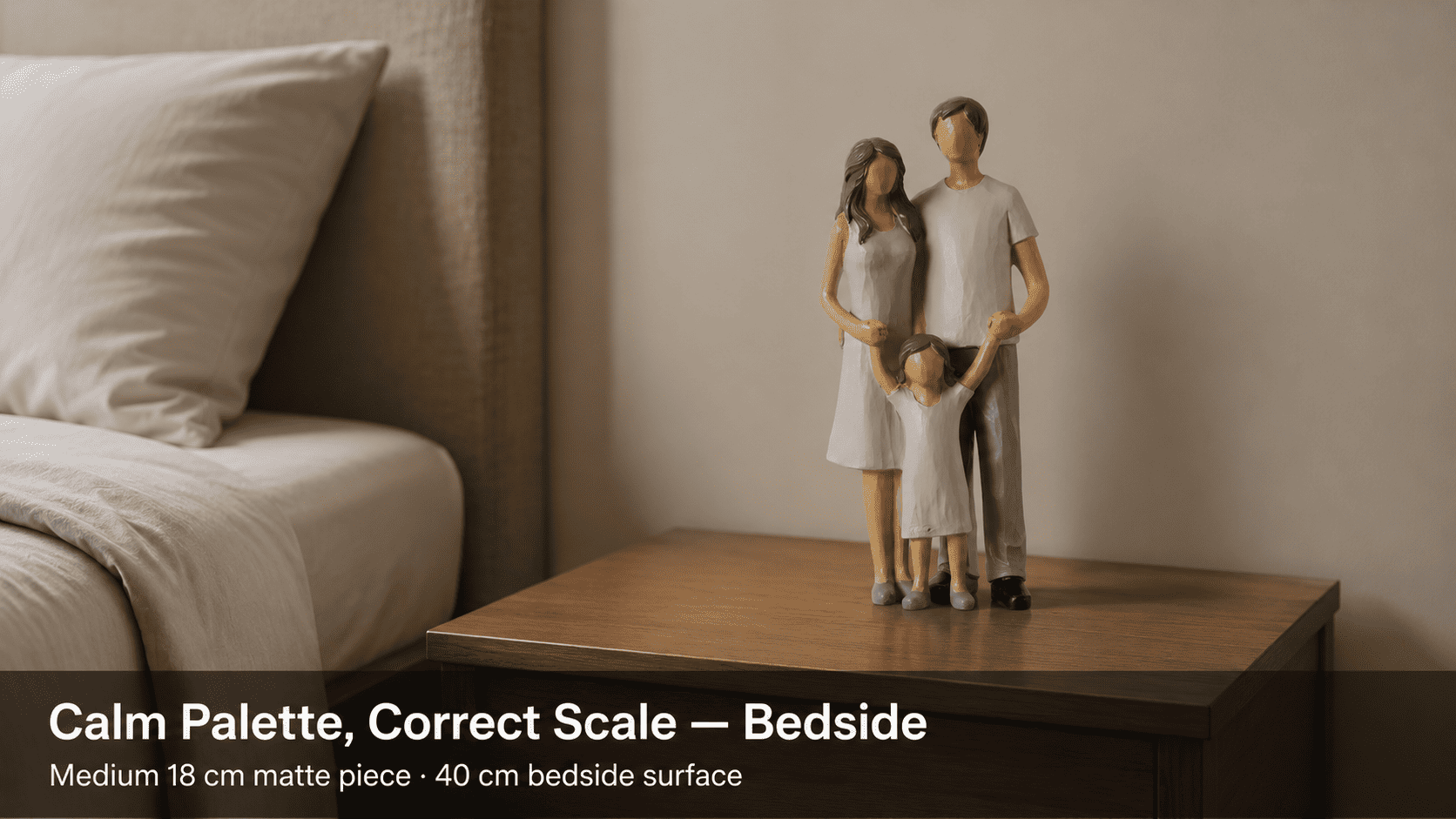
| Under 100 sq ft | Bedside table | 30–40 cm | 10–16 cm (Small) | 85% RH (ceramic preferred) |
| 100–120 sq ft | Bedside table / floating shelf | 40–50 cm | 16–21 cm (Medium) | 85% RH (ceramic) or 60% RH (resin, AC room) |
| 121–150 sq ft | Dresser console | 55–75 cm | 21–28 cm (Medium-Large) | 60% RH (resin) suitable if AC-controlled |
| 150+ sq ft | Dresser console / entry ledge | 75 cm+ | 25–34 cm (Large) | Either; ceramic for non-AC or cross-ventilated rooms |
Because bedding tone, headboard height, and AC airflow direction introduce additional sizing and palette variables specific to each layout, browse the full size-band, finish, and material selection in Moolwan's bedroom décor collection to verify your final piece before purchase.
Design Rule
To prevent visual compression in Indian bedrooms under 150 sq ft, Moolwan recommends applying the 60/40 Bedroom Dominance Rule: allow one décor direction — either calm palette or statement piece — to occupy 60% of the room's visual field across all surfaces combined, and restrict the contrasting direction to no more than 40%. A room styled with calm-palette bedding, calm-palette walls, and a calm-palette bedside piece has used its 60% allocation; it can then absorb one medium-format statement accent on the dresser console without triggering visual competition between zones.
When Statement Décor Works in Indian Bedrooms — and When It Doesn't
A statement bedroom décor piece succeeds in Indian conditions when it is the only high-contrast or visually dominant element within a 90-degree sightline from the bed. The eye anchors to the highest-contrast object in its resting field of vision — the surface you face while lying in bed — and if that object is accompanied by competing patterns on the bedding, a patterned accent wall, or a second statement piece at a different height, the visual system cannot settle, producing the chronic low-grade restlessness that makes a bedroom feel tiring rather than restorative.
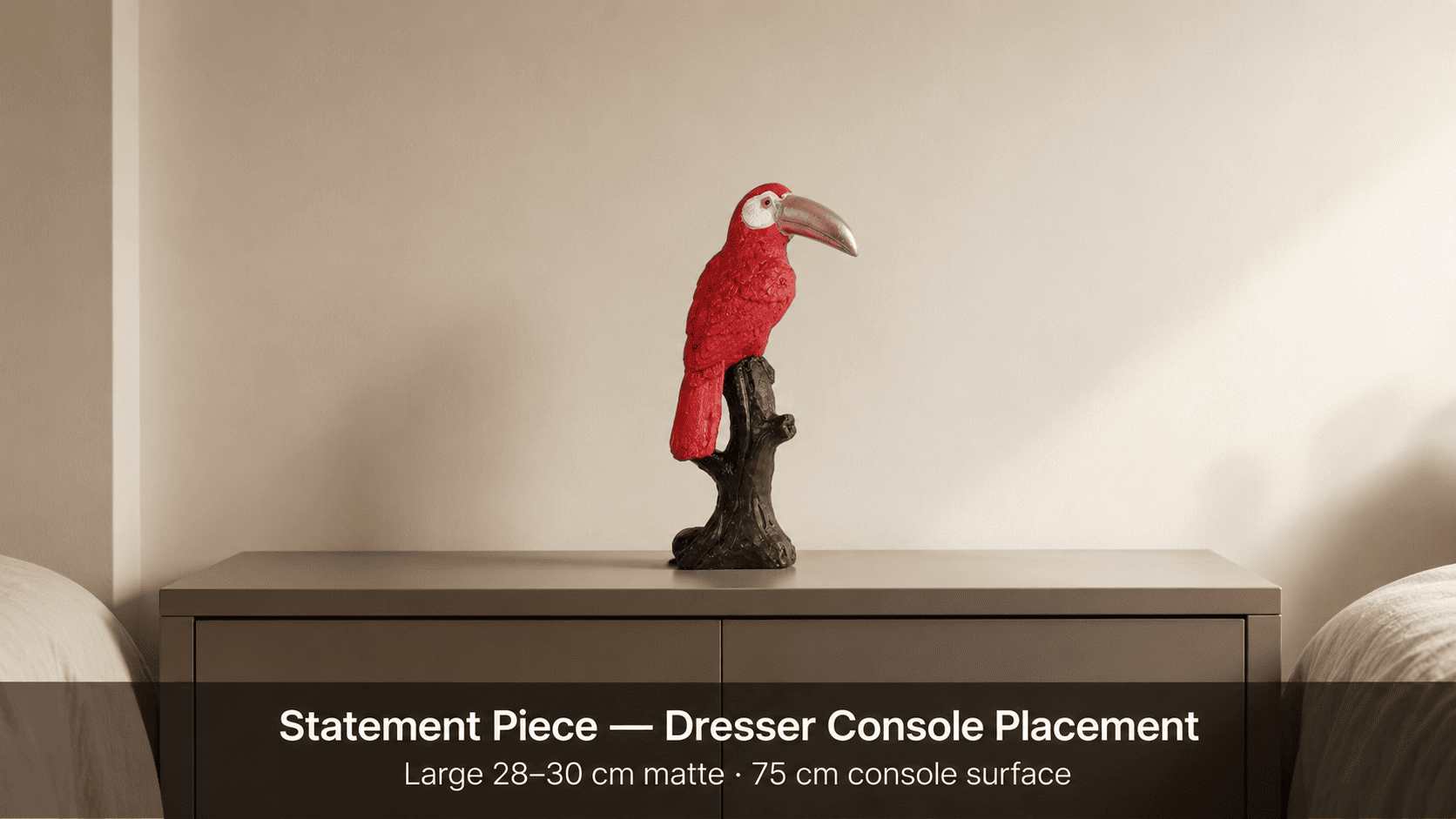
The practical rule for Indian apartments: one statement piece per zone, never two statement-weight objects at the same eye level in the same sightline. A large-format bedroom décor piece (25–34 cm) placed at dresser height — which sits below the direct bed-level sightline — can coexist with neutral-palette bedside pieces without creating competition because the two zones occupy separate visual registers. This zoning principle is why Moolwan's bedroom showpiece collection is categorised by surface placement first, not by style alone: the correct piece for a dresser console and the correct piece for a bedside table are rarely the same object, even in the same palette.
Ready to choose a piece engineered for Indian humidity and sized for your exact surface? Shop the full Moolwan bedroom décor collection now — manufacturer-direct, climate-rated, built for Indian homes.
How to Choose Between Calm and Statement if Your Bedroom Already Has Strong Elements
Most Indian urban bedrooms arrive with at least one strong pre-existing visual element that the homeowner cannot change: a dark-toned laminate wardrobe, a feature wall painted in a deep jewel tone by the builder, or a patterned bedsheet set that functions as a semi-permanent fixture. In these rooms, adding statement décor on top of a strong existing element does not double the visual impact — it creates competition that degrades both elements. The correct approach is to treat the pre-existing strong element as the room's statement allocation and select décor exclusively from the calm palette tier: matte finishes, warm earth or neutral tones, and sizes at the lower end of the recommended range for the surface in question.
Conversely, a bedroom with builder-white walls, a plain platform bed, and plain cotton bedding in off-white or greige is visually underloaded — the eye has no anchor and the room reads as unfinished rather than minimal. A single medium-to-large statement bedroom showpiece (21–28 cm) in a finish with textural contrast — a heavily matte ceramic with visible surface variation, or a resin piece in deep matte terracotta — provides the one focal anchor the room needs without overloading a space that is otherwise successfully calm.
The Role of Finish Texture in Palette and Statement Decisions
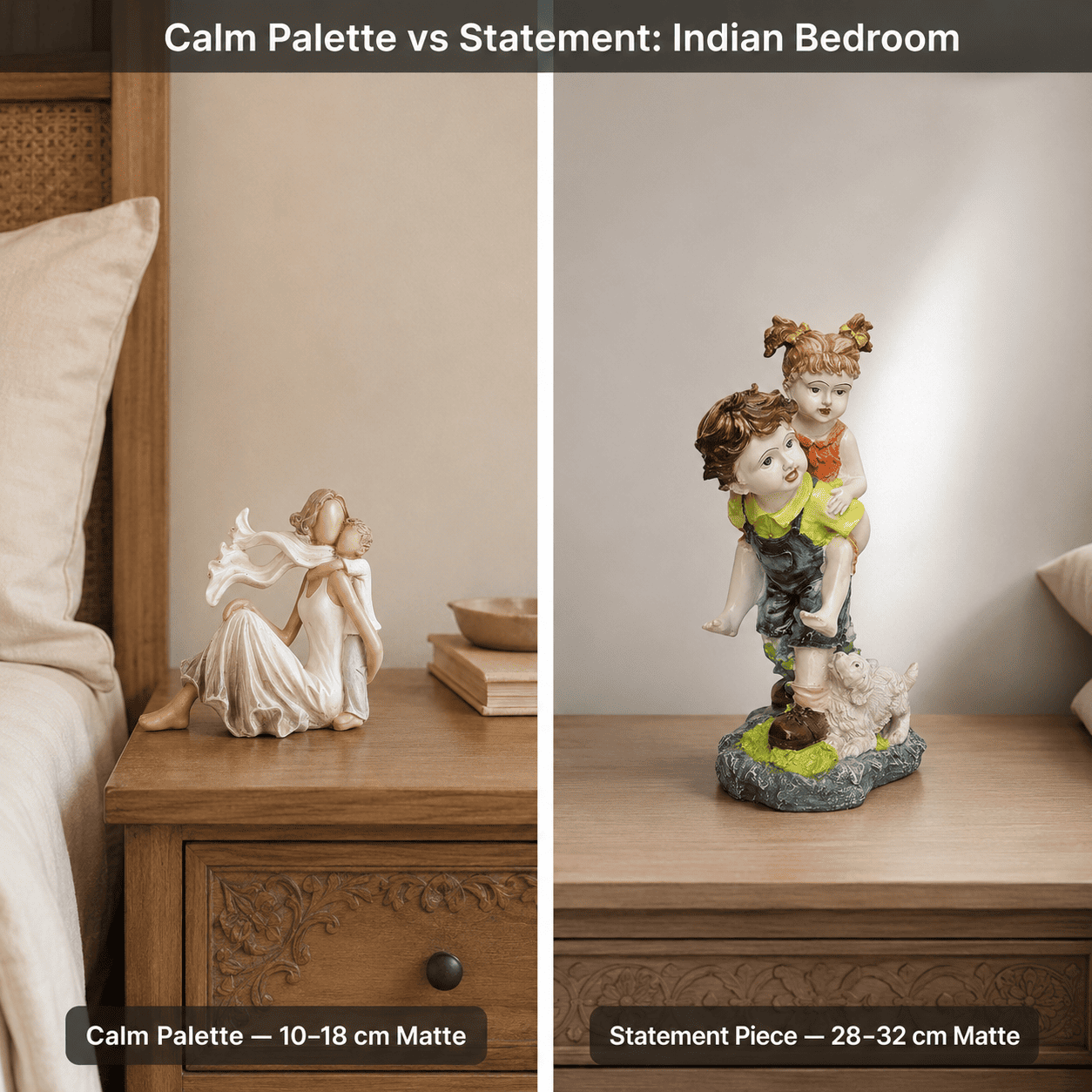
Finish texture is the variable that determines whether a calm-palette piece reads as intentional or forgettable, and whether a statement piece reads as confident or aggressive. In a calm palette, a matte finish with surface micro-texture — the kind produced by high-fired 92% clay ceramic — creates visual depth that keeps the eye interested without competing for dominance, because the texture adds a tactile dimension the eye perceives even without touching. A smooth, semi-glossy piece in the same calm tone reads as inert and forgettable because it contributes no surface information beyond its colour.
In a statement piece, the inverse applies: a heavily textured matte surface in a bold or contrasting tone registers as sculptural and considered, while a high-gloss statement piece in the same tone reads as decorative in the disposable sense — it attracts immediate attention but provides no sustained visual return because gloss finishes contain no surface variation for the eye to explore. This is why Moolwan's bedroom décor collection applies matte and textured finishes as the default across both calm and statement size categories: the durability argument (matte surfaces conceal 5-year micro-scratch accumulation) and the aesthetic argument (matte surfaces provide sustained visual interest) converge on the same finish specification.
Frequently Asked Questions
Is a calm palette always safer than statement décor for small Indian bedrooms?
Not automatically — a calm palette applied incorrectly (too many small pieces in similar tones with no clear anchor) produces visual flatness rather than calm. The safer default for Indian bedrooms under 120 sq ft is one calm-palette medium piece (16–21 cm) on the bedside surface and one calm-palette small piece (10–16 cm) on a shelf or dresser, leaving at least 60% of each surface clear. Moolwan's bedroom collection is organised by surface placement to make this selection systematic rather than intuitive. The calm palette works because muted tones reduce the number of competing focal points the eye must resolve in a compact space.
Can I use a statement piece in a bedroom that already has a dark wardrobe or feature wall?
No — a pre-existing dark wardrobe or a feature wall painted in a deep jewel tone already occupies the room's statement allocation within the 60/40 Bedroom Dominance Rule. Adding a statement décor piece on top creates competing focal points at different heights, which the eye resolves by oscillating between them — producing visual fatigue rather than the settled quality a bedroom requires. The correct approach in these rooms is to select exclusively calm-palette bedroom décor pieces, sized at the smaller end of the recommended range for each surface.
Which material — ceramic or resin — is better for a bedroom with a running AC?
Both perform well in AC-controlled Indian bedrooms, with one distinction: rooms that also receive monsoon humidity ingress through windows or balcony doors require ceramic (85% RH tolerance) rather than resin (60% RH tolerance), because the AC cycle does not fully control humidity during peak monsoon infiltration. For fully sealed, AC-only bedrooms in metro apartment buildings, 94% purity resin pieces perform reliably across the 15–35°C temperature range and 3H pencil-hardness surface durability. For cross-ventilated bedrooms or those with a balcony-facing window, ceramic is the lower-risk long-term choice.
How many décor pieces should a typical Indian bedroom have?
For bedrooms under 150 sq ft, the functional maximum is three to four pieces total across all surfaces — two on bedside surfaces (one per side), one on the dresser console, and optionally one on a floating shelf above the dresser. Beyond four pieces in a compact Indian bedroom, the visual field becomes loaded enough that calm-palette pieces begin to read as clutter rather than as an intentional composition. Each surface should follow the 60/40 Bedroom Dominance Rule: 60% of the surface area left clear, décor clustered within the remaining 40%.
Investing in bedroom décor that is climate-rated for Indian humidity and correctly scaled for Indian room footprints prevents the need for replacement within two to three monsoon seasons — which is the true cost comparison against cheaper, untreated pieces. Bring home a curated piece from the Moolwan bedroom décor collection — manufacturer-direct pricing, 85% RH ceramic and 60% RH resin options, sized specifically for Indian apartment layouts. If you're also considering marble-finish accents, browse the Moolwan marble-finish bedroom showpiece collection for pieces that bring the weight and texture of stone finishes at a direct-to-consumer price point. For a broader view of what works across every bedroom surface, explore the complete Moolwan decorative items for bedroom range — curated by placement, palette, and Indian climate performance.


