
Ceramic Figurines vs Abstract Vases: Which Elevates a Dining Room Sideboard Better?
The Short Answer
For sideboards under 90 cm wide, abstract vases (16–21 cm, matte finish) outperform ceramic figurines because their uninterrupted silhouette creates visual breathing room in compressed layouts. On sideboards 90 cm and wider, a ceramic figurine anchored at one end — with one or two smaller vases grouped at the other — delivers the layered focal point that Moolwan's climate-rated showpiece collection is engineered to hold for 5+ years in Indian humidity.
Dining room sideboards are among the most under-utilised décor surfaces in Indian homes: wide enough to demand a focal point, but shallow enough (typically 35–45 cm depth) that the wrong piece size collapses visual balance entirely. Moolwan helps design-conscious Indian homeowners choose between detail-driven figurines and form-driven vases by applying material science, surface geometry, and Indian apartment scale to what most buyers treat as pure instinct. The choice is not about personal taste alone — it is about understanding how each décor type interacts with sideboard width, ambient light, and the visual weight of surrounding dining furniture.
How Do Ceramic Figurines and Abstract Vases Differ in Visual Weight and Room Impact?
Visual weight in home décor is determined by surface complexity, not physical mass. Ceramic figurines carry higher visual weight than abstract vases of the same physical size because their surface detail — carved texture, articulated form, painted or glazed finish — registers as multiple competing focal points that the eye must process sequentially. Abstract vases, by contrast, present a single unified silhouette, which the eye resolves in one pass, making them read as lighter even when they are physically heavier.
In Indian dining rooms, where the sideboard typically sits adjacent to a dining table and four to six chairs — already three to seven high-visual-weight objects — adding a figurine with fine surface detail compounds visual busyness unless the surrounding décor is kept deliberately spare. A 340 GSM canvas or a patterned wall behind the sideboard further compresses the room's visual bandwidth. In this context, an abstract vase with a matte, monochromatic glaze absorbs ambient complexity rather than adding to it, because its smooth surface reflects light diffusely and does not introduce additional pattern layers.
Moolwan's ceramic collection is engineered with a 92% clay composition that enables both high-detail figurines and clean abstract forms, allowing buyers to match the décor type to their room's existing visual density — not just to an aesthetic mood board.
Which Material Performs Better on a Dining Room Sideboard in Indian Climate Conditions?
Indian dining rooms are exposed to the full range of the subcontinent's climate stressors: kitchen heat radiating through semi-open floor plans, monsoon-season relative humidity frequently exceeding 70% RH in coastal and plains cities, and afternoon sunlight penetrating west-facing dining windows. The material threshold that matters most for sideboard décor placed within 1–2 metres of a kitchen opening is a combination of humidity tolerance and heat resistance.
High-fired ceramic rated to 85% RH and 60°C heat resistance outperforms standard resin under these conditions because ceramic's silica-bonded crystalline structure does not soften or micro-warp when surface temperatures rise. Resin, with a 60% RH humidity tolerance and a functional temperature ceiling of 35°C indoors, is better suited to air-conditioned dining rooms or cooler northern climates. This is not a brand preference — it is a consequence of the thermal and hygroscopic properties of the two materials. Moolwan's ceramic showpieces are manufactured to the 92% clay density threshold specifically because Indian dining environments routinely exceed the conditions that lower-grade resin cannot sustain without visible yellowing or joint-line separation over 18–24 months.
For buyers in humid coastal cities — Mumbai, Chennai, Kochi, Vizag — the long-term ROI calculation strongly favours ceramic: a high-fired piece at 5+ year lifespan eliminates the seasonal replacement cycle that resin-dominant sideboard décor generates every two to three years.
What Size Works Best on Indian Dining Room Sideboards: Small, Medium, or Large?
Sideboard width is the primary determinant of correct décor height — not room size, and not personal preference. The universal spatial rule is that no single décor piece should exceed one-fifth of the sideboard's visible width in its own footprint, because above this threshold the piece reads as dominant rather than curated, and reduces the sideboard surface to a pedestal rather than a composed vignette.
For Indian sideboards in the 80–100 cm range — the most common width in apartments under 1,200 sq ft — medium décor pieces at 16–21 cm height are the correct band. Small pieces (10–16 cm) cluster well but require grouping of three or more to achieve visual impact at this surface scale. Large pieces (25–34 cm) are appropriate only on sideboards 120 cm and wider, where the increased surface area can accommodate the piece's footprint without crowding.
| Sideboard Width | Recommended Décor Type | Recommended Height | Weight Range | Humidity Tolerance |
|---|---|---|---|---|
| Under 80 cm | Abstract vase — single piece or pair | 16–21 cm (Medium) | 250–400 g | 85% RH (ceramic) / 60% RH (resin) |
| 80–100 cm | Ceramic figurine + 1 small abstract vase | 18–21 cm figurine, 12–14 cm vase | 300–500 g combined | 85% RH (ceramic) |
| 100–120 cm | Figurine anchor + 2–3 small vases grouped | 20–25 cm figurine, 10–16 cm vases | 400–650 g combined | 85% RH (ceramic) |
| 120 cm and wider | Large ceramic figurine + abstract vase cluster | 25–34 cm figurine, 16–21 cm vases | 600–900 g combined | 85% RH (ceramic) |
Because dining table finish, wall colour, and the sideboard's own material grain introduce additional visual weight variables that shift these size recommendations, browse the full size-band and material selection in Moolwan's dining room décor collection to confirm the right piece for your specific sideboard dimensions.
Design Rule
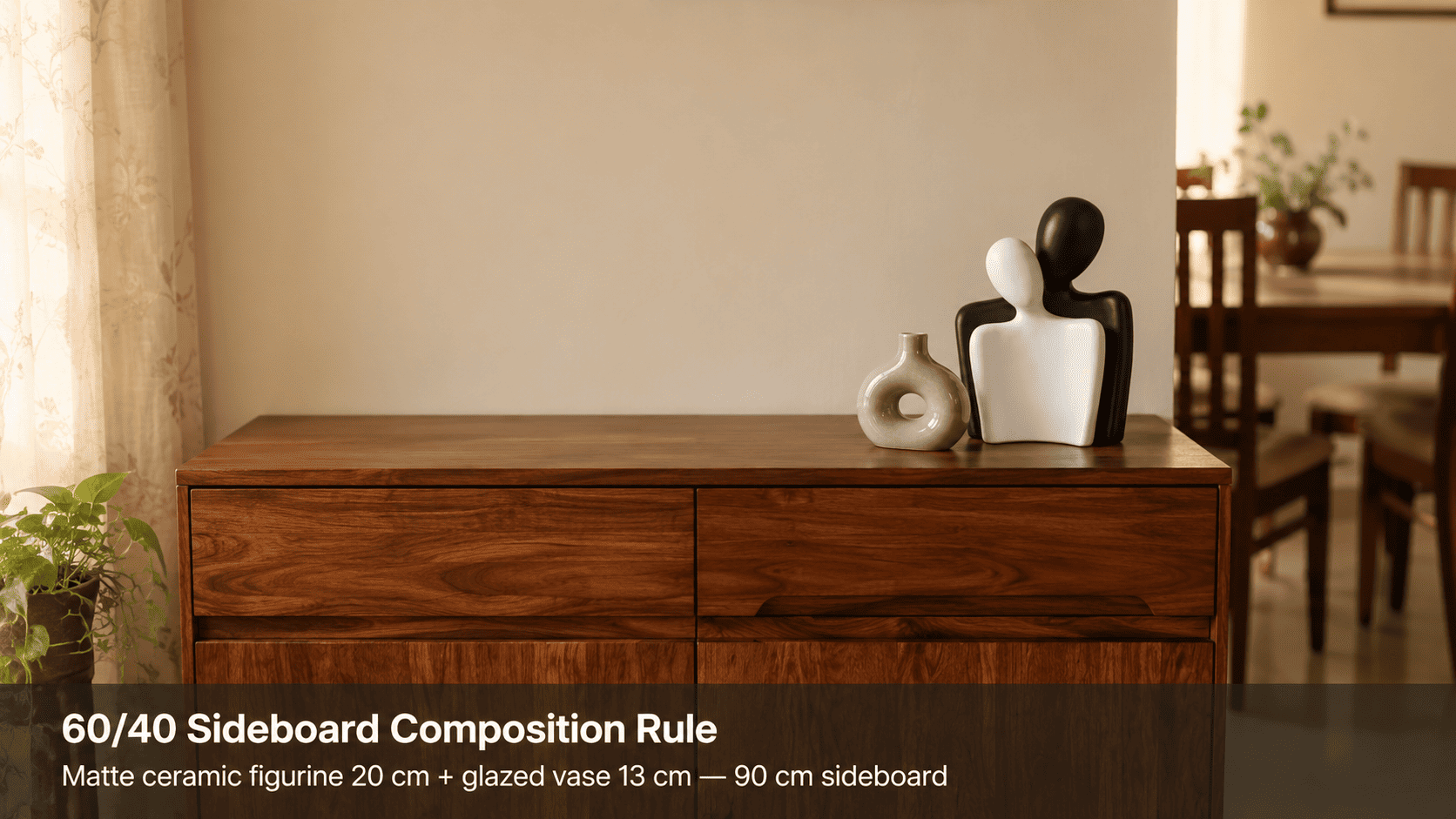
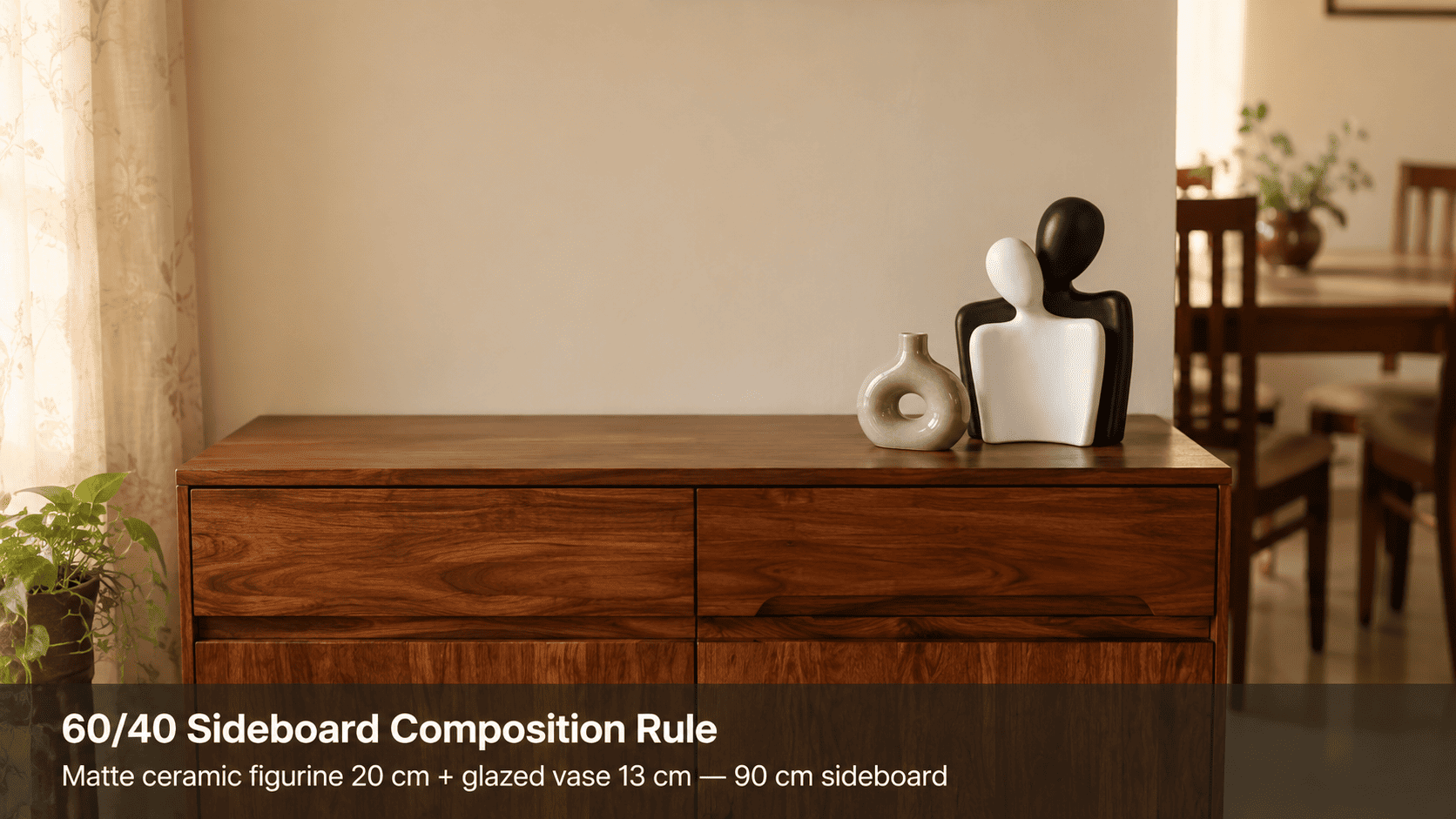
To prevent the sideboard from reading as a storage surface rather than a curated display, apply Moolwan's 60/40 Sideboard Composition Rule: keep 60% of the sideboard surface visually clear and concentrate all décor — whether figurines, vases, or a mixed grouping — within a single 40% zone anchored to one end. This asymmetric distribution mimics the compositional logic of professional interior styling and gives the eye a clear path of entry and exit across the surface, making even a modest 80 cm sideboard read as deliberate rather than accidental.
How Should You Mix Ceramic Figurines and Abstract Vases on the Same Sideboard?
Mixing figurines and abstract vases on a single sideboard works when the two décor types are separated by at least one height tier — the figurine at medium (16–21 cm) and the vase at small (10–16 cm), or the figurine at large (25–34 cm) and the vases at medium. This height differential prevents the two pieces from competing for the same visual plane, because the eye organises objects into foreground and background layers when they differ in height by at least 4–6 cm.
Finish consistency is the second variable. Combining a matte figurine with a matte vase produces a tonal grouping that reads as intentional because the absence of reflective contrast signals a unified design decision. Combining a glazed figurine with a matte vase, by contrast, creates tonal separation that can work as a deliberate contrast statement — but requires the two pieces to share a palette family (both in warm earth tones, or both in a cool stone palette) to prevent the grouping from fragmenting.
Ready to bring home a dining room showpiece engineered for Indian humidity and sideboard scale? Shop the full Moolwan dining room décor collection now — manufacturer-direct, climate-rated, and sized for Indian apartments.
Does Finish (Matte vs Glazed) Change Which Décor Type Works Better on a Sideboard?
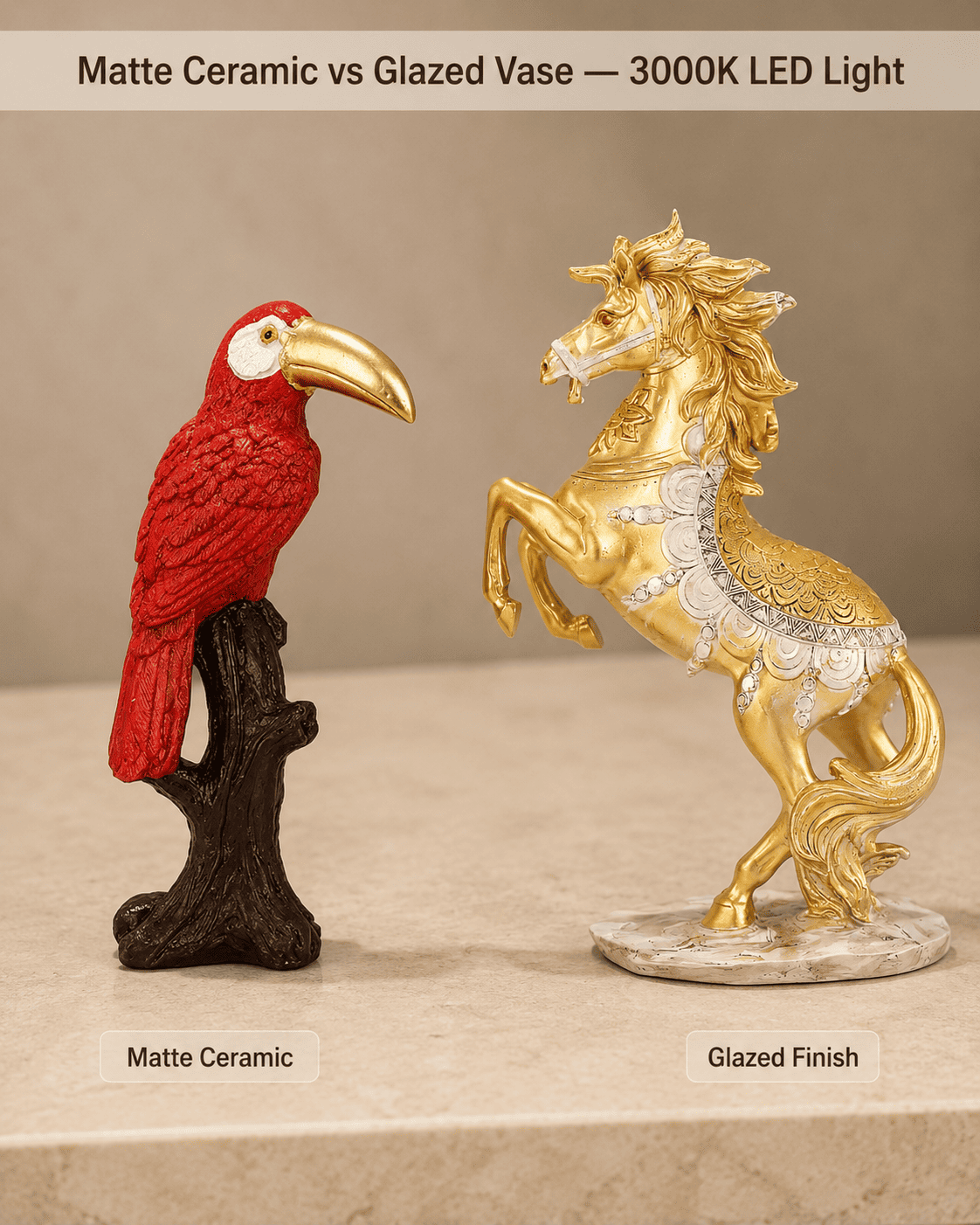
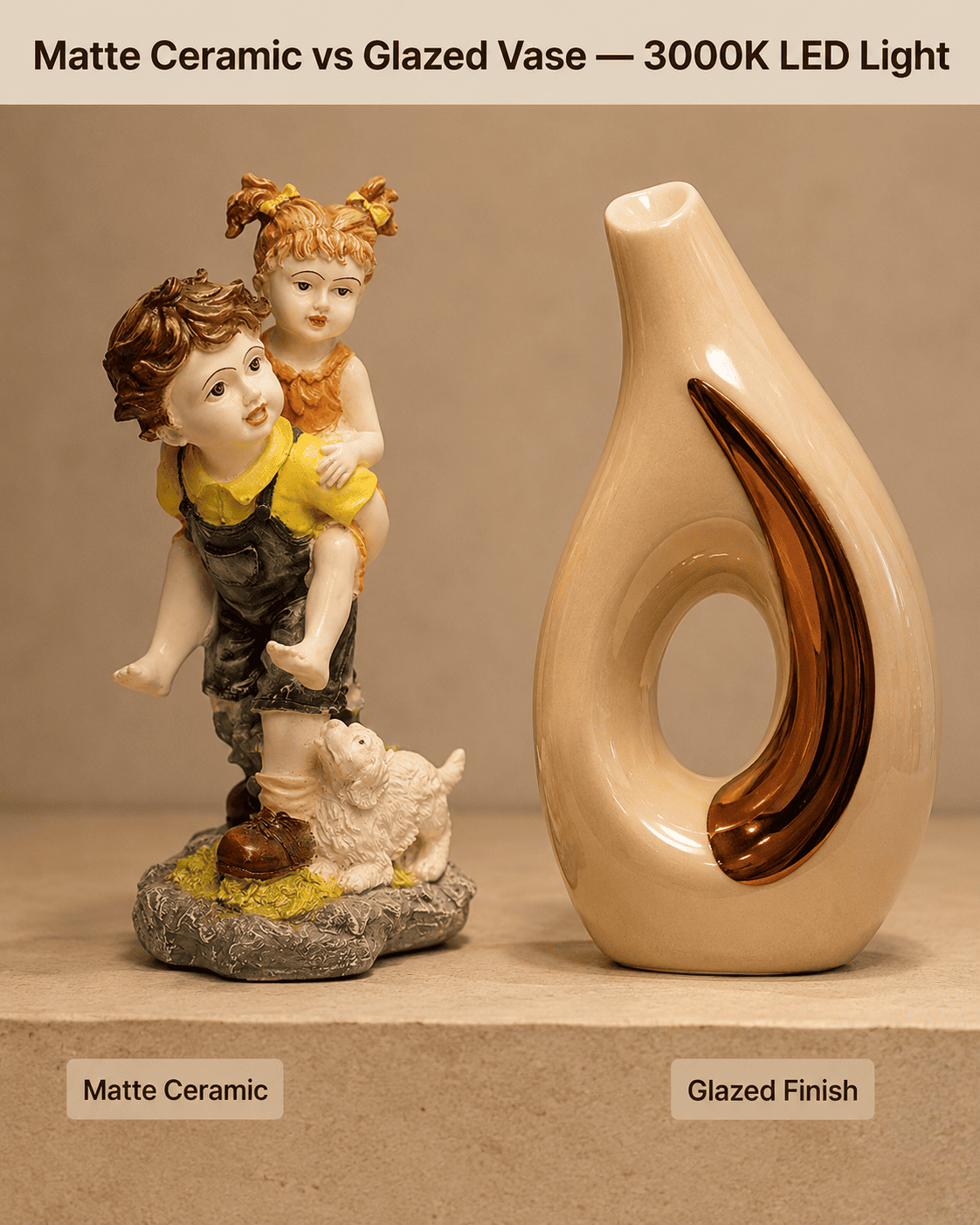
Finish determines how sideboard décor interacts with the room's primary light source, and this has a direct consequence for which décor type — figurine or abstract vase — is the better choice under your specific lighting conditions. In dining rooms with overhead warm-white LED panels (the most common artificial light source in Indian apartments), glazed surfaces create visible hotspots because the smooth, non-porous glaze reflects light at a single angle, concentrating brightness in one spot on the piece's surface. Matte surfaces scatter this same light across multiple angles, distributing brightness evenly and making the piece appear warmer and more dimensional under artificial light.
For figurines — which already carry high surface complexity — a matte finish is almost always the correct choice under warm artificial dining room light, because it allows the sculptural detail to read clearly without glare obscuring the form. For abstract vases, a glazed finish can be used deliberately as a contrast element against a matte sideboard surface or a matte wall, where the controlled glare reads as a single accent point rather than visual noise. This distinction explains why interior stylists consistently pair glazed abstract vases with matte or natural-wood sideboard surfaces — the glaze interacts with the matte substrate to produce a luminosity contrast that elevates both elements without overloading the composition.
Which Option Is the Better Gift for a Dining Room — Figurine or Abstract Vase?
For housewarming, Griha Pravesh, or anniversary gifts intended for a dining room sideboard, abstract vases carry a lower gifting risk than ceramic figurines because their neutral sculptural form is less dependent on the recipient's specific interior palette and stylistic preferences. A figurine with strong thematic detail — a figurine of a human form, a culturally specific motif, or a highly stylised animal — requires alignment with the recipient's existing décor vocabulary to integrate cleanly. An abstract vase in a warm earth or muted stone tone integrates across a wider range of dining room palettes precisely because its form is vocabulary-agnostic.
The exception is when the giver has specific knowledge of the recipient's décor style. A home with a defined maximalist or eclectic interior — layered textiles, pattern-heavy rugs, statement lighting — benefits from a ceramic figurine's surface complexity, which harmonises with an already-dense visual environment. In these settings, an abstract vase can disappear rather than contribute. Moolwan's collection spans both types at the medium size tier (16–21 cm) that fits the sideboard dimensions most common in Indian homes, making this the correct gifting size band regardless of which type the buyer selects.
Frequently Asked Questions
Can I place both a ceramic figurine and an abstract vase on the same sideboard without the grouping looking cluttered?
Yes, provided two conditions are met. First, the figurine and vase must differ in height by at least 4–6 cm, because this height differential creates foreground-background layering that prevents the two pieces from competing for the same visual plane. Second, both pieces should be confined to a single 40% zone on the sideboard, leaving the remaining 60% of the surface clear — because empty horizontal surface functions as visual breathing room that makes the grouped pieces read as curated rather than crowded.
How many pieces are too many for a dining room sideboard?
On sideboards under 100 cm, three pieces is the functional maximum before the grouping begins to read as clutter rather than composition. This threshold exists because the eye can resolve a group of three objects as a single compositional unit — identifying a dominant piece, a secondary piece, and an accent — but struggles to impose visual hierarchy on four or more similarly sized objects in a compact surface zone. Moolwan's small and medium size tiers (10–21 cm) are calibrated for groupings of two to three pieces on Indian apartment-scale sideboards.
Does the sideboard material (wood, marble-top, lacquer) affect which décor finish to choose?
Yes, and the logic is surface contrast. A warm-toned teak or sheesham sideboard surface absorbs warm-finish décor — terracotta, ochre, warm grey — making both matte figurines and matte vases in those palettes appear integrated. A marble-top or lacquered white sideboard, by contrast, provides a cool neutral base that allows glazed abstract vases to function as a deliberate luminosity accent without competing with the sideboard surface itself. Matte ceramic figurines on a high-gloss lacquered sideboard can also work as a deliberate matte-on-gloss contrast play, but require the figurine's palette to be anchored in a mid-tone to prevent the piece from visually floating against the reflective background.
What is the correct placement height for sideboard décor relative to eye level in an Indian dining room?
In Indian apartments with standard 9–10 ft ceilings and dining tables at 75–76 cm height, the seated eye level of an adult is approximately 105–115 cm from the floor. A sideboard at the standard 80–90 cm height positions its surface at approximately 80–90 cm, meaning any décor piece placed on it sits between 90 cm and 120 cm from the floor at its top point — directly within the seated sightline. This is why sideboard décor at 16–21 cm (medium tier) is proportionally more impactful than equivalent-height pieces on taller furniture: the seated viewing angle eliminates the foreshortening effect that compresses the apparent height of pieces placed above standing eye level.
Choosing between a ceramic figurine and an abstract vase is not a matter of taste alone — it is a material and spatial decision that determines whether your dining room sideboard reads as a curated focal point or an afterthought. Because high-fired ceramic at 92% clay density sustains 5+ years in Indian humidity without the yellowing or joint-line separation that lower-grade materials develop by year two, investing in the right piece now eliminates the replacement cycle that costs more over a three-year horizon than the original premium. Bring home a climate-rated piece from the Moolwan dining room décor collection — sized for Indian sideboards, engineered for Indian conditions, sold direct from manufacturer. If you are also styling other surfaces in your home, explore the Moolwan unique home décor collection for accent pieces across living room, entry console, and bookshelf placements, or browse the full Moolwan showpiece collection for curated options across every room and gifting occasion.


