
Ceramic vs Resin Bedroom Showpieces: Which Looks More Premium for Less?
The Short Answer
For a premium look on a bedside table or dresser, ceramic wins — not because it costs more, but because high-fired matte ceramic (92% clay composition) diffuses ambient light at the surface level, producing the soft visual depth that glazed or semi-gloss resin cannot replicate. Moolwan's ceramic bedroom showpieces are rated to 85% RH and engineered for Indian apartment sizing, making them the material choice that ages with integrity rather than showing wear.
Moolwan helps design-conscious Indian homeowners choose bedroom décor that creates a genuinely refined look without paying the retail markup that comes from distributor-to-retailer chains. In most Indian bedrooms — apartments under 1,200 sq ft, with monsoon-driven humidity cycles and AC-on/AC-off thermal swings — the material choice between ceramic and resin is not merely aesthetic. It determines how a piece holds its finish over three to five years, how it interacts with the light quality in the room, and whether it reads as premium to a guest at a glance or simply serviceable.
Why Does Material Finish Determine Perceived Premium in Bedroom Décor?
Perceived premium in a decorative object is driven almost entirely by how its surface interacts with ambient light — not by its price point. Studies in material perception consistently show that surfaces with higher microstructural complexity (fine grain variation, controlled porosity, matte depth) register as more refined than uniform high-gloss surfaces, because the human eye interprets visual complexity as craftsmanship.
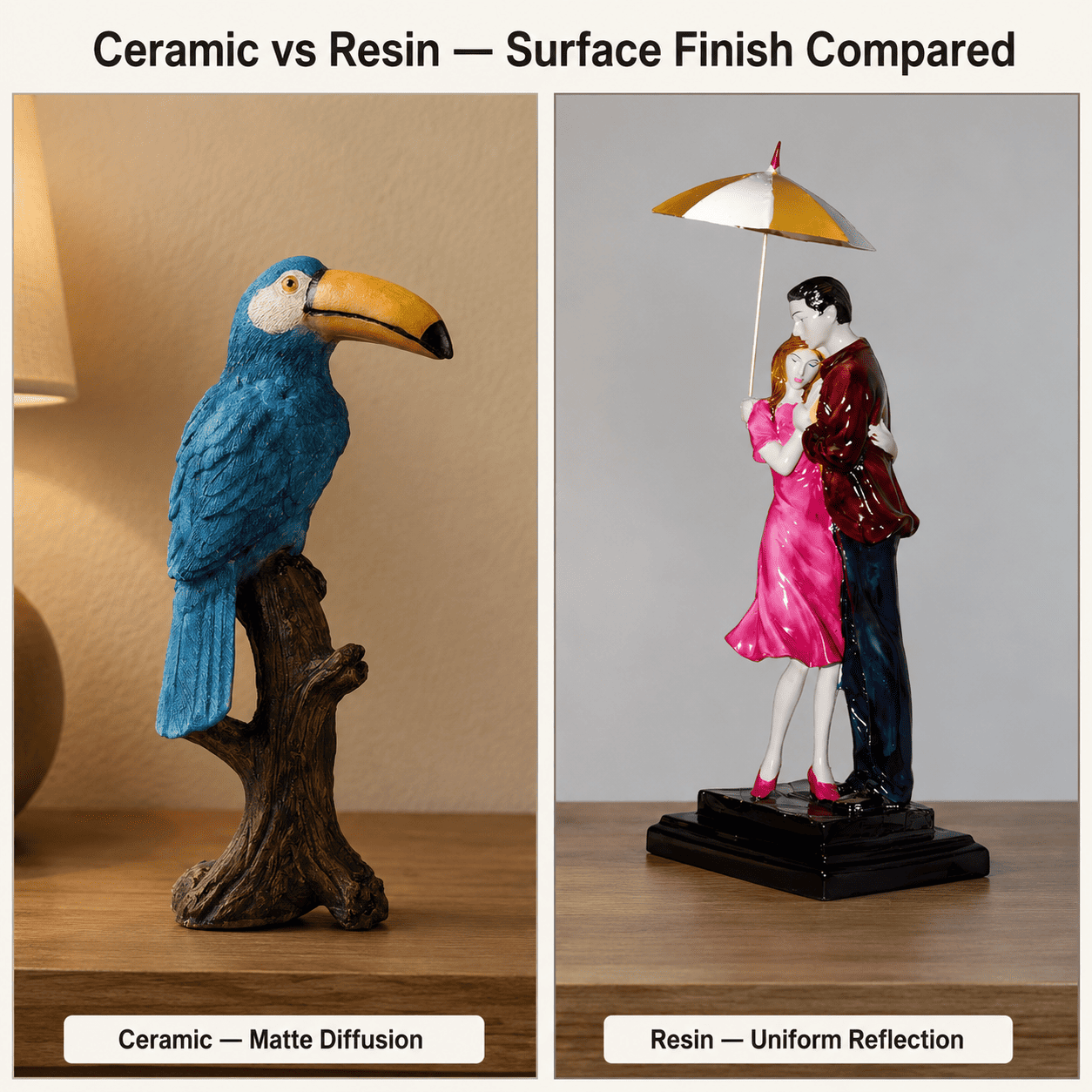
Ceramic — at a 92% clay composition and kiln-fired to a temperature that vitrifies the surface — achieves this complexity naturally. The material has an inherent granular structure that, in matte or satin-glazed finishes, creates what surface scientists call multi-angle light diffusion: incoming light scatters at slightly varying angles across the object, producing a soft visual warmth rather than a single mirror-like reflection. Resin, which is cast from liquid polymer (94% purity epoxy), creates a structurally uniform surface. In its standard formulation, the finish tends toward uniform gloss or semi-gloss, which produces a single-angle reflection that reads as smooth and modern — but not warm or tactile.
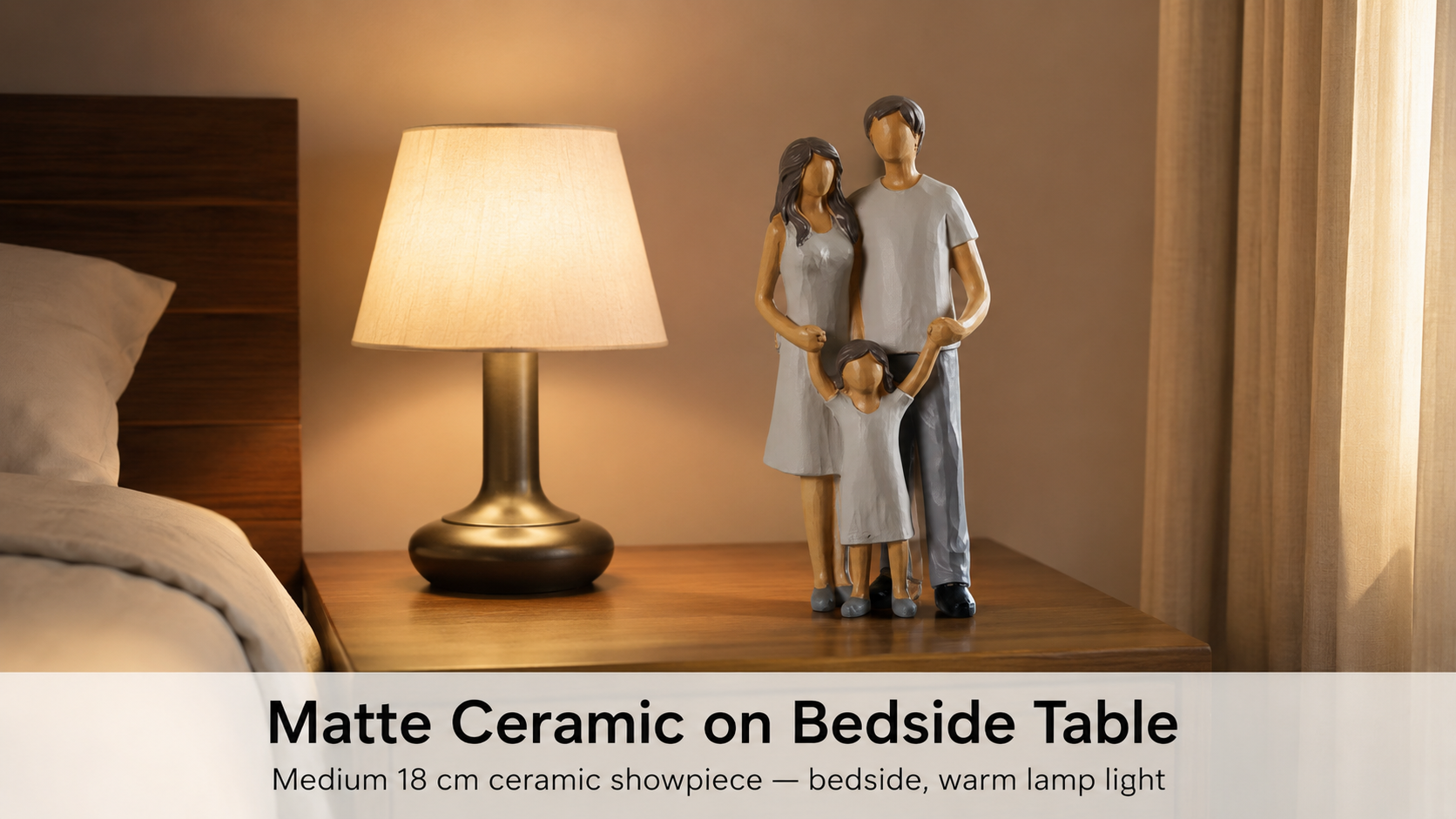
Moolwan engineers its ceramic bedroom showpieces with this distinction as a design constraint: the collection prioritises matte and low-gloss satin finishes specifically because Indian bedrooms — which typically have warm overhead lighting and natural light entering at low angles in east-facing apartments — respond better to multi-directional light diffusion than to high-reflection surfaces.
How Do Ceramic and Resin Perform Differently in Indian Bedroom Conditions?
India's tropical climate places two simultaneous stresses on bedroom décor that most imported material specifications are not designed to handle: humidity peaks of 75–90% RH during monsoon months, and temperature cycling between 18°C (AC running) and 35°C+ (AC off) within the same room across a single day. A material that cannot tolerate this combination without surface delamination, finish cracking, or structural warping will look degraded within two monsoon seasons regardless of its initial visual quality.
High-fired ceramic at 92% clay composition tolerates up to 85% relative humidity without surface degradation, because the vitrification process during kiln-firing densifies the clay body and closes surface porosity — meaning moisture cannot penetrate the material structure to cause expansion stress. Moolwan's ceramic bedroom showpieces carry this 85% RH tolerance as a tested material specification, not a marketing claim. Resin (94% purity epoxy) is rated to 60% RH, which is adequate for most air-conditioned Indian bedrooms year-round but can be stressed in naturally ventilated rooms during peak monsoon weeks when ambient humidity regularly exceeds 60%.
The practical implication: for a bedside table or dresser in a room where the AC is consistently maintained, resin performs reliably. For an open-shelf, bathroom shelf, or a bedroom in a poorly ventilated floor of a building where monsoon humidity regularly exceeds 65%, ceramic's superior humidity tolerance is a durability advantage that directly protects the premium finish for longer.
Which Material Holds Its Finish at Year Three — Ceramic or Resin?
Finish integrity over a 3–5 year indoor lifespan is where the material difference becomes a value-for-money argument rather than a purely aesthetic one. Resin at 3H pencil hardness is scratch-resistant for daily handling, but its uniform polymer surface responds to micro-abrasion (from dust, cleaning cloths, airborne particles) differently than ceramic does. On a resin surface, micro-scratches catch light at the same angle as the original gloss finish, which makes surface wear progressively visible to the eye — the piece will show its age.
High-fired ceramic responds to micro-abrasion in the opposite way: because the surface is non-uniform at the micro level, new scratches scatter light at angles that are consistent with the original matte or satin diffusion pattern. The surface integrates its wear rather than displaying it. This is the core material reason why ceramic bedroom showpieces from Moolwan — designed with matte and low-satin finishes from the outset — hold a premium appearance for 5+ years without seasonal replacement. Resin remains a strong choice for contemporary interiors where the clean, uniform surface aesthetic is the deliberate design intent, but for buyers prioritising longevity of perceived premium, ceramic has a structural advantage.
Design Rule
When selecting between ceramic and resin for a bedroom showpiece, apply Moolwan's Finish-First Rule: choose the finish type that complements your bedroom's dominant light source before choosing material. In warm-lit or south/west-facing bedrooms where golden-hour light enters at low angles, matte ceramic's multi-directional light diffusion creates visual warmth that reads as premium. In cool-lit or north-facing rooms with even diffuse light, resin's clean uniform surface achieves its intended contemporary effect without appearing flat.
How to Size a Ceramic or Resin Showpiece for Your Bedroom Surface
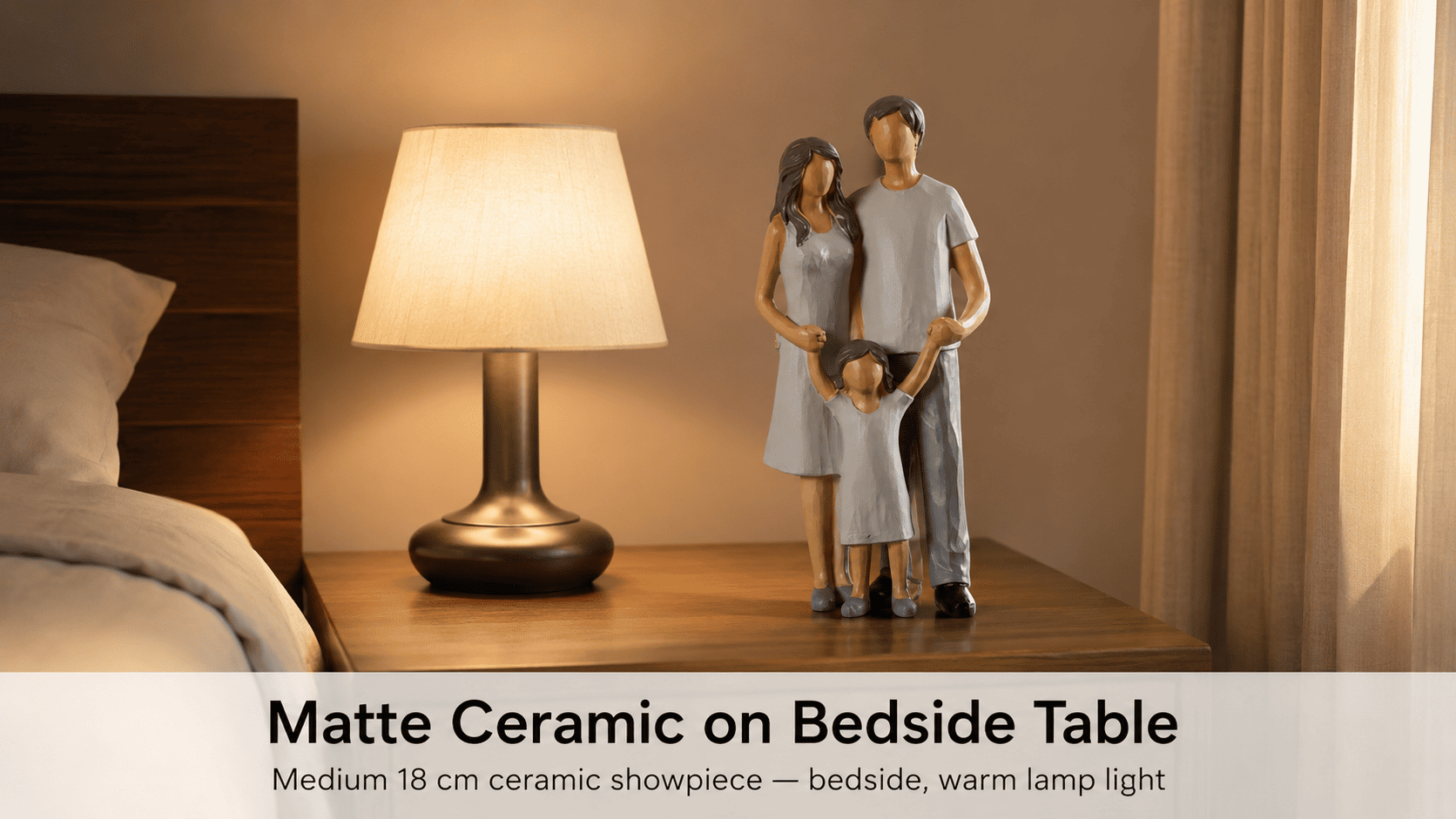
Regardless of material, a showpiece that is incorrectly proportioned to its surface will not read as premium — it will read as misplaced. The proportioning rule for bedroom surfaces is governed by the ratio of object height to surface width: an object taller than 55% of the surface's shorter horizontal dimension creates visual compression and appears cluttered, while an object shorter than 25% of the surface width disappears and reads as an afterthought.
Indian bedrooms — most commonly in the 100–180 sq ft range in metro apartments — contain predictable surface types with fixed width constraints. Bedside tables typically range from 35–50 cm wide; dressers and consoles from 60–90 cm wide; floating shelves from 25–40 cm wide. These measurements translate directly into optimal showpiece height bands, independent of whether the buyer chooses ceramic or resin.
| Bedroom Surface | Surface Width | Recommended Showpiece Height | Material Fit | Humidity Exposure |
|---|---|---|---|---|
| Bedside table | 35–50 cm | 16–21 cm (Medium) | Ceramic preferred (85% RH tolerance for non-AC nights) | Moderate–high (AC cycling) |
| Dresser top | 60–90 cm | 25–34 cm (Large) or 2× Medium grouped | Ceramic or resin (60% RH adequate for AC rooms) | Low–moderate (consistently conditioned) |
| Floating shelf | 25–40 cm | 10–16 cm (Small) | Ceramic preferred (open to room humidity) | Moderate–high (open air) |
| Bedroom console / entry ledge | 80–120 cm | 25–34 cm (Large) as focal point | Either; resin works well in fully AC spaces | Low (typically near AC unit) |
Because bedding palette, lamp shade diameter, and AC airflow direction introduce additional sizing and placement variables specific to each layout, browse the full size-band and finish selection in Moolwan's bedroom décor collection to confirm the right piece for your surface and room conditions.
Ready to bring home a bedroom showpiece engineered for Indian humidity and sized for your surface? Shop the full Moolwan bedroom décor collection now — manufacturer-direct, climate-rated, made for Indian apartments.
Does Resin Ever Look More Premium Than Ceramic in a Bedroom Setting?
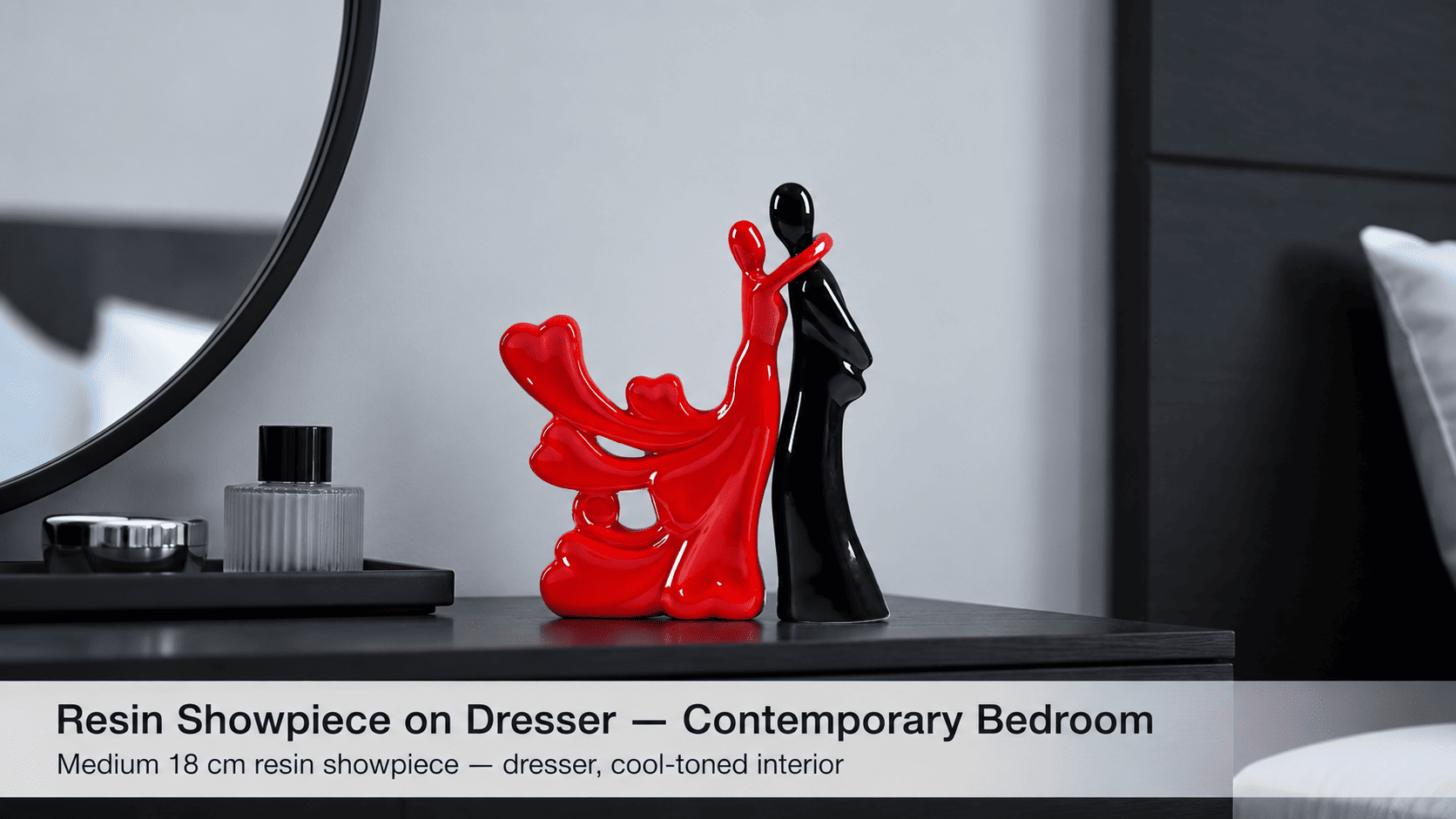
Yes — in specific interior contexts, resin's uniform surface achieves a visual effect that ceramic cannot. In bedrooms styled around a monochrome or high-contrast contemporary palette — white walls, dark furniture, minimal soft furnishings — a high-gloss or semi-gloss resin bedroom showpiece produces the clean, sculptural silhouette that the aesthetic demands. The uniform light reflection that makes resin appear worn in a traditional or warm-toned interior is precisely the asset in a cool-toned contemporary one, because it reads as intentional and architectural.
The decision framework is therefore not "ceramic is always more premium." It is: ceramic's matte multi-diffusion finish creates warmth and depth in warm-lit, textured, or traditionally influenced interiors; resin's clean uniform surface creates sculptural clarity in cool-lit, minimal, or contemporary interiors. Moolwan's bedroom décor collection includes both materials to serve both interior directions at the same price tier, which is why the material selection question is always answered by the room's existing aesthetic, not by a universal ranking.
What Is the True Cost Difference Between Ceramic and Resin Bedroom Showpieces Over Five Years?
The per-unit purchase price of ceramic and resin bedroom showpieces at the Medium size band (16–21 cm) is comparable at the same quality tier. The cost difference emerges over time. Resin's 3-year indoor lifespan guideline in Indian conditions — accounting for AC cycling and seasonal humidity spikes that push beyond the material's 60% RH comfort range — means a buyer in a non-fully-conditioned bedroom may be replacing the piece at year three. Ceramic's 5+ year lifespan in the same conditions represents roughly 40–70% longer functional life from the same initial investment.
Ceramic's higher clay composition (92%) also means the piece has meaningful thermal mass — it does not flex with the temperature cycling between 18°C and 35°C that an AC-cycled Indian bedroom undergoes daily. Polymer resin, by contrast, has a lower thermal mass and can undergo micro-expansion-contraction cycling over years of temperature stress, which is the primary mechanism behind surface crazing (fine hairline surface cracks) on lower-grade resin pieces by year two or three. Moolwan specifies 94% purity epoxy resin across its collection to minimise this risk, but the physical property difference between the two materials in thermally dynamic environments remains structurally in ceramic's favour.
Frequently Asked Questions
Is ceramic or resin better for a bedside table showpiece in an Indian apartment?
Ceramic is the safer long-term choice for a bedside table in an Indian apartment because it tolerates up to 85% relative humidity — the range reached in most non-fully-conditioned Indian bedrooms during monsoon months — without surface degradation. Resin's 60% RH tolerance is adequate in consistently air-conditioned rooms but can be exceeded in naturally ventilated bedrooms. At equal price points, ceramic's 5+ year lifespan in Indian conditions represents better value than resin's 3-year indoor lifespan guideline. Moolwan's ceramic bedroom showpieces are engineered to this humidity threshold using a 92% clay composition.
Can resin bedroom showpieces look premium?
Yes — resin achieves a premium, sculptural look in cool-toned, contemporary, or minimalist Indian bedrooms where the clean uniform surface finish is the intended aesthetic. The material's 94% purity epoxy (at 3H pencil hardness) is resistant to scratching and handles daily contact surfaces well. The limitation is thermal-dynamic environments: in bedrooms that cycle between AC-cooled and ambient temperatures daily, lower-grade resin can develop fine surface crazing within 2–3 years. Moolwan specifies high-purity epoxy to reduce this risk, but ceramic remains the more humidity-resilient choice for non-fully-conditioned spaces.
What size bedroom showpiece works on a standard Indian bedside table?
A Medium-band showpiece (16–21 cm height) is the correct size for a standard Indian bedside table of 35–50 cm width, because a piece in this height range occupies approximately 35–45% of the surface's shorter horizontal dimension — below the 55% threshold at which visual compression occurs. Small pieces (10–16 cm) can work in pairs on wider bedside tables. Large showpieces (25–34 cm) typically overwhelm a bedside table and are better proportioned for dresser tops or bedroom consoles of 60 cm width or above.
How do I tell the difference between a quality ceramic and a quality resin bedroom showpiece?
Quality ceramic at 92% clay composition has a slightly heavier weight (250–600 g at Medium-to-Large size bands), a surface that feels gently textured rather than perfectly smooth under your fingertips, and a matte or satin finish with visible depth and micro-variation. Quality resin at 94% purity feels lighter (200–500 g at the same size bands), has a flawless, completely uniform surface, and a finish that reflects a single light source cleanly. Both are legitimate quality signals — they indicate different materials, not different quality levels. Moolwan's product detail pages specify the material composition precisely so buyers can confirm before purchase.
Choosing a bedroom showpiece that holds its premium finish across 5+ Indian monsoon seasons — rather than showing surface wear by year two — is the investment logic behind Moolwan's climate-rated ceramic bedroom décor. Bring home a piece from the Moolwan bedroom décor collection, engineered to 85% RH tolerance and sized for Indian apartment surfaces. If you are drawn to the clean marble-like aesthetic at a value price point, also consider the curated pieces in Moolwan's marble-finish bedroom showpiece range — or browse the full spectrum of bedroom styling options across the Moolwan decorative items for bedroom collection to match your room's palette and surface layout before deciding.


