
Ceramic vs Resin Bedroom Showpieces: Which One Survives Indian AC Humidity Longer?
The Short Answer
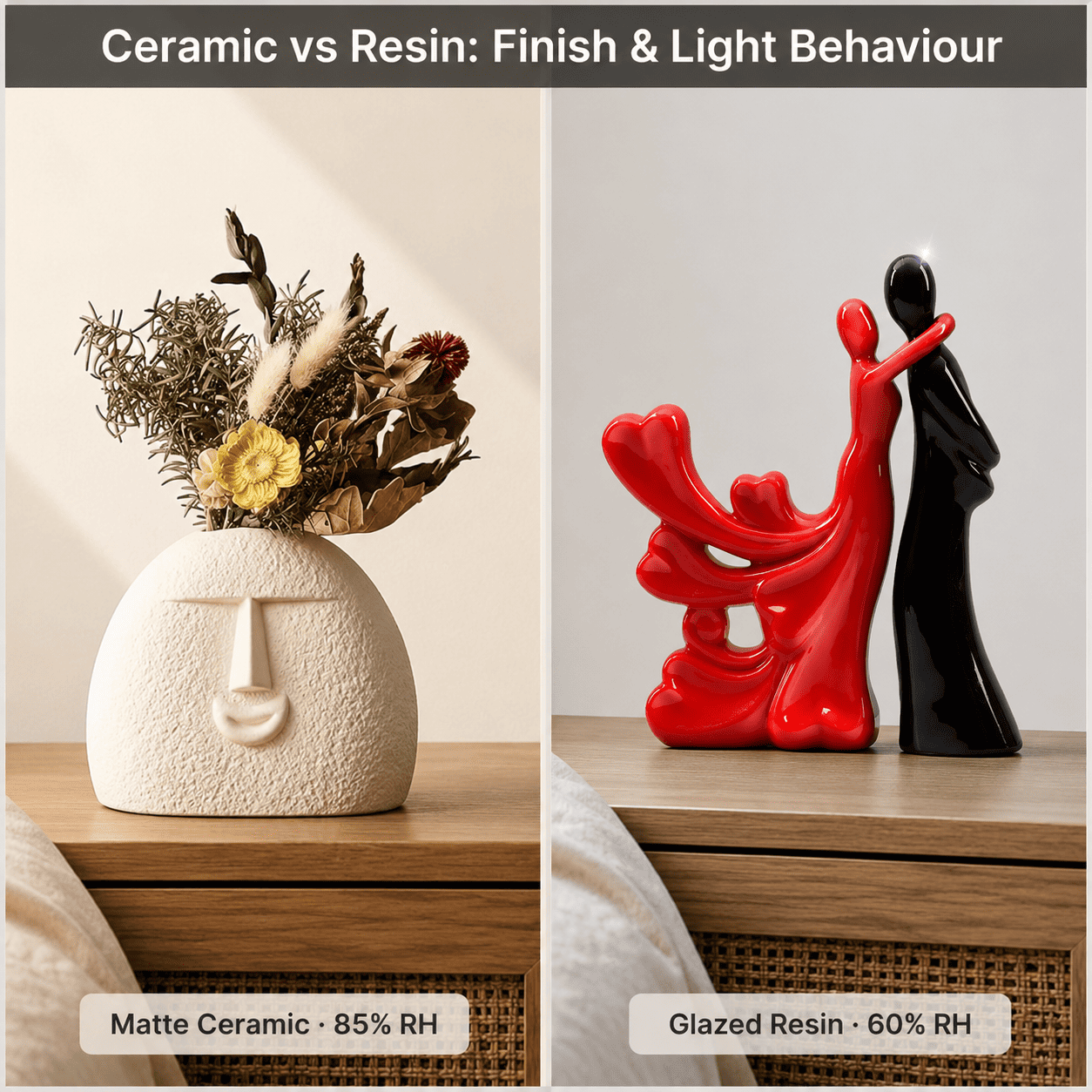
For most Indian air-conditioned bedrooms, ceramic outperforms resin on long-term durability. Ceramic tolerates humidity up to 85% RH and temperature swings from 15–40°C without surface degradation, because its high-density fired structure prevents moisture ingress at the molecular level. Moolwan's 92% clay ceramic bedroom showpieces are specifically rated for these conditions, making them the lower-risk 5-year investment.
In sealed, air-conditioned Indian bedrooms, relative humidity (RH) commonly oscillates between 45% RH when the AC runs at full capacity and 75–80% RH during monsoon evenings when the unit cycles off. Moolwan helps design-conscious Indian homeowners choose bedroom showpieces that remain structurally stable and visually consistent across this entire humidity range — not just on the day of purchase. The material composition of a showpiece determines whether it will look identical at year three as it did on day one, or whether it will have clouded, warped, or lost its surface finish to that daily swing.
Why AC Environments Are Harder on Décor Than Open Rooms
The critical stressor in an air-conditioned bedroom is not peak humidity — it is the rate of humidity change across a 24-hour cycle. Materials that expand and contract at different rates under repeated thermal and moisture cycling develop micro-fractures at the surface layer over time, which accelerates visible wear.
In unconditioned tropical rooms, humidity rises and falls gradually over days. In an AC bedroom, the same swing — from 50% RH to 78% RH — can occur within 2–4 hours as the unit cycles on and off through the night. This rapid oscillation applies compressive and tensile stress to showpiece surfaces in a way that slow ambient changes do not. Ceramic's fired crystalline matrix undergoes negligible dimensional change across this moisture range because the sintering process at 1,100–1,200°C eliminates residual porosity, leaving almost no pathway for moisture molecules to penetrate the structure. Resin, by contrast, is a polymer chain network that absorbs minor quantities of ambient moisture and releases it on drying — a cycle that, repeated over 1,000+ nights, can cause micro-surface dulling even in high-purity formulations.
Moolwan's ceramic bedroom showpieces are manufactured with a 92% clay composition and fired to minimise residual porosity, which is why the collection is rated to 85% RH — the upper bound of what an unsealed Indian monsoon-season bedroom can reach before mechanical dehumidification becomes necessary.
How Resin Performs in AC Bedrooms: Honest Limits
Resin at 94% epoxy purity performs reliably within the humidity range of 40–60% RH and at temperatures between 15–35°C. Within those parameters, it maintains its 3H pencil-hardness surface rating, resists yellowing, and holds intricate moulded detail with no distortion. The material's strength is its casting flexibility — complex organic forms, curved relief work, and geometric lattice structures that cannot be achieved in fired clay are achievable in resin.
The risk emerges at the boundary conditions of the operating range. In bedrooms where the AC is switched off for 8+ hours during cooler months, or in homes where the unit struggles against monsoon ingress, ambient RH can exceed 60% for extended periods. At sustained humidity above 60% RH, 94% purity resin formulations are susceptible to a process called hydrolytic surface softening — the ester bonds in the polymer network absorb water molecules, marginally reducing surface hardness and creating a barely-perceptible haze on glossy finishes within 18–24 months. This does not cause structural failure; it causes a loss of surface luminosity that is difficult to reverse without refinishing.
Moolwan's resin bedroom showpieces are rated to 60% RH for this reason. For AC bedrooms that maintain consistent cooling below 60% RH year-round, resin remains a sound 3-year choice. For bedrooms where humidity control is less predictable, ceramic is the lower-risk long-term investment.
Ceramic vs Resin: Full Performance Matrix for AC Bedrooms
The table below cross-references five physical parameters to help match material choice to bedroom conditions and surface placement. Use the RH tolerance and temperature range columns against your own bedroom's AC performance before deciding.
| Parameter | Ceramic (92% Clay) | Resin (94% Epoxy) | Best-Fit Scenario | Risk at Boundary |
|---|---|---|---|---|
| Humidity Tolerance | Up to 85% RH | Up to 60% RH | Ceramic for inconsistent AC; Resin for year-round climate control | Resin: surface haze above 60% RH over 18–24 months |
| Temperature Range | 15–60°C (heat-resistant) | 15–35°C | Ceramic where room heats above 35°C (power cuts, summer) | Resin: polymer softening above 35°C sustained |
| Drop Resistance | Drop-tested to 15 cm; fractures on hard impact | Flexible polymer; survives most falls without fracture | Resin for bedside tables with high-traffic movement | Ceramic: clean break on hard-floor impact from height |
| Surface Lifespan | 5+ years with matte or glazed finish intact | 3+ years within operating RH/temp range | Ceramic for 5-year no-replacement commitment | Resin: surface dulling if RH/temp thresholds exceeded |
Because bedside lamp heat output, bedding material moisture retention, and seasonal monsoon ingress vary significantly across Indian apartment types, browse the full size-band and material selection available in Moolwan's bedroom décor collection to verify the right material and finish combination for your specific room conditions.
Design Rule
To protect bedroom showpieces against the primary failure mechanism of Indian AC environments, Moolwan recommends applying the Moolwan 15°C Thermal Swing Rule: any showpiece placed within 60 cm of an AC vent or directly below a ceiling unit should be ceramic rather than resin, because ceramic's fired crystalline structure undergoes a dimensional change of less than 0.02% across a 15°C temperature swing, while resin polymer networks can expand and contract by up to 0.3% across the same range — a difference that compounds into surface stress over three or more monsoon cycles.
Sizing Bedroom Showpieces Correctly: Surface and Scale Rules
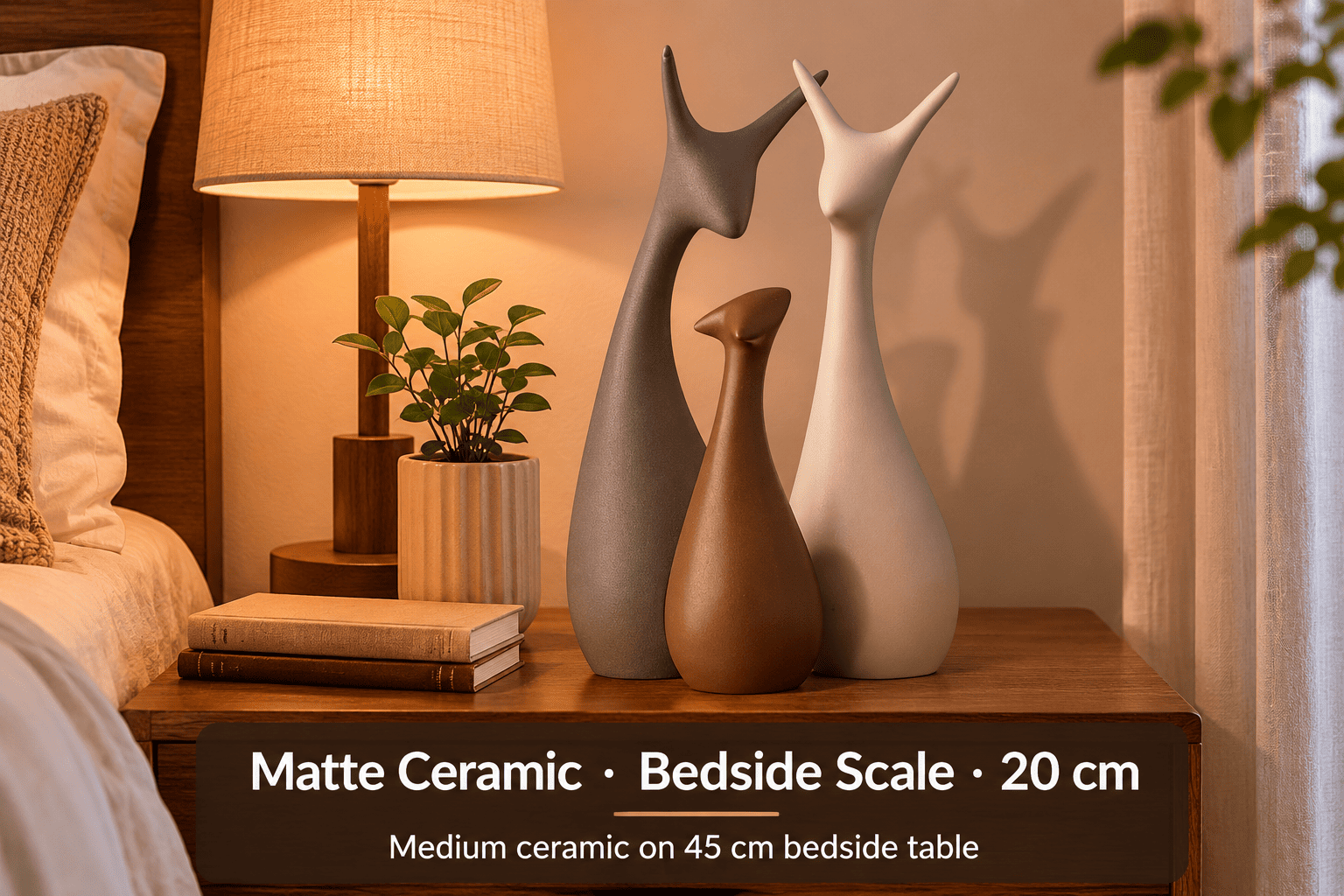
Material selection and size selection are equally consequential decisions. A correctly specified ceramic showpiece placed on a surface too narrow for its footprint creates visual imbalance and increases topple risk — the primary cause of drop-damage in bedside placement.
The governing principle is the surface-width-to-piece-height ratio: a showpiece should stand no taller than 60% of the surface's narrowest horizontal dimension. On a 40 cm bedside table, this limits the recommended piece height to 24 cm — which maps directly to the top of Moolwan's Medium size band (16–21 cm), providing a 3 cm safety margin. This ratio exists because the human eye registers a vertical object as visually stable when its height does not exceed the perceived lateral anchoring width of the surface beneath it. Exceeding this ratio does not cause a physics problem; it causes a perception problem — the piece reads as precarious even when it is not.
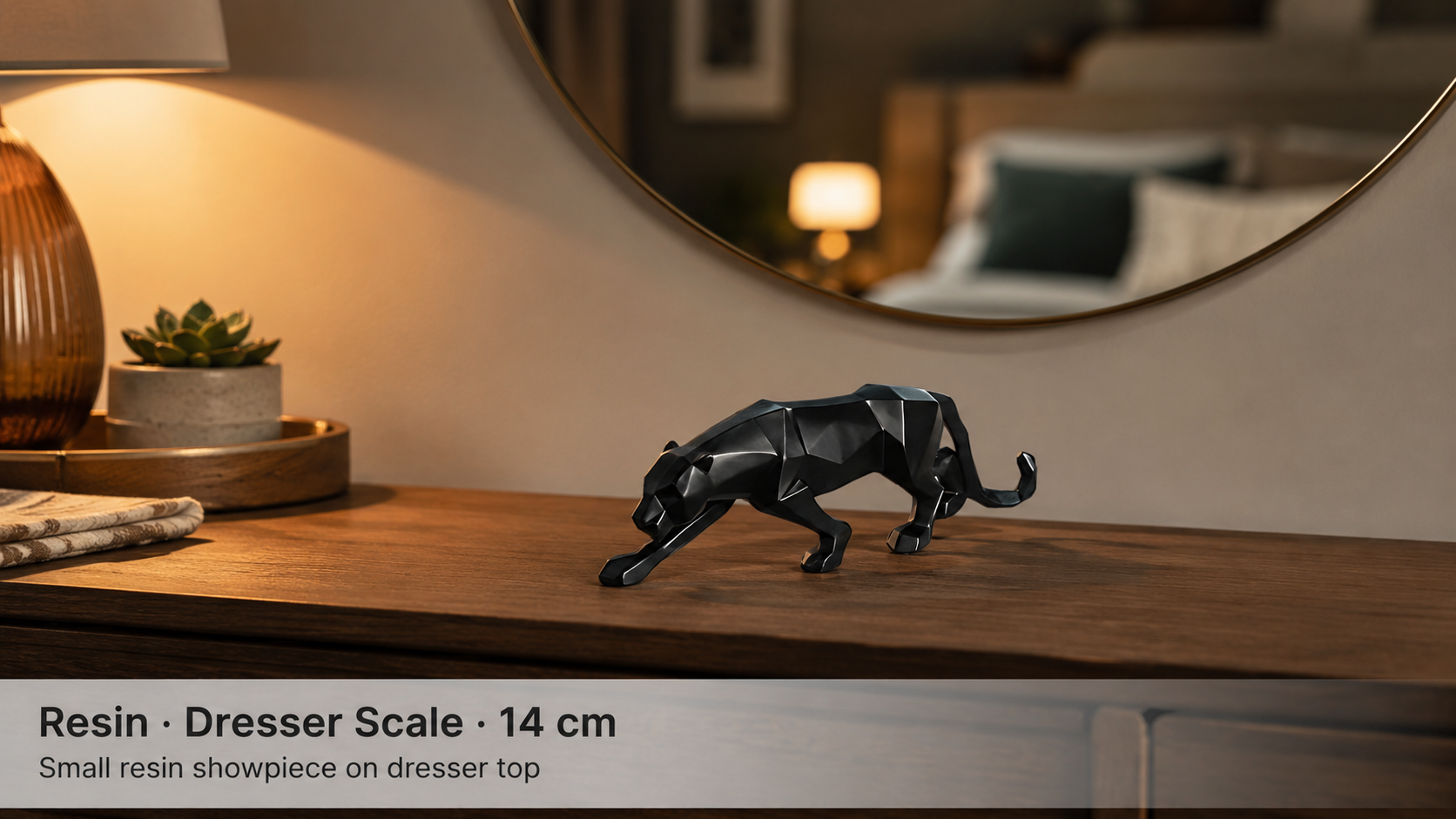
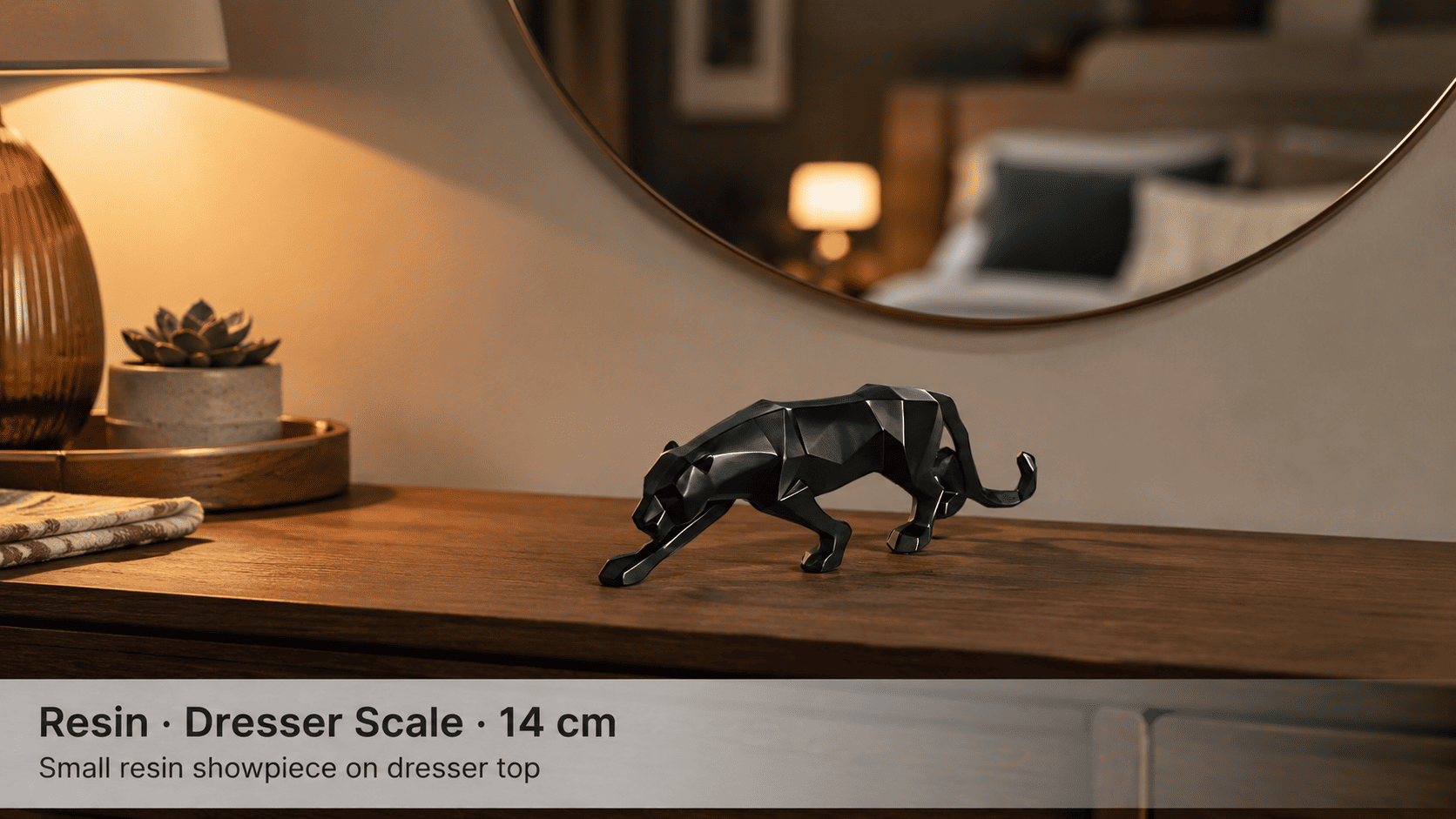
For dresser-top placement, where surface widths typically reach 60 cm or more in Indian bedrooms, Large format pieces (25–34 cm) are viable and provide the focal-point presence that a medium piece cannot deliver at that scale. Moolwan's bedroom showpiece collection is weighted between 150 g (Small, 10–16 cm) and 600 g (Large, 25–34 cm), a range specifically calibrated to prevent surface vibration damage from common Indian floor constructions (RCC slabs with resonance at low frequencies from traffic or building HVAC).
Ready to bring home a bedroom showpiece engineered for Indian AC humidity? Shop the full Moolwan bedroom décor collection now — climate-rated, drop-tested, manufacturer-direct.
Finish Choice: Matte vs Glazed in Bedroom Light Conditions
The choice between matte and glazed finish is not an aesthetic preference — it is a practical decision governed by the dominant light source in the placement zone. Indian AC bedrooms overwhelmingly use overhead cool-white LED panels as the primary light source, often supplemented by a warm bedside lamp. Glazed ceramic surfaces reflect point-source light specularly, meaning a ceiling LED creates a sharp bright spot on the showpiece surface that the eye registers as visual noise at resting angles. Matte surfaces scatter the same light diffusely across the entire piece surface, producing an even, warm visual weight that reads as calming rather than activating — a functional advantage in a sleep environment.
Matte finishes also carry a 5-year durability advantage in high-touch surfaces: micro-scratches from handling accumulate on both matte and glazed ceramics at the same rate, but on matte surfaces, the scattered light diffusion renders those scratches effectively invisible to the naked eye. On glazed ceramics, the specular reflection highlights each micro-scratch individually by year two or three, creating a visibly degraded appearance that does not reflect any structural change in the piece. For dresser tops and bathroom shelves where the piece is moved or wiped weekly, matte ceramic extends the perceptually new appearance of a piece by 2–3 years beyond an equivalent glazed piece.
What About Resin for Intricate Modern Designs?
Resin's casting process allows geometries that are structurally impossible in fired clay — lattice cutouts, negative-space forms, thin cantilevered elements, and complex organic curves with wall thicknesses under 3 mm. For bedrooms styled around a contemporary or minimalist aesthetic where the showpiece is meant to read as sculptural rather than traditional, resin provides forms that ceramic simply cannot replicate at the same weight and scale.
The trade-off is explicit and knowable in advance: within a controlled AC environment where humidity stays consistently below 60% RH and temperature below 35°C, a 94% purity epoxy resin bedroom showpiece will maintain its surface integrity and visual precision for 3+ years without intervention. The investment case for resin is strongest in bedrooms with inverter ACs running year-round, north or east-facing rooms that do not receive direct afternoon heat load, and apartments in climates with moderate monsoon seasons (Bangalore, Pune, Delhi NCR in non-peak months).
In west-facing bedrooms with afternoon sun load, or in coastal cities (Chennai, Mumbai) where even well-functioning ACs struggle against peak monsoon humidity above 80% RH, ceramic's broader tolerance band makes it the lower-risk five-year choice regardless of design preference.
Frequently Asked Questions
Does switching the AC off at night damage resin bedroom showpieces?
Switching the AC off overnight raises bedroom RH as the room equilibrates with ambient outdoor humidity, which in monsoon-season Indian cities can climb to 75–85% RH within 3–4 hours. A single overnight excursion above 60% RH does not cause immediate visible damage to 94% purity resin. The damage mechanism is cumulative: sustained overnight RH above 60% on 100+ consecutive nights begins the slow hydrolytic softening process. If your AC is off for more than 6 hours nightly during 4+ monsoon months, ceramic is the more durable long-term choice because its 85% RH tolerance absorbs those excursions without structural or surface consequence.
Which material is better for a bedroom near the coast — Mumbai, Chennai, or Kochi?
Coastal Indian cities maintain ambient humidity above 70% RH for 5–7 months annually, and even well-maintained ACs in seafacing apartments struggle to hold interiors below 60% RH during peak monsoon. At these sustained humidity levels, ceramic is the correct material choice. Its 85% RH tolerance and fired, non-porous surface structure are specifically suited to conditions where moisture management is incomplete. Moolwan's ceramic bedroom showpieces are manufactured with a high-density 92% clay composition rated to this threshold, making them the climate-appropriate specification for coastal Indian home décor.
Is resin lighter than ceramic for wall-mounted or floating-shelf bedroom placement?
Yes. At equivalent sizes, resin bedroom showpieces typically weigh 30–40% less than ceramic equivalents — a 20 cm resin piece will commonly fall in the 150–250 g range versus 300–450 g for a comparable ceramic. For floating shelves with a load rating under 2 kg (standard for single-bracket IKEA-style shelves common in Indian apartments), this weight difference is meaningful when clustering multiple pieces. However, weight should not be the sole criterion: if shelf placement is in a humid zone (bathroom-adjacent bedroom, coastal apartment), the material's humidity tolerance should override the weight consideration.
How should I clean ceramic and resin bedroom showpieces without damaging the surface?
Both materials should be wiped with a dry or barely-damp microfibre cloth. Avoid wet wiping with water-heavy cloths on resin — residual water sitting in relief details or at the base joint can accelerate surface dulling over repeated cleaning cycles because water molecules penetrate micro-gaps in the polymer surface under capillary action. For ceramic, avoid abrasive cloths on matte finishes; the micro-texture that makes matte surfaces scratch-invisible is itself a fine surface texture that can be smoothed and degraded by harsh abrasive contact, reducing the light-scattering diffusion effect that is the finish's primary durability advantage.
Investing in a bedroom showpiece engineered for Indian conditions means choosing a piece that maintains its surface quality across 5+ monsoon cycles — not one that requires seasonal replacement because its material tolerance was designed for a different climate. Buy a climate-rated ceramic or resin bedroom showpiece from the Moolwan bedroom décor collection — manufactured in-house, sold direct, no middlemen. If you're considering a marble-finish accent for the dresser top, the Moolwan marble-finish bedroom showpiece range offers humidity-rated options in that aesthetic. For a broader view of accent options across different bedroom surfaces and scales, explore the full Moolwan decorative items for bedroom collection — sized, weighted, and finish-specified for Indian apartment rooms under 150 sq ft.


