
Cart
The Short Answer
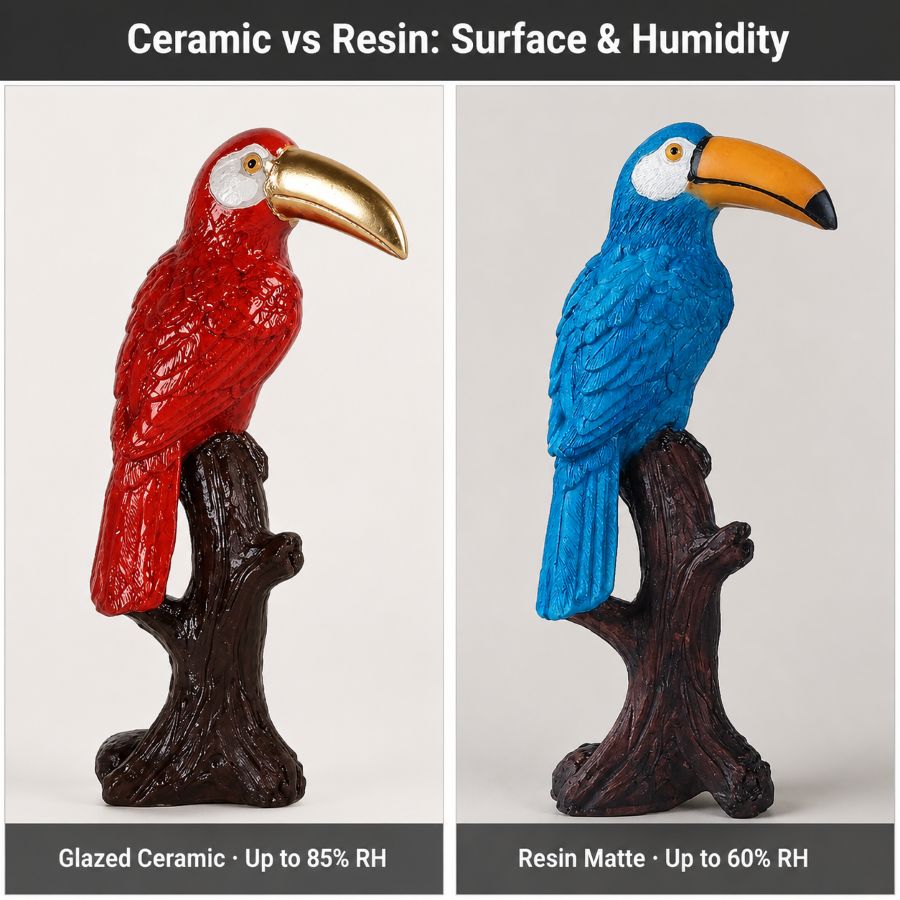
Ceramic is the safer material for most Indian bedrooms. Moolwan's ceramic showpieces tolerate humidity up to 85% RH and heat up to 60°C — well beyond what Indian AC cycles produce. Resin is rated to 60% RH and 15–35°C, which suits a tightly climate-controlled room but risks surface stress during off-hours in coastal or monsoon-heavy cities. If you live in Chennai, Mumbai, or Kolkata, choose ceramic.
Moolwan helps design-conscious Indian homeowners choose bedroom décor that performs as well in July as it does in January — because most Indian bedrooms are not air-conditioned around the clock. The relative humidity inside a Bangalore or Mumbai flat can swing from the low 40s during peak AC hours to the high 70s or beyond overnight, through a power cut, or during the monsoon months. Most imported showpieces are never tested across this range. The material your piece is made from is what determines whether it looks the same in year three as it did on delivery day.
A split AC running at 24–26°C draws indoor humidity down to roughly 45–60% RH during active cooling. Both ceramic and resin are well within safe range during those hours. The problem is what happens the other twelve.
In coastal cities and across the June–September monsoon, bedrooms that are not actively air-conditioned regularly reach 75–85% RH by early morning. A power cut, an overnight switch-off, or a weekend away can put a room through a 40-point humidity swing — from 45% RH at 11 pm to 82% RH by 6 am. Materials not rated for that range will micro-stress over months, showing up as hairline surface cracks in resin or finish cloudiness in poorly formulated ceramics.
Moolwan engineers each bedroom collection against the full Indian climate range, not just the comfortable AC-on hours. Understanding what the material specifications actually mean makes it easier to buy once and not replace in year two.
Ceramic (92% clay composition) tolerates humidity up to 85% RH and temperatures up to 60°C. Resin (94% purity epoxy) is rated to 60% RH and a temperature window of 15–35°C. The 25-point gap in those upper humidity limits — 85% vs 60% RH — is precisely the range that separates a safe Indian monsoon night from a stressed one for a resin showpiece.
Surface hardness matters on bedroom surfaces where daily brushes and accidental knocks are routine. Resin at 3H pencil hardness handles this well for everyday handling. Kiln-fired ceramic carries higher inherent hardness, and a well-fired glaze resists micro-scratching better than resin over a 5-year horizon. Both materials are drop-tested, but ceramic's lifespan advantage — 5-plus years against resin's 3-plus years — comes from its stability across wider humidity swings, not from superior drop resistance.
Weight is comparable: both run 150g–600g across the collection, so shelf load is not a meaningful decision factor in either direction.
A ceramic bedroom showpiece on a teak bedside table — humidity-rated to 85% RH with no finish degradation across Indian monsoon cycles. See the full range in Moolwan's bedroom décor collection.
Ceramic belongs on any surface in any Indian bedroom — bedside table, dresser top, floating shelf above the headboard, windowsill corner, or a low display console near the bedroom door. Its 85% RH tolerance means it requires no controlled environment. For cities like Chennai, Kochi, Mumbai, and Kolkata — where even the drier months bring 65–75% overnight humidity — ceramic is the only rational default. Browse Moolwan's bedroom décor collection to see the full range of ceramic and mixed-finish showpieces sized for Indian shelves and surfaces.
Resin earns its place on surfaces that stay within a predictable AC-maintained range: a bedside table directly below a split unit, an enclosed display shelf, or a nook that rarely opens to unfiltered morning air before the AC switches on. In Bangalore or Delhi, where baseline humidity is lower and AC cycles are longer, resin is a genuinely viable choice. In a home where the air conditioning runs overnight without interruption, resin's 3H surface hardness and typically lighter price point make it a sensible option for a styled bedside surface.
Moolwan's bedroom showpiece range includes both ceramics and resin pieces — the size guide below helps you match format to surface before settling on material.
Indian metro apartments average under 130 sq ft per bedroom, which means every surface reads at close range and scale errors are immediately visible. Overscaling a bedside table with a 30cm piece crowds the surface and makes it feel cluttered; underscaling a dresser top with two 10cm figurines makes it look half-finished.
The small format (10–16cm) works best on a floating bedside shelf, a study desk corner, or a bathroom vanity ledge. The medium format (16–21cm) is the most versatile size in the range: it holds its own on a dresser top, a showcase shelf, or a console table near the bedroom door without dominating the surface. The large format (25–34cm) is reserved for a corner floor shelf, a low pedestal surface, or a wide dresser where it stands as the room's single focal object.
For a wider browse across bedroom-specific styling options grouped by surface and size, Moolwan's decorative items for bedroom collection is a useful reference — particularly if you are styling more than one surface in the same room at once.
Glazed ceramic (left) versus resin matte finish (right) — texture macros showing surface quality and finish depth at close range. Both formats available in Moolwan's bedroom décor collection.
A medium resin showpiece (16–21cm) on a dresser top, styled with neutral-toned bedding — well-suited to Bangalore and Delhi interiors with consistent overnight AC use.
A split AC running at 24–26°C typically reduces indoor relative humidity to 45–60% RH during active cooling. Both ceramic (rated to 85% RH) and resin (rated to 60% RH) are within safe range during those hours. The stress window is overnight or during power cuts — when humidity can climb to 75–85% RH — which is precisely where resin approaches its upper limit in coastal and monsoon-affected cities.
Resin performs best between 15°C and 35°C. Direct airflow from a split AC unit typically brings the surface near the vent to 18–22°C, which stays within the safe range. The real risk is rapid temperature cycling — if the AC switches off and the room climbs from 22°C to 33°C within an hour, repeated stress over months can cause micro-cracking. Keeping resin pieces away from the direct vent path reduces this meaningfully.
Glazed ceramic carries a sealed surface layer that adds a small but meaningful barrier against moisture absorption. For bedrooms in cities where baseline overnight humidity regularly exceeds 65% RH, a glazed finish extends ceramic's lifespan advantage further. Moolwan's ceramic collection includes both matte and glazed finishes; for coastal locations or homes without overnight AC, glazed is the lower-maintenance choice across a five-year horizon.
Most standard Indian floating shelves — 12mm MDF or plywood, 30–40cm bracket span — safely carry 3–5 kg of static load. Bedroom showpieces in the 150g–600g range sit far below that ceiling, so weight is not a constraint. The only practical decision factor is visual scale: a shelf should look considered, not strained.
The decision between ceramic and resin comes down to two questions: how consistently is your bedroom climate-controlled, and which city are you in? For most Indian homes — where AC is seasonal, humidity is variable, and décor needs to carry five monsoons — ceramic is the material that earns its shelf space. If you are furnishing a bedside surface in a well-regulated room and want the tactile depth of a stone-like finish, Moolwan's marble-finish bedroom showpieces offer a resin-based option worth exploring. For the full edit of bedroom-ready showpieces across both materials and all three size formats, browse Moolwan's bedroom décor collection.
Written by Moolwan Design Concept Team. Reviewed by Ruchi Malhotra, Founder & CEO, Moolwan (Euphorica Ventures Pvt Ltd), Bangalore. Published 27 May 2026.


