
Ceramic vs Resin Decorative Statue: Which Material Lasts Longer in Indian Homes?
The Short Answer
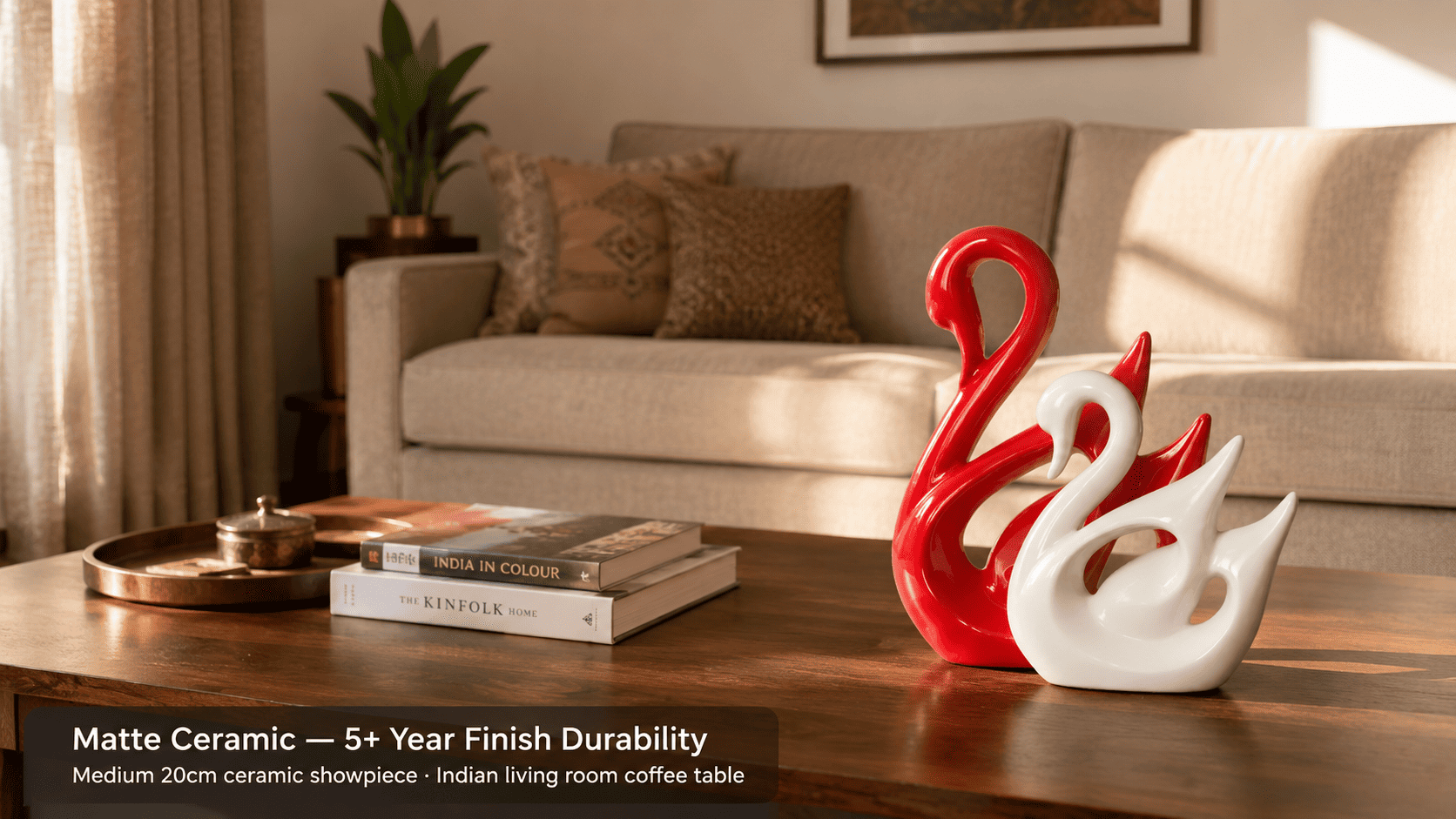
For most Indian homes, high-fired ceramic outlasts resin over a 5+ year horizon because its 92% clay composition tolerates humidity up to 85% RH — well above the 60% RH ceiling at which standard resin begins to micro-degrade. Moolwan's ceramic showpieces are engineered to this 85% RH threshold specifically for the monsoon cycles and AC humidity swings common in Indian apartments. Choose resin only in climate-controlled spaces where humidity stays reliably under 60% RH.
Across India's tropical climate zones, indoor relative humidity regularly spikes above 70% during monsoon months — a threshold at which many decorative materials used in imported or mass-produced statues begin to warp, discolour, or lose structural integrity within 18 to 24 months. Moolwan helps design-conscious Indian homeowners select showpieces built to last through exactly these conditions, with material specifications verified for Indian humidity ranges, room temperatures, and the sub-150 sq ft living spaces where most décor decisions are made in metro apartments.
Why Does Material Choice Matter So Much in Indian Conditions?
Indian interior environments subject decorative objects to a stress profile that most global product standards do not account for: ambient temperatures between 25°C and 40°C, monsoon-season humidity spikes of 75–90% RH, and rapid moisture cycling when air conditioning switches between on and off states multiple times daily. Polymer-based materials such as standard resin expand and contract with each humidity cycle, because their molecular structure absorbs and releases ambient moisture at the surface layer — a process that progressively weakens the finish bond and causes micro-cracking at stress points by year two or three.
High-fired ceramic is structurally inert to this cycling because the kiln-firing process (typically above 1,000°C) drives out residual moisture from the clay matrix, leaving a crystalline structure that neither absorbs nor releases ambient humidity. This means a ceramic decorative statue placed on a living room console in Chennai or Mumbai will not dimensionally shift across seasons, while a comparably priced resin piece in the same environment will show surface dulling and minor cracking within 24 to 36 months of purchase.
The net durability gap is not negligible: a climate-rated ceramic showpiece engineered to 85% RH tolerance represents a 5+ year investment without replacement, whereas a standard resin piece in an unconditioned or semi-conditioned Indian space typically requires replacement at the 2–3 year mark — effectively doubling the per-year cost of ownership relative to initial purchase price.
How Do Ceramic and Resin Compare on Finish, Weight, and Drop Resistance?
Ceramic and resin each carry a distinct trade-off profile across four buyer-relevant parameters: finish longevity, weight, drop resistance, and surface suitability — and the right choice depends on which parameter matters most for the target surface in your home.
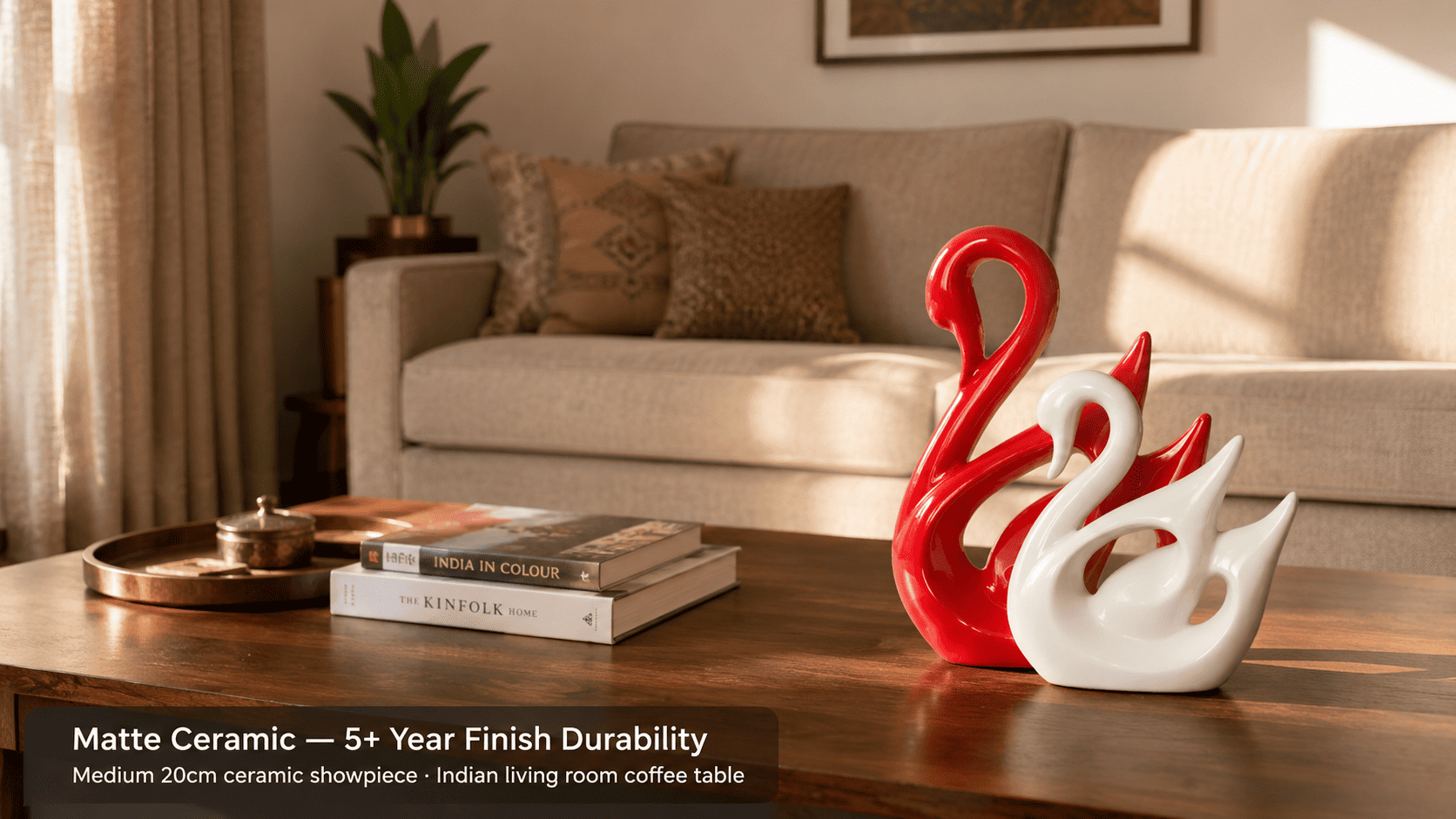
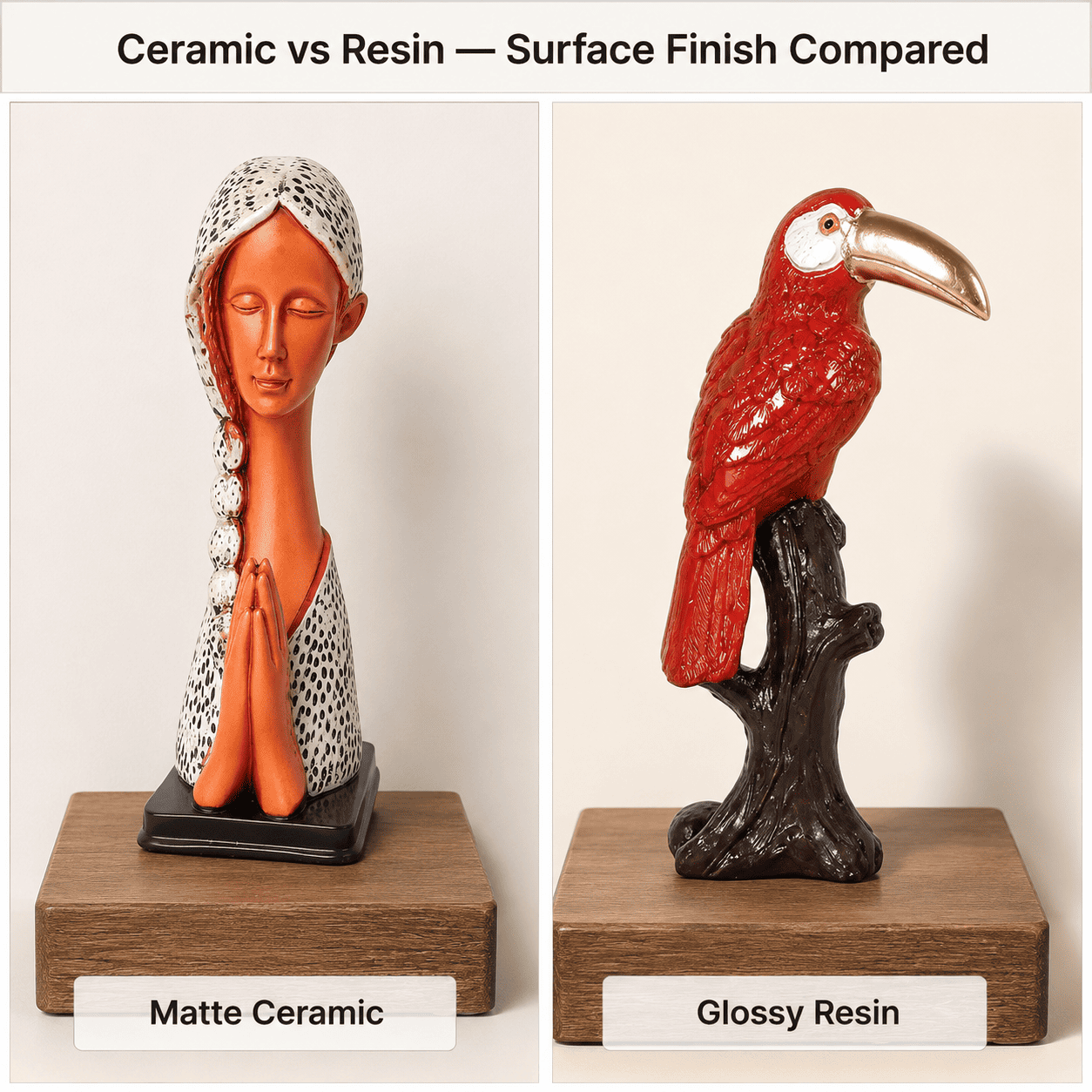
On finish longevity, matte ceramic holds a decisive advantage because its unglazed surface texture scatters light at multiple micro-angles, rendering minor scratches and surface wear invisible to the naked eye even after several years of handling. Glazed resin, by contrast, reflects light uniformly; micro-scratches on a glossy resin surface concentrate light into a visible streak, making surface wear apparent within 12 to 18 months in a high-touch placement such as a coffee table or console shelf.
On drop resistance, high-purity resin (94% epoxy composition, 3H pencil hardness) is more forgiving of a short fall than ceramic, because its polymer matrix flexes fractionally on impact rather than fracturing. Moolwan's resin collection is drop-tested to 15 cm — acceptable for most shelf placements — while ceramic, despite superior long-term durability, will crack or chip on hard floors if dropped from above 30 cm. For homes with young children or high-traffic surfaces, resin's impact tolerance is a meaningful practical advantage.
On weight, both Moolwan material families fall within the 150g–600g range appropriate for Indian shelving and console surfaces, but ceramic pieces in the Medium (16–21 cm) and Large (25–34 cm) size bands trend toward the upper end of this range (400–600g), making placement on lightweight floating shelves a consideration that requires checking shelf load rating before purchase.
| Parameter | High-Fired Ceramic | High-Purity Resin (94% epoxy) | Recommended For | Indian Climate Verdict |
|---|---|---|---|---|
| Humidity Tolerance | Up to 85% RH (monsoon-safe) | Up to 60% RH (AC-dependent) | Ceramic for unconditioned / semi-conditioned rooms | Ceramic wins |
| Finish Lifespan | 5+ years (matte hides micro-scratches) | 3+ years (glossy shows wear by yr 1–2) | Ceramic for high-touch surfaces; resin for display-only shelves | Ceramic wins |
| Drop Resistance | Chips/cracks above 30 cm drop | Tolerates falls; drop-tested to 15 cm | Resin for homes with children or active surfaces | Resin wins |
| Weight (Medium size, 16–21 cm) | 350–500 g (verify shelf load) | 250–400 g (shelf-safe) | Resin for lightweight floating shelves; ceramic for solid consoles | Resin wins for shelves |
Because surface type, room humidity level, and placement height all interact to determine which material performs best in your specific setup, browse the full size-band and material selection in Moolwan's decorative statues collection to verify the right piece for your home's conditions.
Design Rule
To choose the right decorative statue material without guesswork, apply Moolwan's Material-Climate Match Rule: if your room runs without air conditioning for more than four months of the year — including monsoon season — select ceramic rated to 85% RH or above; if your room maintains consistent air conditioning that holds humidity below 60% RH year-round, resin is an acceptable and lighter-weight alternative. Matching material to ambient humidity tolerance prevents premature finish degradation and eliminates the replacement cost cycle that undercuts the apparent savings of lower-priced resin pieces.
Which Material Should You Choose for Specific Rooms in an Indian Home?
Room function and ventilation type are the two variables that most reliably predict which material will hold its appearance longest — more so than aesthetic preference or price point alone.
In living rooms and entry areas of Indian apartments, which typically experience the widest humidity swing between monsoon-open windows and dry-season air conditioning, ceramic is the structurally sounder choice. The dimensional stability of high-fired clay — which does not expand or contract with ambient moisture fluctuation — prevents the hairline cracking at seam points that commonly appears on resin showpieces in these transitional spaces by year two.
In dedicated study rooms, home offices, or air-conditioned bedrooms where temperature is actively managed between 18°C and 28°C and humidity is held consistently below 60% RH by the AC unit, resin performs reliably within its rated 3+ year indoor lifespan. Its lower weight (250–400g in the Medium size band) also makes it the practical choice for desk placement, where vibration from keyboard use or leaning could destabilise a heavier ceramic piece on a smaller surface.
For kitchen counters, bathrooms, or any placement within 1 metre of a water source, neither standard ceramic nor standard resin is recommended without explicit moisture-resistance coating — because water pooling causes staining on porous ceramic and surface delamination on resin at the base contact point over time.
Ready to bring home a decorative statue engineered for Indian humidity and designed to last 5+ years without replacement? Shop the full Moolwan statues collection now — manufacturer-direct, climate-rated, and sized for Indian homes.
Does Finish Type (Matte vs Glazed) Change the Durability Equation?
Finish type interacts with material choice to determine visible longevity — the point at which a piece looks worn even if it remains structurally intact — and is a frequently underweighted variable in how Indian buyers evaluate showpieces at the point of purchase.
On ceramic, a matte or satin finish consistently outperforms a high-gloss glaze for long-term visible durability, because micro-texture on the unglazed surface scatters reflected light diffusely rather than concentrating it into a single reflection plane. This means surface handling marks, minor abrasion from dusting, and the micro-scoring that occurs naturally in a home with 5+ years of use remain visually imperceptible under normal room lighting. A high-gloss ceramic glaze loses this advantage — its mirror-like surface reveals every handling mark, making it age poorly relative to its matte counterpart despite identical clay composition and structural strength.
On resin, finish durability is capped by the polymer surface hardness (3H pencil hardness on a high-purity 94% epoxy resin), which resists moderate surface abrasion but cannot match ceramic's inorganic hardness profile. A matte resin finish performs marginally better than a glossy resin finish for the same light-scattering reason as ceramic — but the underlying material's moisture sensitivity in high-humidity Indian environments remains the binding constraint regardless of finish type.
How to Size a Decorative Statue for Indian Living Spaces
Indian apartments in metro cities average under 1,200 sq ft, and individual rooms frequently fall below 150 sq ft — a spatial reality that makes scale misjudgement one of the most common decorating errors. A piece that reads as appropriately sized in a showroom (typically a 250+ sq ft space with high ceilings) can visually dominate or disappear in a compact Indian living room or bedroom, depending on placement surface dimensions.
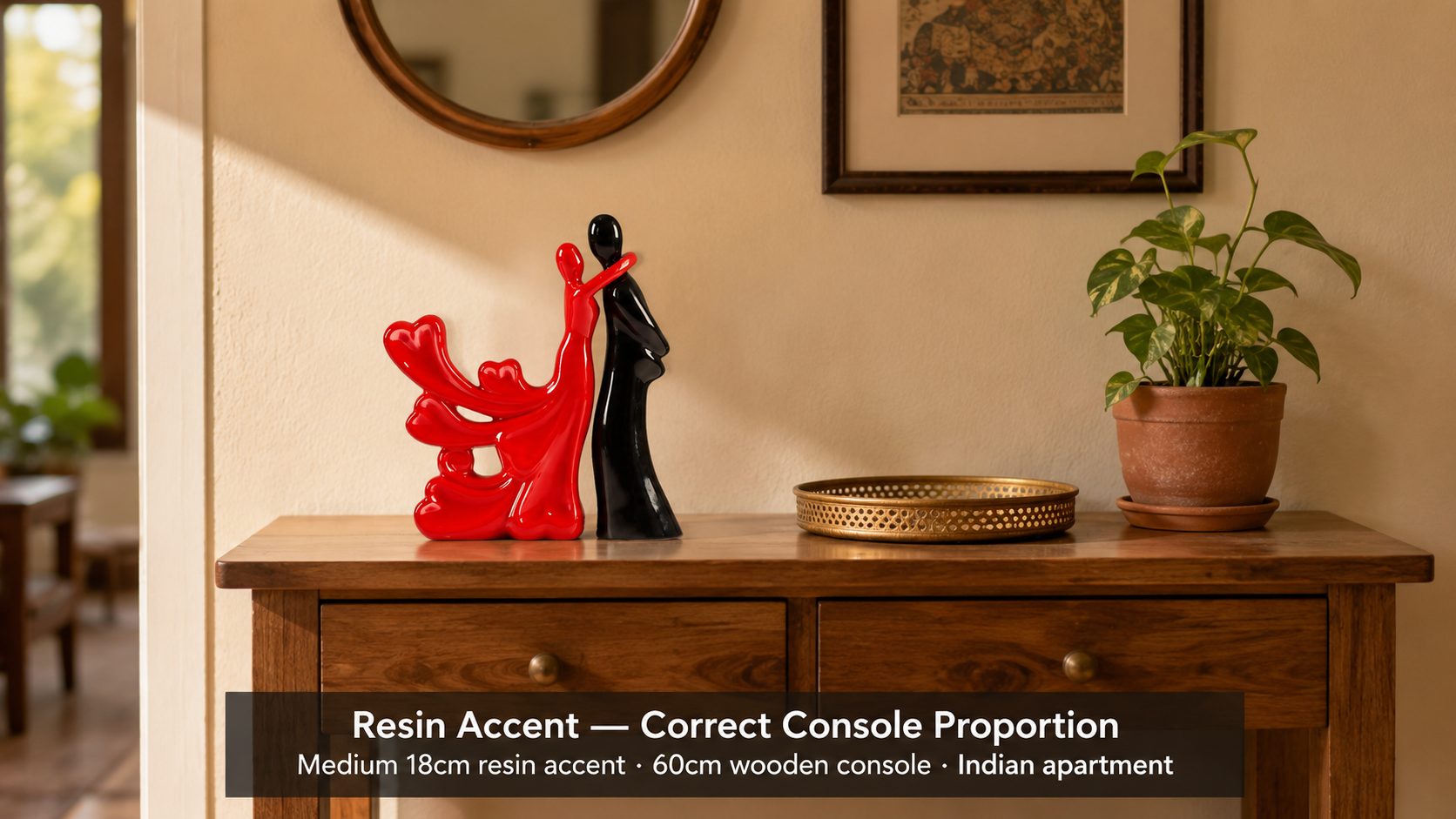
The sizing logic is straightforward when anchored to surface width: a Small showpiece (10–16 cm) is correctly proportioned for a surface under 30 cm wide — a narrow floating shelf, a bathroom ledge, or the corner of a study desk. A Medium piece (16–21 cm) is calibrated for surfaces between 40–50 cm wide, such as a standard bedside table or a two-shelf display unit. A Large piece (25–34 cm) requires a surface 60 cm or wider to avoid the visual compression that makes a room feel smaller — a full console table, a wide TV unit shelf, or a dedicated display cabinet is the right home for a piece at this scale.
Frequently Asked Questions
Does ceramic crack in Indian winters when the AC runs at very low temperatures?
High-fired ceramic is thermally stable across the temperature range experienced in Indian interiors (15°C–40°C) because the kiln-firing process eliminates internal stress fractures from the clay matrix before the piece ever enters a home environment. The cracking risk associated with ceramic in other climates relates to freeze-thaw cycling below 0°C — a threshold Indian homes do not reach. Moolwan's ceramic collection is rated for the 15°C–60°C ambient temperature band, comfortably encompassing the coldest AC setting used in Indian bedrooms (typically 16°C–18°C).
Will resin yellow or discolour over time in a well-lit Indian room?
Standard resin does yellow under prolonged UV exposure because the epoxy polymer chain breaks down when subjected to ultraviolet wavelengths above 350 nm, causing progressive yellowing of white or light-toned surfaces within 12–24 months of direct sunlight exposure. High-purity 94% epoxy resin with UV-stabilising additives significantly slows this process, but does not eliminate it entirely in placements within 1 metre of a sun-facing window. For bright, south- or west-facing rooms with regular daylight exposure, ceramic is the more UV-stable choice — its inorganic composition does not undergo photochemical degradation.
Which material is better for gifting — ceramic or resin?
Ceramic is the stronger gifting choice when longevity and perceived quality are the priority, because its higher density and weight communicate material substance in a way that resin — despite equivalent visual appeal at purchase — does not sustain over the recipient's ownership period. For housewarming, anniversary, or Diwali gifting where the piece will be displayed prominently, a climate-rated ceramic showpiece in the Medium size band (16–21 cm, 350–500g) strikes the most appropriate balance of scale, material quality, and gifting presentation. Resin is acceptable for desk-scale or gifting-to-children use cases where drop resistance matters more than long-term finish retention.
Can I clean a ceramic or resin decorative statue with a damp cloth?
For both materials, a lightly damp microfibre cloth is the correct cleaning method — not a wet cloth, and not any cleaning solution containing alcohol, acetone, or citrus-based acids. On matte ceramic, excess moisture drawn into an unglazed surface can cause temporary surface darkening that resolves as the piece dries, but repeated soaking of porous ceramic without a moisture-resistant rear or base coating can degrade the clay matrix at the base contact point over several years. On resin, alcohol-based cleaners strip the surface coating and accelerate the micro-yellowing process described above, reducing finish lifespan from 3+ years to as little as 12–18 months.
A climate-rated ceramic decorative statue that holds its finish for 5+ years without replacement pays for itself relative to a lower-priced resin piece replaced at year two or three — a core reason Moolwan builds its showpiece collection to the 85% RH humidity standard most Indian homes require. Bring home a piece engineered for the real conditions of your home: choose from the full size-band and material selection in the Moolwan statues collection. If you are also furnishing other living areas, the Moolwan home décor collection covers a wider range of accent categories including vases, candle holders, and decorative trays — and the Moolwan modern home décor items range curates contemporary pieces sized for Indian console tables, display shelves, and dining surfaces.


