
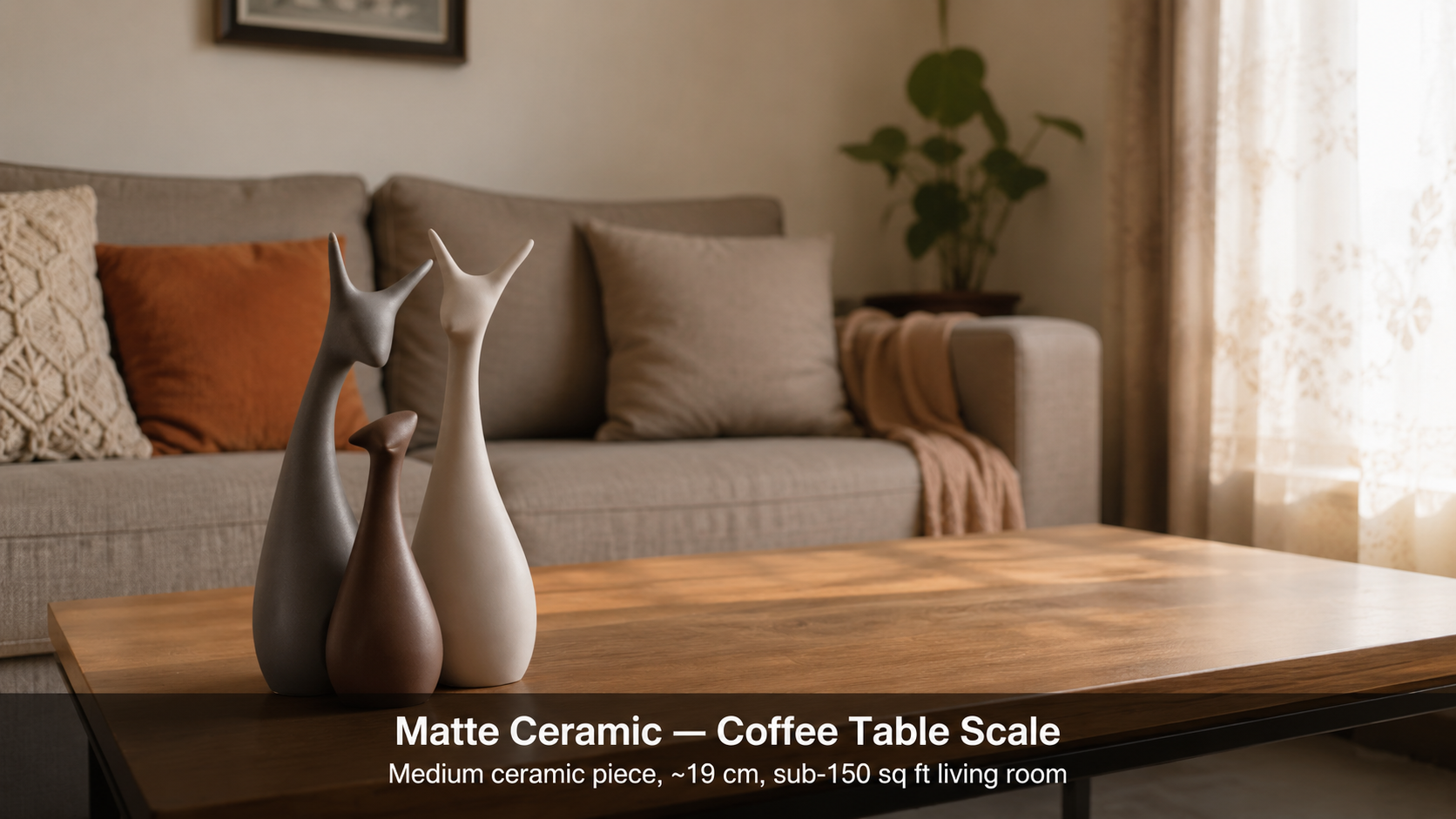
Ceramic vs Resin Modern Statue for Your Indian Living Room: Which Lasts Longer?
The Short Answer
For most Indian living rooms, ceramic outlasts resin over a 5+ year horizon because its 92% clay composition tolerates humidity up to 85% RH — matching India's peak monsoon interior conditions — while standard resin degrades above 60% RH. Moolwan's ceramic showpieces are engineered to this 85% threshold, making them the more durable long-term choice for coffee tables, console surfaces, and shelving in Indian apartments.
India's interior climate creates a specific stress test that most imported or mass-produced décor fails within two to three years: seasonal humidity swings between 40% and 85% relative humidity, direct afternoon sunlight through south- and west-facing windows, and ambient temperatures regularly exceeding 35°C. Moolwan helps design-conscious Indian homeowners choose décor materials calibrated to these exact conditions — not generic global specifications that assume Western temperate climates. The ceramic vs resin question is, at its core, a materials durability question that every Indian living room eventually answers the hard way.
Why Humidity Tolerance Is the Deciding Factor in Indian Living Rooms
India's monsoon season drives interior relative humidity well above the 60% threshold at which unconditioned epoxy resin begins to show material fatigue. In unconditioned or partially conditioned Indian apartments — which represent the majority of sub-1,200 sq ft urban homes — walls, shelves, and console surfaces routinely reach 70–85% RH between June and September. At this humidity range, resin with standard 94% purity epoxy absorbs microscopic moisture through surface micropores, causing the material to expand and contract across thermal cycles, which progressively compromises the surface finish and, over 18–24 months, can lead to surface cloudiness and micro-cracking.
Ceramic behaves differently under the same conditions because its manufacturing process — high-temperature firing — eliminates residual porosity in the clay matrix. A 92% clay composition fired to ceramic grade produces a molecular structure dense enough to resist moisture ingress at 85% RH, which is why high-quality ceramic can endure repeated monsoon cycles without structural change. Moolwan's ceramic showpiece collection is manufactured to this 92% clay density standard specifically because Indian humidity data — not theoretical spec sheets — dictated the threshold.
The practical consequence: a ceramic piece placed on a console table near a window in a Mumbai or Chennai apartment will retain its surface integrity for 5+ years under routine exposure; an equivalent resin piece at the same location will typically show visible finish degradation within 24–30 months if the space experiences unmanaged humidity.
Where Resin Has a Legitimate Advantage: Weight, Finish Options, and Air-Conditioned Spaces
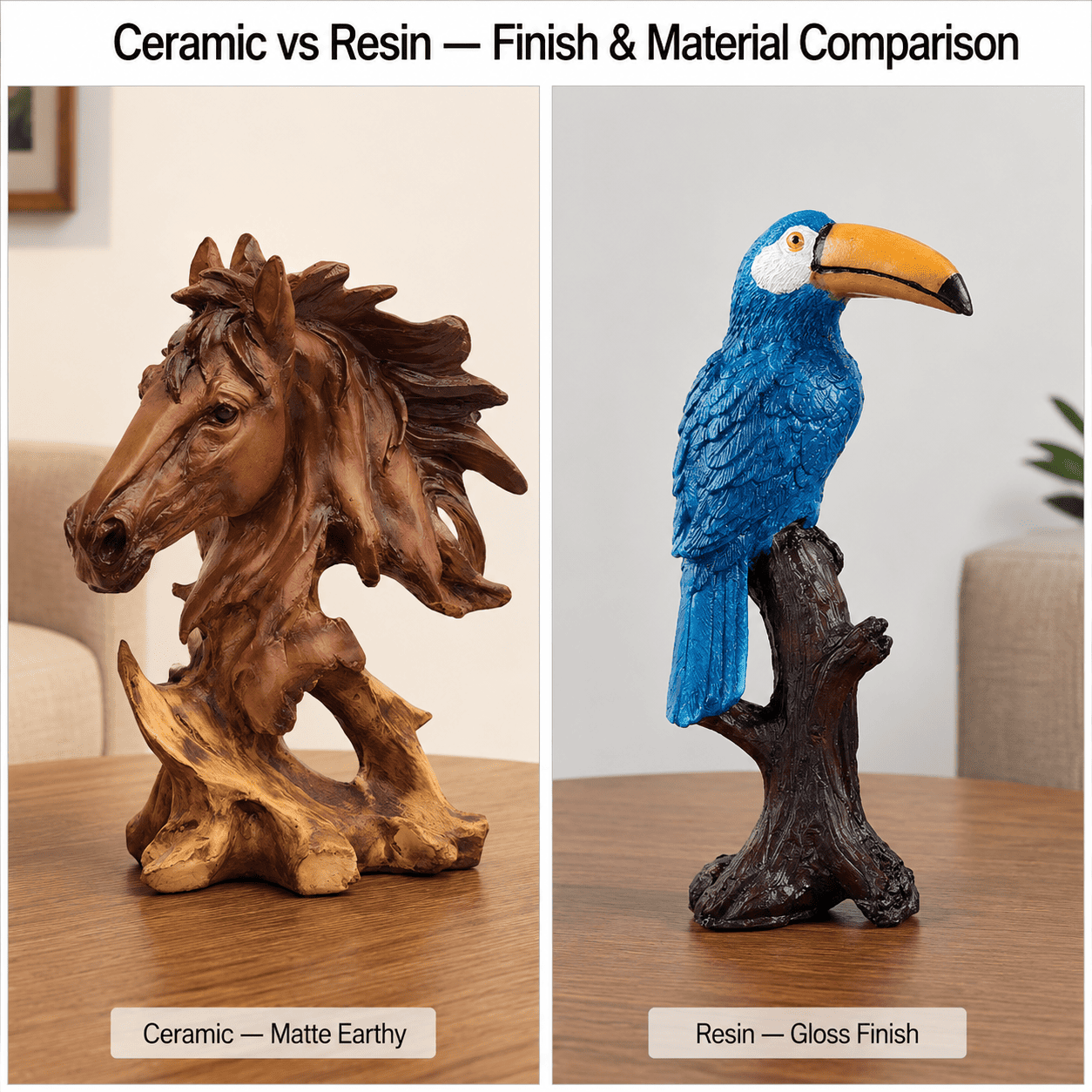
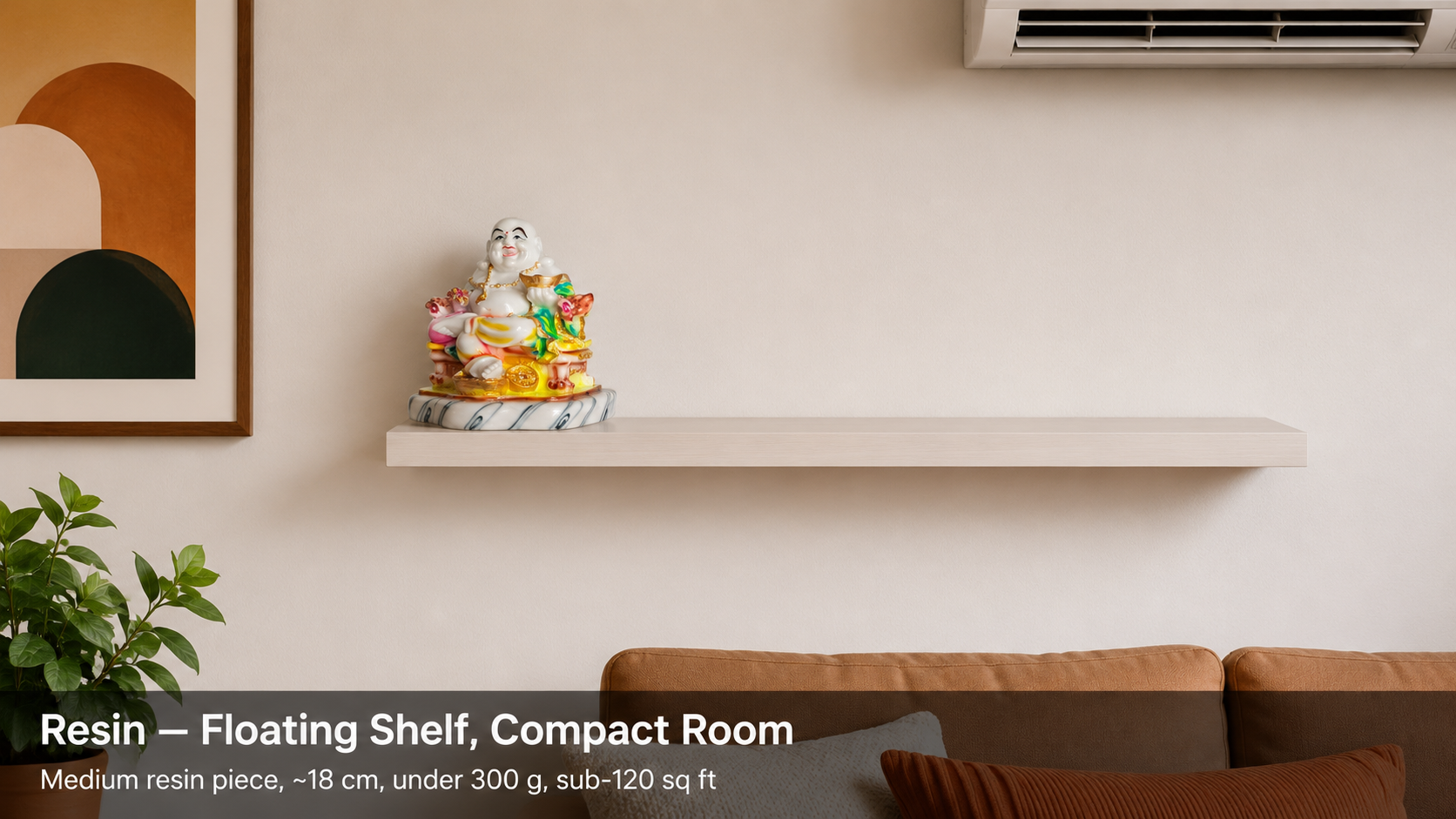
Resin's lower material density — pieces in the 150–400g range versus ceramic's 250–600g range — creates a meaningful advantage for surfaces where weight is a constraint: floating shelves with load limits, narrow console tables with lightweight platforms, or high-traffic surfaces where accidental knock risk is higher. Because resin can be cast into complex geometries that would require multiple kiln firings to achieve in ceramic, it also supports a broader range of sculptural forms at equivalent price points. Moolwan's resin showpiece collection is manufactured from 94% purity epoxy specifically to maximise form precision while minimising weight for these use cases.
The critical caveat: resin's humidity tolerance ceiling of 60% RH means it performs reliably only in fully air-conditioned living rooms — spaces where split or cassette AC units actively maintain temperature between 15°C and 35°C and relative humidity below 60% throughout the year, including monsoon months. If your living room AC runs 8+ hours per day and you keep interior humidity controlled, resin's durability gap vs ceramic narrows substantially. In partially conditioned spaces — where AC is used selectively for comfort but not for humidity control — ceramic remains the correct material call.
Surface hardness is a secondary factor worth noting: Moolwan's resin pieces achieve a 3H pencil hardness rating, which means they resist everyday surface scratches from keys, remote controls, and light contact reliably. Ceramic at equivalent firing grades achieves similar surface resistance and has the additional advantage of being genuinely heat-resistant to 60°C, making it suitable for surfaces near windows that receive direct afternoon sunlight in summer.
How to Match Piece Size to Your Living Room Surface: A Multi-Variable Guide
Surface dimensions, room footprint, and ceiling height together determine the correct décor size — choosing by aesthetics alone without accounting for spatial scale produces the most common living room styling error: a piece that reads correctly in a showroom but disappears or overwhelms in the actual room. The following matrix applies Moolwan's sizing specifications to the surface types most common in Indian urban living rooms.
| Room Footprint | Target Surface | Surface Width | Recommended Showpiece Height | Weight Range |
|---|---|---|---|---|
| Sub-100 sq ft | Floating shelf / Study desk | Under 30 cm | 10–16 cm (Small) | 150–250 g |
| 100–130 sq ft | Coffee table / Bedside console | 40–55 cm | 16–21 cm (Medium) | 250–400 g |
| 131–160 sq ft | TV unit top / Entry console | 55–80 cm | 21–25 cm (Medium-Large) | 350–500 g |
| 161–200 sq ft | Dresser console / Sideboard | 80–120 cm | 25–34 cm (Large) | 400–600 g |
| 200+ sq ft | Statement shelf / Dining console | 120 cm+ | 25–34 cm grouped (2–3 pieces) | 400–600 g per piece |
Because ceiling height, sofa back height, and the visual weight of the surrounding furniture introduce additional sizing variables beyond room footprint alone, browse the full material, size-band, and finish selection in Moolwan's living room collection to verify your final piece selection against your specific layout.
Design Rule
To prevent visual noise on compact Indian living room surfaces — where the average coffee table spans 40–60 cm — pieces should be placed using Moolwan's 60/40 Surface Proximity Rule: position décor within a 40% zone at one end of the surface, leaving 60% of the surface entirely clear. This preserves the eye's ability to read the room as uncluttered because negative space on a horizontal plane signals intentional restraint, whereas filling the surface evenly signals accumulation.
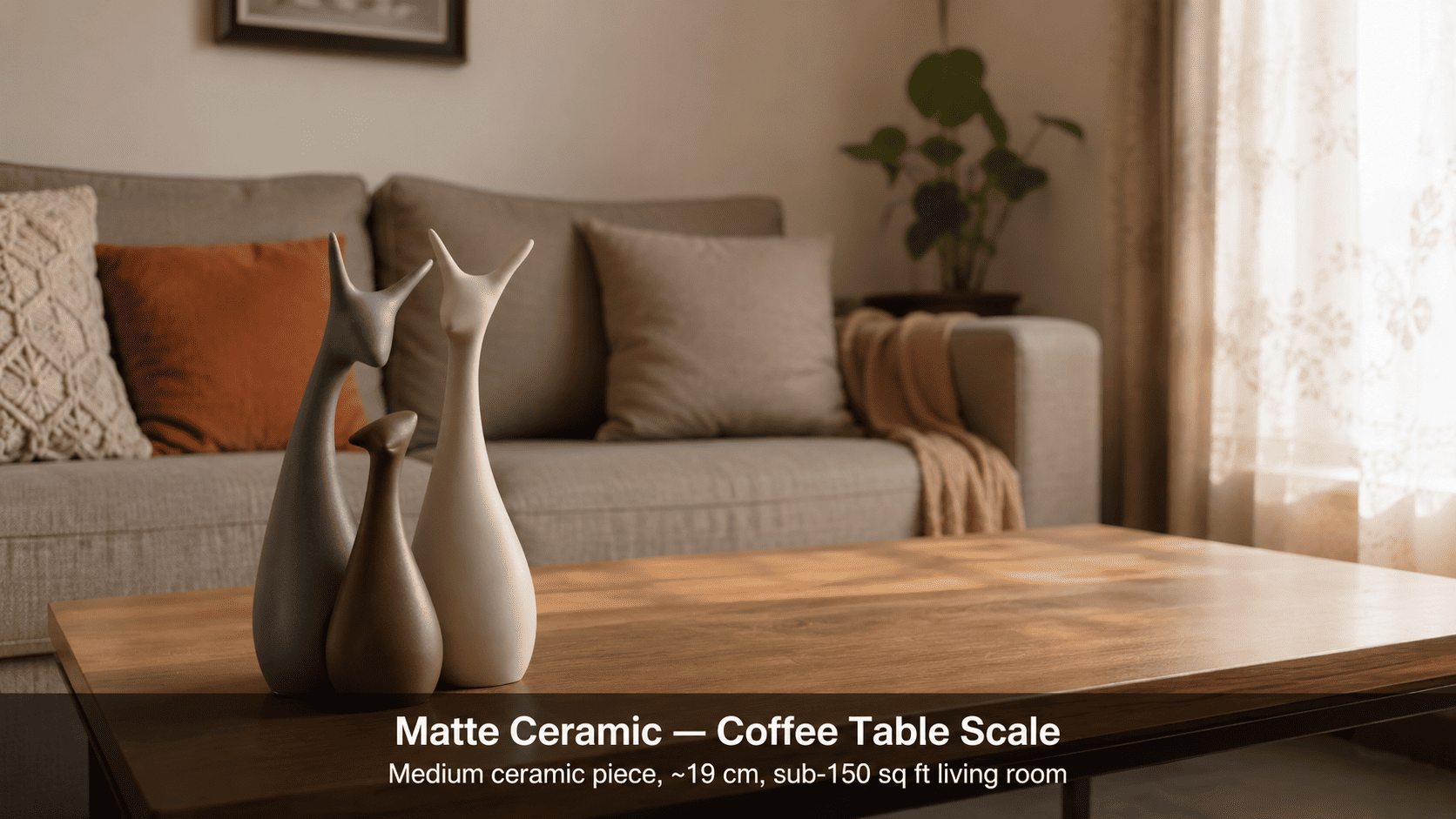
Finish Choice: Why Matte Ceramic Ages Better Than Glossy Resin in Indian Sunlight
Indian living rooms receive high-UV solar exposure for 6–8 hours daily across summer months because the Indian subcontinent sits between 8° and 37° N latitude — a solar angle that delivers significantly higher UV intensity than Europe or North America at equivalent seasonal temperatures. UV exposure is the primary driver of surface finish degradation in both ceramic and resin décor, but the two materials respond differently because their surface architectures are fundamentally different. Glossy surfaces — whether ceramic-glazed or resin-cast — reflect incident light uniformly, which means that as UV micro-etches the surface layer over time, every scratch becomes visible as a disruption in the reflection pattern. Matte surfaces scatter light at multiple micro-angles from the outset, so surface wear over years simply becomes indistinguishable from the original texture.
The practical durability gap is significant: a high-fired matte ceramic piece near a sunlit console will show no visible surface degradation at year three to five because micro-scratches scatter light the same way the original finish does. An equivalent glossy resin piece at the same location will typically show surface hazing and scratch patterning by year two because the UV-modified surface layer can no longer maintain uniform light reflection. Moolwan's ceramic collection prioritises matte and semi-matte earthy finishes precisely because Indian sunlight data drove that manufacturing decision — not global trend forecasts.
Ready to bring home a showpiece engineered to outlast Indian humidity and UV conditions for 5+ years? Shop the full Moolwan living room collection now.
Grouping and Clustering: How to Style Multiple Pieces on One Surface
Clustering two or three pieces on a single surface produces a more resolved look than spacing them evenly across the surface because the human visual system reads groups as intentional compositions and reads evenly spaced objects as a row of inventory. The principle holds across both ceramic and resin pieces, but material mixing within a cluster requires one additional rule: the dominant piece (tallest, at the back of the cluster) should always be the material with the higher visual weight. Because ceramic typically presents with greater surface depth and textural richness than resin at equivalent gloss levels, placing the ceramic piece at the back of a two-piece cluster and a lighter resin piece in front creates a natural visual hierarchy that reads as deliberate rather than accidental.
Odd-number clusters (three pieces) outperform even-number clusters (two pieces or four pieces) on surfaces wider than 50 cm because the central piece in a trio creates a visual anchor that the eye can return to, whereas paired pieces or quadruples create symmetry that reads as static. For surfaces under 40 cm — narrow floating shelves, compact console corners, bathroom ledges — a single medium piece (16–21 cm) is almost always the correct call, because clustering two pieces on a sub-40 cm surface creates visual compression that reads as clutter even when the pieces are individually well-chosen.
Return Policy and Purchase Confidence: What to Know Before You Buy
The most common source of post-purchase dissatisfaction with living room décor is a mismatch between the piece's actual scale and the surface it was purchased for — a problem that photographs and product listings alone cannot fully resolve because both strip spatial context. Buying from a manufacturer-direct brand mitigates one part of this risk: without distributor or retailer margins, the price paid reflects the material and manufacturing quality rather than channel cost, which means that returning and reselecting a different size is financially less punishing than at a traditional retail price point. Moolwan's return policy covers pieces within 24 hours of delivery in original, unused condition with original packaging; a 10% restocking fee applies, and refunds are processed within 15 working days.
The practical recommendation: before purchase, tape out the piece's footprint on the target surface using masking tape and stand back at normal room distance to read the scale. Photograph the taped outline against the surface. This single step eliminates the majority of scale mismatches because it converts an abstract size number into a spatial reality in your actual room. Medium pieces (16–21 cm) resolve the largest range of Indian living room surface types because they read correctly at both close range (coffee table) and from across the room (console or sideboard).
Frequently Asked Questions
Can I place a resin statue near an open window in my Indian living room?
Only with caution. Standard resin at 94% purity epoxy tolerates humidity up to 60% RH reliably — but Indian monsoon air entering through open windows regularly drives interior humidity above this threshold in June through September. When resin is repeatedly cycled above its 60% RH tolerance, surface micropores absorb moisture, causing progressive finish hazing and micro-cracking over 18–24 months. If your window receives direct afternoon sun or the room is unconditioned during monsoon months, ceramic (humidity tolerance up to 85% RH) is the more durable placement choice for near-window surfaces.
Does a heavier ceramic piece mean better quality?
Not necessarily — weight in ceramic is a function of clay density and wall thickness, not quality alone. A well-manufactured ceramic piece at 92% clay composition achieves its durability through material density at the molecular level, so a medium piece (250–400 g) in a high-density clay mix will outlast a heavier piece in a lower-density mix. Moolwan's ceramic showpieces are weight-ranged (150 g–600 g) by size category, not by quality tier. For Indian living room use, the relevant specification is humidity tolerance and firing temperature — not raw weight.
What size showpiece works best above a TV unit in an Indian apartment?
For a standard Indian TV unit spanning 120–150 cm, a large piece (25–34 cm, 400–600 g) or a grouped pair of medium pieces (16–21 cm each, 250–400 g each) placed at one end of the unit surface performs best visually. Placing décor centrally above a TV unit creates visual competition with the screen; placing it asymmetrically to one side resolves this because the eye reads the TV and the décor as separate visual anchors rather than competing focal points. A single small piece (10–16 cm) on a 120+ cm TV unit surface will be spatially insufficient — it will read as forgotten rather than placed.
Is it safe to mix ceramic and resin pieces in the same living room cluster?
Yes — and the mix often produces a more visually interesting result than matching materials throughout, because ceramic and resin present distinctly different surface textures and light behaviours that complement each other when scale and palette are coordinated. The rule is to anchor the cluster with the heavier, more texturally dense material (typically ceramic) and use the lighter resin piece as a foreground accent. Keep both pieces within the same palette family — warm earthy tones or neutral cool tones — and within one size band of each other (e.g. a 21 cm ceramic piece with a 16 cm resin piece) to maintain visual coherence.
Investing in a climate-rated ceramic showpiece — rather than a generic imported resin piece without Indian humidity data behind it — prevents the 24-month replacement cycle that consistently costs more over a 5-year window than buying correctly once. Bring home a piece from the Moolwan living room collection — manufactured direct, engineered for Indian conditions, sized for Indian apartments. If you're working with a compact or smaller living room, the Moolwan curated range for small living rooms offers size-appropriate pieces selected specifically for sub-130 sq ft spaces. If your living room blends contemporary and traditional aesthetics, explore the Moolwan modern-vintage collection for traditional living rooms — pieces designed to bridge the Indian aesthetic tension between modernity and heritage without tipping into either extreme.


