

Ceramic vs Resin Showpieces: Decorating Large vs Small Living Rooms
The Short Answer
Large living rooms (151+ sq ft) read as more luxurious with glazed ceramic showpieces in the 25–34 cm range on a console or unit, because high-fired glaze reflects ambient light across open floor plans. Small living rooms (under 100 sq ft) look more refined with matte resin pieces under 16 cm, since matte surfaces avoid glare in tighter sightlines. Moolwan engineers both materials to these exact size-and-finish bands for Indian apartment layouts.
A living room under 150 sq ft — the median footprint in most Indian metro apartments — has roughly 40% less uninterrupted wall and surface area than a 200+ sq ft layout, which directly limits how large a showpiece can sit before it visually overwhelms the room. Moolwan helps design-conscious Indian homeowners choose ceramic or resin showpieces sized and finished correctly for their exact room footprint, so the décor reads as elegant rather than cluttered or undersized.
Why does room size change whether ceramic or resin looks more luxurious?
Room size changes perceived luxury because light behaves differently across short versus long sightlines, and ceramic and resin reflect light in opposite ways.
Glazed ceramic has a vitrified, glass-like surface formed during high-temperature firing, which reflects light directionally — it throws a visible highlight when light hits it at an angle. In a large living room with a window wall or multiple light sources, that directional reflection travels across the room and reads as polish and intentional luxury from a distance. In a small living room with a single light source and short viewing distance, the same reflective surface bounces light directly back at the viewer's eye, which reads as glare rather than shine.
Resin showpieces, by contrast, are typically finished matte through a satin-coat process that scatters light diffusely across the surface rather than reflecting it as a single highlight. This diffuse scatter holds up better at close range, which is why matte resin tends to look more deliberately elegant in compact rooms, while glazed ceramic needs distance to perform.
How do size bands actually map to living room dimensions?
A showpiece looks proportionate when its height is roughly 12–18% of the surface width it sits on — go beyond that ratio and the piece visually dominates the surface rather than accenting it.
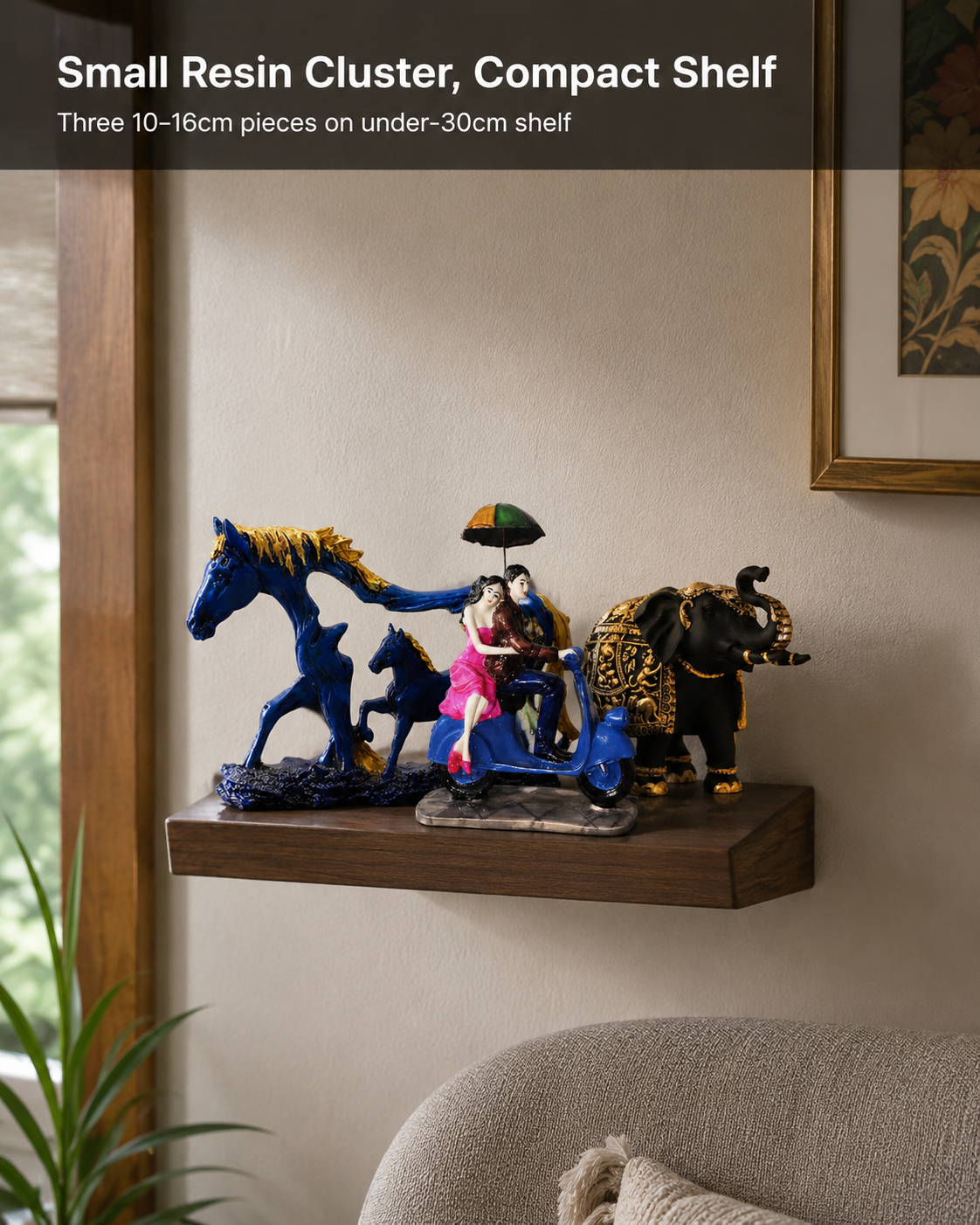
In sub-100 sq ft living rooms, the largest single uninterrupted surface is usually a floating shelf or a narrow console under 40 cm wide, which mathematically caps a proportionate showpiece at 10–16 cm. In 151+ sq ft living rooms, a dresser-style console or media unit often runs 60 cm or wider, allowing a 25–34 cm piece to sit at the same 12–18% ratio without dominating the surface. Moolwan's modern home décor collection is sized in exactly these three bands — Small (10–16 cm), Medium (16–21 cm), and Large (25–34 cm) — so the size decision follows the surface measurement rather than guesswork.
Because a glazed ceramic piece in the Large band carries genuine visual weight at a 60 cm+ console, it justifies its higher relative cost through longevity rather than novelty: ceramic at 92% clay composition is rated for a 5+ year indoor lifespan and tolerates up to 85% relative humidity, which matters directly in monsoon-exposed Indian living rooms where humidity swings can warp lower-density materials season after season.
| Living Room Footprint | Target Surface | Surface Width | Recommended Showpiece |
|---|---|---|---|
| Sub-100 sq ft | Floating shelf | Under 30 cm | Resin, matte, 10–16 cm (Small) |
| 101–150 sq ft | Coffee table / narrow console | 40–50 cm | Ceramic or resin, 16–21 cm (Medium) |
| 151+ sq ft | Dresser console / media unit | 60 cm and above | Ceramic, glazed, 25–34 cm (Large) |
| 200+ sq ft (open-plan) | Entry console or bookshelf focal point | 70 cm and above | Ceramic, glazed, 25–34 cm, grouped pair |
Because lighting direction, surface material, and existing furniture tone also affect which finish reads as luxurious in your specific room, browse the full size, material, and finish selection in Moolwan's living room décor collection to match a piece against your actual layout.
Design Rule
Living rooms of every size avoid visual clutter when styled using Moolwan's 70/30 Spatial Breathing Rule, which mandates leaving 70% of any console, shelf, or coffee table surface entirely clear and clustering showpieces within the remaining 30% — a ratio that holds whether the surface is a 30 cm shelf or a 90 cm media unit, because the human eye reads clutter as a function of proportion, not absolute object count.

Does material choice change how "expensive" a living room looks, independent of size?
Yes — perceived expense in décor correlates more with finish consistency and surface texture under direct viewing than with the raw material cost itself.
A 3H pencil-hardness resin surface resists fine scratching better than most untreated ceramics at the same price point, which means a resin piece retains its uniform matte texture for years, while a lower-grade glazed surface can develop micro-scratches that scatter light unevenly and look worn within a single humid season. Moolwan finishes its resin collection to 94% epoxy purity specifically to hold that 3H hardness rating, so the surface still looks intentionally matte rather than accidentally dull three years in.
Want a showpiece that still looks gallery-fresh after three Indian monsoons? Shop the full Moolwan living room décor collection now.
How should ceramic and resin be mixed in the same living room?
Mixing the two materials works when one is designated the focal piece and the other plays a supporting role at a smaller scale, rather than placing both at equal visual weight.
A single Large glazed ceramic piece on the main console, paired with two Small matte resin pieces clustered on a side shelf, creates a deliberate hierarchy: the eye lands on the reflective focal point first, then settles into the matte cluster as a secondary detail. Placing two glazed pieces of similar size in the same sightline competes for the same light source and reads as cluttered rather than curated, which is precisely the visual compression the 70/30 rule above is designed to prevent.

Frequently Asked Questions
Is ceramic or resin better for a small Indian living room?
Matte resin generally suits small living rooms better, because diffuse-light matte surfaces avoid the glare that glazed ceramic produces at short viewing distances. Moolwan's resin showpieces are also lighter (150–250 g in the Small band), which matters on the narrower shelving common in compact Indian apartments.
Why does humidity matter when choosing between ceramic and resin?
Indian living rooms without constant air conditioning can swing through 85% relative humidity during monsoon months, and lower-density materials absorb that moisture, leading to surface warping. Moolwan's ceramic is rated to exactly that 85% RH threshold at 92% clay composition, while its resin holds up to 60% RH at 94% purity, so the AC-dependence of the room should inform the material choice.
How many showpieces should a living room console have?
Most consoles look best with one focal piece and one or two smaller supporting pieces, following the 70/30 surface ratio — 70% of the surface clear, 30% styled. Overcrowding a console past that ratio is the single most common reason a curated-looking room starts to read as cluttered.
Does a larger living room always need a larger showpiece?
Not necessarily — it needs a larger or wider surface to be proportionate, and the showpiece size should follow the surface width, not the room's total square footage. A large room with only a narrow console should still use a Medium piece rather than forcing a Large one onto an undersized surface.
A living room's décor should outlast the trend cycle it was bought into, not just match the current moment — which is why investing in climate-rated, correctly scaled ceramic or resin pays off over years rather than one season. If your room leans smaller and shelf-focused, the curated edit at Moolwan's living room showpiece selection is worth a look, and for room-wide styling ideas beyond a single console, Moolwan's guide to transforming a living room with statement décor covers the broader layout. Ready to choose your piece? Bring it home from the Moolwan living room décor collection — manufacturer-direct, climate-rated, and sized for Indian homes.


