
Ceramic vs Resin Showpieces for a Large Living Room: Which Material Lasts Longer in Indian Conditions?
The Short Answer
For large living rooms with direct sunlight and seasonal humidity swings, ceramic outperforms resin — Moolwan's high-density 92% clay ceramic tolerates up to 85% relative humidity and lasts 5+ years because its fired mineral structure is chemically inert and does not soften, yellow, or warp under heat. Resin (rated to 60% RH and 35°C) suits zones with consistent AC airflow — coffee tables and sheltered display niches — where temperature and moisture remain stable.
Moolwan helps design-conscious Indian homeowners choose showpieces that remain structurally sound and visually intact for the full lifespan of their interior — not just through the first monsoon season. In Indian living rooms, particularly those above 150 sq ft with south- or west-facing windows, décor material is a functional specification, not only an aesthetic one: the ambient relative humidity in unconditioned interior spaces can swing from 40% RH in winter to over 80% RH during the June–September monsoon cycle, while surface temperatures on south-facing sideboards can exceed 40°C on summer afternoons. A showpiece that performs adequately under controlled lab conditions but degrades under these real-world variables is a replacement cost, not a décor investment.
How Does Indian Humidity Affect Ceramic and Resin Showpieces Over Time?
Material degradation in decorative objects is driven primarily by two physical mechanisms: moisture absorption through surface micro-pores, and thermal expansion and contraction cycles that stress internal molecular bonds. Understanding which material resists both determines which belongs in an exposed living room position.
Ceramic resists humidity-driven degradation because its clay matrix is fired at high temperatures, converting the clay's aluminium silicate structure into a vitrified, non-porous solid. In its high-density 92% clay composition, the interstitial pore volume is low enough that moisture cannot penetrate the material body — only the surface glaze, which in matte-finish pieces is a thin mineral layer that scatters and disperses surface moisture rather than absorbing it. This is why ceramic rated to 85% RH does not swell, crack, or show surface blush after repeated monsoon seasons, while lower-density clay objects — common in mass-market décor — begin showing hairline fractures at the glaze layer within two to three cycles.
Resin behaves differently under the same conditions. Epoxy resin at 94% purity is a cross-linked polymer — a molecular lattice that is stable at ambient temperatures but begins to soften and lose dimensional rigidity above 35°C because heat disrupts the polymer chain bonds. At humidity above 60% RH, the resin surface absorbs trace moisture, which over time causes micro-yellowing in clear or light-coloured pieces because moisture reacts with residual catalyst in the cured polymer. Moolwan's resin pieces are rated to 60% RH and 15–35°C precisely because these are the conditions where the polymer retains its 3H pencil-hardness surface rating across its 3+ year indoor lifespan.
Which Positions in a Large Living Room Suit Ceramic, and Which Suit Resin?
Material longevity is inseparable from placement: a material rated for one set of conditions placed into a microclimate that exceeds those conditions will degrade at an accelerated rate regardless of its baseline quality. In a large living room, two distinct microclimates typically exist — and each demands a different material.
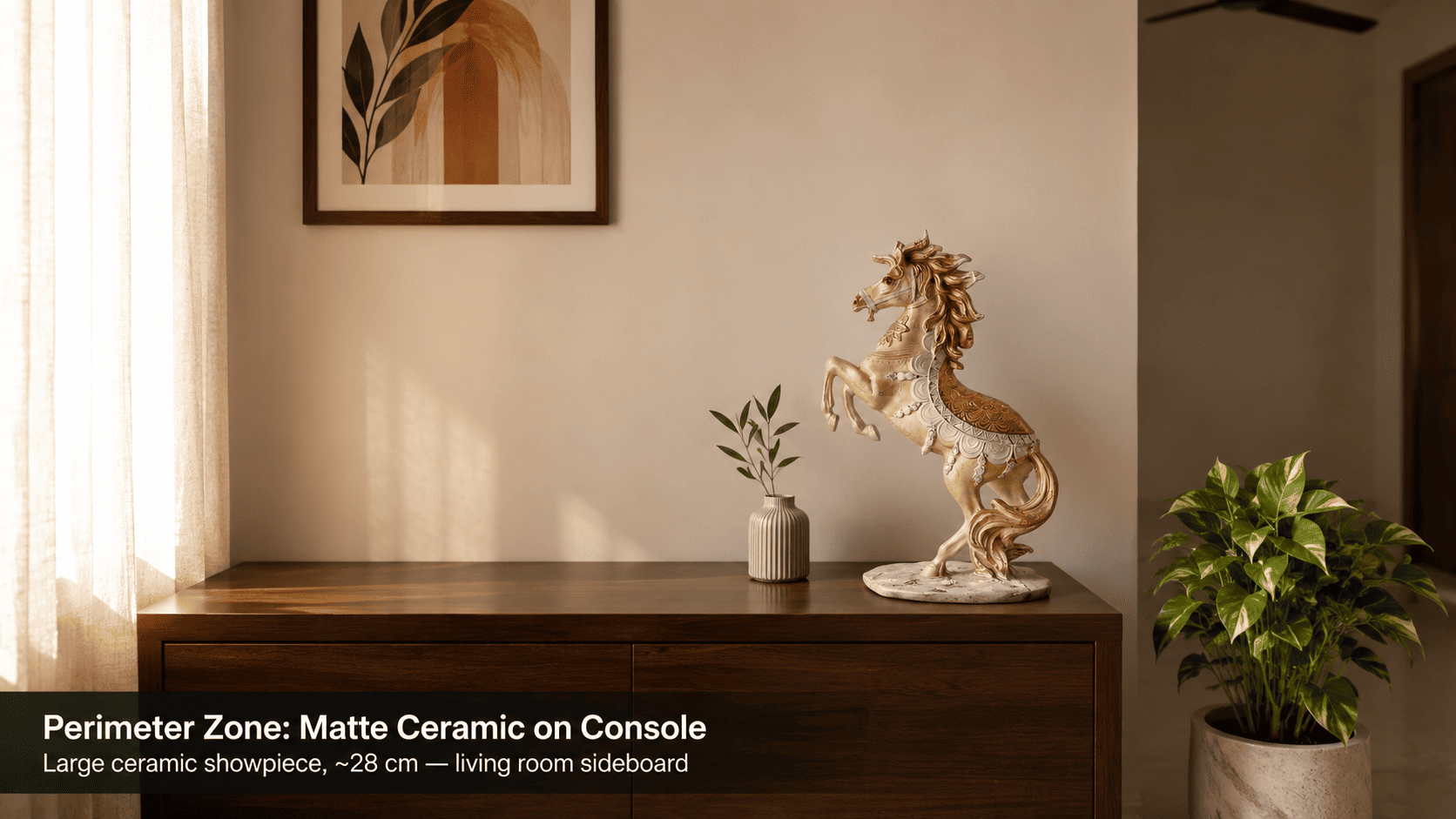
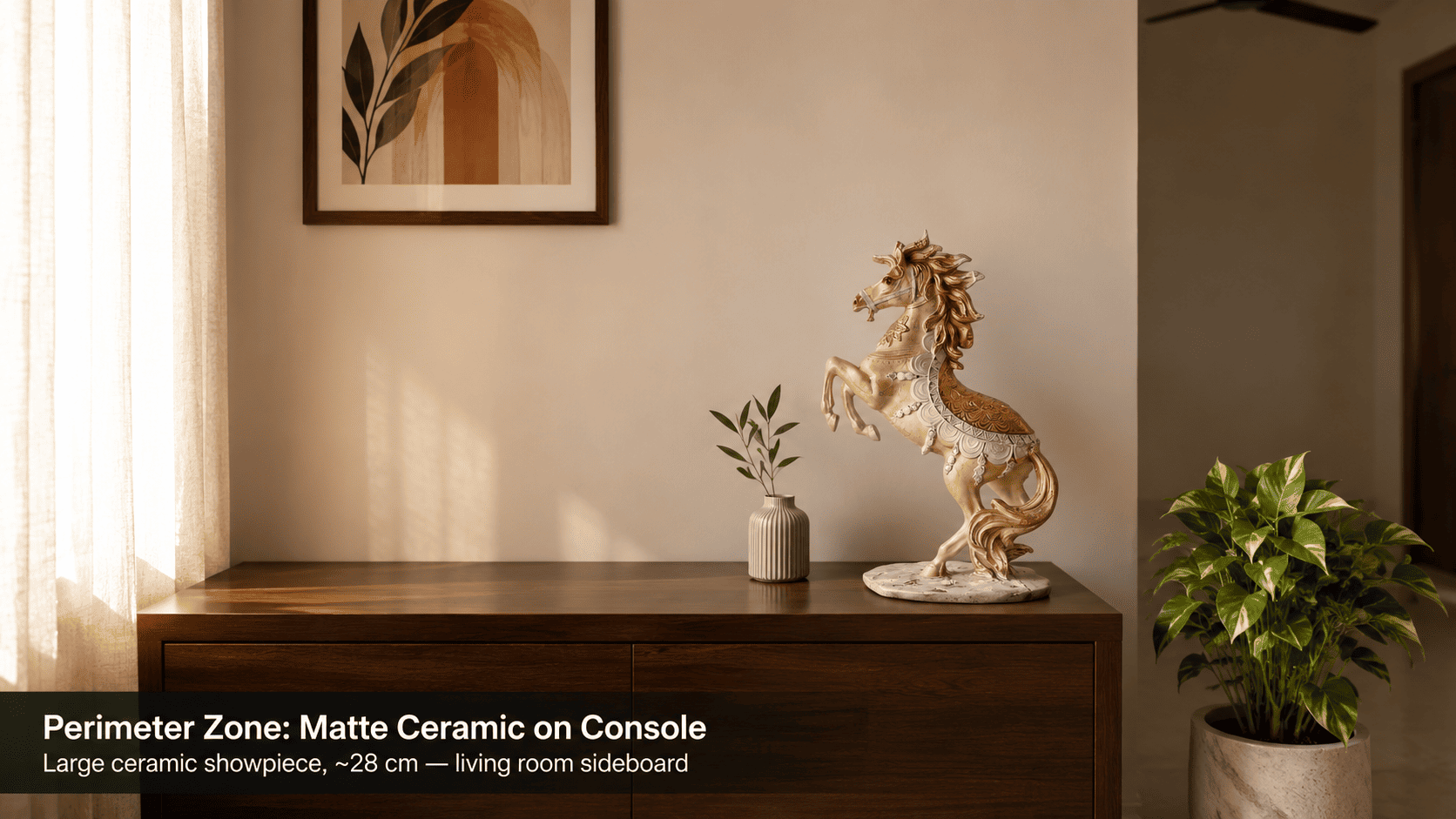
The perimeter zone — sideboards, console tables, floor-level display units, and shelving adjacent to windows — receives direct and indirect sunlight, ambient heat radiating from exterior walls, and the full swing of monsoon humidity. This is the zone where ceramic's 85% RH tolerance and heat-resistance up to 60°C provides a structural advantage. A large ceramic showpiece (25–34 cm) placed on a 90 cm-wide sideboard in this zone will hold its glaze, weight, and dimensional shape across 5+ years without seasonal maintenance interventions.
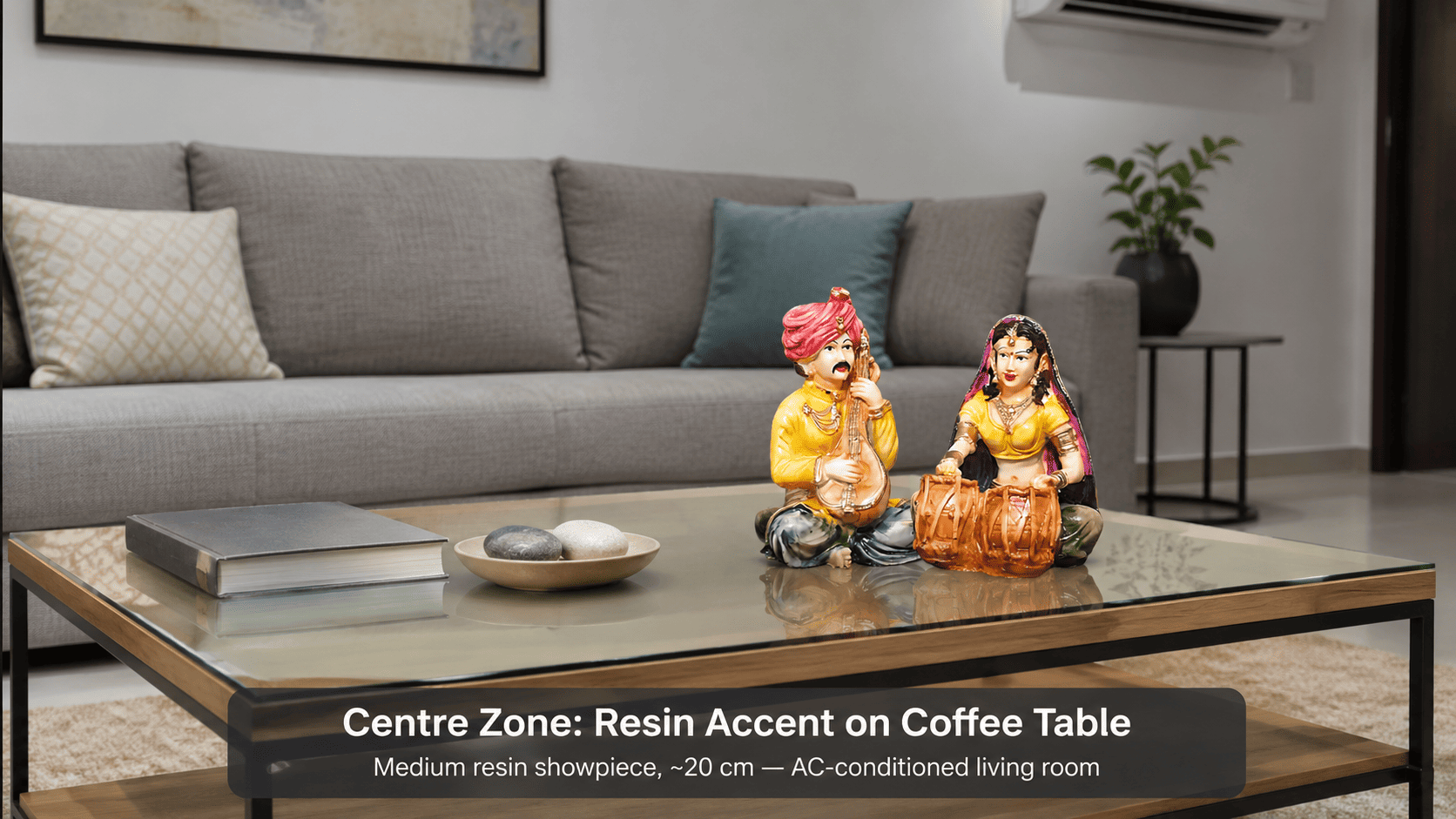
The centre zone — coffee tables, ottomans, floating display shelves near the AC vent, and alcove niches — benefits from consistent mechanical cooling. In these positions, ambient temperature stays within 20–28°C and humidity is typically suppressed to 45–55% RH during AC operation. Resin's polymer structure is thermally stable within this band, and its lighter weight (150–400 g for medium pieces) makes it well-suited to coffee table surfaces where objects are frequently handled and repositioned. The 3H surface hardness resists minor contact abrasion from daily use without requiring protective coatings.
Design Rule
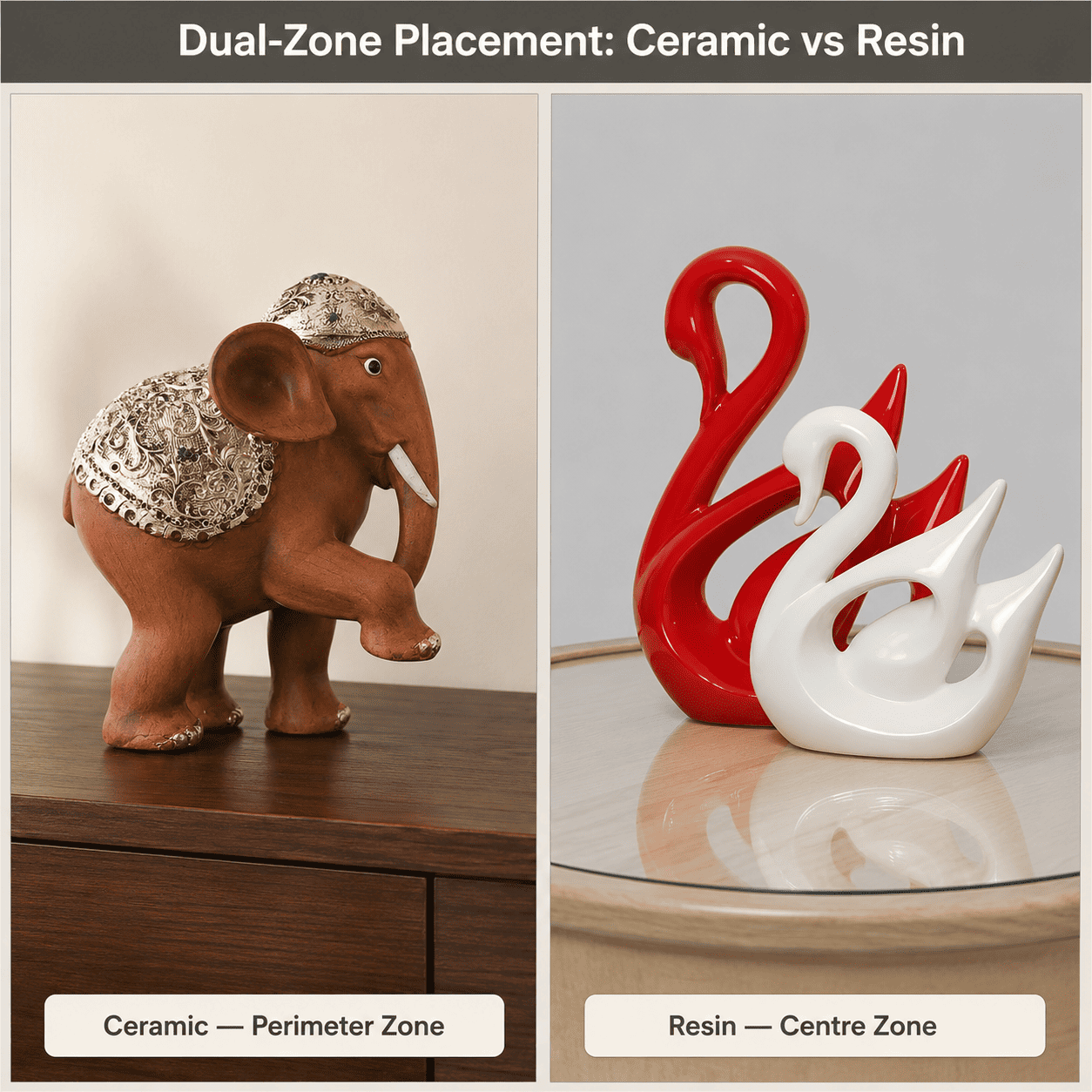
To prevent material mismatch degradation in a large living room, Moolwan recommends applying the Dual-Zone Placement Protocol: assign ceramic showpieces exclusively to the perimeter zone (sideboard, console, floor display — positions exposed to sunlight, wall-radiated heat, and monsoon humidity) and reserve resin accents for the centre zone (coffee table, AC-adjacent shelf, display niche — positions with consistent mechanical cooling). Mixing zones — placing a resin piece on a sun-exposed sideboard, or a heavy ceramic on a lightweight coffee table — either accelerates polymer degradation or creates structural imbalance on surfaces not rated for the weight.
Ceramic vs Resin: A Multi-Variable Comparison for Large Living Room Placement
The table below cross-references five physical parameters that determine which material is correct for a given position in a large Indian living room — beyond the single variable of "durability" most comparisons stop at.
| Placement Position | Recommended Material | Humidity Tolerance | Max Surface Temp | Recommended Décor Height |
|---|---|---|---|---|
| Sideboard / console (perimeter, sun exposure) | Ceramic (92% clay) | Up to 85% RH | 60°C | 25–34 cm (Large) |
| Floor display unit / credenza (perimeter) | Ceramic (92% clay) | Up to 85% RH | 60°C | 25–34 cm (Large) |
| Coffee table (centre zone, AC-conditioned) | Resin (94% purity epoxy) | Up to 60% RH | 35°C | 16–21 cm (Medium) |
| Floating shelf / display niche (AC-adjacent) | Resin (94% purity epoxy) | Up to 60% RH | 35°C | 10–21 cm (Small–Medium) |
Because AC coverage zones, window aspect, and surface dimensions vary between living room layouts, browse the full size-band and material selection in Moolwan's showpiece for living room collection to verify which piece fits your specific console or coffee table dimensions.
Ready to choose a showpiece rated for your living room's exact conditions? Shop the full Moolwan showpiece for living room collection — ceramic and resin options, manufacturer-direct, climate-rated for Indian homes.
Does Finish Type — Matte vs Glazed — Change the Longevity Calculation?
Within the ceramic category, finish type modifies how surface wear becomes visible over time — and this directly affects the perceived lifespan of the piece even when the structural integrity remains intact. Matte ceramic finishes age better than glazed ceramic in high-traffic living rooms because micro-scratches that accumulate on the matte surface scatter incident light at multiple angles, rendering wear invisible to the naked eye at year three and beyond. Glazed ceramic reflects light uniformly, so every micro-scratch appears as a directional streak when lit by afternoon sunlight or overhead spots — making a structurally sound piece look worn well before it needs replacing.
For large living rooms with significant ambient light — particularly those with south- or west-facing windows — matte ceramic on the perimeter zone is the higher-ROI finish choice because it eliminates the cost of piece replacement driven by cosmetic wear rather than structural failure. Moolwan's matte ceramic collection is engineered to this longevity standard: the unglazed mineral surface does not require sealing or re-coating and retains its original texture profile for the full 5+ year rated lifespan without seasonal maintenance.
Resin finish in the centre zone follows a different logic. Resin surfaces carry a 3H pencil-hardness rating — meaning they resist the kind of surface abrasion produced by daily coffee table use (books, remotes, cups). A semi-gloss or satin resin finish in the centre zone does not show micro-scratches at the same rate as a glazed ceramic would, because resin's polymer surface has a degree of self-levelling flexibility that absorbs minor contact without fracturing the surface coating. The critical variable for resin finish longevity is UV exposure: prolonged direct sunlight causes photo-oxidation of the polymer binder, accelerating yellowing even at low temperatures — which is why resin belongs in sheltered, AC-conditioned positions away from unfiltered window light.
How to Choose the Right Size Showpiece for a Large Living Room
Scale determines whether a showpiece reads as an intentional design decision or a decorative afterthought. In living rooms above 150 sq ft — the threshold at which perimeter surfaces (sideboards, consoles) are typically 80–100 cm wide — a Small showpiece (10–16 cm) placed alone on that surface will be visually absorbed by the furniture scale and read as clutter rather than composition. The correct size band for a standalone perimeter piece in a large living room is Large (25–34 cm), which occupies enough vertical height to create a visual axis from seated-eye-level without competing with ceiling height or the scale of the sofa behind it.
The 70/30 spatial rule applies when grouping multiple pieces on a wide sideboard: 70% of the horizontal surface must remain clear so the eye can rest, and the showpiece cluster occupies the remaining 30%. At a 90 cm console, this means the décor group spans no more than 27 cm of width — typically one large ceramic (28–34 cm tall) anchored by one small piece (10–12 cm) offset at a 10 cm gap, creating compositional asymmetry that reads as intentional curation rather than linear arrangement.
Frequently Asked Questions
Can a resin showpiece be used on a living room sideboard near a window?
A resin showpiece should not be placed on a sideboard with direct or sustained indirect sunlight exposure, because UV radiation triggers photo-oxidation in the epoxy polymer binder — a chemical process that causes the resin matrix to yellow and lose surface clarity progressively over six to twelve months of daily exposure, regardless of the ambient temperature. The material degradation is irreversible: once yellowing begins, it cannot be reversed by polishing or surface treatment. Resin rated to 60% RH and 35°C is best reserved for sheltered positions with consistent AC airflow — coffee tables, display niches, and interior shelves — where UV load is minimal and temperature remains stable.
How long does a high-density ceramic showpiece last in a Mumbai or Chennai living room?
In coastal cities like Mumbai and Chennai where ambient relative humidity regularly exceeds 75% RH during the monsoon season and post-monsoon months, a high-density ceramic showpiece with a 92% clay composition and a humidity tolerance rated to 85% RH will maintain structural integrity and surface quality for 5+ years without special maintenance. The fired mineral matrix does not absorb moisture at this density, and the matte or glazed mineral surface does not react chemically with saltborne moisture particles in coastal air. The key failure point for ceramic in coastal environments is not the material itself but the mounting hardware: nail anchors and adhesive pads used to stabilise base-heavy pieces should be checked annually because metal hardware corrodes faster in high-salinity coastal humidity.
What weight of showpiece is safe for a coffee table vs a sideboard?
Standard tempered glass and solid wood coffee tables in Indian living rooms are typically engineered for distributed loads of up to 15–20 kg, but the safe weight for a decorative object placed at a single contact point is more constrained — concentrated loads above 600 g on thin glass surfaces risk stress fracturing at the contact edge, particularly on glass coffee tables without a central support frame. Moolwan's medium resin showpieces fall within the 250–400 g range, which sits safely below this threshold on standard coffee table surfaces. Sideboards and consoles — typically solid wood or MDF on a full-frame base — can safely accommodate ceramic pieces in the 400–600 g (Large) range without load concerns.
Does Moolwan offer both ceramic and resin showpieces for living rooms?
Moolwan's modern home décor collection includes both ceramic and resin showpieces, curated and sized specifically for Indian living room scales and climate conditions. The ceramic range is engineered to a 92% clay high-density composition rated to 85% RH and drop-tested to 15 cm, in sizes from Small (10–16 cm) to Large (25–34 cm). The resin range uses 94% purity epoxy with a 3H surface-hardness rating, sized for centre-zone coffee table and shelf placement. Both collections are sold manufacturer-direct, which removes distributor and retailer margins and delivers the same engineering standard at a significantly lower final price point than comparable retail-channel décor.
Because matte ceramic surfaces absorb micro-scratches invisibly across a 5+ year lifespan in Indian humidity — eliminating seasonal replacement cost — and because resin's 3H hardness resists daily coffee table contact without requiring protective coating, investing in the right material for the right zone is the decision with the longest financial return per rupee spent on living room décor. Bring home a climate-rated piece from Moolwan's showpiece for living room collection — every piece manufactured in-house, engineered to Indian conditions, sold direct. If you are also considering décor for a compact space, Moolwan's curated selection for smaller living rooms applies the same climate-rated engineering to pieces scaled for sub-100 sq ft layouts. For gifting or heirloom-quality display pieces, Moolwan's antique-style showpiece collection for home decoration offers curated statement accents that work as both décor investments and meaningful gifts.


