
Ceramic vs Resin Showpieces for Indian Living Rooms: Which Material Lasts in Heat and Humidity?
The Short Answer
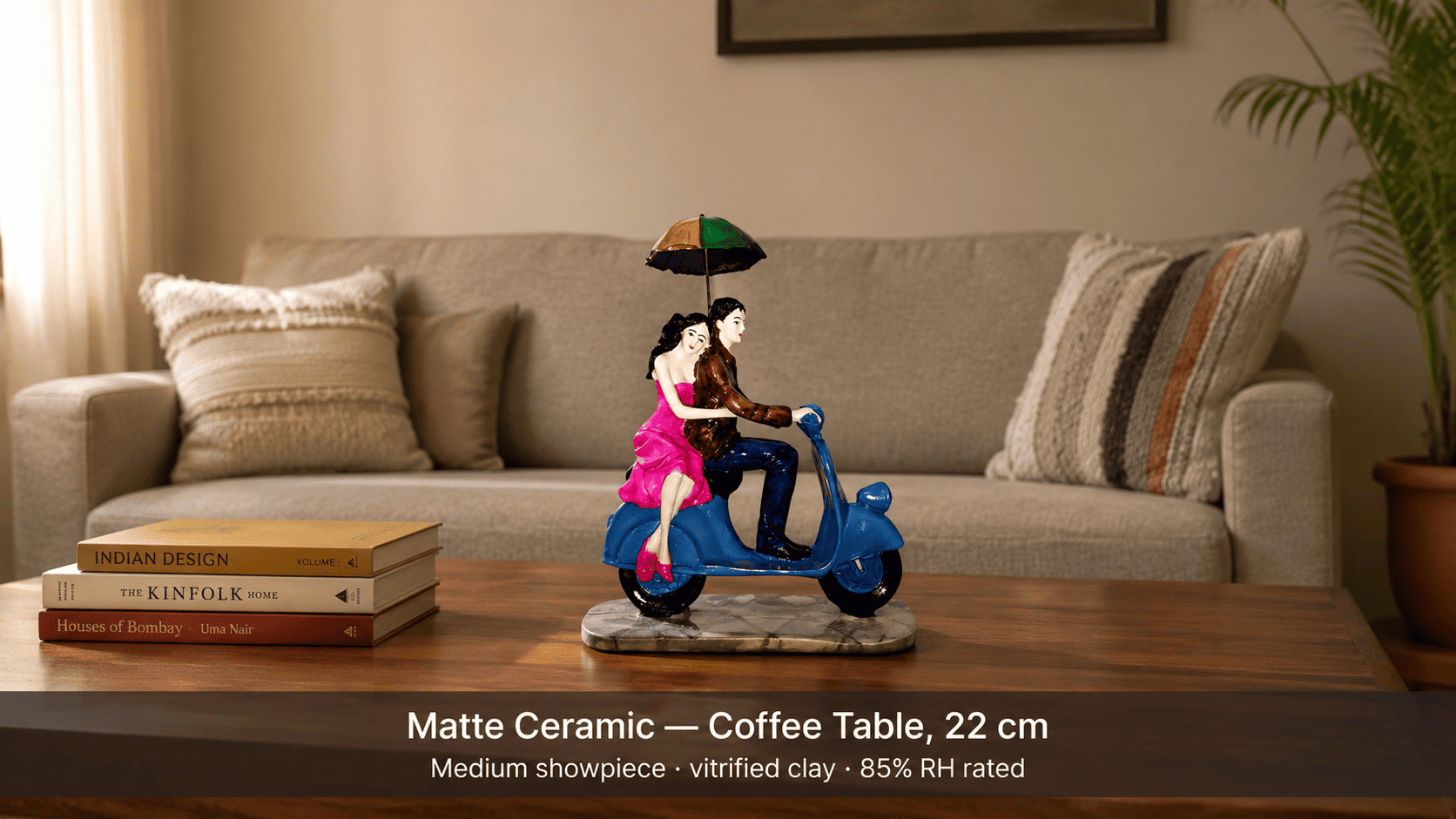
For Indian living rooms that reach 85% relative humidity during monsoon and 35°C+ in summer, ceramic is the safer long-term material — its 92% clay composition is inert to both moisture and heat, preventing structural deformation that resin becomes susceptible to above 35°C. Moolwan's ceramic showpieces are rated to 85% RH and 60°C, making them the default choice for unconditioned or semi-conditioned rooms. Resin suits air-conditioned rooms that stay below 35°C year-round.
Indian living rooms are not a stable climate. Relative humidity swings from 40% in winter to 85% or higher during monsoon; afternoon surface temperatures on south- and west-facing shelves can exceed 45°C in May and June. Most imported décor is engineered for temperate European or North American interiors and fails these thresholds silently — warping, crazing, or yellowing within two to three years. Moolwan helps design-conscious Indian homeowners choose showpieces that are engineered for these exact conditions, so a piece bought today still looks right in year five.
Why Indian Climate Conditions Stress Decorative Materials More Than Buyers Expect
At 85% relative humidity, materials that absorb even trace amounts of atmospheric moisture begin to experience micro-expansion in their structural matrix. In low-density polymers — the base of most budget resin — this moisture uptake is cumulative, meaning each monsoon season adds a fractional degree of dimensional change that becomes visible as surface blooming, colour shift, or base warping by year two or three.
Ceramic responds differently because high-fired clay at 92% purity undergoes vitrification during manufacture — a process in which silica particles fuse into a glass-like matrix that is structurally sealed against moisture absorption. The result is a material with near-zero moisture uptake, which is why ceramic cookware and tiles have been used in tropical climates for centuries without structural failure.
Heat compounds the problem for resin. Standard epoxy resin begins to soften at its glass transition temperature (Tg), which for 94% purity epoxy sits between 35°C and 45°C depending on formulation. A showpiece placed on a south-facing console shelf in a Bengaluru or Chennai apartment in May can reach surface temperatures of 42–46°C through radiant heat alone — within the softening range — causing the base to deform under its own weight over repeated heat cycles.
How Ceramic and Resin Differ Structurally, and What That Means for a 5-Year Lifespan
The core structural difference is density and thermal stability. High-fired ceramic at 92% clay composition achieves a fired density of approximately 1.8–2.2 g/cm³, with a heat tolerance of up to 60°C before any structural change occurs. This density means the material does not flex under ambient thermal cycling, which is why a ceramic showpiece on an unconditioned shelf retains its dimensional geometry through repeated summer–monsoon–winter cycles.
Resin at 94% epoxy purity has a density of approximately 1.1–1.3 g/cm³ and a practical indoor temperature ceiling of 35°C before micro-softening begins. In a fully air-conditioned living room maintained at 22–24°C year-round, this threshold is never breached, and a high-purity resin piece can achieve a 3+ year lifespan with correct placement. The problem is that Indian homes — particularly in metros outside of fully sealed apartments — rarely maintain a stable 22°C through the full calendar year.
Moolwan's resin collection is formulated to 94% purity epoxy with a 3H pencil hardness rating, which means surface scratching from normal handling is negligible. The caveat is the 60% RH and 35°C ceiling: below both thresholds, the lifespan and finish durability are comparable to ceramic; above either, ceramic becomes the rational long-term choice.
Matte finishes on both materials age more gracefully than glazed finishes in high-use rooms because micro-scratches from incidental contact scatter light at multiple angles, dispersing the evidence of wear rather than concentrating it into visible streaks that glazed surfaces highlight.
| Material | Humidity Tolerance | Heat Ceiling | Pencil Hardness | Recommended Room Type |
|---|---|---|---|---|
| Ceramic (92% clay) | Up to 85% RH | 60°C | High (vitrified surface) | Any Indian living room — conditioned or unconditioned |
| Resin (94% epoxy) | Up to 60% RH | 35°C | 3H | Fully air-conditioned rooms only (22–24°C maintained year-round) |
| Ceramic — matte finish | Up to 85% RH | 60°C | High | High-dust or high-touch surfaces (coffee table, console) |
| Resin — matte finish | Up to 60% RH | 35°C | 3H | Enclosed display shelves in AC rooms, low-touch surfaces |
Because room orientation, AC runtime hours, and shelf proximity to windows introduce additional climate variables that affect the practical ceiling of each material, browse the full material-band and size selection in Moolwan's living room showpiece collection to verify the right fit for your specific room conditions.
Design Rule
When selecting a decorative showpiece for an Indian living room, apply Moolwan's Material-Climate Fit Rule: if the room is unconditioned for more than four months of the year — including monsoon — choose ceramic over resin, because ceramic's vitrified 92% clay matrix is the only common decorative material that remains dimensionally stable at both 85% RH and 60°C simultaneously, which are the two climate stress peaks that cause the most visible long-term degradation in Indian interiors.
Which Surface in Your Living Room Determines the Right Size and Material
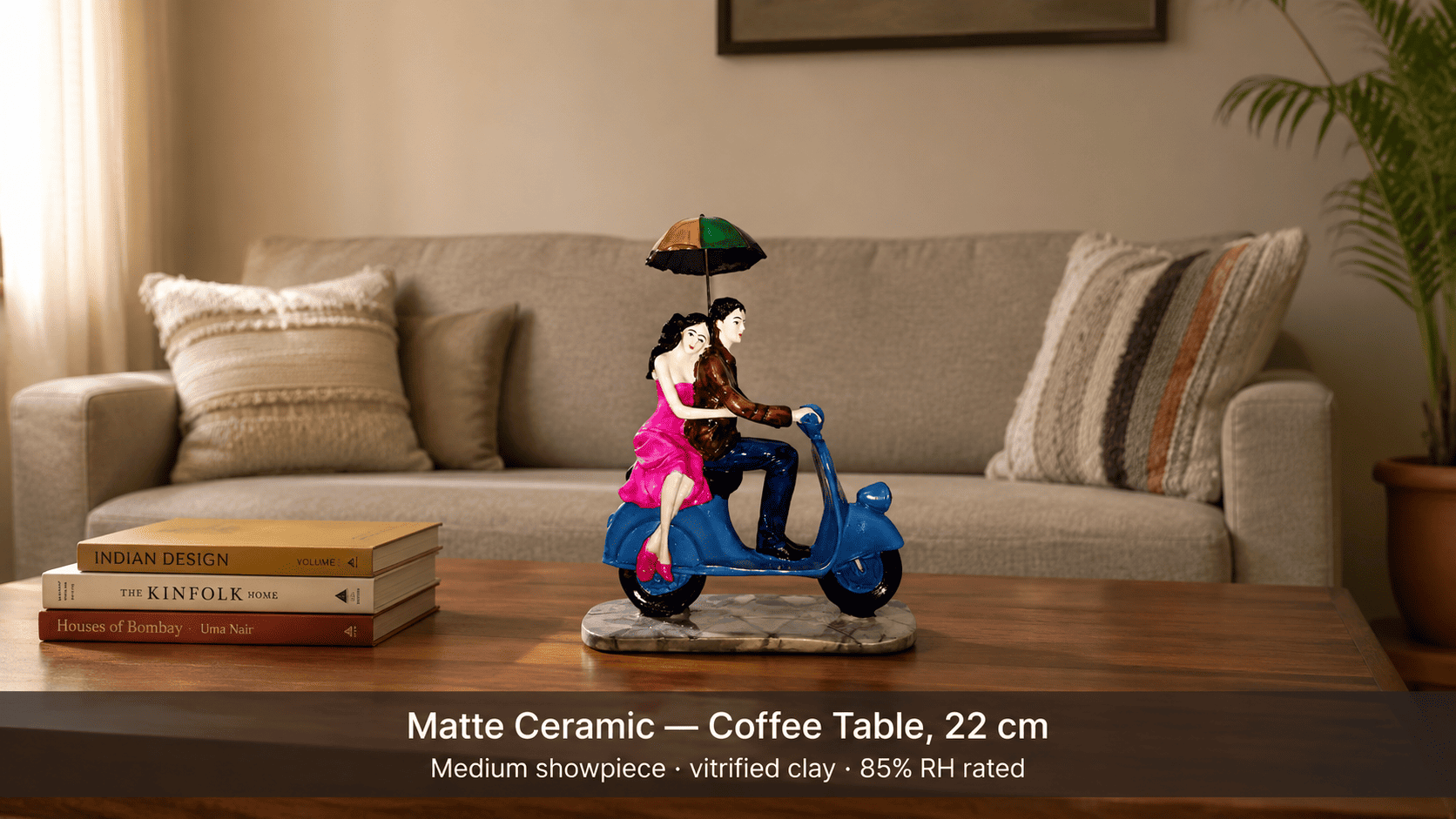
The surface a showpiece sits on governs both the size band and the material priority. Surfaces with direct sunlight exposure — south-facing window consoles, open shelves near glass doors — compound heat stress on any material, making ceramic the non-negotiable choice regardless of AC status. Enclosed shelves in the interior of the room with no direct sunlight contact are the only surfaces where resin performs comparably to ceramic in Indian conditions.
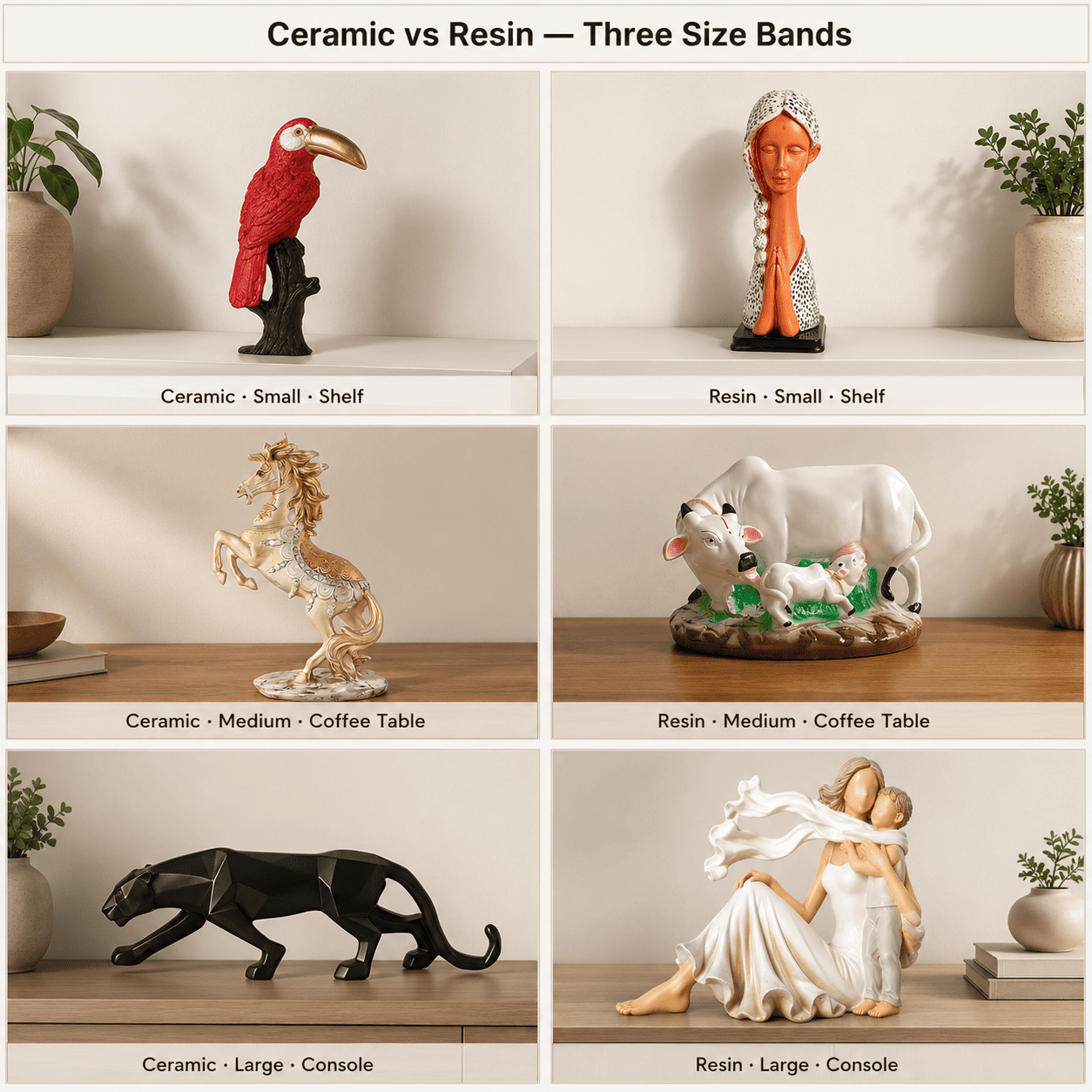
Size selection follows a surface-width rule: a showpiece that occupies more than 30% of the visible surface width creates visual compression in rooms under 150 sq ft — a footprint that covers the majority of Indian urban apartments. A 40–50 cm wide bedside table or side console calls for a medium piece in the 16–21 cm height range; a 60+ cm wide console or credenza can carry a large piece in the 25–34 cm range without compressing the sightline.
Weight matters on floating shelves. A 400–600 g large ceramic showpiece at 25–34 cm is at the upper range of what a standard single-bracket floating shelf rated to 5 kg can carry safely alongside books or other objects. Resin pieces in the same size band run 250–400 g, making them the structurally lighter option for overloaded floating shelves — provided the room meets the climate criteria above.
Ready to buy a showpiece engineered to outlast five Indian monsoons on your coffee table or console? Shop the full Moolwan living room showpiece collection now.
How Finish, Palette, and Grouping Rules Affect Long-Term Visual Durability
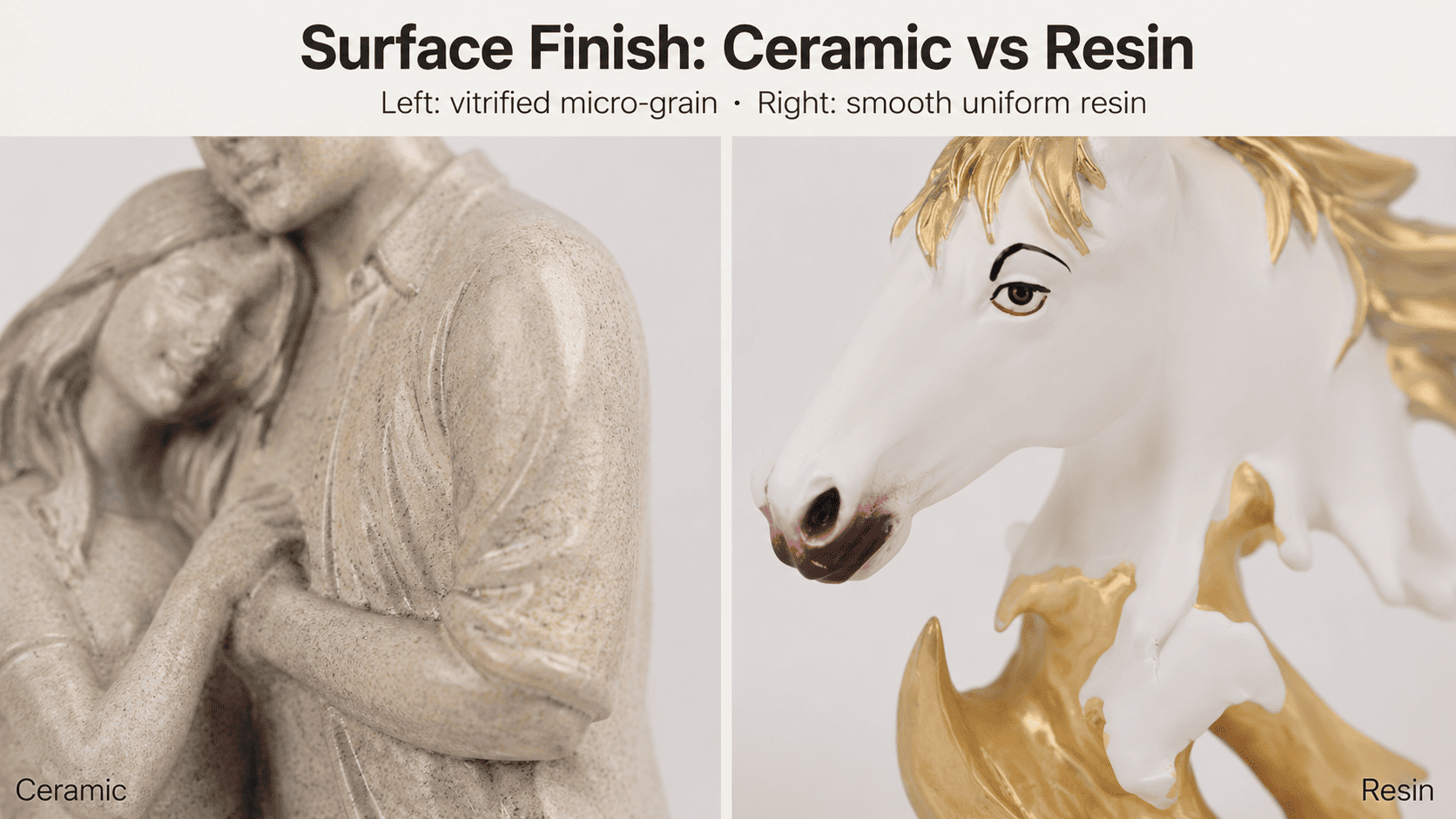
A showpiece's finish is not purely aesthetic — it is a wear-management decision. Glazed ceramic surfaces reflect light uniformly, which means every micro-scratch from dusting or incidental contact creates a locally non-reflecting zone that the eye reads as surface damage. Matte ceramic surfaces scatter light at multiple angles across the micro-texture, rendering the same scratch invisible at year three because no single angle produces a stark contrast between scratched and unscratched zones.
Palette coherence between the showpiece and the surrounding room surfaces determines whether the piece reads as intentional or accidental. In Indian living rooms where walls are most commonly finished in off-white, warm beige, or greige, warm earth-toned ceramics — ochres, burnt siennas, stone-greys — create a tonal continuation that optical science calls analogous harmony: adjacent hues on the colour wheel reinforce each other rather than competing, so the eye experiences the room as unified rather than busy.
Grouping — clustering multiple smaller pieces rather than placing a single large piece — extends the visual life of a styled surface because the eye reads a cluster as a composition, not a single object, and compositions are less susceptible to the "that doesn't fit anymore" fatigue that single statement pieces accumulate as furniture and textiles change. The grouping rule for Indian living rooms under 150 sq ft is odd numbers of pieces (three or five) with height variation of at least 30% between the tallest and shortest piece.
Maintenance, Dust, and the Long-Term Cost of the Wrong Material Choice
Indian living rooms accumulate airborne dust at a significantly higher rate than temperate-climate homes — particularly in metros during pre-monsoon months when particulate matter peaks. A showpiece that requires specialist cleaning products or careful handling to maintain its surface finish becomes a maintenance liability; a material whose finish tolerates a dry microfibre wipe without surface degradation has a meaningful practical advantage over five years of weekly cleaning.
Ceramic tolerates dry and lightly damp cleaning without finish risk because its vitrified surface has no porous layer that moisture can penetrate and lift. Resin at 94% purity is also cleanable with a dry cloth under normal conditions, but repeated cleaning with even mildly alkaline solutions — common in Indian households where surfaces are cleaned with mild detergent — can degrade the surface coating on lower-purity resin formulations over time, causing a chalky bloom that is irreversible without refinishing.
The long-term cost equation therefore favours ceramic for unconditioned rooms: a ceramic piece rated for 5+ year lifespan that requires no specialist maintenance amortises its purchase price more efficiently than a resin piece that needs replacement at year two or three because its climate threshold was exceeded.
Frequently Asked Questions
Can resin showpieces be used in Indian living rooms at all?
Yes, but only in fully air-conditioned rooms where temperature stays below 35°C and humidity stays below 60% RH year-round. Standard epoxy resin begins to soften at its glass transition temperature of 35–45°C, meaning a resin piece on a south-facing console in a non-AC room can deform under its own weight during peak summer months. In a sealed, temperature-controlled room, 94% purity resin at 3H hardness has a practical 3+ year indoor lifespan with normal handling and dry-cloth maintenance.
Why does ceramic perform better in humidity than resin?
Ceramic at 92% clay composition undergoes vitrification during high-temperature firing, which fuses silica particles into a glass-like, near-zero-absorption matrix. This means the material does not take on atmospheric moisture during monsoon humidity cycles. Resin is a polymer with a measurably higher moisture vapour transmission rate, meaning it absorbs trace atmospheric moisture over time — and repeated expansion and contraction through humidity swings causes micro-stress at the surface coating layer, which manifests as surface blooming or colour shift by year two.
What size showpiece is right for an Indian living room coffee table?
For a standard Indian living room coffee table 90–120 cm wide, a medium showpiece in the 16–21 cm height range is the correct size band. A piece taller than 21 cm on a coffee table creates a sightline obstruction for seated occupants across the table — a spatial problem unique to low-profile seating common in Indian living rooms. A cluster of three small pieces (10–16 cm each) with height variation of at least 30% between the tallest and shortest is a valid alternative that avoids the sightline problem while creating a more visually dynamic composition.
Does Moolwan offer a return policy on showpieces?
Returns are accepted within 24 hours of delivery, provided the piece is unused and in original packaging. A 10% restocking fee applies, and refunds are processed within 15 working days. This window is intentionally tight because the brand manufactures direct-to-consumer and does not carry the inflated margins that allow larger retailers to absorb open-ended return windows — the trade-off is manufacturer pricing that typically runs 3–5x lower than retail-channel equivalents for equivalent material quality.
A ceramic showpiece at 92% clay composition, rated to 85% RH and 60°C, is the only decorative material in this category that does not require a stable air-conditioned environment to deliver its stated 5+ year lifespan in an Indian living room — making it an investment that pays back through eliminated replacement cycles rather than seasonal redecoration. Bring home a climate-rated piece from the Moolwan living room showpiece collection — manufactured direct, no distributor margins, sized for Indian rooms. If you are also considering compact or smaller accent formats, the Moolwan luxury décor range for small living rooms is curated specifically for under-150 sq ft Indian apartment layouts. For handcrafted originals in this same category, the Moolwan handmade showpiece collection offers unique pieces not available through any retail channel.


