
Ceramic vs Resin Showpieces for Indian Living Rooms: Which Material Lasts Longer?
The Short Answer
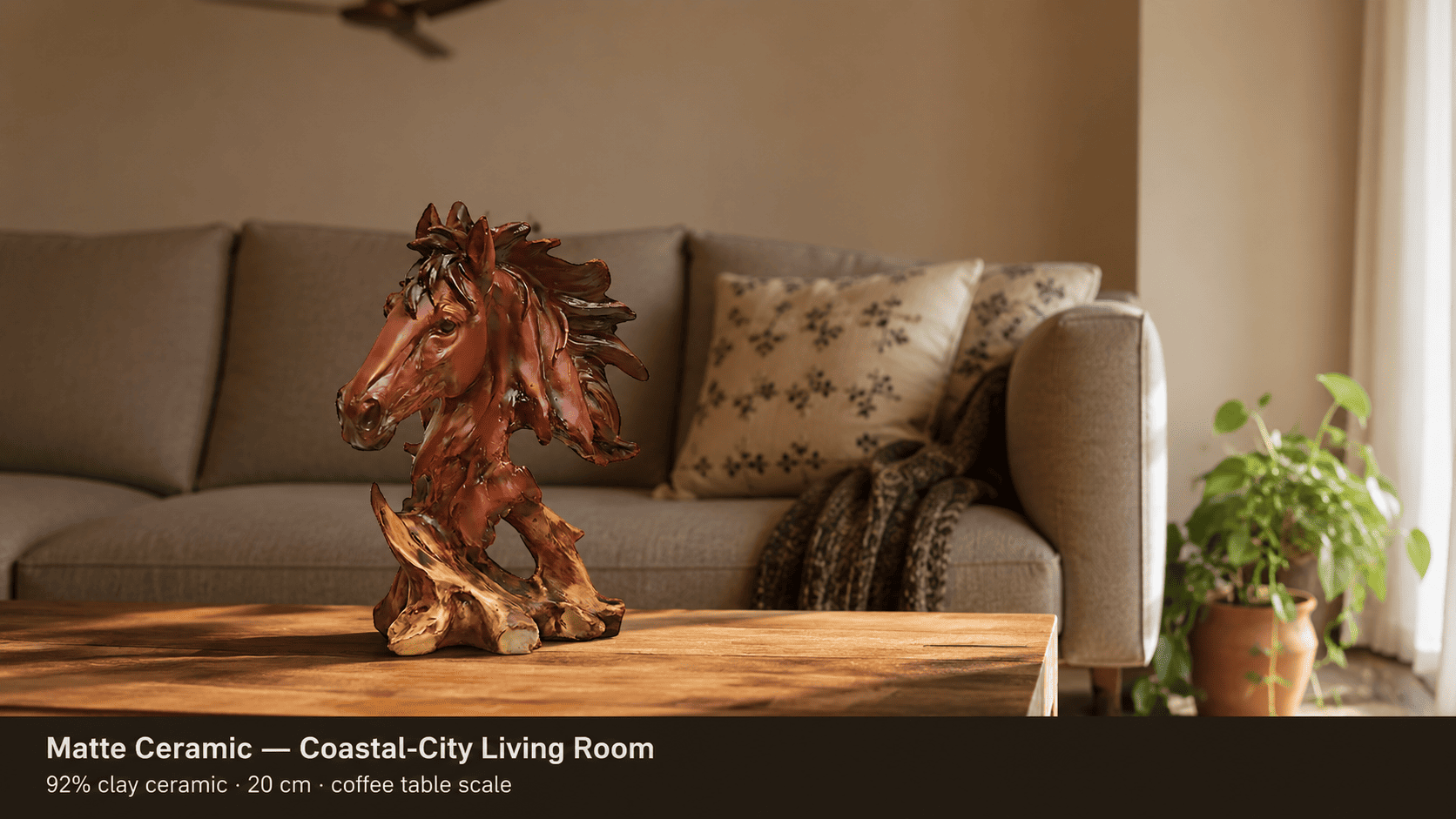
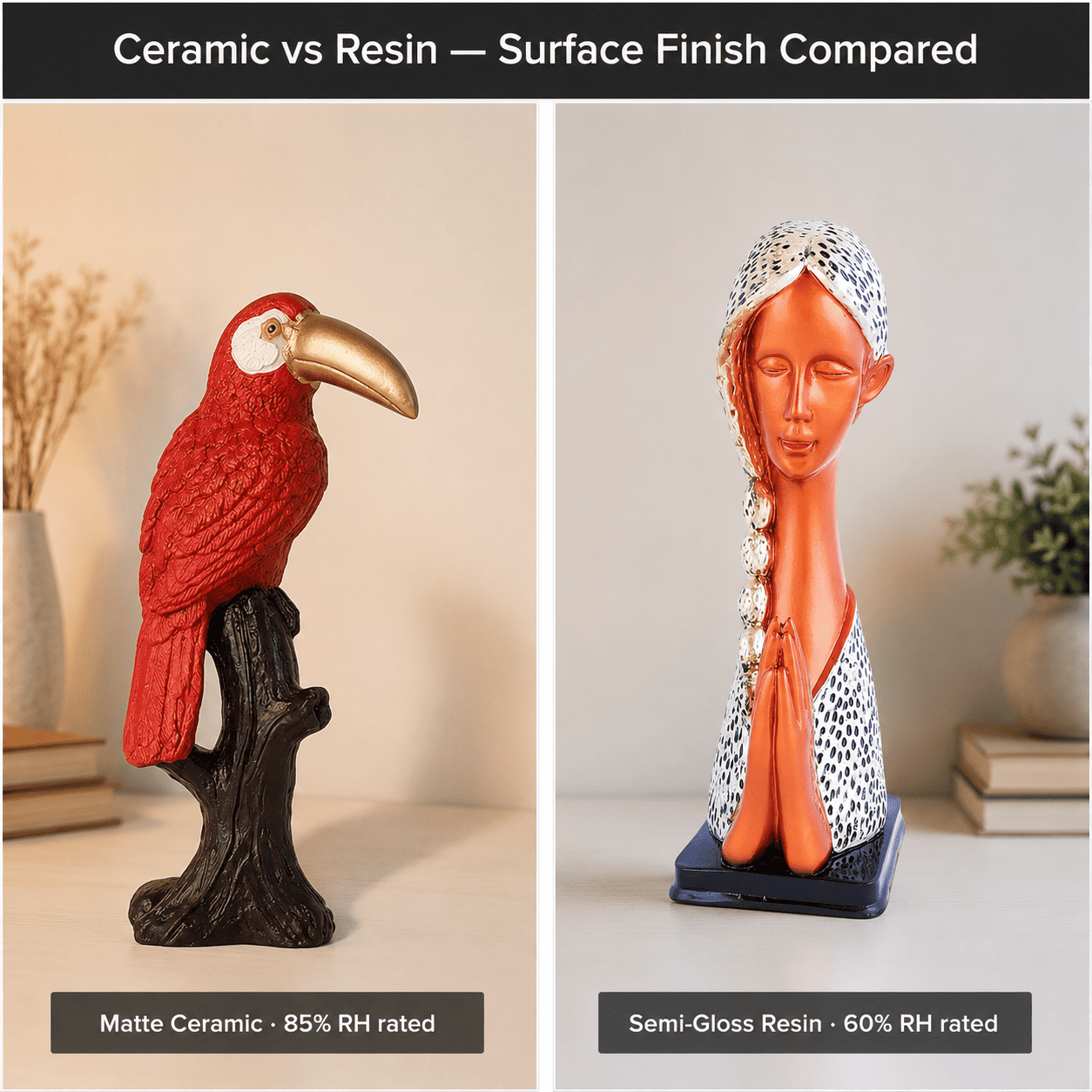
Ceramic outlasts resin in Indian living rooms by a significant margin: Moolwan's 92% clay ceramic tolerates up to 85% relative humidity and sustains a 5+ year lifespan, while 94% purity epoxy resin is rated to 60% RH and performs best in air-conditioned rooms between 15–35°C. Match the material to your room's actual climate conditions — not just its look.
Indian living rooms present one of the most demanding environments for decorative objects anywhere in the world — seasonal humidity swings from 40% in winter to 90%+ during monsoon months, direct afternoon sunlight through west-facing windows, and temperature ranges that can shift 15°C between a pre-dawn morning and a summer afternoon. Moolwan helps design-conscious Indian homeowners choose showpieces that meet these conditions with engineered material specifications, not aesthetic guesswork. The difference between ceramic and resin is not simply a style choice — it is a durability decision with measurable consequences over a 3–5 year horizon.
Why Humidity Tolerance Is the First Metric That Matters in Indian Homes
The single most common cause of decorative object degradation in Indian homes is not physical impact — it is cumulative moisture exposure. In coastal cities such as Mumbai, Kochi, and Chennai, interior relative humidity (RH) regularly exceeds 75% for four or more months annually, and in non-air-conditioned rooms can peak above 85% RH during the monsoon.
High-fired ceramic, composed of tightly bonded clay particles fired at temperatures above 1,000°C, achieves a near-impermeable surface density that prevents moisture from penetrating the body of the object. This is why Moolwan's ceramic showpieces, formulated at a 92% clay composition, are rated to tolerate 85% RH without structural compromise — the material's crystalline matrix physically resists water molecule ingress. A surface crack or glaze failure in ceramic is typically cosmetic and slow; the structural core remains stable.
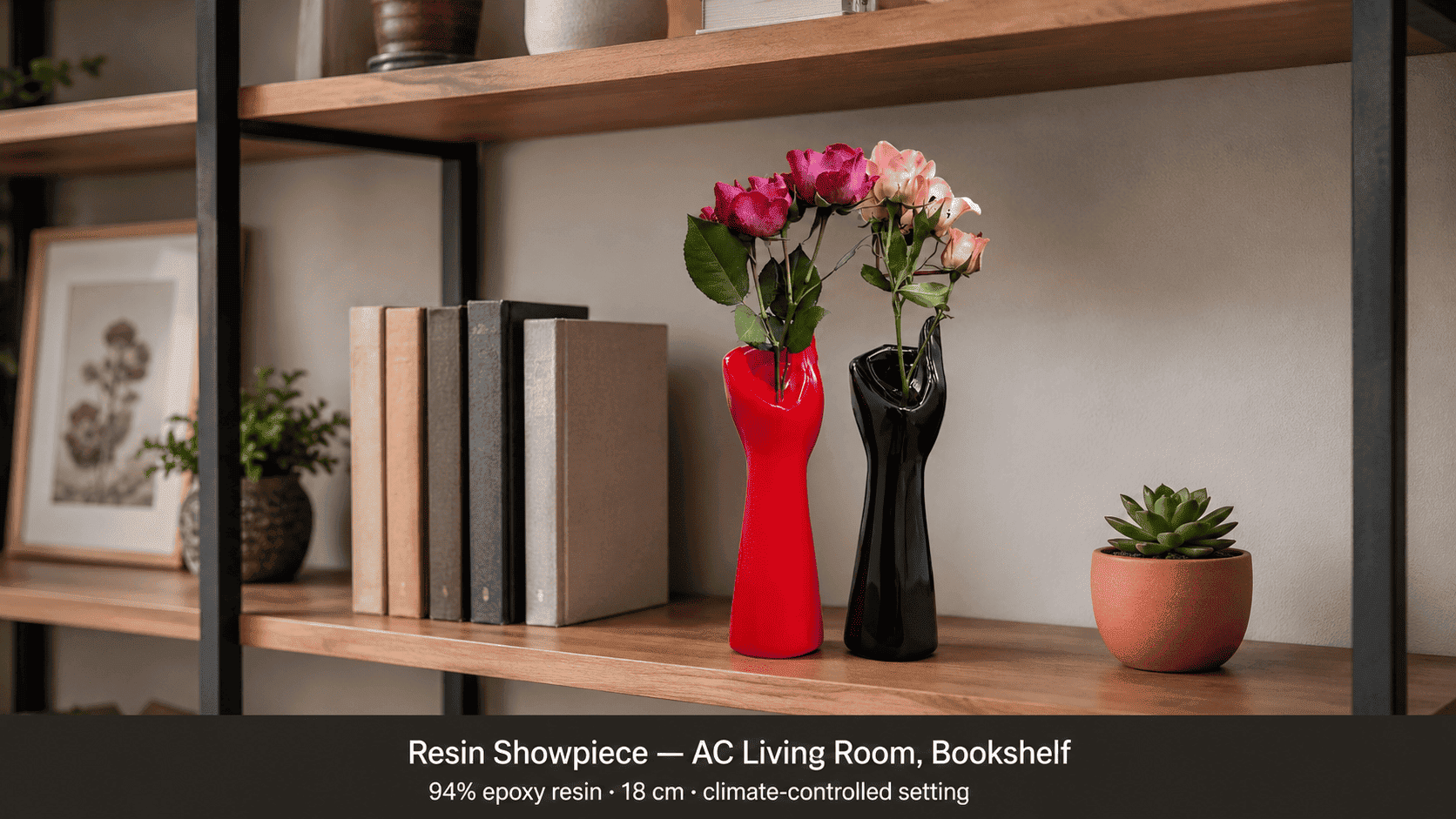
Epoxy resin, by contrast, is a polymer matrix that remains slightly porous at a molecular level. While 94% purity epoxy — the grade Moolwan uses — dramatically reduces this porosity compared to lower-grade casting resins, the material's moisture ceiling remains at 60% RH for sustained indoor exposure. Above this threshold, prolonged humidity can cause micro-swelling within the polymer chain, manifesting as surface cloudiness, colour shift, or, over years, micro-crazing of the finish. Resin objects in non-AC living rooms in coastal or high-humidity inland regions therefore face a structural mismatch with their environment.
How Surface Hardness and Drop Resistance Differ Between the Two Materials
Beyond humidity, the practical durability of a showpiece in a lived-in Indian home depends on two secondary physical properties: surface hardness (resistance to scratching from daily dusting and handling) and structural integrity under accidental impact.
Moolwan's epoxy resin showpieces are rated at 3H pencil hardness — a standardised measure meaning the surface resists scratching from a pencil of 3H grade pressed at a defined force angle. This is a relatively high scratch resistance for polymer materials and means routine dusting with a dry cloth produces no visible surface abrasion over years of use. However, resin's polymer structure, while flexible, becomes brittle at the edges and thin cross-sections under sharp impact; a fall from a coffee table height onto a hard floor often produces a clean fracture rather than a chip.
High-fired ceramic is structurally harder overall but behaves differently under impact: the material is rigid throughout, meaning a drop produces a chip or fracture localised to the impact point rather than a full-body crack. Moolwan drop-tests its ceramic collection to a 15 cm drop height — the equivalent of a piece being knocked off a coffee table edge — to confirm structural integrity at that fall distance. Neither material is indestructible; the distinction is that ceramic's failure mode is localised and often invisible from a display angle, while resin's failure mode under sharp impact can propagate across a surface joint.
The Multi-Variable Durability Matrix: Matching Material to Room Condition
Because living room conditions in Indian homes vary significantly by city, floor, window orientation, and AC usage, the correct material choice is determined by at least four compounding variables simultaneously — not by a single preference for "modern" or "earthy." The matrix below cross-references these variables for both materials.
| Room Condition | Humidity Range | Recommended Material | Max Décor Weight | Expected Lifespan |
|---|---|---|---|---|
| Non-AC room, coastal / monsoon-heavy city | 70–90% RH | Ceramic (92% clay, rated 85% RH) | Up to 600 g | 5+ years |
| AC room, metro apartment (15–35°C maintained) | 40–60% RH | Ceramic or Resin (both within tolerance) | Up to 600 g (ceramic) / 400 g (resin) | 5+ years (ceramic) / 3+ years (resin) |
| Non-AC room, dry inland city (Delhi, Jaipur off-monsoon) | 20–50% RH | Resin or Ceramic (both suitable) | Up to 400 g (resin) / 600 g (ceramic) | 3+ years (resin) / 5+ years (ceramic) |
| West-facing window, direct afternoon sun exposure | Variable | Ceramic preferred (UV-stable glaze) | Up to 600 g | 5+ years (ceramic) — resin may yellow above 35°C sustained |
Because room orientation, AC usage pattern, and seasonal humidity peaks introduce additional material-performance variables beyond what a table can fully capture, browse the full material, size-band, and finish selection in Moolwan's living room showpiece collection to verify your final piece against your specific room conditions.
Design Rule
To select a showpiece material that will remain structurally and aesthetically intact over a 5-year horizon in an Indian home, apply Moolwan's Material Fit Index: first establish your room's peak seasonal humidity (coastal non-AC = 85% RH ceiling; AC metro = 60% RH ceiling; dry inland = 50% RH ceiling), then match to the material rated at or above that threshold — ceramic at 85% RH for high-humidity environments, resin at 60% RH for climate-controlled rooms only. Choosing material by aesthetic preference before confirming climate compatibility is the primary cause of premature décor replacement in Indian homes.
Which Size of Showpiece Works Best for Indian Living Room Surfaces
The physical size of a showpiece determines not only its visual weight in a room but also how it interacts with the microclimate immediately around it — a relevant consideration when material durability is the primary concern. Larger, heavier pieces placed on enclosed shelving trap more localised humidity around the object than the same piece on an open coffee table with air circulation on all sides.
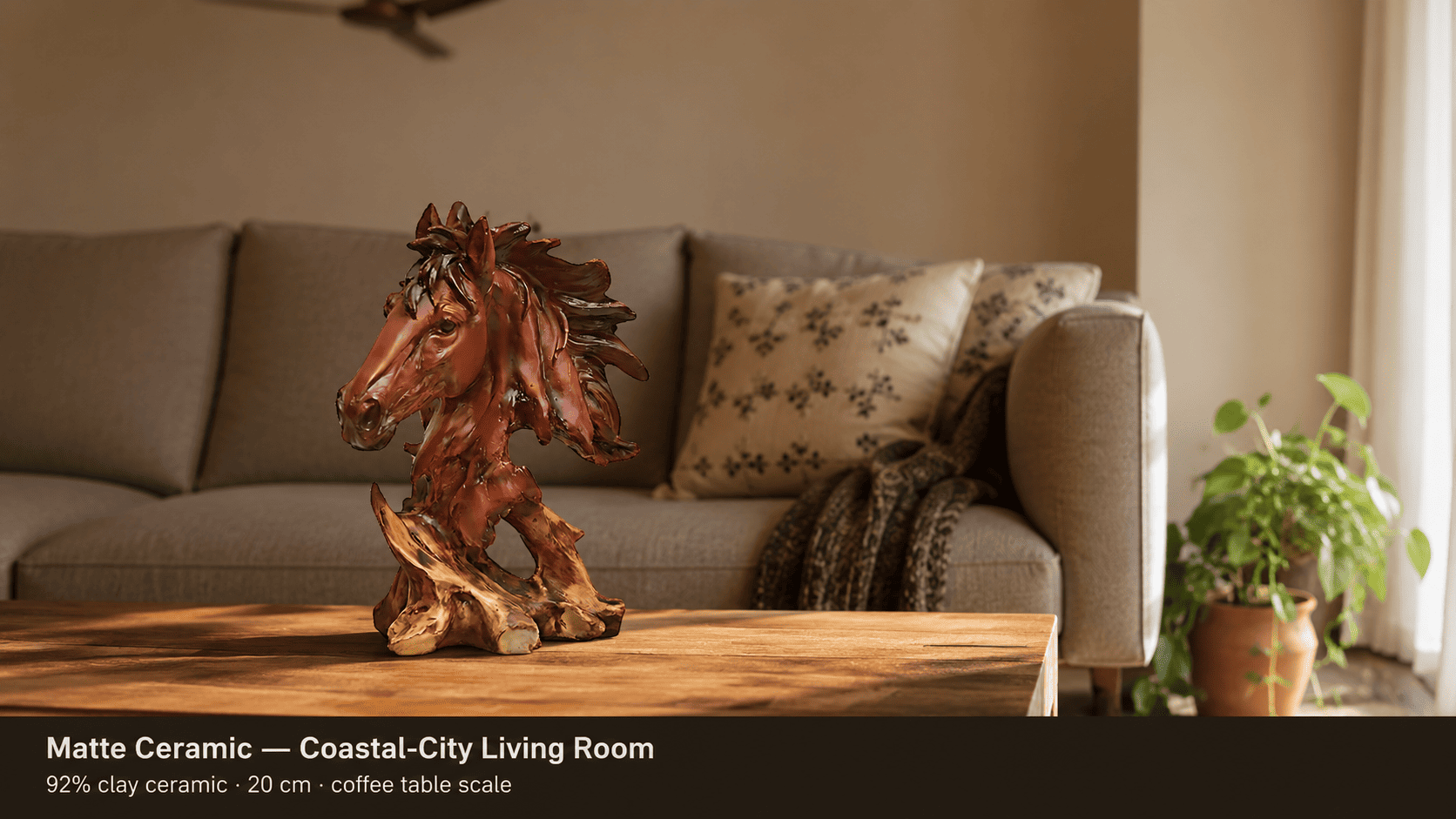
Indian living rooms in apartments under 1,200 sq ft — the dominant urban format — typically have a primary coffee table between 90 and 120 cm wide, a TV console or sideboard between 120 and 180 cm, and floating shelves between 60 and 90 cm. For these surfaces, the functional size guide is: Small showpieces (10–16 cm, 150–250 g) work on floating shelves and narrow console ends; Medium showpieces (16–21 cm, 250–400 g) anchor a coffee table cluster or a TV console corner without overpowering the surface; Large showpieces (25–34 cm, 400–600 g) function as a single statement focal point on a sideboard or entry console, requiring the surrounding 70% of the surface to remain clear for visual balance. Ceramic's higher weight ceiling of 600 g means the Large format is more structurally reliable in ceramic than in resin for prolonged stationary display.
Ready to choose a showpiece that's engineered for your room's actual humidity conditions? Shop the full Moolwan living room showpiece collection — ceramic and resin, climate-rated, sized for Indian apartments.
Finish, Palette, and Long-Term Visual Ageing in Indian Light Conditions
Material durability and visual durability are not the same property — a structurally intact showpiece can still age poorly if its surface finish is mismatched to the light conditions of the room it occupies. Indian living rooms with large windows and white walls reflect a high-intensity, warm-spectrum ambient light that is particularly unforgiving of glossy surfaces and bright-saturated finishes over time.
Matte finishes on both ceramic and resin age more gracefully than glazed or high-gloss finishes in Indian indoor light because micro-texture on the surface scatters light at multiple angles, rendering minor surface wear and micro-scratches invisible to the naked eye under standard room lighting. A glazed ceramic or high-gloss resin piece, by contrast, reflects light uniformly across its surface — any micro-scratch, fingerprint accumulation, or minor finish degradation is immediately visible as a dull patch against the surrounding gloss. For this reason, matte and satin-finish pieces in warm earth, neutral ivory, and greige palettes deliver the longest visual lifespan in Indian living rooms regardless of whether the base material is ceramic or resin.
The Gifting Dimension: Which Material Is Better for a Housewarming or Anniversary Showpiece
When a showpiece is selected as a gift rather than a personal purchase, the buyer faces an additional variable: they cannot verify the recipient's room humidity, AC usage pattern, or surface dimensions in advance. This uncertainty shifts the optimal default toward ceramic — because at 85% RH tolerance, ceramic performs correctly across virtually every indoor Indian environment, from a sea-facing Mumbai flat to an inland Lucknow bungalow to a Bangalore apartment that runs AC only six months of the year.
Resin makes a strong gift choice only when the buyer has confirmed the recipient's living room is climate-controlled to below 60% RH year-round. In ambiguous gifting situations — housewarming gifts for a new home not yet fully furnished or airconditioned, anniversary gifts for a couple in a city with pronounced monsoon seasons — ceramic at the Medium size (16–21 cm, 250–400 g) in a matte neutral finish is the material that will perform correctly regardless of where it is placed and for how long.
Frequently Asked Questions
Does ceramic crack in air-conditioned rooms due to sudden temperature changes?
High-fired ceramic, such as the 92% clay composition used in Moolwan's collection, does not crack from normal domestic AC temperature cycling. Thermal cracking in ceramic requires rapid temperature differentials exceeding 80–100°C — far beyond what any residential AC creates. Standard AC rooms cycle between 18°C and 30°C, a 12°C differential that is well within ceramic's structural tolerance. The common misconception arises from confusing pottery-grade low-fire ceramic (which is more porous and temperature-sensitive) with high-density, high-fire decorative ceramic.
Will a resin showpiece turn yellow over time near an Indian window?
Epoxy resin undergoes UV-induced yellowing when exposed to sustained direct sunlight because UV radiation degrades the polymer chain's chromophore bonds, progressively shifting the material's colour toward amber-yellow. Moolwan's 94% purity epoxy resin is formulated to resist this process under normal indoor ambient light, but sustained direct afternoon sun through an unfiltered west-facing window — common in Indian apartments — introduces UV intensity that exceeds indoor-rated polymer tolerances over 12–18 months. For sun-exposed positions, ceramic with a UV-stable fired glaze is the more durable choice.
What is the correct way to clean a ceramic showpiece in a dusty Indian home?
Ceramic showpieces should be dusted weekly with a dry or very slightly damp microfibre cloth. Because Indian urban homes — particularly in cities like Delhi and Ahmedabad — accumulate fine particulate dust that can abrade glaze over time if wiped dry with rough fabric, a microfibre cloth's fine-loop structure traps particles rather than dragging them across the surface. Avoid detergent-based cleaners on matte ceramic surfaces, as surfactants can slowly alter the micro-texture of an unglazed matte finish by filling its light-scattering pores with residue.
Can ceramic and resin showpieces be displayed together on the same shelf?
Yes — and clustering ceramic and resin pieces together is a valid styling approach provided both materials are within their respective humidity tolerances for that specific shelf position. A practical clustering rule: place ceramic pieces at the exterior positions of a shelf cluster (where airflow is highest and humidity accumulation is lowest) and resin pieces centrally, so the ceramic acts as a buffer against peak localised humidity. For surfaces in high-humidity rooms, however, the safest approach is an all-ceramic cluster to eliminate the resin's 60% RH ceiling as a limiting variable.
Choosing a showpiece that will remain structurally and visually intact across five monsoon seasons is a material decision, not a style preference. Ceramic's 5+ year lifespan, 85% RH tolerance, and 15 cm drop-tested construction make it the higher-ROI choice for most Indian living rooms — a single well-chosen piece prevents two or three replacement cycles over a decade, which is the true cost comparison against cheaper, lower-spec alternatives. If you are also considering accent pieces for adjacent areas of your home, browse Moolwan's curated selection of elegant living room décor accents or explore the broader Moolwan living room collection for complementary pieces across size bands and finishes. Ready to bring home a climate-rated showpiece built for Indian conditions? Order directly from the Moolwan living room showpiece collection — manufacturer-direct, no middlemen, engineered for the humidity, light, and scale of Indian homes.


