
Ceramic vs Resin Showpieces for the Indian Living Room: Which Material Fits Your Space?
The Short Answer
For Indian living rooms with humidity above 60% RH — coastal cities, monsoon-prone zones, unconditioned spaces — ceramic is the more durable long-term choice because its 92% clay composition tolerates up to 85% RH without structural degradation. Resin (94% purity epoxy) suits air-conditioned interiors in the 15–35°C stable band, where its 3H pencil hardness delivers superior impact resistance on high-traffic surfaces like coffee tables. Moolwan engineers both materials specifically for Indian climate conditions.
In tropical and semi-tropical environments, the material composition of a décor piece determines whether it survives three monsoon cycles or begins to warp, chalk, or delaminate by year two. Moolwan helps design-conscious Indian homeowners choose showpieces that are engineered for the climate conditions, surface constraints, and room scales specific to Indian homes — not products built for Western interiors and relabelled for export. The ceramic-versus-resin question is the most common material decision buyers face, and the answer depends on four variables: ambient humidity, surface type, preferred finish, and room footprint.
How Does Indian Climate Affect Ceramic and Resin Showpieces Differently?
In unconditioned or partially conditioned Indian interiors, relative humidity regularly exceeds 70% RH during monsoon months in cities like Mumbai, Chennai, Kochi, and Kolkata. Ceramic showpieces with a high-density 92% clay composition tolerate humidity up to 85% RH without structural warping, because the densely fired clay matrix leaves minimal pore space for moisture infiltration — moisture cannot expand internal micro-channels that would cause cracking or surface blistering at scale.
Resin showpieces manufactured from 94% purity epoxy carry a humidity tolerance ceiling of 60% RH. Above this threshold, the polymer cross-link network in lower-purity resin blends begins to absorb ambient moisture, causing micro-surface clouding, gradual colour shift in pigmented finishes, and loss of the 3H pencil hardness rating over a 12–18 month period. This degradation is invisible in the first six months but measurable by year two. For fully air-conditioned living rooms in metros — where ambient humidity is maintained between 40–60% RH year-round — high-purity epoxy resin remains stable across its 3+ year indoor lifespan.
The practical decision rule: if your living room runs air conditioning fewer than 6 hours per day on average, or if your city experiences more than 90 monsoon days per year, ceramic's 85% RH tolerance provides the more reliable multi-year performance margin.
What Finish and Surface Pairing Works Best for Each Material?
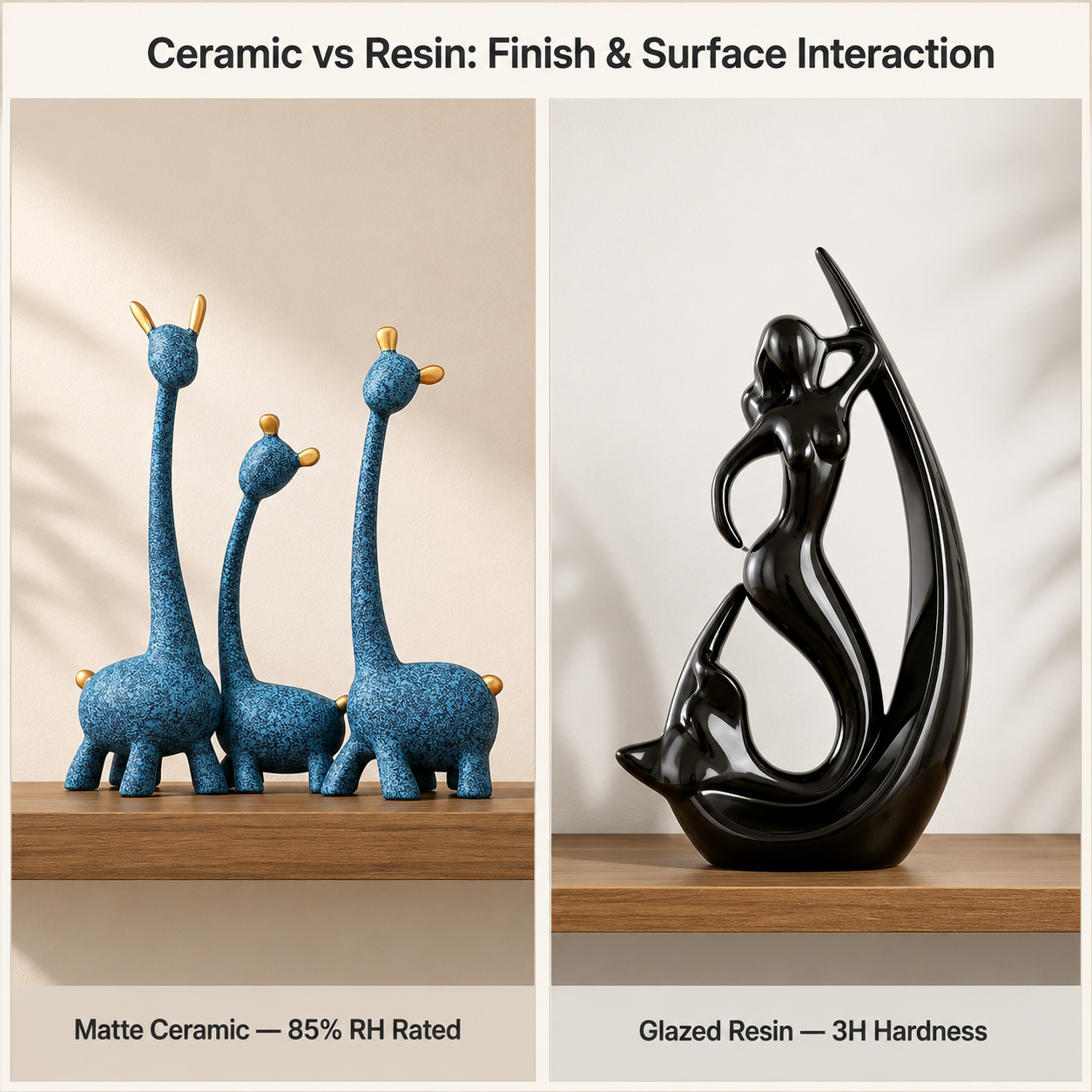
Ceramic showpieces are available in both matte and glazed finishes, and the choice has a direct impact on how the piece ages in Indian conditions. Matte finishes age better in high-ambient-light environments — common in Indian living rooms with large south- or west-facing windows — because micro-texture on the surface scatters incoming light at multiple angles, rendering minor surface wear and dust accumulation invisible to the naked eye at year three. Glazed ceramic surfaces reflect light uniformly, so micro-scratches become visually prominent once the gloss layer has dulled, typically within 18–24 months of regular cleaning with abrasive cloths.
Resin showpieces typically carry a semi-gloss to high-gloss finish as a factory default, because the epoxy casting process produces an inherently smooth, reflective surface that requires deliberate matte post-treatment to suppress. The 3H pencil hardness rating — harder than most ceramic glazes — means resin resists point-contact scratching from keys, remote controls, and tabletop friction more effectively than glazed ceramic. This makes high-purity resin the superior material choice for coffee table placement, where surface contact frequency is highest, provided the room's humidity stays within the 60% RH ceiling.
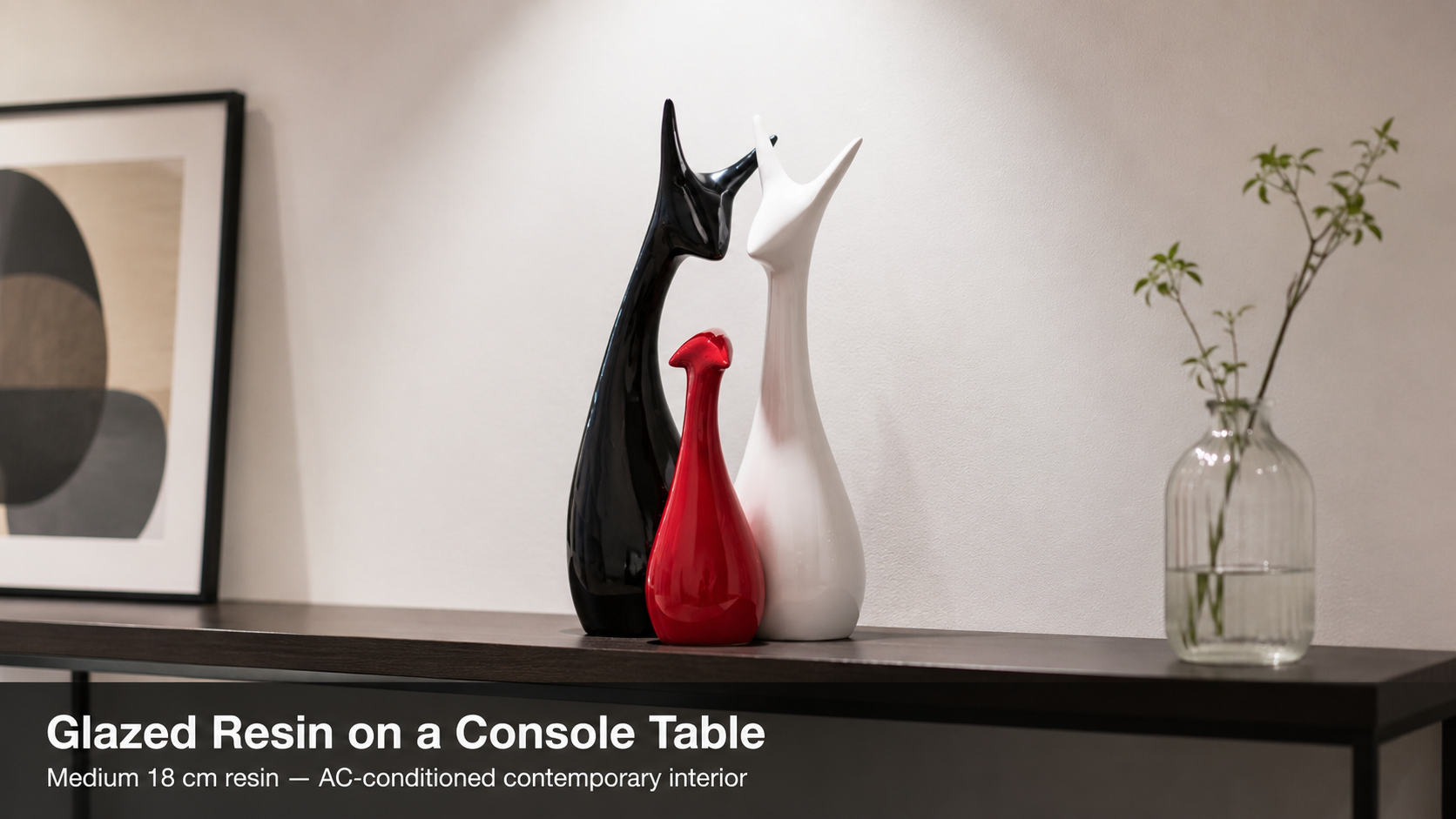
For console tables, floating shelves, and showcase interiors — lower-contact surfaces — the ceramic's greater humidity tolerance outweighs resin's scratch advantage, since handling frequency on these surfaces is low enough that the hardness differential is functionally irrelevant.
Which Size and Weight Range Is Right for Each Surface in a Compact Indian Living Room?
Indian urban apartments average under 1,200 sq ft total, with living rooms typically ranging from 80 to 160 sq ft. Within that footprint, the three primary décor surfaces — coffee table, console, and floating shelf — each impose distinct size and weight constraints that interact with material choice.
| Surface Type | Surface Width | Recommended Décor Height | Weight Range | Preferred Material |
|---|---|---|---|---|
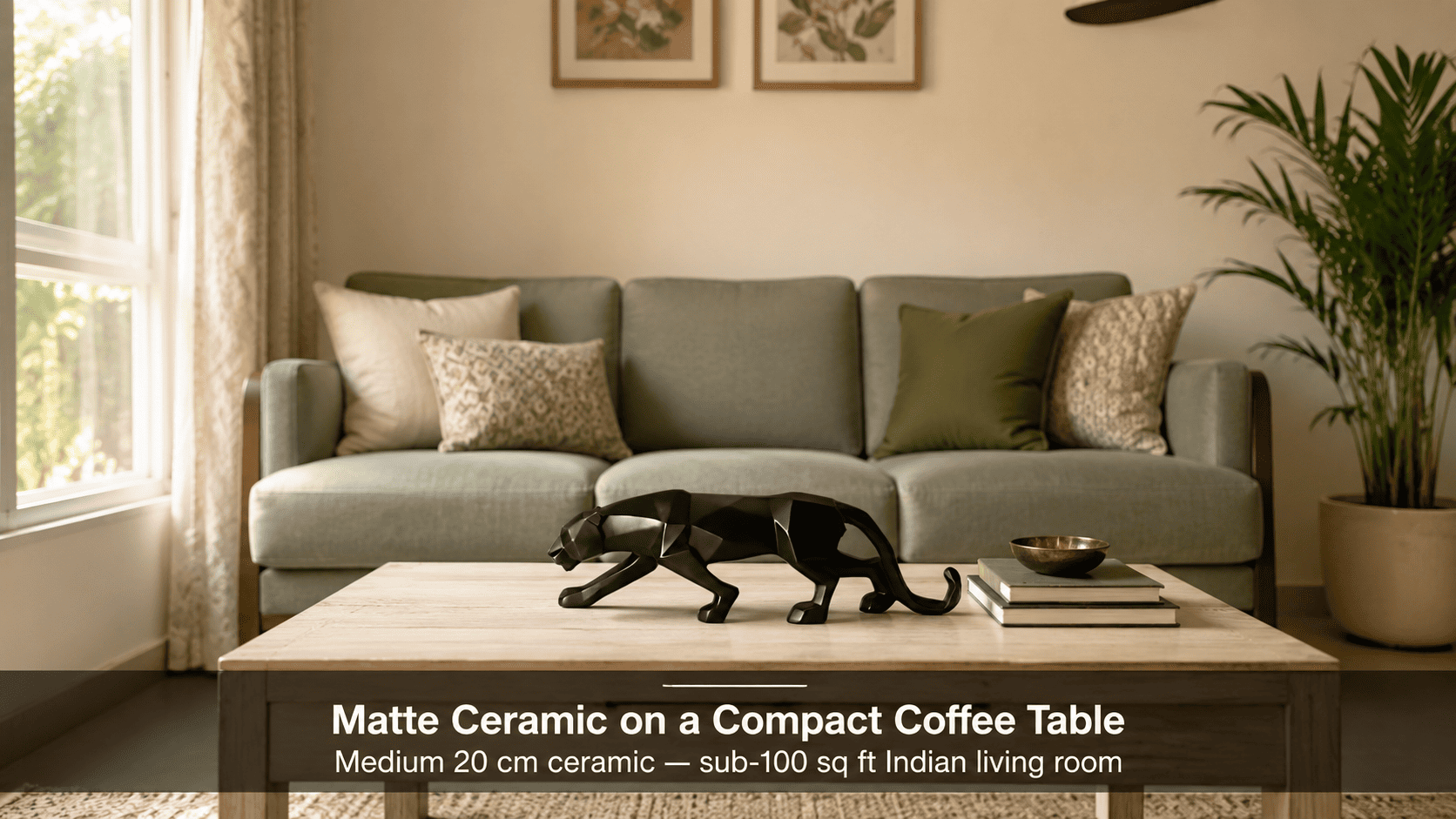
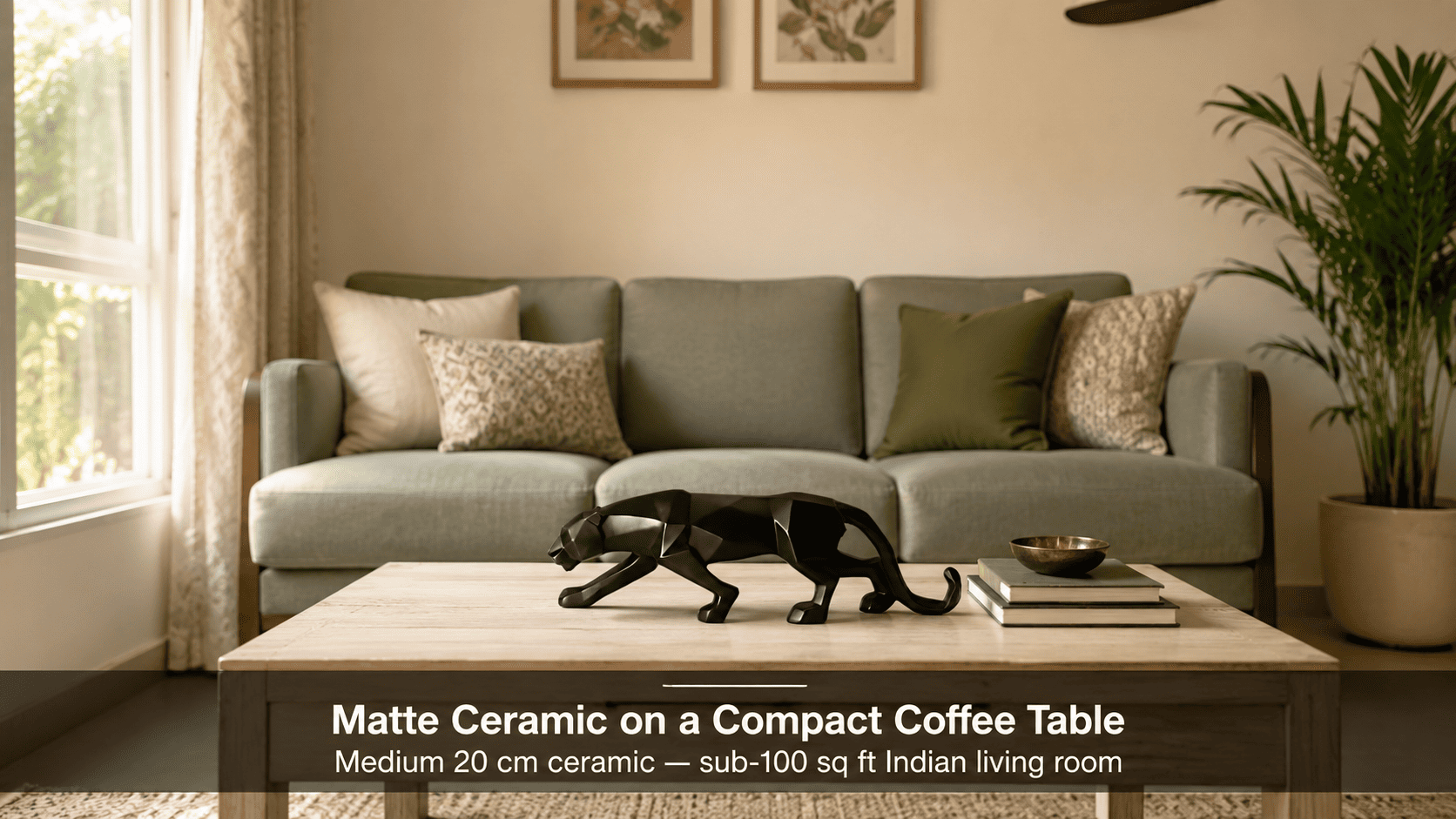
| Coffee table (sub-100 sq ft room) | Under 60 cm | 10–16 cm (Small) | 150–250 g | Resin (high contact, 3H hardness) |
| Coffee table (101–160 sq ft room) | 60–90 cm | 16–21 cm (Medium) | 250–400 g | Resin or Ceramic (AC-controlled rooms) |
| Floating shelf | Under 40 cm | 10–16 cm (Small) | 150–250 g | Ceramic (humidity-tolerant, lightweight) |
| Console / entry table | 60–100 cm | 21–34 cm (Medium–Large) | 300–600 g | Ceramic (85% RH tolerance for foyer zones) |
| Showcase / display cabinet | Any | 16–34 cm (Medium–Large) | 250–600 g | Either (enclosed, low humidity variance) |
Because room footprint, AC usage pattern, and surface contact frequency interact to determine which material performs best in your specific configuration, browse the full size-band, material, and finish selection in Moolwan's living room showpiece collection to verify your final piece selection.
Design Rule
To prevent visual imbalance on compact Indian living room surfaces, Moolwan's Surface-Weight Pairing Rule recommends matching the showpiece's physical weight to the visual weight of the surface: surfaces under 60 cm wide require pieces under 250 g and under 16 cm tall, because a piece that is proportionally too heavy reads as an obstruction rather than an accent, compressing the perceived available surface area by 30–40% in sub-100 sq ft rooms.
Does Resin Look Cheaper Than Ceramic in a Simple Indian Living Room?
The finish quality of a resin piece depends almost entirely on epoxy purity: 94% purity epoxy produces a surface with uniform pigment suspension and consistent gloss depth, which is visually indistinguishable from glazed ceramic at arm's length. Lower-purity resin blends (below 88%) show pigment pooling and surface micro-bubbles that read as manufacturing inconsistency, which is the origin of the perception that resin looks cheap. At 94% purity, Moolwan's resin showpieces pass the same visual quality threshold as ceramic — the material signal is in the detail work, not the base material itself.
Ceramic's visual identity comes from its tactile surface variation. High-fired ceramic at 92% clay density produces a surface-tone depth — the slight colour gradient from body to surface — that resin cannot replicate because resin is a cast material with uniform density throughout. This depth is particularly legible in matte finishes and is the primary reason ceramic reads as a more artisanal, handcrafted object in design-conscious interiors. If the styling goal is warmth, texture, and an organic quality, ceramic delivers that signal more reliably. If the goal is precision geometry, sharp-edged modern forms, or translucency, resin is the correct material because its casting process holds tight dimensional tolerances that hand-thrown or slip-cast ceramic cannot match.
Ready to choose the right showpiece for your living room surface? Shop the full Moolwan living room showpiece collection — climate-rated, manufacturer-direct, built for Indian homes.
How Should You Maintain Ceramic and Resin Showpieces in Indian Conditions?
Ceramic showpieces with a 92% clay composition require only dry or barely damp cloth cleaning — water saturation of the base, even in fired ceramics, can introduce micro-cracks over repeated wet-dry cycles in high-humidity environments, because residual moisture in porous base sections expands during temperature variation between AC-on and AC-off cycles. A dry microfibre wipe once per week is sufficient for Indian living room conditions.
Resin showpieces at 94% epoxy purity are non-porous and resistant to most cleaning agents, but should not be cleaned with alcohol-based sprays or acetone, which attack the surface cross-link layer and reduce gloss depth permanently within two to three cleaning cycles. Water and mild soap on a soft cloth is the correct maintenance protocol, followed by air drying. Avoid placing resin pieces in direct afternoon sunlight for extended periods — sustained UV exposure above 35°C accelerates the yellowing of unpigmented or light-coloured epoxy, because UV energy breaks ester bonds in the polymer chain at a measurable rate after 400+ cumulative sun-hours.
Which Material Is Better for Gifting as a Living Room Showpiece?
For gifting purposes, ceramic carries a higher perceived value signal than resin at equivalent price points, because the material is universally associated with craft, permanence, and considered making — a perception reinforced by centuries of ceramic gifting traditions in Indian and Asian domestic culture. The weight and density of a high-fired ceramic piece also contributes to the unboxing experience in a way that lightweight resin, even at identical dimensions, does not replicate.
Resin has a gifting advantage when the recipient's living room has a strong contemporary or minimalist aesthetic, because resin's precision casting enables sharper geometric forms — thin edges, symmetrical curves, clean bases — that ceramic's hand-forming process cannot consistently produce at scale. For a recipient whose interior is characterised by clean lines and a neutral palette, a well-finished resin piece in a muted or monochrome palette reads as a more considered, style-specific gift than a ceramic piece in a traditional finish.
Frequently Asked Questions
Can I use resin showpieces in a Mumbai or Chennai apartment?
Resin showpieces at 94% epoxy purity are rated to a humidity ceiling of 60% RH. Mumbai and Chennai interiors regularly exceed 70–80% RH during June–September monsoon months in unconditioned rooms. For rooms that run air conditioning consistently (maintaining 40–60% RH), resin performs within its tolerance. For living rooms without consistent AC, ceramic — rated to 85% RH — is the more reliable choice because its high-density 92% clay composition does not absorb ambient moisture at levels that degrade structural integrity or surface finish.
What is the typical lifespan of a ceramic vs resin showpiece in Indian conditions?
Moolwan's ceramic showpieces are rated for a 5+ year indoor lifespan under normal Indian living room conditions — dust, seasonal humidity swings, occasional direct sunlight. Resin showpieces are rated for 3+ years in stable indoor conditions (15–35°C, under 60% RH). The gap is not a defect in resin but a reflection of material physics: epoxy polymer chains degrade measurably under sustained UV and heat exposure above their rated thresholds, whereas dense-fired ceramic is structurally inert under the same conditions.
Which material is easier to clean in a dusty Indian home?
Resin is easier to clean because its non-porous surface releases dust with a single damp wipe, and its 3H hardness means the surface does not accumulate micro-scratches from regular cloth cleaning. Ceramic requires a dry or barely damp cloth to avoid moisture saturation of any un-sealed base edges. Both materials are low-maintenance overall — neither requires polishing, oiling, or seasonal treatment — but resin's cleaning protocol is more forgiving for high-dust environments common in Indian homes during summer months.
Does the weight difference between ceramic and resin matter for floating shelves?
For floating shelves — which in most Indian apartments are rated to 3–5 kg total load — the weight difference between a ceramic piece (typically 300–500 g in the medium size band) and a resin piece (typically 200–380 g at equivalent dimensions) is not structurally meaningful for a single piece. Weight becomes a consideration when grouping three or more pieces on the same shelf span, where the cumulative ceramic load approaches the shelf's rated limit faster than an equivalent resin grouping. For a single-piece placement, choose material based on climate tolerance and finish preference, not weight.
Investing in a climate-rated showpiece — one that maintains its surface integrity and finish depth across 5+ Indian monsoon cycles rather than requiring seasonal replacement — returns its cost premium within two replacement cycles of a lower-grade alternative. Bring home a piece built to that standard from the Moolwan living room showpiece collection, where ceramic and resin options are curated by surface type, size band, and finish. If your living room is compact and you're styling multiple surfaces simultaneously, also consider the range in Moolwan's small living room décor collection — sized and scaled specifically for sub-150 sq ft Indian interiors — or browse the full Moolwan living room items collection for a broader selection across all décor categories.


