
Ceramic vs Resin Showpieces for Your Dining Table: Which Lasts Longer in Indian Homes?
The Short Answer
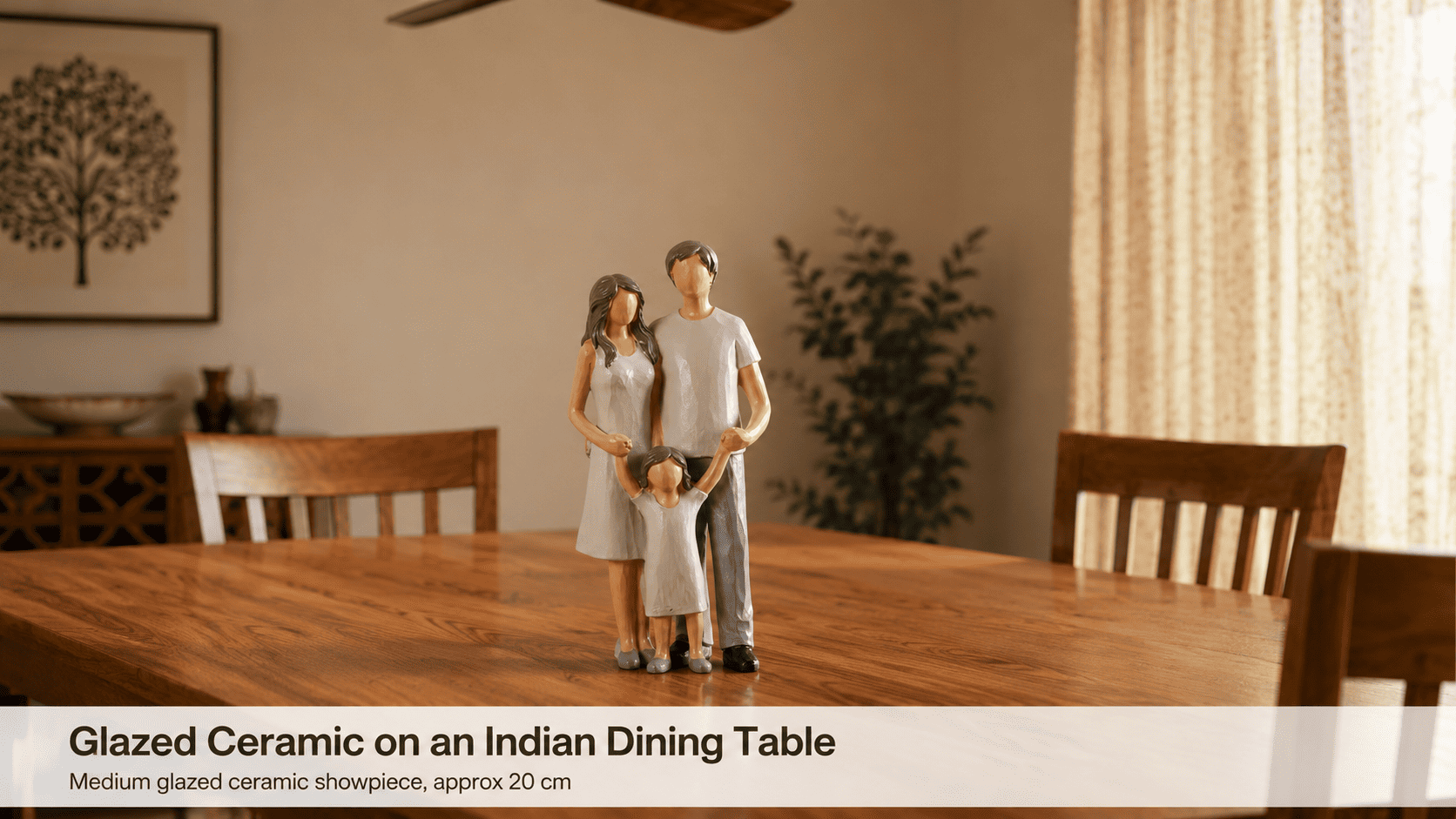
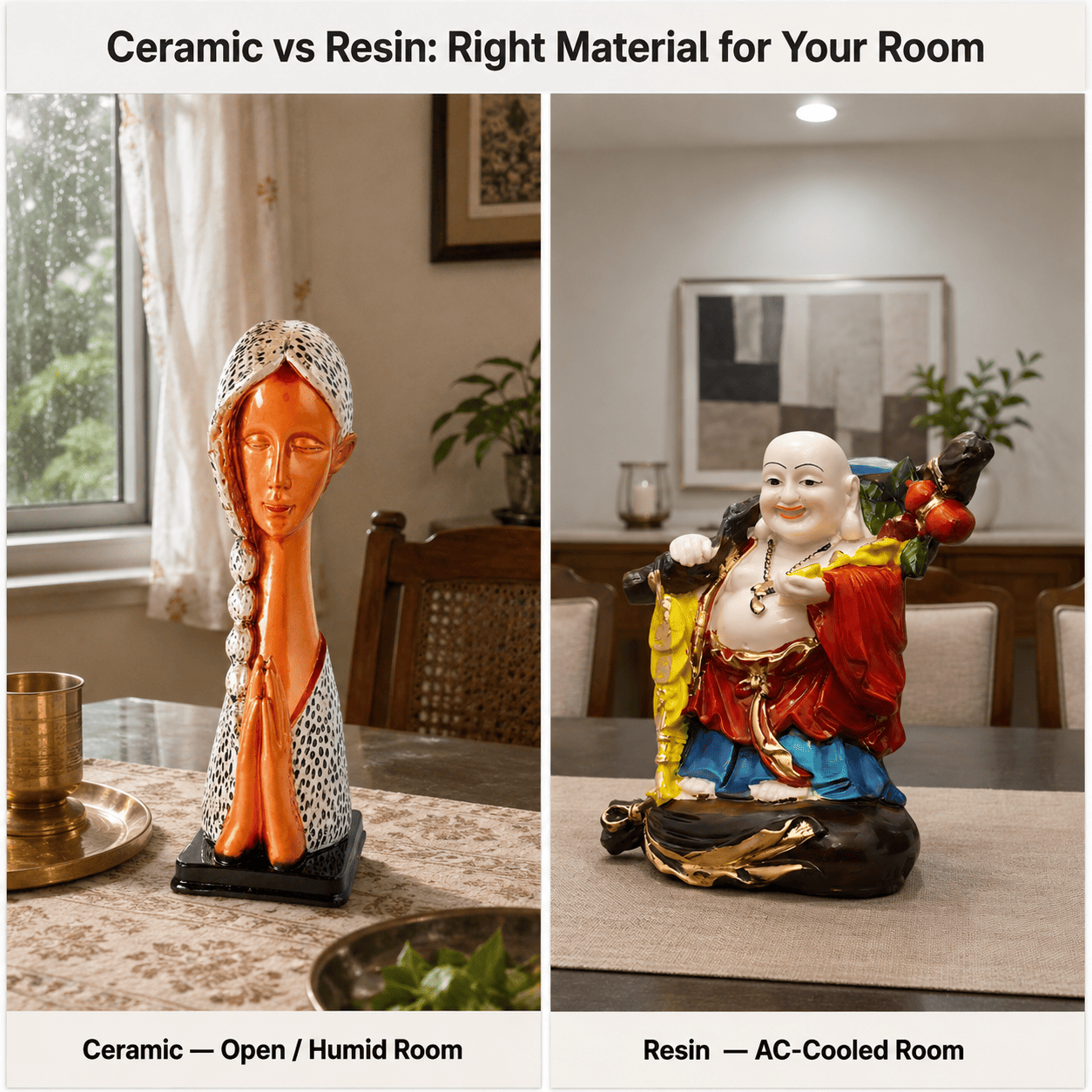
For most Indian dining rooms, ceramic outlasts resin — because high-fired ceramic (92% clay composition) tolerates humidity up to 85% RH without structural degradation, while resin is rated to 60% RH and softens above 35°C. Moolwan's ceramic dining showpieces are engineered to this 85% RH threshold, giving them a verified 5+ year lifespan under Indian monsoon conditions. Choose resin only for fully AC-cooled dining spaces with controlled humidity.
In Indian homes, the dining table occupies a social centre — it absorbs steam from fresh rotis, humidity rolling in from open balconies, and the temperature swings of a room that sits in direct afternoon sun for six months a year. Moolwan helps design-conscious Indian homeowners choose showpieces that survive these conditions and stay visually intact across years, not just weeks. Two materials dominate the decorative accent market: ceramic and resin. Both look compelling on a product page. Their durability story, however, diverges sharply once placed on a real Indian dining table.
How Does Indian Dining Room Climate Actually Affect Showpiece Materials?
India's Bureau of Indian Standards classifies the country's major metros into humidity zones where indoor relative humidity (RH) regularly climbs between 70–90% during the June–September monsoon period — even in rooms with a ceiling fan and open windows. Materials that cannot tolerate this humidity range begin degrading structurally within one to two monsoon cycles, typically expressed as surface clouding, micro-cracking, or finish lift.
Ceramic's durability in this environment is a function of its firing temperature. High-fired ceramic at 1,200–1,280°C produces a dense vitrified matrix where water absorption is suppressed below 0.5% by mass — meaning monsoon humidity cannot penetrate the body of the piece to cause internal expansion or cracking. A 92% clay composition, as used in Moolwan's ceramic collection, achieves this density threshold and maintains dimensional stability at humidity levels up to 85% RH, across the temperature range that encompasses Indian ambient conditions (15–45°C).
Resin behaves differently because its base — epoxy polymer — is a thermosetting plastic rather than a fired mineral body. At humidity levels above 60% RH, epoxy matrices begin absorbing trace moisture at the surface-coating interface, which over time causes microscopic delamination between the décor finish and the epoxy body. At ambient temperatures above 35°C — common in un-airconditioned Indian dining rooms from March through June — standard resin begins to exhibit surface-level softening, making the piece susceptible to pressure marks from hard objects placed against it. Moolwan's resin décor is rated to 60% RH and 15–35°C, which reflects these physical limits, not a conservative engineering margin.
Ceramic vs Resin: Chip, Drop, and Impact Resistance Compared
Resin offers better impact recovery on hard-floor drops: its polymer matrix absorbs kinetic energy elastically rather than fracturing. A 94% purity epoxy resin piece dropped from 15 cm onto a tile floor is significantly less likely to chip at the contact point than a same-weight ceramic piece, because the polymer deforms slightly on impact and rebounds. Moolwan's resin pieces are drop-tested to the 15 cm standard.
Ceramic's brittleness at the moment of impact, however, is compensated by its complete resistance to ongoing environmental attrition. Once in place on a dining table, a ceramic showpiece is not being dropped — it is being cleaned, occasionally moved, and exposed to daily ambient conditions. In this settled-use scenario, ceramic's 3H pencil hardness equivalent surface (from the fired glaze layer) resists cutlery contact marks, cloth-wipe micro-scratches, and direct steam exposure far more effectively than resin's 3H-rated epoxy surface, which softens in heat cycles and loses hardness rating as ambient temperature approaches 35°C.
The practical verdict: resin survives an accidental fall better; ceramic survives five years of a real Indian dining table better. For a piece intended as a permanent dining accent — not a desk toy subject to frequent repositioning — ceramic's long-term surface integrity is the more relevant durability axis.
Design Rule
Choose your dining showpiece material using Moolwan's Material-First Dining Rule: if your dining room is uncooled or semi-cooled (AC used intermittently or only in evenings), and exposed to seasonal humidity above 60% RH, ceramic is the only material whose structural and surface rating — 85% RH tolerance, 5+ year lifespan, 1,200°C-fired vitrified matrix — meets the actual environmental demand. Reserve resin for fully climate-controlled dining rooms where humidity is held consistently below 60% RH and temperature below 35°C year-round.
Which Size of Showpiece Works on a Standard Indian Dining Table?
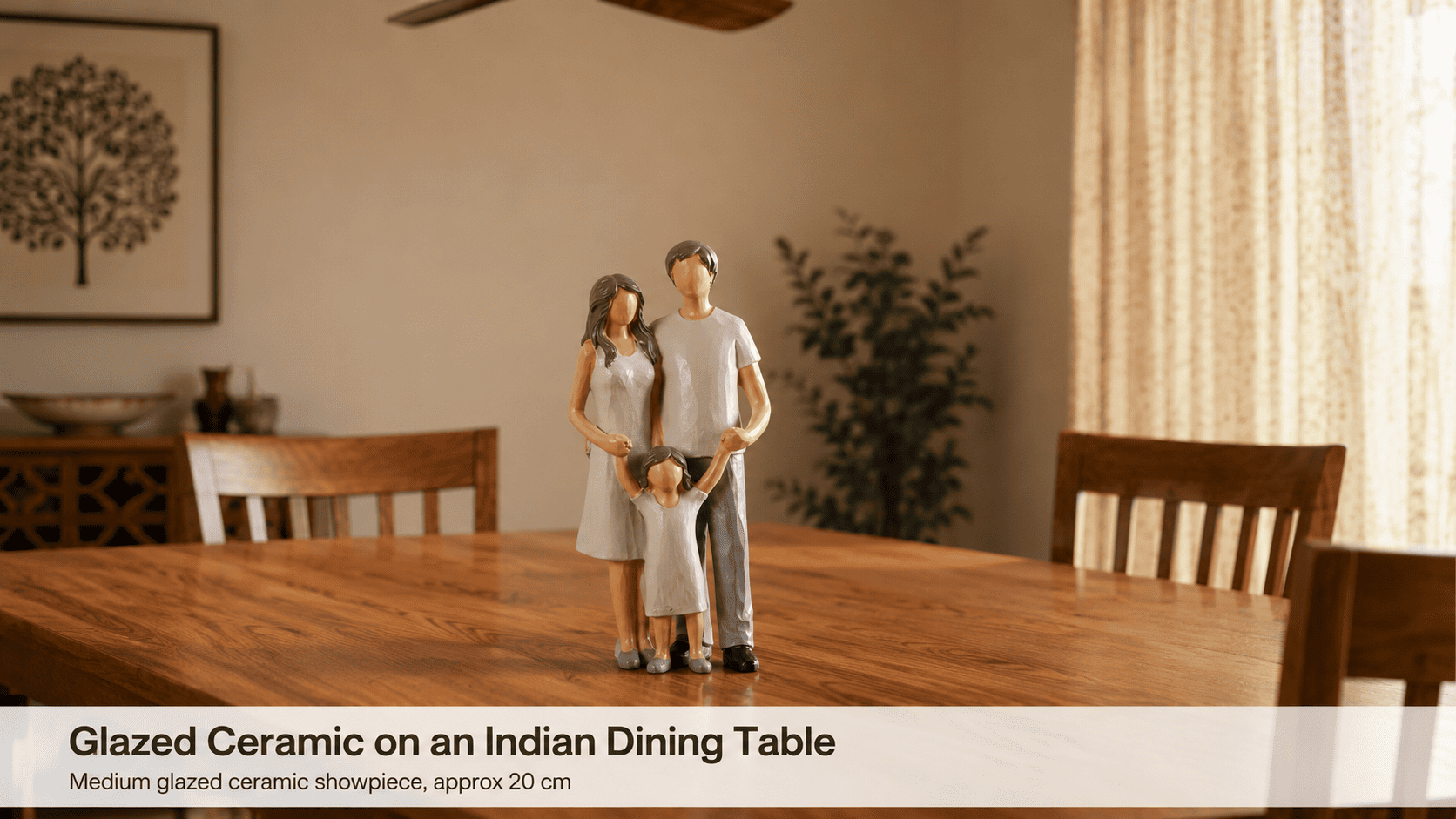
Standard 4-seater dining tables in Indian apartments measure 120–140 cm in length and 75–85 cm in width. The usable centrepiece zone — the strip of table surface not occupied by place settings, serving dishes, or family members' forearm reach — averages 30–40 cm in width and 40–50 cm in length for a 4-seater layout. A showpiece placed in this zone must occupy no more than 40% of either centrepiece dimension to remain functional during a meal, which means the practical décor height ceiling for most Indian 4-seater dining tables is 21 cm.
For 6-seater and above tables, where the centrepiece zone expands to 50–70 cm in length, a showpiece in the 25–34 cm (Large) range remains proportionally appropriate without blocking sightlines across the table. The key caution is that very large pieces (above 34 cm) on a standard 4-seater create both a visual and physical obstruction — diners cannot comfortably make eye contact across the table, which is why dining centrepiece décor should almost always be chosen one size band below what instinct suggests.
| Room / Table Type | Ambient Humidity | Recommended Material | Showpiece Size Range | Expected Lifespan |
|---|---|---|---|---|
| Sub-100 sq ft dining area, no AC | 70–90% RH (monsoon peak) | Ceramic (92% clay, 85% RH rated) | Small: 10–16 cm | 5+ years |
| 4-seater, semi-cooled (evening AC) | 60–75% RH (seasonal) | Ceramic preferred; resin marginal | Medium: 16–21 cm | Ceramic 5+ yrs / Resin 2–3 yrs |
| 6-seater, fully AC-cooled year-round | Below 60% RH (controlled) | Ceramic or resin (both within spec) | Large: 25–34 cm | 5+ yrs (ceramic) / 3+ yrs (resin) |
| Open-plan dining-living, coastal city | 80–90% RH (year-round) | Ceramic only (resin out of spec) | Small–Medium: 10–21 cm | 5+ years (ceramic only) |
Because dining table dimensions, centrepiece zone widths, and ambient humidity levels vary significantly across Indian apartment layouts, browse the full material and size-band selection in Moolwan's dining room décor collection to verify the right piece for your specific table footprint and room conditions.
How to Clean and Maintain Ceramic vs Resin Showpieces on a Dining Table
Ceramic glazed surfaces are cleaned with a damp cloth and mild detergent — the vitrified glaze layer repels oil vapour and food particle adhesion because its glass-phase surface energy is too low for organic molecules to bond strongly. This means a weekly damp wipe is sufficient to maintain surface appearance across a 5+ year lifespan, with no sealant or coating reapplication required.
Resin surfaces require more protective handling. The epoxy finish, while rated at 3H pencil hardness in controlled conditions, is chemically reactive to cleaning agents with pH above 9.0 — which includes most common Indian kitchen degreasers and many all-purpose cleaners. Cleaning resin with alkaline agents accelerates surface yellowing by breaking down the UV stabiliser layer, reducing both the visual appeal and the rated 3-year indoor lifespan. Resin pieces on dining tables therefore require pH-neutral cleaning agents only, and should be kept away from steam-release zones (directly adjacent to a serving vessel of hot dal or rice, for example).
Ready to bring home a dining showpiece that stays beautiful through five Indian monsoons? Shop the full Moolwan dining room décor collection — climate-rated, manufacturer-direct, designed for real Indian dining rooms.
Finish, Palette, and Aesthetic: Which Material Suits Indian Dining Room Styles?
The aesthetic case for ceramic in Indian dining rooms extends beyond durability. Glazed ceramic produces a depth of colour that resin cannot replicate, because the glaze layer sits above a clay body that absorbs light differently from epoxy — the result is a warm, slightly translucent surface luminosity that reads as premium under both warm incandescent dining lighting and cooler daylight from an east-facing window.
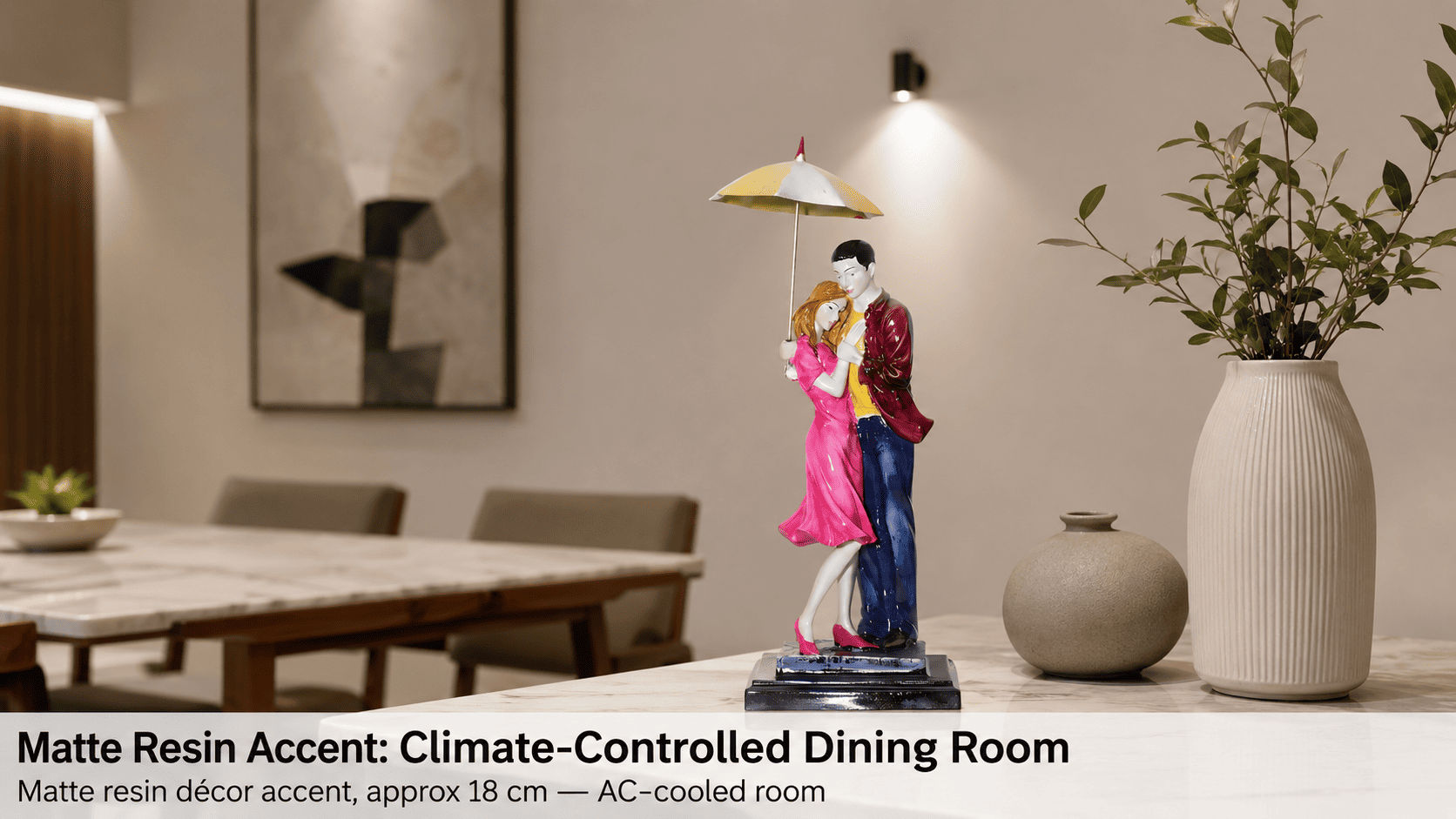
Matte ceramic, by contrast, provides the low-sheen, textured finish that pairs naturally with the warm terracotta, muted sage, and greige palettes that dominate Indian interior preferences in 2024–2026. Because an unglazed or satin-fired matte ceramic surface has micro-relief at the molecular scale, it diffuses light at multiple angles simultaneously — creating a visual softness that neither a glossy ceramic nor a matte resin surface fully reproduces. Matte resin achieves its finish through a topcoat, not through material microstructure, and so its surface uniformity reads as flat rather than soft under raking light from a wall-mounted dining room fixture.
For dining rooms with warm wood tones in the table or chairs, glazed warm-earth ceramic (ochre, rust, cream, or deep terracotta) provides the strongest visual anchor. For dining rooms with marble-top tables or grey-tone upholstered chairs, a satin-matte ceramic in neutral warm white or muted sage provides complement without competition.
Frequently Asked Questions
Will a resin showpiece warp or discolour on a dining table near a sunny window?
Yes, standard resin is susceptible to both UV yellowing and heat-induced surface softening in direct sunlight above 35°C — because the epoxy polymer matrix lacks the mineral crystalline structure needed to reflect UV radiation, and UV photons break down the epoxy's carbon-hydrogen bonds over time, causing irreversible yellowing. Moolwan's resin pieces include a UV-stabiliser additive, which extends resistance, but placement in direct sustained sunlight (more than 3–4 hours of direct sun per day) will exceed the rated protective margin within 12–18 months. For window-adjacent dining tables, glazed ceramic is the correct material choice.
Can I use a ceramic showpiece as a gift for a housewarming in a new Indian apartment?
A climate-rated ceramic dining showpiece is one of the most practical housewarming gifts for a new Indian apartment precisely because it requires no customisation to the recipient's specific room conditions — the 85% RH and 5+ year durability rating means it is within specification for virtually every Indian indoor environment, from a coastal Chennai apartment to a dry Delhi flat. Moolwan's dining room décor collection is curated to gift-appropriate size and weight ranges (150–600 g), making pieces easy to carry and present without specialist packaging.
Is the weight of a ceramic showpiece a concern for a glass-top dining table?
Small and Medium ceramic pieces (150–400 g) are within the static load tolerance of all standard 8mm and 10mm tempered glass dining tops, which are rated to distributed loads of several kilograms per square centimetre — a 400 g ceramic showpiece on a 10 cm base produces far less point pressure than a standard serving dish. Large pieces (25–34 cm, up to 600 g) should be placed on a cloth or cork base pad to distribute the contact load across a wider glass surface area, reducing the risk of stress concentration at the base edge.
What is Moolwan's return policy on dining décor showpieces?
Moolwan accepts returns within 24 hours of delivery, provided the piece is unused and in its original packaging. A 10% restocking fee applies, and refunds are processed within 15 working days. Given the climate-matching specificity of the selection guidance in this article, reviewing the size, material, and humidity-zone match before purchase eliminates most return scenarios — a correctly chosen piece delivers its rated 5+ year lifespan without needing to be returned.
Because matte and glazed ceramics maintain their rated surface integrity across 5+ years in Indian humidity — eliminating the cost of seasonal replacement that resin-based pieces risk — investing in a high-fired ceramic dining showpiece is the lower long-term cost decision, not a premium indulgence. Order your climate-matched piece directly from Moolwan's dining room décor collection — manufactured in-house, sold direct, no distributor margin. If you're also refreshing other surfaces in your home, the Moolwan unique home décor collection covers statement pieces for living rooms, consoles, and bookshelves, and the Moolwan home showpiece collection is curated by room type and surface scale across the full catalogue.


