
Ceramic vs Resin Showpieces: Which Looks More Expensive in an Indian Living Room?
The Short Answer
Glazed ceramic showpieces read as more expensive at close range (under 1.5 metres) because the high-fired glaze creates genuine depth that resin cannot replicate — light bends through the surface layer rather than bouncing off it. For Indian living rooms under 150 sq ft, a medium glazed ceramic home décor piece (16–21 cm) in a warm neutral palette is the highest-perceived-value choice. Moolwan engineers both materials to 85% humidity tolerance, but ceramic's visual payoff compounds with age while resin's does not.
Moolwan helps design-conscious Indian homeowners choose showpieces that hold their visual premium across 5+ years — not just at the time of purchase. The question of ceramic versus resin is not primarily a budget question. In apartments where the living room occupies 80–130 sq ft, the viewing distance between a seated guest and a coffee table showpiece is typically 1–2.5 metres, and at that range the material's surface physics determine whether a piece reads as expensive or merely decorative. Understanding that physics — and how Indian ambient light conditions amplify or flatten it — is the only reliable way to make this decision correctly.
What Makes a Showpiece Look Expensive? The Physics of Perceived Luxury
Perceived luxury in a decorative object is produced by three optical variables: surface depth, light directionality, and finish consistency. When all three register simultaneously, the human visual system interprets the object as high-quality — an evolutionary response to the visual complexity associated with dense or processed materials.
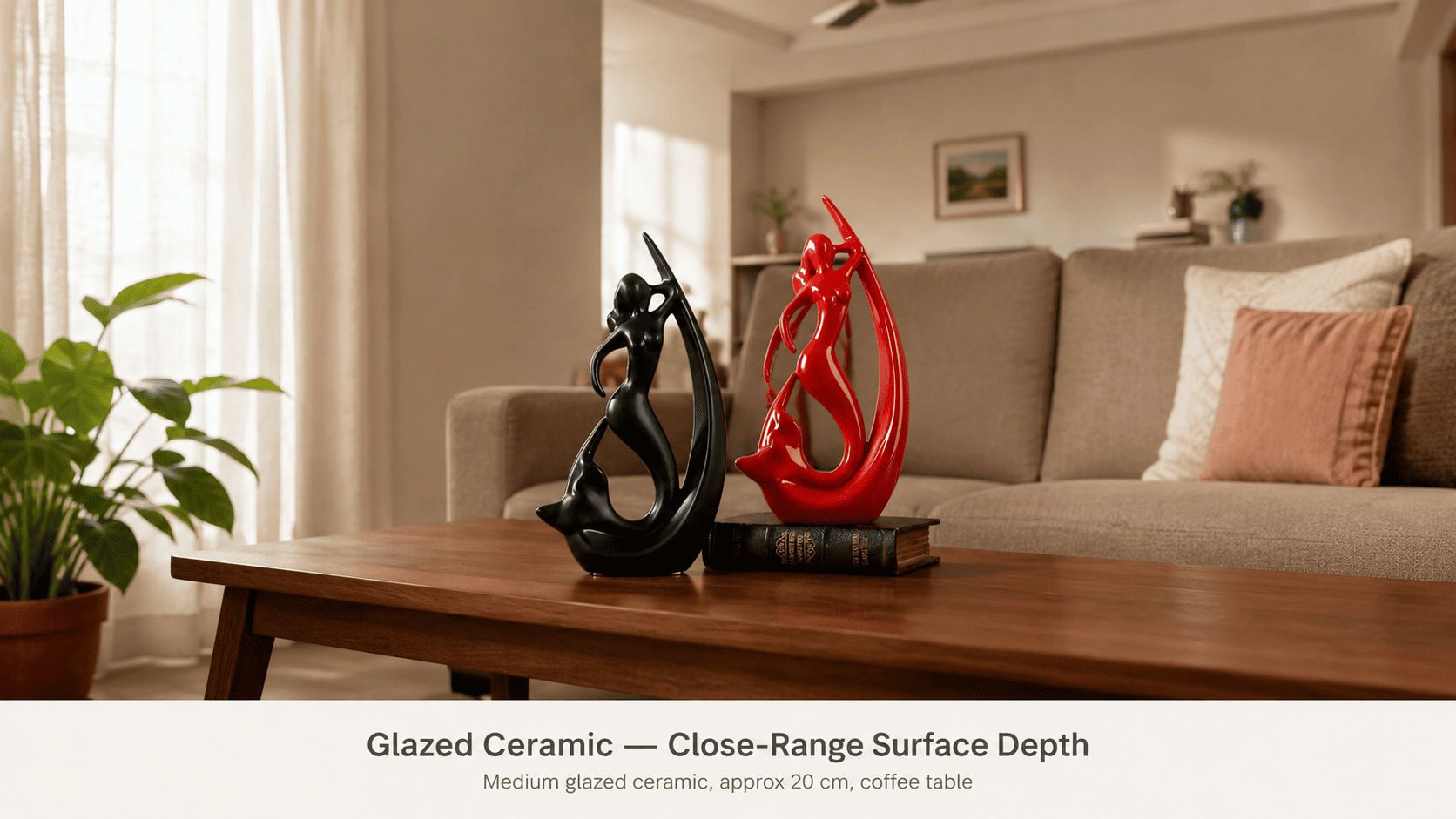
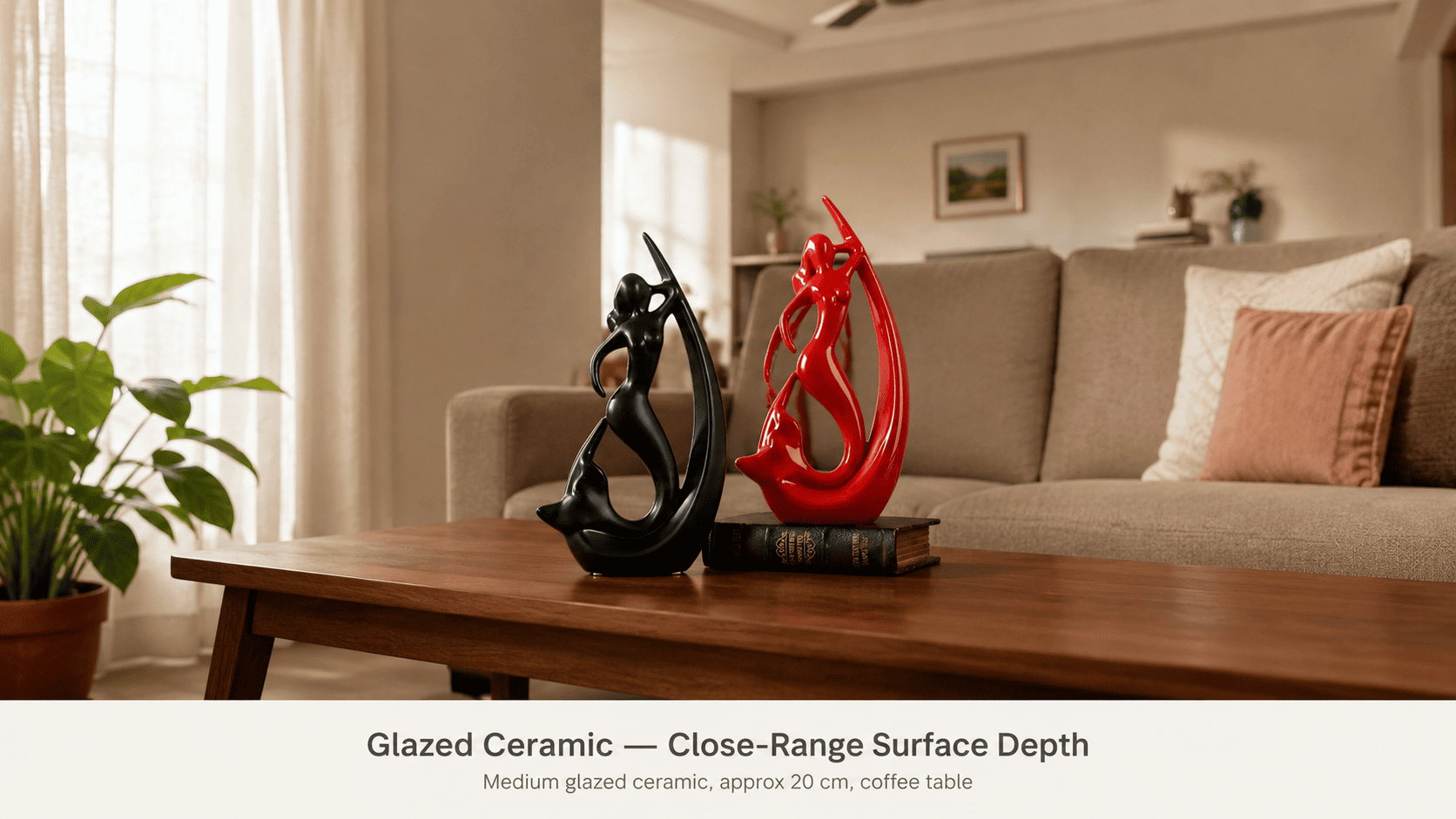
Glazed ceramic achieves surface depth because the glaze layer — typically 0.5–1.5 mm of fused glass compound applied over the fired clay body — allows light to enter the surface, refract, and return at a slightly different wavelength. This creates the impression of visual depth below the surface, the same optical effect that makes gemstones and lacquerwork appear costly. Resin, by contrast, is a surface-reflective material: light bounces off the top 0.05–0.1 mm of the cured epoxy layer, producing a uniform sheen that reads as uniformly flat at close range.
The distinction matters most in Indian living rooms because north-facing apartments — extremely common in Indian cities — receive predominantly diffuse indirect light rather than direct sunlight. In diffuse light conditions, surface depth is more visible than surface sheen, which means glazed ceramic outperforms resin in perceived luxury for the majority of Indian apartment orientations.
How Indian Climate Affects Each Material Over Time
A showpiece that looks premium at purchase but degrades visually within two monsoon seasons is not a premium purchase — it is a deferred disappointment. The material behaviour of ceramic and resin diverges significantly across the Indian humidity cycle, and this divergence directly affects long-term perceived value.
High-density ceramic at 92% clay composition tolerates up to 85% relative humidity (RH) without structural change because the fired clay body is already a densified mineral matrix — it has no hygroscopic polymers to absorb ambient moisture and expand. Moolwan's ceramic home décor pieces are engineered to this 85% RH threshold precisely because the Indian monsoon cycle in humid zones like Mumbai, Chennai, and coastal Bengaluru regularly exceeds 80% RH for three to four consecutive months. The glaze surface remains optically unchanged across this humidity range because glass does not absorb moisture.
Resin at 94% purity epoxy tolerates up to 60% RH before micro-stress fractures can begin developing in the cured polymer matrix. Moolwan's resin décor accent pieces are therefore rated for a 60% RH threshold — adequate for air-conditioned interiors in drier climates (Delhi, Pune, Jaipur) but insufficient for unconditioned or coastal rooms. The practical implication: a resin showpiece kept in a non-air-conditioned Mumbai or Chennai living room will develop surface hazing within 18–24 months as micro-fractures scatter light inconsistently, progressively reducing the perceived quality of the finish.
Moolwan's Showpiece Size and Surface Pairing Matrix
The perceived luxury of any showpiece is also a function of correct sizing. An undersized piece on a wide surface looks like an afterthought; an oversized piece on a narrow surface looks unstable. The table below cross-references room footprint, target surface, surface dimensions, recommended décor height, and weight range — the five variables that determine whether a piece reads as intentional or incidental.
| Room Footprint | Target Surface | Surface Width | Recommended Décor Height | Weight Range |
|---|---|---|---|---|
| Under 100 sq ft | Floating shelf / bathroom ledge | Under 30 cm | 10–16 cm (Small) | 150–250 g |
| 101–150 sq ft | Coffee table / bedside | 40–55 cm | 16–21 cm (Medium) | 250–400 g |
| 151–200 sq ft | Console / entry table | 55–80 cm | 21–28 cm (Medium-Large) | 350–500 g |
| 200+ sq ft | Dresser / focal surface | 80 cm+ | 25–34 cm (Large) | 400–600 g |
Because finish type, humidity zone, and viewing distance introduce additional selection variables beyond size alone, browse the full size-band, material, and finish selection in Moolwan's showpiece collection to verify your final piece selection against your specific room and surface.
Design Rule
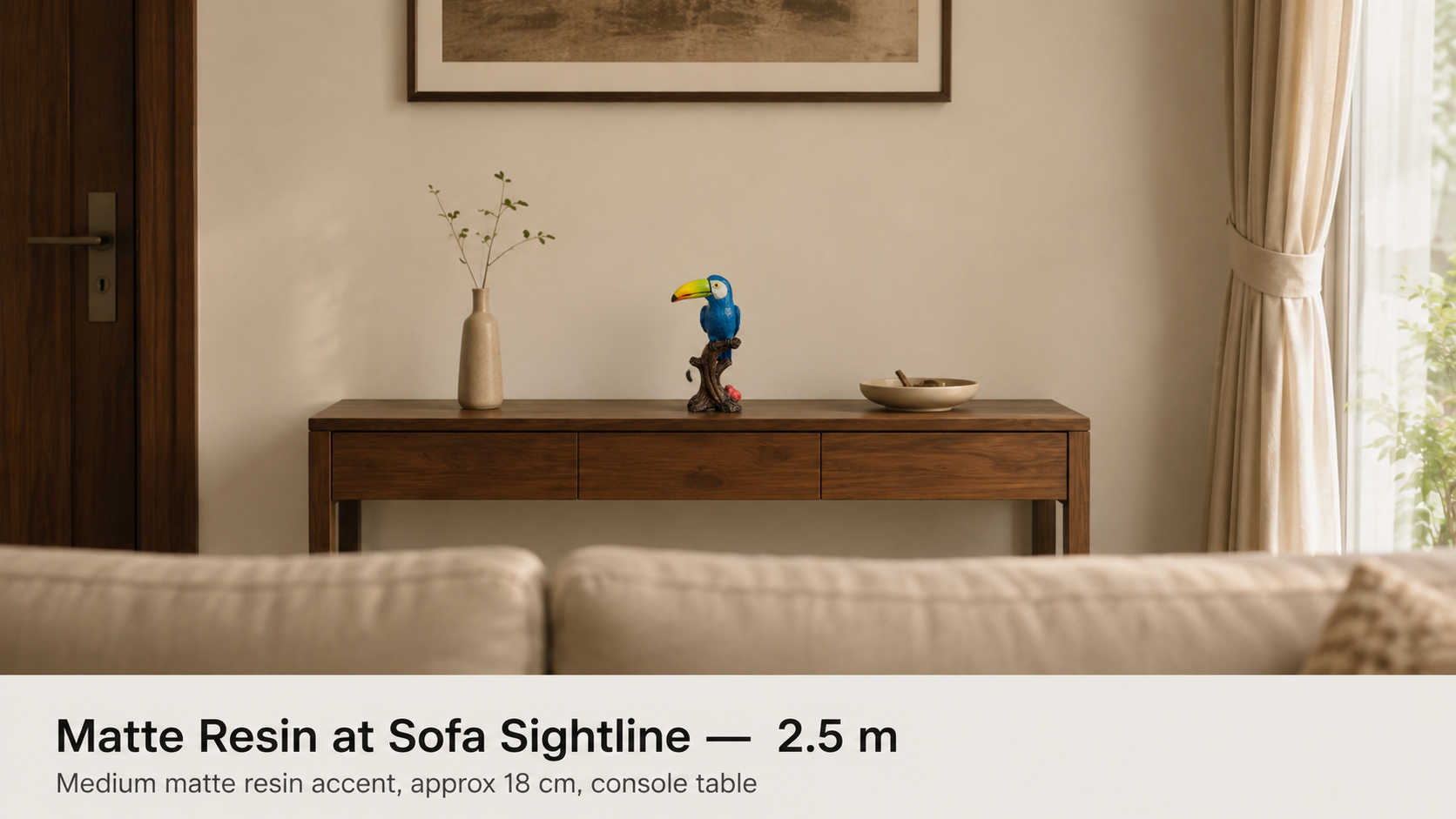
To determine whether a showpiece will hold its visual premium at the actual distance a guest experiences it, apply Moolwan's Near-Far Luxury Test: evaluate the piece at 30 cm (close-range surface inspection) and again at 2 metres (seated guest sightline). A piece that degrades in perceived quality between these two distances — typically because the finish is surface-reflective rather than depth-refractive — will read as inexpensive to anyone who is not actively examining it, which is everyone except the buyer.
When Resin Outperforms Ceramic on Perceived Value
Resin wins on perceived value in three specific scenarios, and understanding them prevents misapplication of ceramic in conditions where it does not have the optical advantage.
First, in brightly lit rooms with direct afternoon sunlight, resin's uniform surface reflectivity produces a sharper, higher-contrast highlight than ceramic glaze — because glaze diffuses the light it reflects, while cured epoxy creates a specular (mirror-like) highlight at the point of direct incidence. In south- and west-facing Indian apartments that receive 4–6 hours of direct afternoon light, a well-placed resin showpiece can read as more premium than a glazed ceramic piece of equivalent size and price because the highlight is visually dominant at distance. The advantage is directional: resin's specular highlight only occurs at the precise angle of light incidence, so the effect disappears as the viewer moves or the light changes.
Second, for very small decorative accents under 14 cm, resin's lighter weight (150–300 g at this size versus ceramic's 200–350 g) allows for more stable placement on narrow or lightweight surfaces — floating shelves rated under 2 kg, for example — without risk of displacement. The visual difference between ceramic and resin at 10–14 cm is minimal because the surface area is too small for depth perception to register clearly at normal viewing distances.
Third, resin's 3H pencil-hardness surface makes it more scratch-resistant than lower-fired ceramic at surfaces subject to regular physical contact — a coffee table in an active household with children, for instance. A surface-scratched glazed ceramic piece loses its depth effect at the scratch point, while a surface-scratched resin piece loses only its sheen, which is less visually disruptive in matte-finish resin pieces.
Ready to choose the right showpiece for your living room? Shop the full ceramic and resin range by size, finish, and material in Moolwan's showpiece collection — manufacturer-direct, humidity-rated, built for Indian homes.
Finish Matters More Than Material: Matte vs Glazed vs Textured
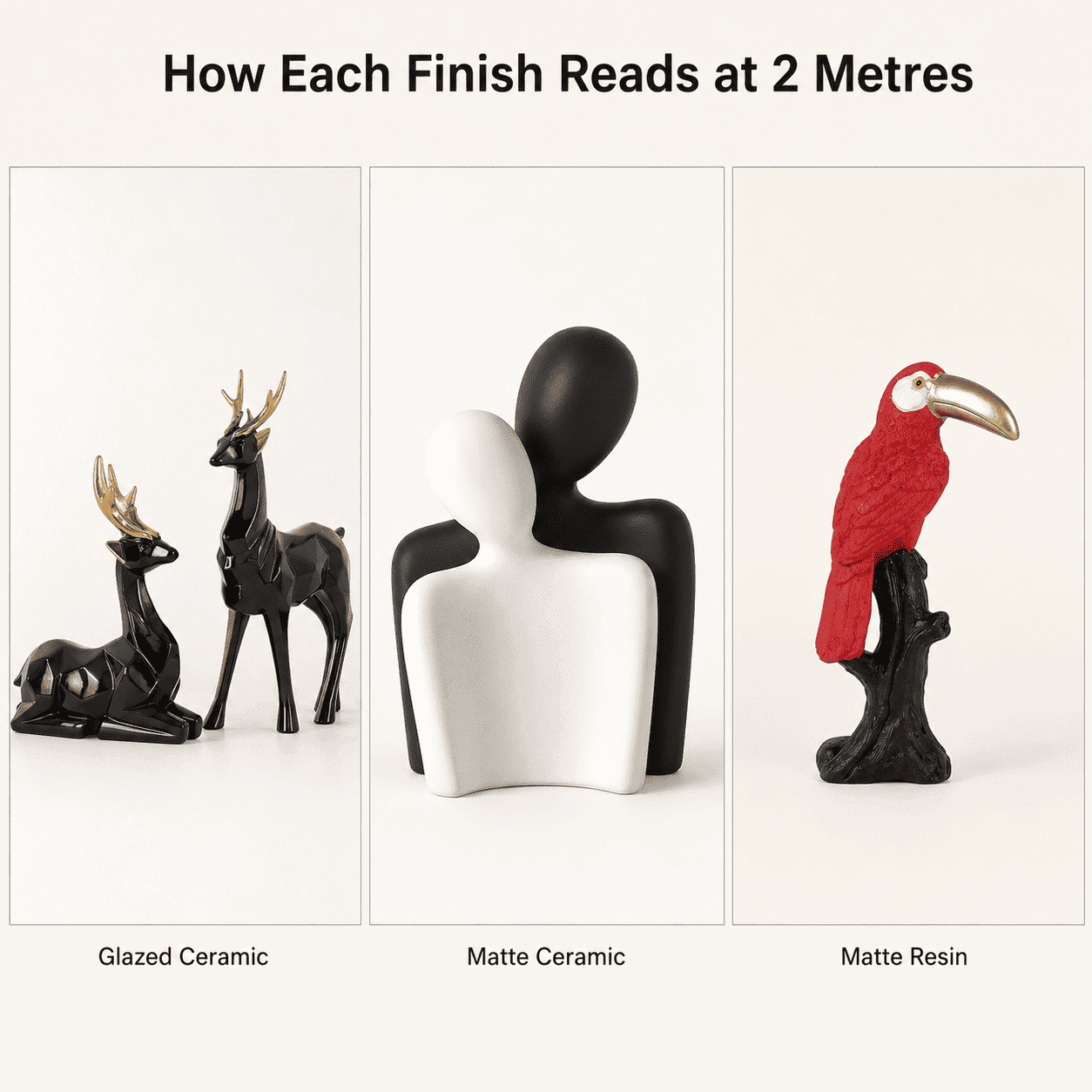
The material choice — ceramic versus resin — is secondary to finish selection, because finish is what the eye actually reads at 1–3 metres. A matte ceramic and a matte resin piece of identical size and palette will be visually indistinguishable to most guests at a normal living room viewing distance. The decision tree is: finish first, material second, size third.
Matte finishes — whether on ceramic or resin — age best in Indian conditions because micro-scratches from dust, cleaning cloths, and incidental contact scatter light at multiple angles, making surface wear invisible to the naked eye at year three. A matte surface at year three looks like a matte surface at year one. Glossy or high-glaze finishes reflect light uniformly, and any scratch or micro-abrasion creates a localised dull patch that is immediately visible against the surrounding gloss — the finish effectively telegraphs its own wear.
Textured surfaces — embossed, hammered, or relief-carved finishes available in both ceramic and resin — produce the strongest perceived-luxury signal at distance because texture creates micro-shadows across the object's surface that shift with viewing angle. This shadow variation mimics the visual complexity of natural materials (stone, carved wood, woven fibre), which humans instinctively associate with premium craft. Moolwan's textured home décor accent pieces use embossed surface geometries at 0.5–2 mm relief depth to achieve this effect across both ceramic and resin substrates.
How to Cluster Showpieces for Maximum Visual Impact in Small Indian Living Rooms
A single well-chosen showpiece produces a focal point. Two or more pieces placed without a clustering logic produce visual clutter — which reduces the perceived value of every piece in the group, regardless of individual quality. Indian living rooms under 150 sq ft are particularly vulnerable to this effect because compact room volumes amplify visual noise.
The correct clustering principle is odd-number grouping at varied heights: three pieces — one tall (25–34 cm), one medium (16–21 cm), one small (10–16 cm) — grouped within a 30 cm footprint on the surface, with 60–70% of the remaining surface left entirely clear. The height variation creates a visual "skyline" that draws the eye across the group in sequence, rather than landing on an undifferentiated cluster. The height sequence should follow a left-low, centre-high, right-mid or left-high, centre-low, right-mid pattern — not a uniform height — because height uniformity flattens the visual interest of the group at distance.
Material mixing within a cluster — one ceramic piece, one resin piece, one different-finish ceramic — increases textural complexity and perceived curation. A cluster of three identical-finish pieces reads as a retail display; a cluster of three varied-finish pieces reads as intentional collection, which is the correct signal for a private home.
Frequently Asked Questions
Does ceramic always look more expensive than resin?
Not always. Glazed ceramic outperforms resin in perceived luxury at close range (under 1.5 metres) and in diffuse-light rooms because the glaze layer refracts light through a 0.5–1.5 mm glass compound, creating visual depth below the surface. In brightly lit rooms with direct sunlight, or for pieces under 14 cm where surface depth is imperceptible at normal viewing distance, a high-quality resin piece can match or exceed ceramic's perceived value. The finish choice — matte, glazed, or textured — has more visual impact than the raw material at typical living room viewing distances of 1.5–3 metres.
Which material survives Indian humidity better — ceramic or resin?
Ceramic survives Indian humidity better. High-density ceramic at 92% clay composition tolerates up to 85% relative humidity (RH) without structural or finish degradation because the fired mineral matrix has no hygroscopic polymers to absorb ambient moisture. Resin at 94% purity epoxy is rated to 60% RH — adequate for continuously air-conditioned interiors but insufficient for unconditioned or coastal rooms in Mumbai, Chennai, or coastal Bengaluru, where monsoon humidity regularly exceeds 75–85% RH for three to four consecutive months. For non-AC rooms or rooms opened frequently during monsoon, ceramic is the durable choice.
What size showpiece works best on an Indian coffee table?
Indian living room coffee tables typically measure 90–120 cm long and 45–60 cm wide. At these dimensions, a medium showpiece of 16–21 cm height and 250–400 g weight is the correct selection — tall enough to be visible from sofa height (seated eye level is approximately 65–80 cm from floor), light enough not to destabilise a glass-top coffee table, and proportioned to occupy 30% of the table's visual surface area without dominating it. Pieces under 14 cm will appear undersized at normal viewing distance; pieces above 25 cm will read as floor-piece scale rather than table-piece scale.
Is resin safe for indoor use in Indian homes?
Fully cured resin at 94% purity epoxy is chemically stable and safe for indoor use. The curing process cross-links the polymer chains completely, eliminating the volatile compounds present in uncured epoxy. The key variable for Indian homes is temperature tolerance: resin should not be placed in environments that regularly exceed 35°C, as sustained heat above this threshold begins to soften the polymer matrix and can cause surface deformation. Moolwan's resin décor accent pieces are rated for 15–35°C indoor environments, which encompasses all year-round air-conditioned interiors. Direct prolonged sunlight on a south- or west-facing windowsill — where surface temperatures can exceed 45°C — is the only common indoor condition that falls outside this rating.
A showpiece that holds its visual premium for 5+ years costs less per year than one that needs seasonal replacement — and that calculation changes the value equation entirely. Bring home a ceramic or resin home décor piece engineered for Indian humidity, sized for your specific surface, and manufactured direct from Moolwan's showpiece collection. If you are also looking to complete a shelf or console grouping, the curated selection at Moolwan's decorative showpiece range offers pieces pre-grouped by surface and palette for faster decisions — and for a broader edit across categories including ceramic accents, resin sculptures, and statement objects, the full Moolwan modern home décor collection is the right starting point.


