
Ceramic vs Resin Showpieces: Which Looks More Expensive in Indian Living Rooms?
The Short Answer
Glazed ceramic showpieces read as more expensive because the 92% dense clay body reflects ambient light at a depth that resin — at any finish — cannot replicate. Moolwan's ceramic collection achieves this through high-fire kiln temperatures that produce surface depth visible at 1.5–3 metres, the typical viewing distance in an Indian living room under 150 sq ft.
The question of which material looks more expensive is not subjective — it is physics. Surface density, light-refraction depth, and thermal firing temperature all produce measurable visual cues that the human eye interprets as "quality" before the brain consciously registers a price tag. Moolwan helps design-conscious Indian homeowners choose showpieces engineered to trigger exactly those luxury cues within the constraints of sub-150 sq ft apartments, Indian humidity cycles, and the viewing distances typical of compact Indian living rooms.
Why Ceramic Glazes Look Richer Than Resin at a Distance
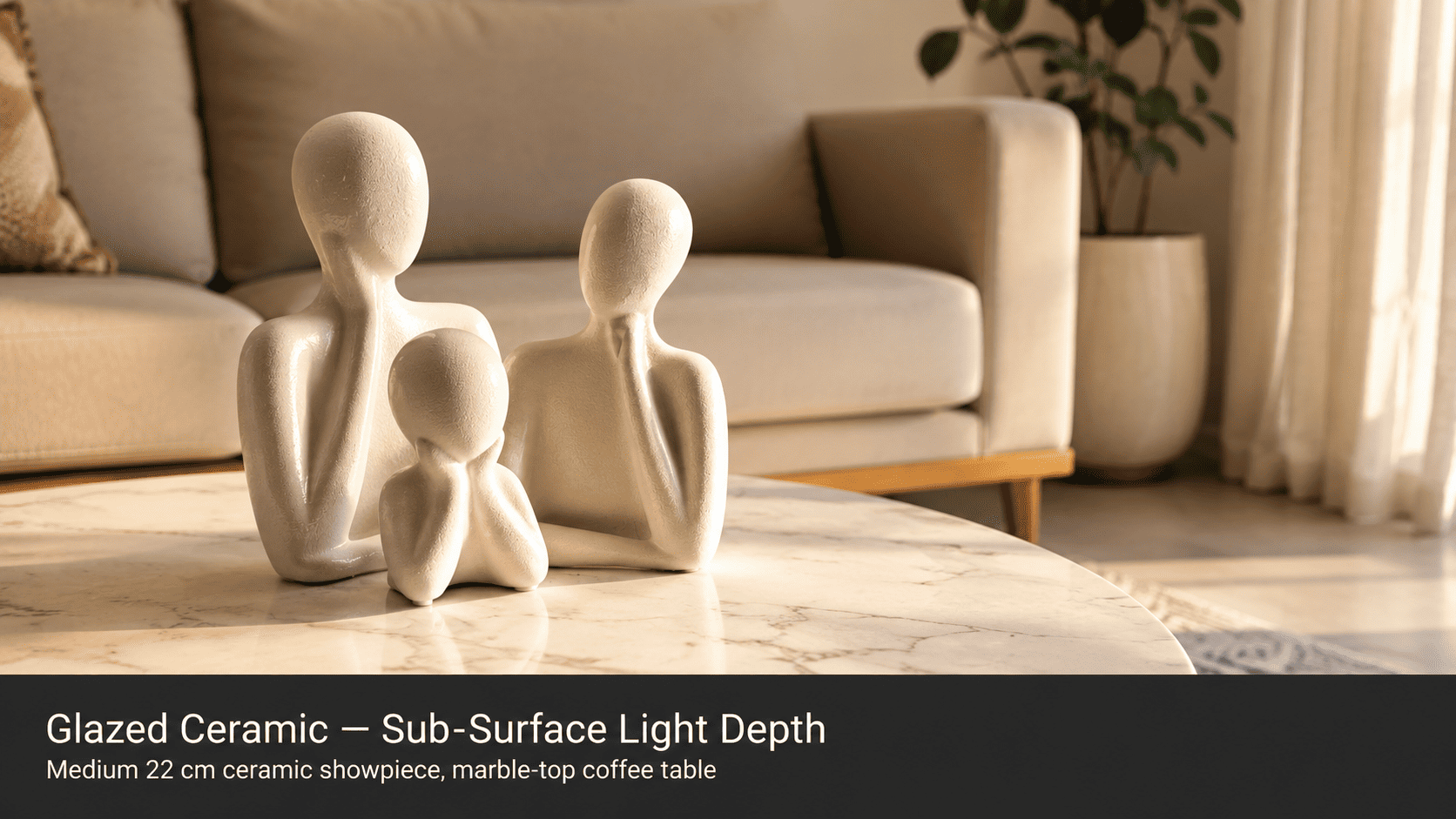
The perceived luxury of a surface is determined by the depth at which light is refracted, not merely reflected. A high-fired ceramic glaze at 92% clay density creates a semi-translucent vitrified layer: light enters the glaze, travels to the clay body beneath, and bounces back through the glaze at a slightly different angle — producing a visual depth that observers at 1.5–3 metres perceive as warmth and richness.
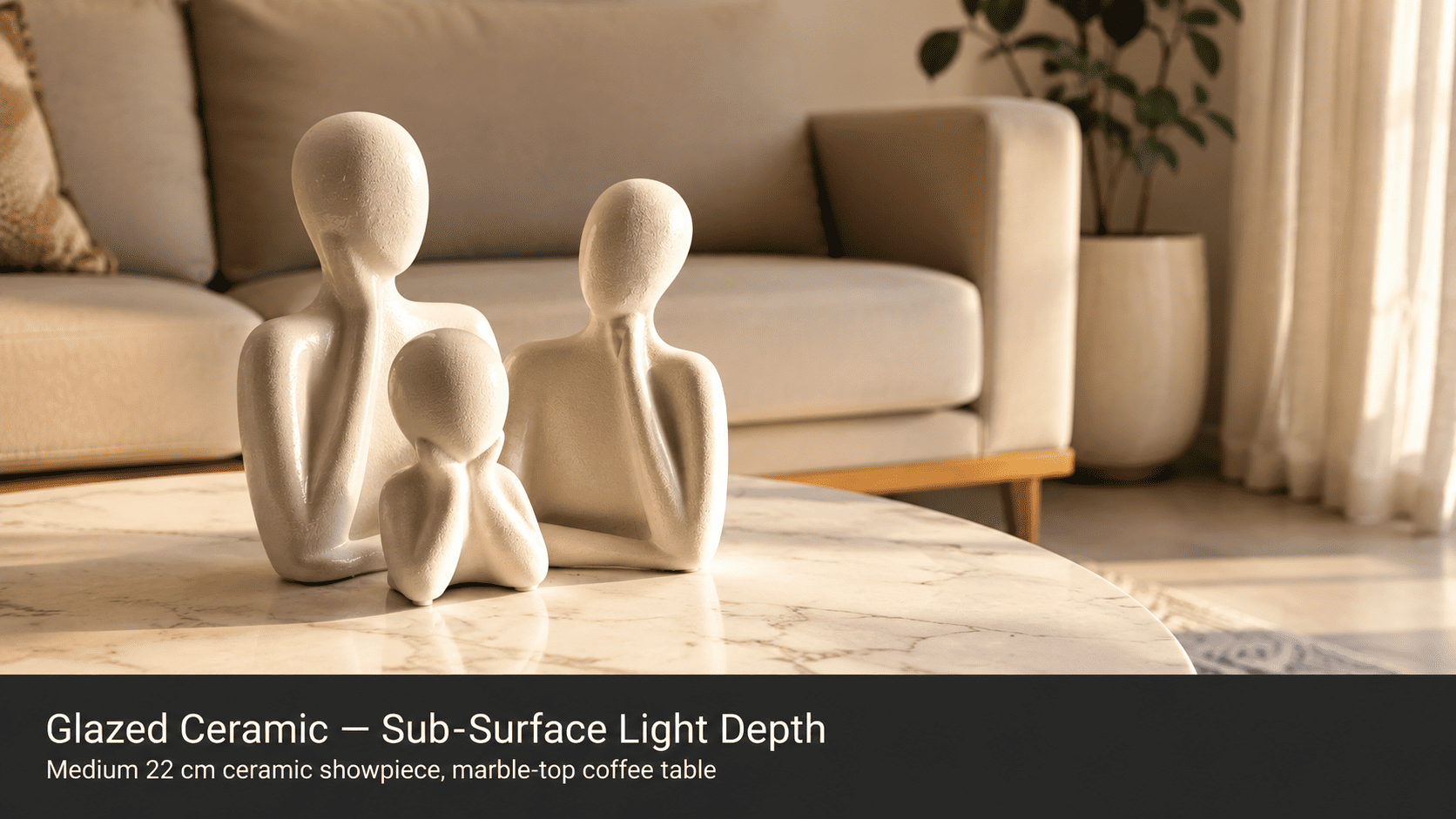
Resin, even at 94% purity epoxy, is a surface material: its finish sits on top of the casting rather than bonding into a crystalline structure. This means light is refracted only at the surface plane, which reads as flat or plastic-adjacent at viewing distances beyond 80–100 cm. The visual effect is strongest on glossy resin; matte resin closes the gap but still lacks the sub-surface refraction depth that ceramic firing produces.
Moolwan's ceramic showpieces are kiln-fired to temperatures that produce a vitrified body, ensuring this refraction depth is present even in compact Indian living rooms where natural and artificial light angles change significantly across morning, afternoon, and evening hours.
How Indian Living Room Light Conditions Affect Material Perception
Indian apartments under 1,200 sq ft — and particularly those under 150 sq ft in living room footprint — receive light from one or two directions, often supplemented by warm-spectrum LED downlights. This lighting profile dramatically changes how both ceramic and resin showpieces read.
Under warm directional light (3,000–4,000 K, the range most common in Indian homes), glazed ceramic surfaces produce a colour-shift effect: the glaze intensifies slightly in direct light and holds warmth in shadow, because the clay body underneath stores and diffuses a fraction of the thermal light spectrum. Resin under the same conditions produces either a glare spike (glossy) or a flat, light-absorbing matte — neither of which produces the tonal variation that reads as premium.
Under indirect ambient light — typical in North-facing Indian apartments — the gap narrows: matte resin performs closer to matte ceramic because neither material depends on direct refraction. In these rooms, the size, form language, and finish complexity of the piece matter more than material alone.
Design Rule
To evaluate whether a showpiece will read as premium in your specific living room before buying, Moolwan recommends applying the 60° Light-Strike Rule: hold a torch or direct your phone torch at 60° to the showpiece surface at 1.5 metres distance. If the surface shows sub-surface depth or tonal variation (a halo or colour shift), it will read as expensive under standard Indian indoor lighting. If the surface reflects uniformly with no variation, it will read as flat regardless of price.
Where Resin Showpieces Win: Durability and Form Complexity
Resin's manufacturing advantage is geometric freedom: 94% purity epoxy can be cast into complex negative-space sculptures, undercut forms, and ultra-thin profiles that would fracture during ceramic firing. This means resin showpieces can achieve form complexity — thin arcs, cantilevered elements, interlocking shapes — that ceramic cannot replicate without a significant price premium.
Moolwan's resin collection achieves a 3H pencil hardness rating and tolerates humidity up to 60% RH, making it structurally sound in Indian apartments during non-peak monsoon months. For rooms that face heavy humidity exposure (coastal cities, top-floor apartments without consistent AC), resin's non-porous surface gives it a longevity advantage over low-fired ceramic — though Moolwan's high-fired ceramic at 85% RH tolerance outperforms both.
Where resin wins the luxury perception contest is in collections designed for form-forward, contemporary interiors: rooms where the sculptural silhouette of a piece, rather than surface material richness, carries the visual weight. In a high-contrast, low-palette room — white walls, dark wood furniture — a complex matte resin form reads as confident and deliberate.
Ready to choose the right showpiece finish for your living room? Shop the full Moolwan living room décor collection — climate-rated, finish-tested, made for Indian homes.
Sizing Both Materials Correctly for Indian Living Room Surfaces
Surface size governs the correct showpiece height regardless of material. A showpiece that is too small for its surface reads as an afterthought; one that is too large creates visual compression in already-compact Indian rooms. The table below cross-references room footprint, surface type, and the correct showpiece size for both ceramic and resin pieces in Moolwan's collection.
| Room Footprint | Target Surface | Surface Width | Recommended Showpiece Height | Best Material Choice |
|---|---|---|---|---|
| Sub-100 sq ft | Floating shelf / study desk | Under 40 cm | 10–16 cm (Small) | Resin — lighter (150–250 g), form-complex; less visual weight in tight space |
| 100–130 sq ft | Coffee table / bedside console | 40–60 cm | 16–21 cm (Medium) | Ceramic — sub-surface glaze depth reads at 1.5 m typical viewing distance |
| 130–150 sq ft | TV unit / display showcase | 60–90 cm | 21–28 cm (Medium–Large) | Ceramic — scale supports glaze richness; warm LED backlighting amplifies depth |
| 150+ sq ft | Entry console / focal-point shelf | 90 cm+ | 25–34 cm (Large) | Ceramic or resin — form language governs; large resin sculptures work at this scale |
Because surface material, lamp placement, and wall colour introduce additional perception variables not captured in the table above, browse the full finish, size-band, and material selection in Moolwan's living room décor collection to verify your specific surface and room combination.

Which Finish Within Each Material Actually Reads as Expensive?
Within ceramic, glazed finishes read as more expensive than matte ceramic in direct-light rooms because the vitrified glaze produces that sub-surface refraction depth. However, in rooms with warm-white indirect lighting (common in Indian apartments with low ceilings), matte glazed ceramic — a partially vitrified surface — often reads richer than a fully glossy glaze because it eliminates glare spikes while retaining tonal variation.
Within resin, matte resin at 3H hardness is categorically more expensive-looking than glossy resin in Indian living rooms because glossy resin under warm directional light creates a "wet plastic" visual effect that registers as synthetic regardless of the piece's form complexity. The reason is that high-gloss resin has a refractive index close to glass, but lacks glass's sub-surface depth — so the eye detects the inconsistency and reads it as low-quality material mimicking a premium one.
The practical decision tree: if your room receives strong directional light (south or west-facing, or with prominent downlights), choose glazed ceramic. If your room is north-facing or ambient-lit, matte resin is competitive on perceived luxury and adds durability advantages for humid coastal or monsoon-exposed rooms.
Frequently Asked Questions
Does ceramic always look more expensive than resin?
Not always — it depends on lighting and room size. In rooms under 100 sq ft with a single light source, a complex matte resin form at the right size can read equally premium because visual complexity compensates for material depth. But in rooms above 130 sq ft with warm directional lighting, a high-fired glazed ceramic showpiece consistently outperforms resin on perceived luxury because sub-surface light refraction is visible at the 1.5–3 metre viewing distances typical in Indian living rooms. Moolwan's sizing guide categorises pieces by room footprint to account for this variable.
Which material is more durable in Indian climate conditions?
Moolwan's high-fired ceramic is rated to 85% relative humidity — the higher threshold — making it the more robust choice in monsoon-exposed rooms, particularly in coastal cities or apartments with fluctuating AC usage. Moolwan's 94% purity resin tolerates up to 60% RH, performing well in consistently air-conditioned interiors. Both materials are drop-tested; ceramic at weight ranges up to 600 g from 15 cm, resin at equivalent heights. The practical difference: coastal Indian apartments or rooms without consistent AC should favour ceramic.
What size showpiece works on a standard Indian coffee table?
Most Indian coffee tables in apartments under 150 sq ft have a surface width of 40–60 cm. At this surface width, a Medium showpiece of 16–21 cm height is the correct proportion — tall enough to be visible when seated (the primary viewing angle for a coffee table piece), but not so tall as to interrupt sightlines across the room. This applies to both ceramic and resin pieces. Moolwan's Medium category spans 16–21 cm with weight ranges of 250–400 g, stable on standard glass and wood-veneer coffee table surfaces without requiring adhesive anchoring.
Is resin safe for Indian homes with children or pets?
Moolwan's 94% purity epoxy resin pieces are non-toxic once cured, with no off-gassing at Indian indoor temperatures of 15–35°C. The material achieves a 3H pencil hardness rating, meaning normal contact and bumping will not cause surface breakdown or particle release. Resin's lower weight range (150–400 g for Small and Medium pieces) means tip-over impact is lower than equivalent-sized ceramic pieces. Both materials are finished without lead-based pigments.
Choosing between ceramic and resin is ultimately an investment in how your living room reads for the next 5+ years — not just for guests today. Because high-fired ceramic at 85% RH tolerance eliminates the need for seasonal replacement that cheaper, humidity-sensitive pieces require, it delivers a measurably lower cost-per-year of display. Bring home a piece from the Moolwan living room décor collection — manufacturer-direct, climate-rated, sized for Indian apartments. If you're working with a compact layout, also consider Moolwan's luxury décor edit for small living rooms, curated specifically for surfaces under 60 cm in sub-120 sq ft rooms. Or if you want a single statement piece that transforms the room's character rather than completing it, browse Moolwan's unique décor collection for elegant living rooms — pieces selected for maximum visual impact in compact Indian interiors.


