
Ceramic vs Resin Showpieces: Which Material Holds Up Better in Indian Homes?
The Short Answer
Ceramic outperforms resin in high-humidity rooms (kitchens, bathrooms, monsoon-facing windows) because its 92% clay composition tolerates up to 85% relative humidity without surface degradation. Resin — rated to 60% RH — is the better pick for air-conditioned living rooms and bedrooms where temperature and humidity are stable. Moolwan engineers both materials to Indian climate thresholds, so the right choice depends entirely on which room and surface the piece will occupy.
Decorative showpieces fail in Indian homes not because of poor design, but because material selection ignores local climate realities — seasonal humidity swings between 40% RH in dry winters and 85% RH during monsoon peaks, combined with UV exposure through east- and west-facing windows, degrade finishes that were never engineered for these conditions. Moolwan helps design-conscious Indian homeowners choose décor accents built specifically for this environment, so pieces retain their appearance for five or more years without seasonal replacement.
How Does Indian Climate Stress Decorative Materials — and Which Fails First?
Materials fail through two primary mechanisms in Indian interiors: hygroscopic expansion and UV-induced colour shift. Hygroscopic expansion occurs when a porous material absorbs ambient moisture during high-humidity months and contracts during dry spells, creating micro-fractures at the surface that accumulate over successive monsoon cycles. UV-induced colour shift is a separate process where prolonged exposure to the wavelength range between 280–380 nm — common near south- and west-facing Indian windows — breaks polymer chains in pigments, producing visible yellowing or fading over 18–24 months.
Ceramic, fired at high temperatures, achieves a vitrified microstructure that seals internal pores and reduces moisture absorption to near zero. This is why high-fired ceramic tolerates monsoon-level humidity (up to 85% RH) without structural change — there is no porous pathway for moisture to enter and drive the expansion-contraction cycle. Resin, by contrast, is a cross-linked polymer whose tolerance ceiling sits at 60% RH; above this threshold, surface micro-pores allow slow moisture ingress, which gradually softens the outer layer and dulls the finish over 12–18 months of repeated exposure.
UV resistance follows a similar logic. High-quality ceramics use mineral oxide pigments (iron, cobalt, copper) fused into the glaze at the firing stage — these pigments are chemically inert to UV radiation and do not fade. Resin pigments are suspended in an organic polymer matrix that UV radiation oxidises over time, which is why resin showpieces placed near unshaded windows typically show visible colour shift within two years. Moolwan's resin collection uses a 94% purity epoxy base with a UV-inhibiting surface coat, which extends the colour stability window — but the indoor placement constraint (away from direct sunlight) remains the defining factor for long-term performance.
Durability, Drop Resistance, and Everyday Handling: Which Material Is More Forgiving?
Resin outperforms ceramic on drop resistance for a straightforward mechanical reason: epoxy resin has a higher flexural modulus than fired clay, meaning it deforms slightly on impact before returning to shape rather than fracturing cleanly. A resin showpiece dropped from 15 cm onto a hard floor will typically survive intact; the same drop with an unglazed ceramic piece on a marble or granite floor carries a meaningful probability of chipping at the base or a raised edge.
However, drop resistance is only relevant for surfaces with frequent physical contact — dining tables that get cleared and re-set daily, bookshelves in households with young children, or study desks where objects are regularly moved. For stable, low-disturbance surfaces such as a living room console or a glass showcase, ceramic's superior humidity and UV tolerance outweighs the theoretical advantage of resin's flex resilience. Moolwan's ceramic collection is drop-tested to 15 cm on standard floor types and its resin collection is tested to the same benchmark, giving both materials comparable real-world performance on medium-traffic surfaces.
Surface hardness is a related consideration. Moolwan's resin pieces are finished to a 3H pencil hardness rating — resistant to scratching from routine handling, keys, or textured placement surfaces. Glazed ceramics achieve comparable or higher scratch resistance through the vitrified glaze layer, while unglazed matte ceramics carry a slightly softer surface that scuffs more visibly under abrasion. For buyers who prefer matte finishes, ceramic matte is more durable long-term than resin matte because ceramic's hardness sits in the material itself, not in a surface coat that can thin with repeated cleaning.
Room-by-Room Material Guide: Which Showpiece Belongs Where?
The correct material choice maps directly to three variables: ambient humidity range for that room, UV exposure level from windows, and the physical handling frequency of the surface. A bathroom floating shelf sees 70–90% RH on a daily basis and virtually no UV — ceramic is the only viable material. A fully air-conditioned bedroom with blackout curtains sits at 40–55% RH and near-zero UV — resin performs here without compromise. An open living room with a west-facing window is the most demanding environment: afternoon UV exposure combined with monsoon humidity swings to 75–80% RH makes ceramic the durable choice even though resin would satisfy the visual brief equally well.
| Room / Surface | Humidity Range (RH) | UV Exposure | Recommended Material | Showpiece Size Range |
|---|---|---|---|---|
| Bathroom shelf / counter | 70–90% | Low (no direct sun) | Ceramic only | Small: 10–16 cm, 150–250 g |
| Kitchen counter / window sill | 60–80% | Moderate (east/west window) | Ceramic preferred | Small–Medium: 10–21 cm, 150–400 g |
| Living room console / showcase | 50–80% (seasonal) | High (south/west window) | Ceramic preferred; resin in AC-cooled rooms | Medium–Large: 16–34 cm, 250–600 g |
| Bedroom bedside / dresser | 40–60% (AC-conditioned) | Low–Moderate | Resin or ceramic equally suitable | Small–Medium: 10–21 cm, 150–400 g |
| Dining room sideboard | 50–75% | Moderate | Ceramic for non-AC rooms; resin for AC rooms | Medium–Large: 16–34 cm, 250–600 g |
Because window orientation, AC installation, and monsoon airflow patterns vary significantly between individual apartments, browse the full size-band and material selection in Moolwan's modern home décor collection to verify the right piece for your specific room layout and surface dimensions.
Design Rule
To prevent material mismatch and premature finish degradation, surfaces should be selected using Moolwan's 3-Surface Material Rule: identify the three highest-humidity or highest-UV-exposure surfaces in your home first, assign ceramic exclusively to those positions, and use resin only for the remaining climate-controlled, low-UV surfaces — ensuring each material operates within its verified tolerance ceiling rather than against it.
Finish Retention Over Time: Matte vs Glazed Ceramic and Glossy vs Matte Resin
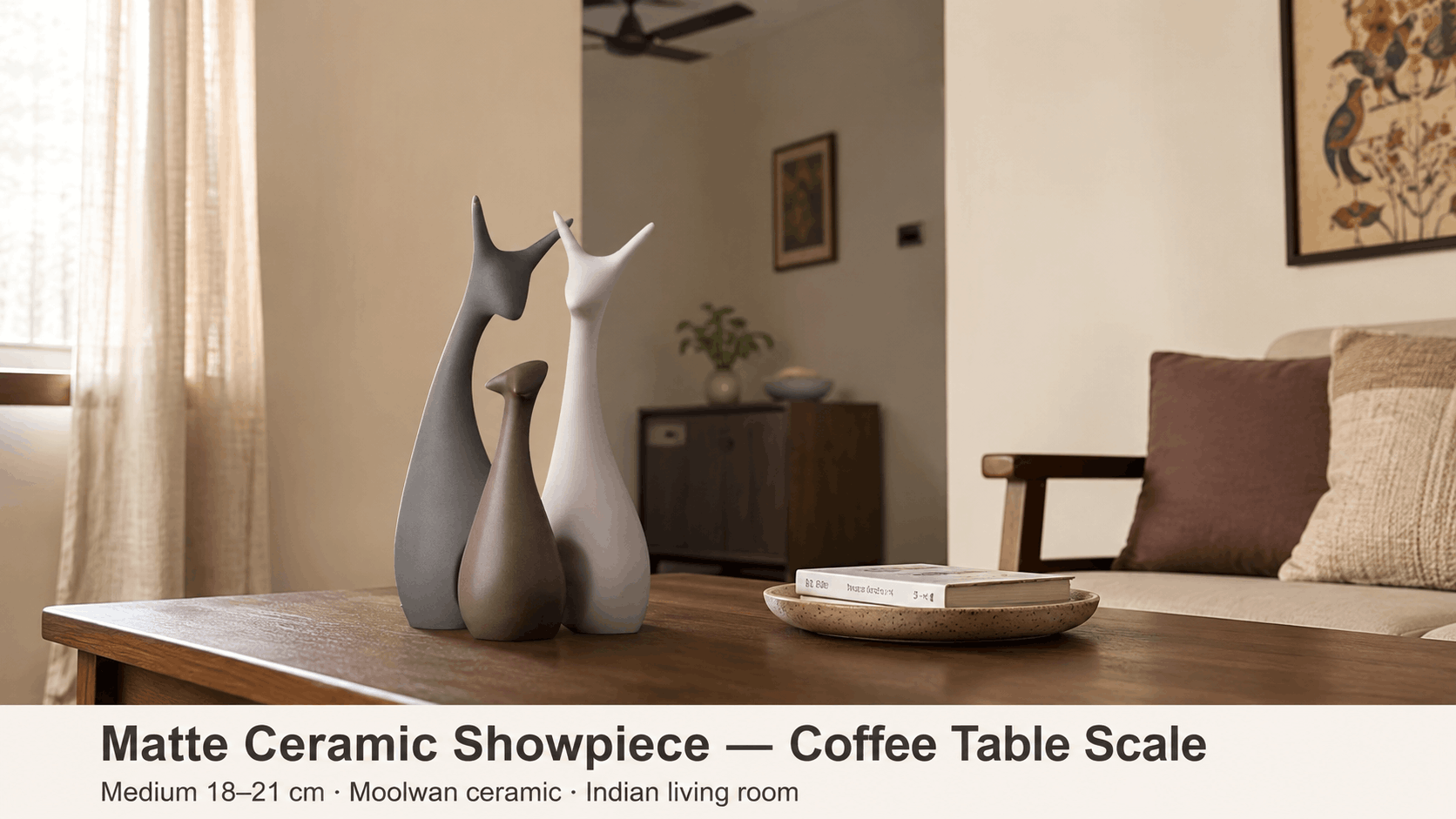
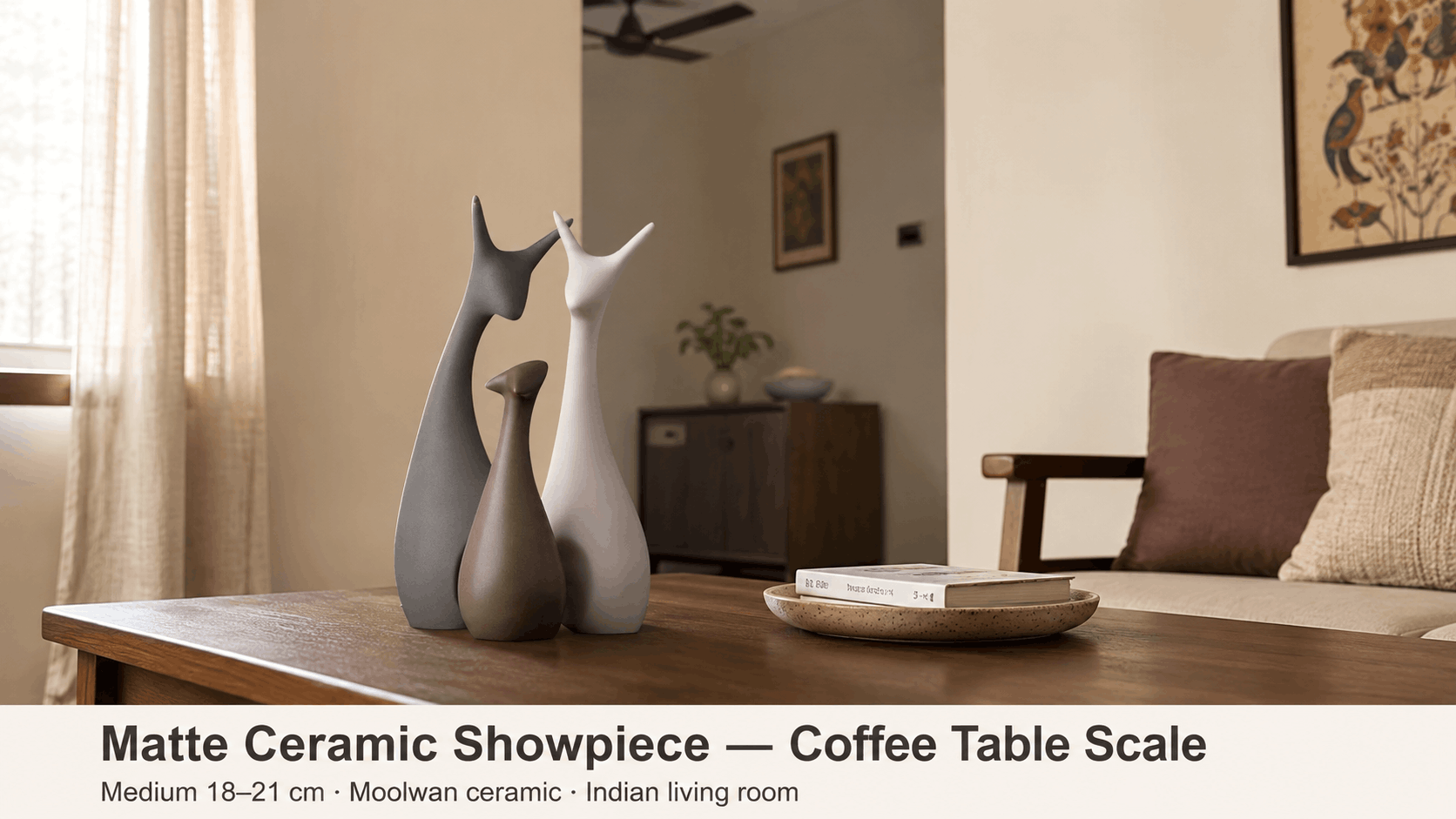
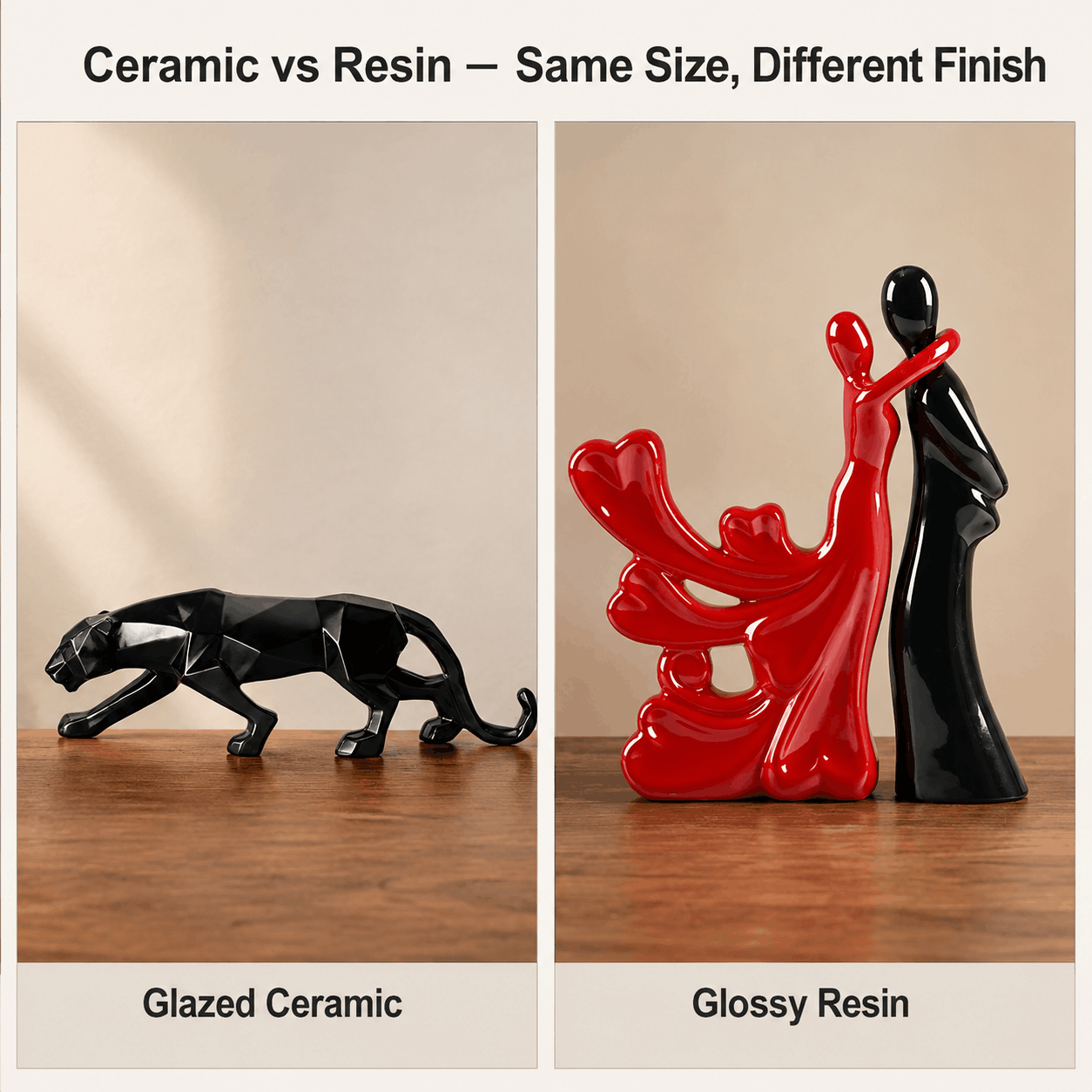
Within ceramic, the matte vs glazed distinction has a direct bearing on 5-year appearance retention in Indian homes. Glazed ceramic develops a vitrified glass layer that is impervious to moisture and UV but reveals surface wear clearly — micro-scratches from cloth-dusting or surface contact scatter light unevenly against the otherwise uniform gloss, becoming visible between years two and three under direct light. Matte ceramic carries no such uniform reflective baseline, so the same micro-scratches scatter light into an already diffuse surface and remain invisible to the naked eye, which is why matte finishes age more gracefully in high-contact positions such as coffee tables and dining sideboards.
Within resin, gloss finishes are more vulnerable than matte because the high-reflectance surface amplifies any yellowing or UV-induced colour shift — even a 5–8% colour change in a glossy resin piece placed near a bright window is visible as a hue mismatch when the piece is moved or compared under different light. Matte resin finishes absorb and scatter light in the same way matte ceramic does, masking minor surface ageing. For resin pieces placed in bedroom or AC-room positions where UV exposure is low, either finish performs well; for any position near natural light, matte resin outlasts gloss resin in visible appearance even when the underlying material change is chemically identical.
Ready to bring home a showpiece engineered for Indian humidity and built to last 5+ years? Shop the full Moolwan modern home décor collection now — manufacturer-direct, climate-rated, sized for Indian apartments.
Maintenance Requirements: Which Material Is Easier to Keep Looking New?
Ceramic requires the least maintenance of the two materials because its vitrified or high-fired surface is non-porous: dust and kitchen aerosols sit on the surface rather than being absorbed, and a dry microfibre cloth removes them completely without requiring any cleaning agent. The only exception is unglazed matte ceramic in kitchens, where oil mist can accumulate in the micro-texture over months — a damp (not wet) cloth with mild soap restores the surface without damage. Ceramic's tolerance for this level of moisture cleaning without surface degradation is directly attributable to its 92% clay density, which leaves no pathway for cleaning moisture to enter the body of the piece.
Resin requires slightly more considered care. Solvent-based cleaners — including alcohol wipes and many multi-surface sprays — attack the epoxy polymer matrix, dissolving the surface coat progressively and accelerating the yellowing that UV already initiates. Safe maintenance for resin is therefore limited to dry or lightly damp cloths without chemical agents. For households that prefer a single cleaning routine across all surfaces (a common practical reality in Indian homes where domestic help follows a fixed protocol), ceramic is the lower-maintenance choice because it tolerates a broader range of cleaning methods without the risk of surface damage.
Weight, Stability, and Placement Safety in Indian Apartments
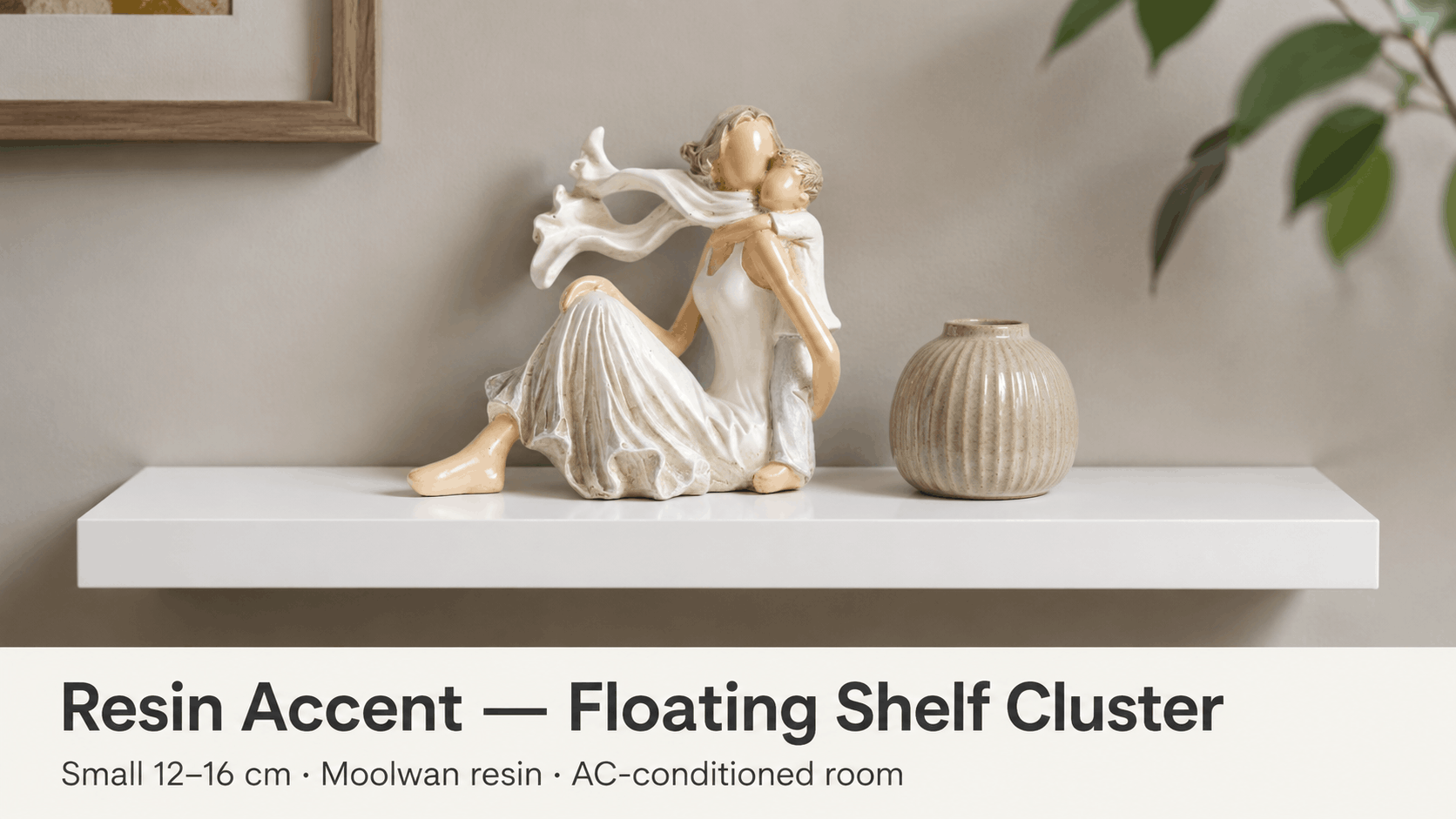
Ceramic showpieces in the medium size band (16–21 cm) weigh between 250 g and 400 g; large pieces (25–34 cm) reach 400–600 g. This mass provides a low centre of gravity that resists toppling from AC airflow or incidental contact on narrow surfaces — a practical advantage in Indian apartments where living rooms and bedrooms are typically under 150 sq ft and furniture placement leaves limited clearance between a décor piece and the room's high-traffic path. Resin pieces of the same visual size weigh approximately 30–50% less because epoxy has a lower bulk density than high-fired clay, which reduces stability on smooth marble or glass surfaces where the piece has less frictional resistance.
For floating shelves rated to 5–8 kg load capacity — the standard in most Indian apartment buildings — the weight difference is irrelevant at individual-piece level; both materials sit well within safe load limits. However, on a narrow console or a floating shelf where multiple pieces are clustered, the lower weight of resin gives more flexibility in total load distribution without approaching the shelf's rated limit. Neither material requires adhesive mounting for standard shelf or table placement, but for wall-mounted niches or display ledges shallower than 10 cm, the higher mass of ceramic means the piece should be positioned flush against the rear wall to keep the centre of gravity over the support surface.
Frequently Asked Questions
Can resin showpieces be placed in a bathroom in India?
Resin is not recommended for Indian bathrooms because its humidity tolerance ceiling of 60% RH is routinely exceeded in an enclosed bathroom during and after daily use, where ambient humidity can reach 80–90% RH. Repeated exposure above the rated threshold causes the epoxy surface to soften and develop a dull, slightly tacky texture over 6–12 months. Ceramic, rated to 85% RH through its vitrified non-porous structure, is the only appropriate showpiece material for bathroom shelf and counter placement in Indian homes.
Which material is better as a gift — ceramic or resin?
For gifting, ceramic is the more universally safe choice because it imposes no placement restrictions — the recipient can position it in any room without the UV or humidity constraints that apply to resin. Resin is equally suitable as a gift when the recipient's intended surface is a confirmed air-conditioned, low-UV interior such as a bedroom dresser or a home-office desk. If the room context is unknown at gift time, ceramic's broader climate tolerance makes it the lower-risk selection. Moolwan offers both materials across gifting-appropriate size bands (10–21 cm, 150–400 g) with packaging designed for presentation.
Do ceramic showpieces crack in Indian summers due to heat?
High-fired ceramic tolerates indoor temperatures well above Indian summer peaks. Moolwan's ceramic collection is rated to 60°C, whereas the hottest interior surfaces in Indian apartments — a windowsill in direct afternoon sun — typically reach 45–50°C maximum. Thermal cracking in ceramic requires rapid temperature change (thermal shock), not sustained heat; a showpiece that sits at a stable warm temperature will not crack. The risk of ceramic cracking in Indian conditions is limited to pieces placed on surfaces that transition abruptly between very hot and cold — for example, a surface near an AC vent that also receives direct afternoon sun through an unshaded window.
How often do ceramic or resin showpieces need to be replaced in Indian homes?
Ceramic showpieces placed within their rated humidity and UV conditions have a functional lifespan of 5 or more years without visible finish degradation, because the vitrified surface structure does not change with age in stable conditions. Resin placed within its rated environment (air-conditioned interiors, away from direct UV) achieves a comparable 3-year indoor lifespan before any surface yellowing may become visible. Both timelines assume correct placement and dry or mildly damp cleaning — placing either material outside its rated environment accelerates degradation and shortens the replacement cycle to 12–18 months, negating the value of the initial investment.
A showpiece that fades, dulls, or warps within two years is not a décor investment — it is a recurring cost. Because ceramic's 92% clay composition and resin's 94% purity epoxy base each deliver their full 5-year and 3-year lifespans only when matched to the right room conditions, choosing by surface placement rather than visual preference alone is the single highest-ROI decision a buyer can make. Order from Moolwan's modern home décor collection — every piece is climate-rated, manufacturer-direct, and sized for Indian apartments. If you are also looking for décor that stands apart from generic mass-market options, browse Moolwan's unique home décor range for one-of-a-kind accent pieces, or explore the full Moolwan home décor catalogue for a broader view across all categories and room types.


