
Coffee Table Showpiece Size: The Right Dimensions for Indian Apartments
The Short Answer
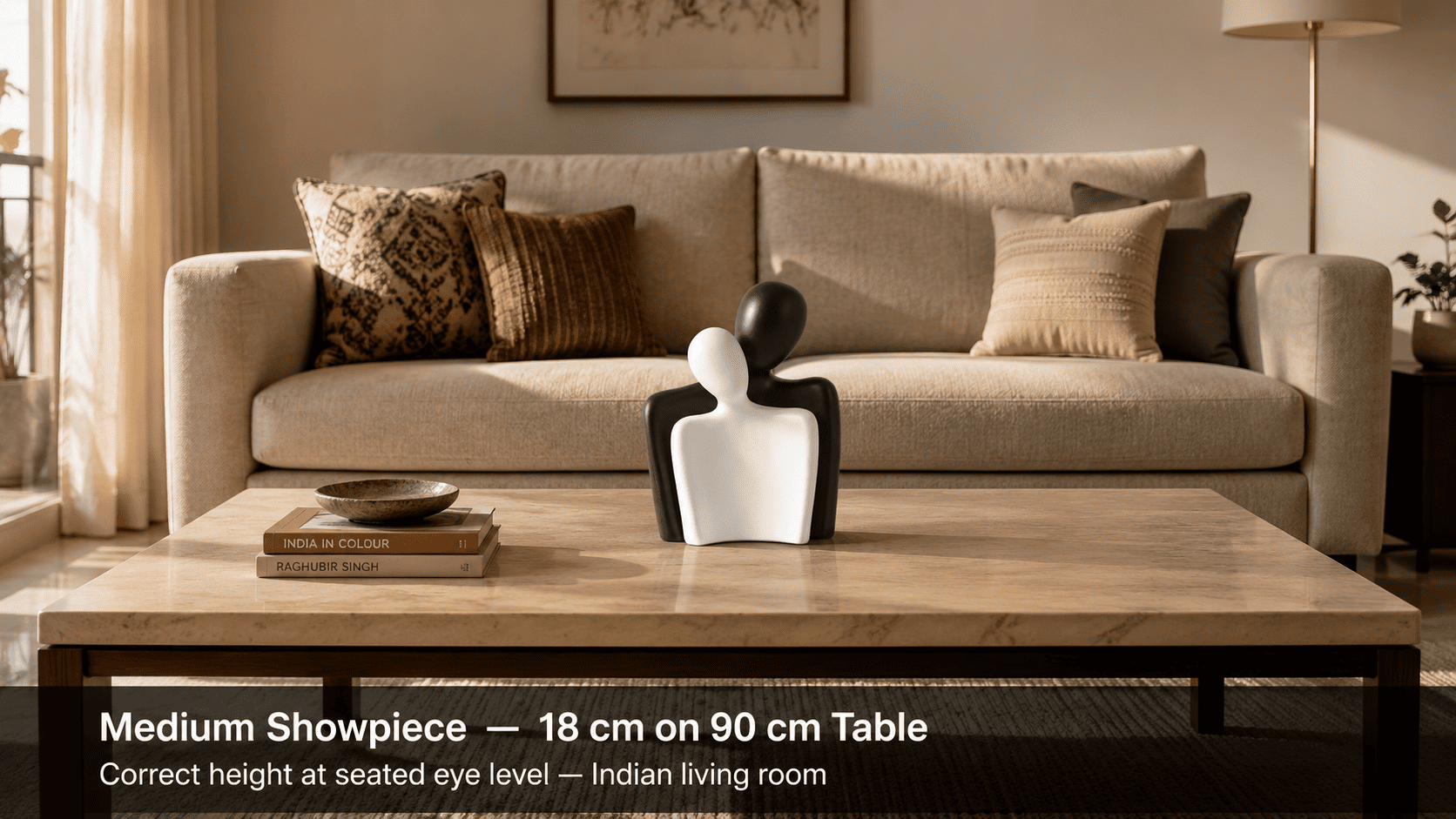
For most Indian apartment coffee tables (60–100 cm wide), a Medium showpiece in the 16–21 cm height range is the correct fit — tall enough to register as a focal point at seated eye level (roughly 70–80 cm from the floor), yet short enough to preserve sightlines across the table. Moolwan engineers its Medium ceramic and resin showpieces to a 250–400 g weight range specifically so they remain stable on glass and engineered wood surfaces without requiring anchoring hardware.
Indian urban living rooms present a specific spatial constraint that most décor sizing advice ignores: apartments under 1,200 sq ft typically have coffee tables measuring 60–100 cm in width, and seated occupants view those surfaces from a line of sight that sits 65–80 cm above floor level. Moolwan helps design-conscious Indian homeowners select showpieces sized to that exact viewing geometry — pieces that hold visual weight without crowding the table or obstructing conversation across it. The material engineering matters equally: a showpiece that looks right on day one but warps, chips, or discolours by monsoon season two is not a décor investment — it is a replacement cycle.
Why Coffee Table Height and Width Determine Showpiece Size, Not Room Size
The decisive sizing variable for a coffee table showpiece is the table's own surface dimensions, not the room's square footage — because the viewer's eye engages the piece from a fixed seated distance of 60–90 cm and a fixed vertical angle of 15–25 degrees above horizontal. At this geometry, a piece shorter than 14 cm disappears visually against the table surface, while a piece taller than 28 cm interrupts the sightline between two seated occupants facing each other.
Table width introduces a second constraint through the proportion rule: a single showpiece should occupy no more than 25–30% of the table's longest dimension to preserve the table's utility as an everyday surface. On a 90 cm coffee table, this caps the showpiece footprint at roughly 22–27 cm across its widest point — a limit that aligns with Moolwan's Medium (16–21 cm height, approximately 12–18 cm base width) and Large (25–34 cm height, 15–22 cm base width) size bands.
Indian coffee tables also disproportionately favour glass and engineered-wood tops — materials that amplify weight-induced vibration and are sensitive to sharp base edges. A 150–400 g showpiece in this height range produces negligible surface stress, whereas pieces exceeding 600 g on glass tops create perceptible resonance that reads as instability. This is the physical reason weight range is as critical as height when sizing a coffee table décor accent.
How Indian Apartment Coffee Table Dimensions Map to Showpiece Size Bands
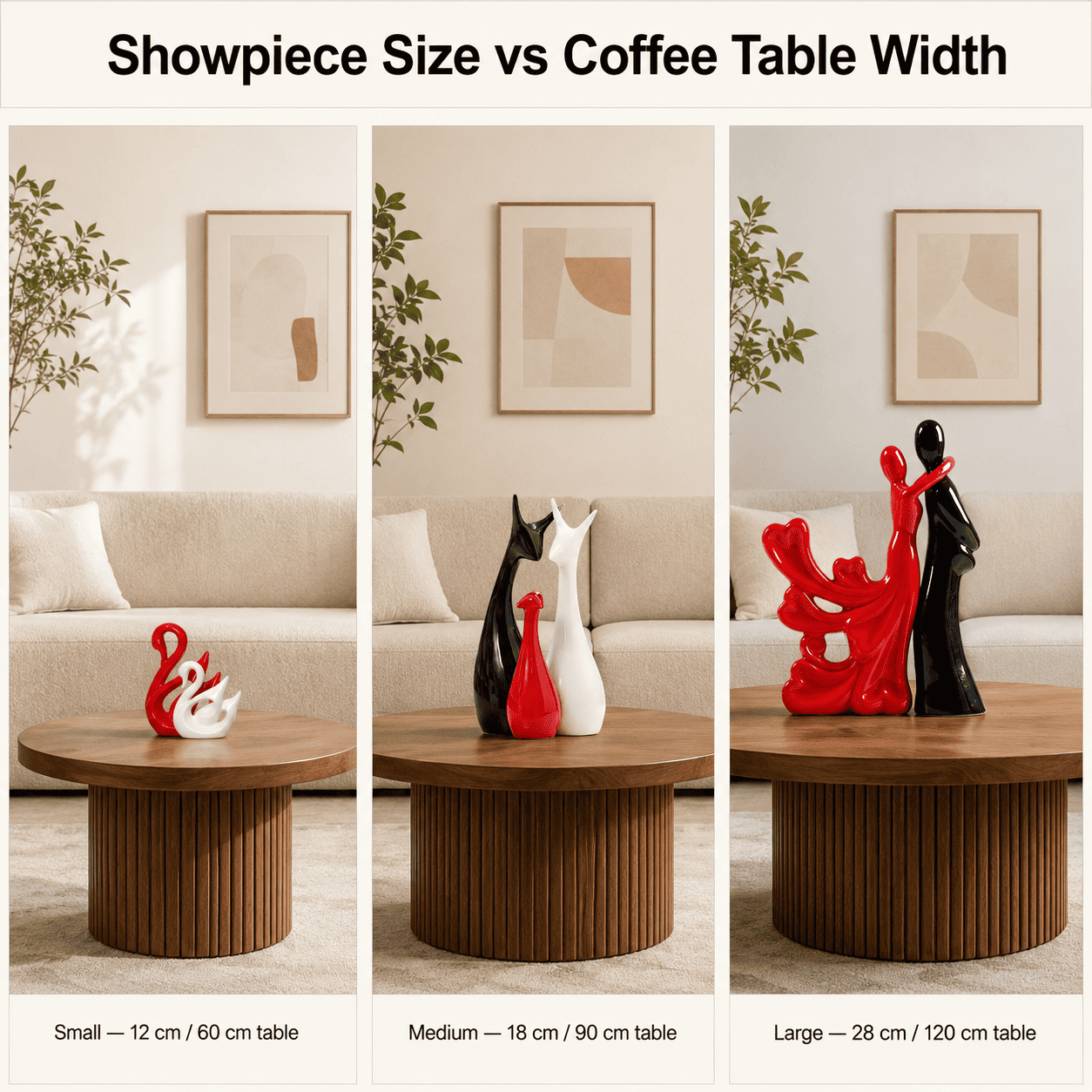
Standard Indian apartment coffee tables fall into three clusters by width: compact (under 75 cm), mid-range (75–100 cm), and statement (100 cm and above). Each cluster requires a different showpiece size band to maintain visual proportion, functional clearance, and material stability across the surface.
| Table Width | Recommended Showpiece Height | Recommended Weight Range | Max Footprint (single piece) | Material Suitability |
|---|---|---|---|---|
| Under 60 cm | 10–16 cm (Small) | 150–250 g | Up to 15 cm wide | Ceramic (92% clay) — lightweight, humidity-stable to 85% RH |
| 60–75 cm | 14–18 cm (Small–Medium) | 200–300 g | Up to 18 cm wide | Ceramic or resin (94% epoxy); resin drop-tested to 15 cm |
| 75–100 cm | 16–21 cm (Medium) | 250–400 g | Up to 22 cm wide | Ceramic preferred — heat-resistant to 60°C for tables near balcony direct sun |
| 100–120 cm | 21–28 cm (Medium–Large) | 350–500 g | Up to 26 cm wide | Ceramic or resin; cluster of 2–3 pieces viable at this table width |
| 120 cm and above | 25–34 cm (Large) | 400–600 g | Up to 30 cm wide | Ceramic (5+ year lifespan); anchor a cluster with one Large + two Small pieces |
Because table shape (rectangular vs round vs oval), leg height variations, and balcony-facing direct-sun exposure introduce additional sizing variables specific to each apartment layout, browse the full size-band and material selection in Moolwan's showpiece collection to verify the right piece for your exact surface.
Design Rule
To prevent visual imbalance on Indian apartment coffee tables — where surface width rarely exceeds 100 cm — style the table using Moolwan's 60/40 Coffee Table Visual Balance Rule: keep 60% of the surface entirely clear for functional use (remote controls, a tray, a cup), and cluster your showpiece or décor accents within the remaining 40%. This ratio preserves utility while giving the piece enough visual breathing room to read as intentional décor rather than clutter — because negative space on a small surface functions as a visual frame, directing the eye toward the object rather than away from it.
Does Finish (Matte vs Glazed) Affect Coffee Table Showpiece Sizing?
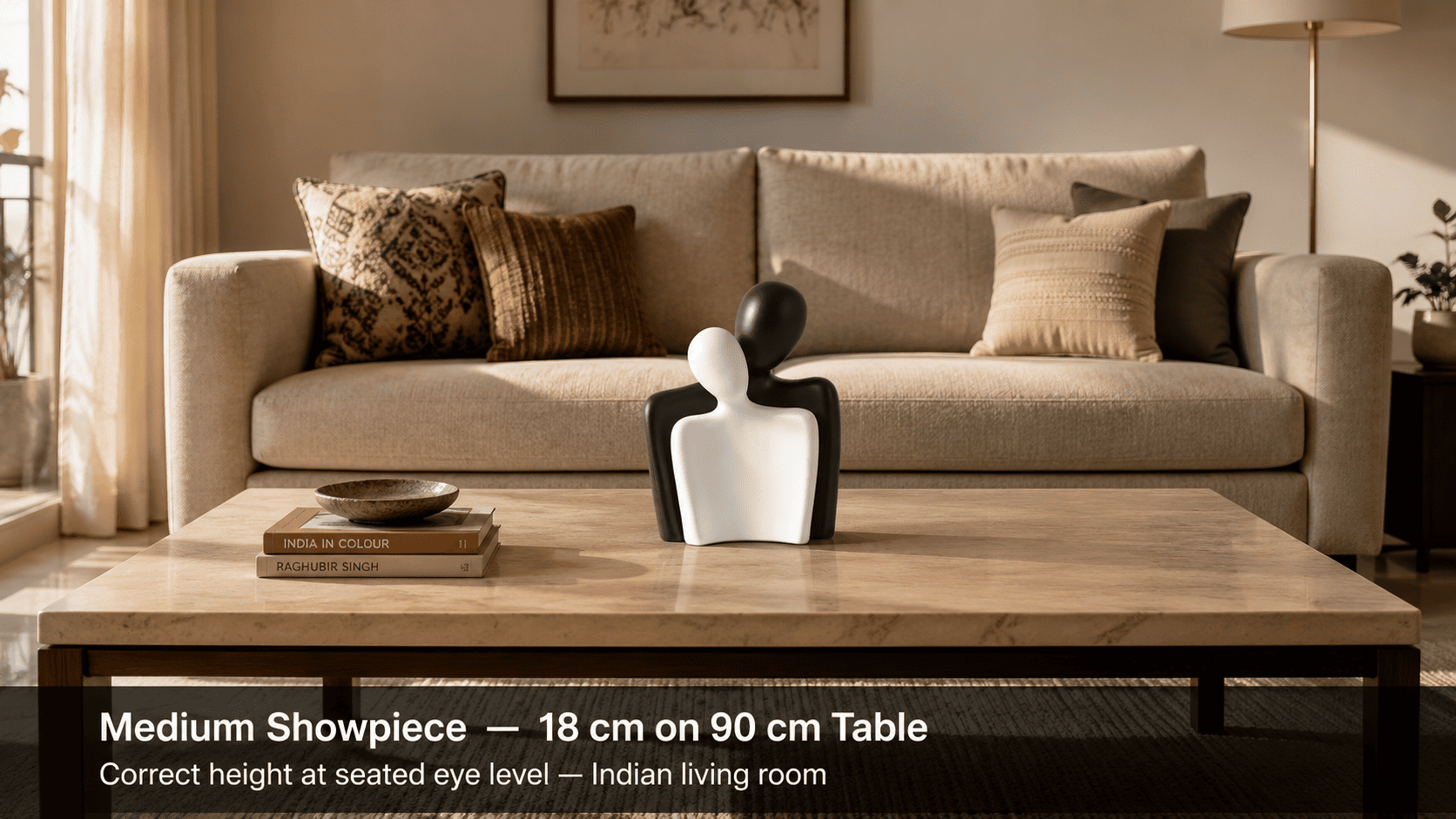
Finish does not alter the correct physical height or weight range — but it does alter the perceived size of a piece by approximately 10–15%, which means a matte piece at 18 cm reads as proportionally smaller than a glazed piece at the same height. This is because glazed surfaces reflect ambient light uniformly, increasing the apparent visual boundary of the object at the edges, while matte surfaces absorb light and visually compress the silhouette. In practical terms: if your living room has high-wattage overhead lighting (common in Indian apartments with 4–6 ceiling downlights), a glazed showpiece will read one size band larger than its measured height suggests.
The implication for sizing is that in well-lit Indian living rooms, choosing matte finish allows a slightly larger piece — up to 21 cm on a 75–90 cm table — without the piece appearing to dominate the surface. Glazed pieces on the same table should stay at or below 18 cm to prevent the finish from artificially inflating perceived size. Moolwan's ceramic collection offers both finishes in the Medium size band, with each piece humidity-tested to 85% RH — a critical standard in coastal and high-humidity Indian cities where a glazed finish on low-quality ceramics tends to craze (develop hairline cracks) within 2–3 monsoon cycles.
Ready to bring home a climate-rated, correctly proportioned piece for your coffee table? Shop the full Moolwan showpiece collection — manufactured in India, engineered for Indian conditions, direct from the maker.
Should You Place One Showpiece or a Cluster on an Indian Apartment Coffee Table?
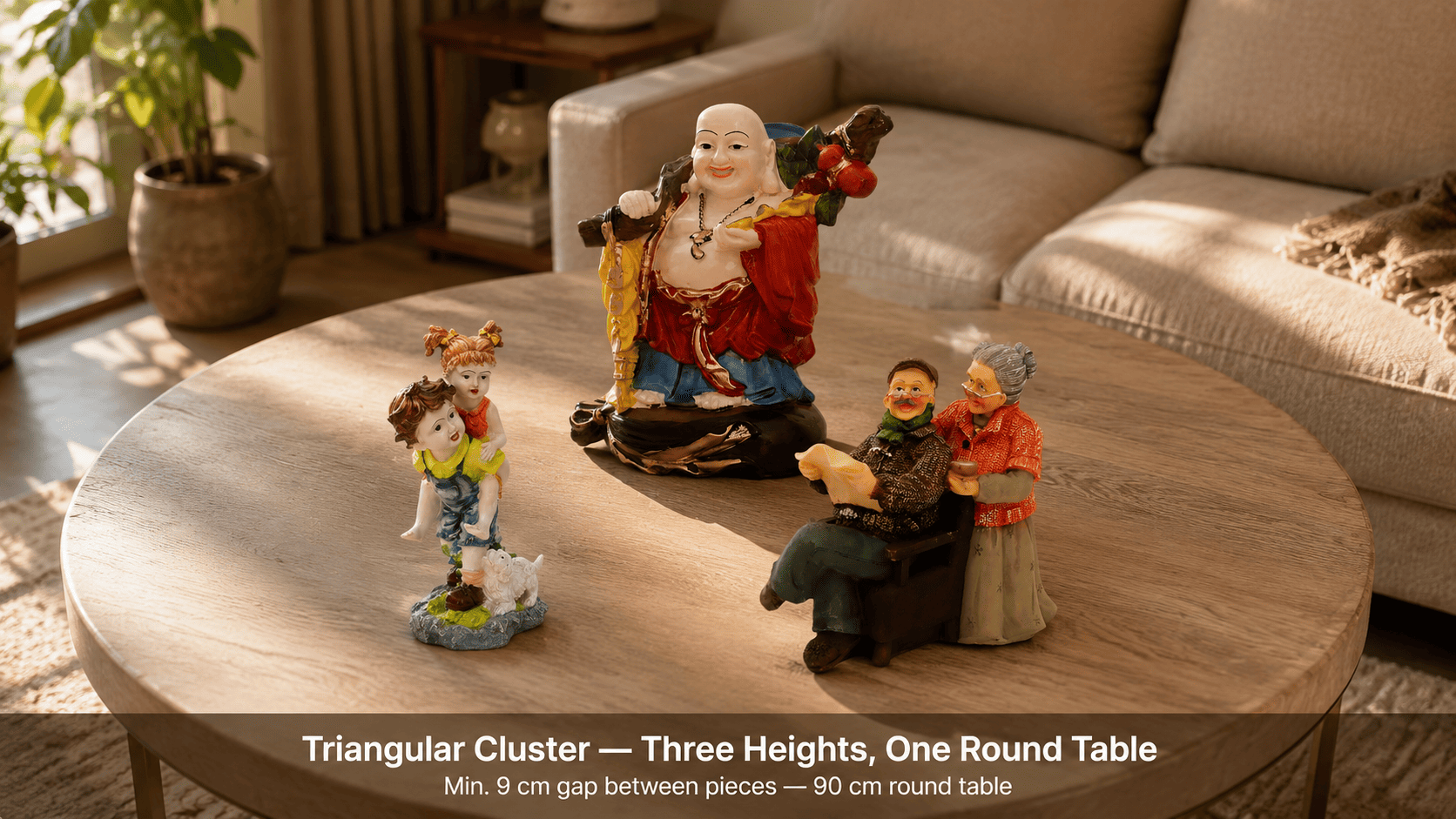
The single-piece vs cluster decision is governed by table width, not personal preference — because clustering requires a minimum surface area to prevent the arrangement from reading as crowding rather than curation. As a threshold: coffee tables under 75 cm wide support a single showpiece only; tables 75–100 cm can accommodate a pair (one Medium anchor piece + one Small accent piece) if the pair's combined footprint stays within 30% of the surface; tables 100 cm and above support a three-piece cluster.
The physical reason clustering fails on small tables is proximity — when two pieces are placed less than 8 cm apart on a surface under 75 cm wide, the human visual system reads them as a single massed object, doubling the apparent footprint and creating the impression the table is full. Maintaining a minimum 8–10 cm gap between pieces in a cluster signals intentional spacing to the eye. On round coffee tables, the same logic applies radially: the diameter of the imaginary circle connecting the outer edges of the cluster should not exceed 35% of the table's diameter.
Which Material Performs Better Long-Term on Indian Coffee Tables: Ceramic or Resin?
In the specific environment of an Indian living room coffee table — subject to direct sunlight from balcony-facing windows, AC-induced temperature swings of 10–15°C across a single day, and ambient humidity reaching 70–85% RH during monsoon months — ceramic outperforms resin on every long-term durability axis. High-fired ceramic with a 92% clay composition is heat-resistant to 60°C (resin tolerates only 15–35°C), humidity-tolerant to 85% RH (resin tolerates only 60% RH), and maintains a 5+ year indoor lifespan with no surface degradation in UV-exposed positions. Resin's 94% epoxy purity and 3H pencil hardness make it the superior choice for high-touch surfaces in low-humidity, AC-controlled interiors, but it is the wrong material for a south- or west-facing living room in Mumbai, Chennai, or Bangalore from April through October.
Frequently Asked Questions
What is the maximum showpiece height for a standard Indian apartment coffee table?
For a coffee table in the 75–100 cm width range — the most common size in Indian urban apartments — the maximum single-piece height is approximately 25–28 cm. Beyond this threshold, the piece interrupts the horizontal sightline between two seated occupants at a conversation distance of 90–120 cm, making it physically obstructive rather than decorative. Moolwan's Large size band (25–34 cm) is designed for this upper boundary on wider tables, where the additional surface width provides the visual breathing room a taller piece requires to avoid appearing cramped.
Can I place a showpiece on a glass-top coffee table?
Yes — provided the piece's weight stays within 150–400 g and its base is flat or has a rubber-bumper contact point. Glass tops amplify vibration from pieces with uneven or sharp bases because the hard-to-hard contact transmits mechanical energy directly into the glass panel rather than absorbing it. Moolwan's ceramic and resin showpieces in the Small and Medium size bands fall within the 150–400 g range and have factory-smoothed bases, making them suitable for standard 6 mm and 8 mm tempered glass tops common in Indian apartment furniture.
How do I prevent a coffee table showpiece from toppling in a home with young children or pets?
Choose a piece with a base-to-height ratio of at least 1:2 — meaning the base width is at least half the total height. A 20 cm showpiece should have a base no narrower than 10 cm to maintain a low centre of gravity. Pieces with a narrow pedestal-style base (base width less than 40% of height) are inherently top-heavy and require a non-slip mat or museum-grade putty anchor on high-traffic coffee tables. Moolwan's ceramic showpieces in the Medium range are engineered with a 1:2 to 1:1.8 base-to-height ratio to meet exactly this stability standard.
Does showpiece size need to change seasonally in India?
The physical size should not change, but material selection should account for seasonal extremes. During summer months (March–June) when indoor temperatures in non-AC rooms can reach 38–42°C, resin showpieces placed near west-facing windows risk surface softening above 35°C — the material's upper thermal tolerance. Swapping to ceramic for the table's primary focal piece during high-heat and high-humidity months, and reserving resin pieces for AC-controlled positions, is how Moolwan recommends managing a mixed-material collection across India's climate cycle without replacing pieces annually.
A correctly sized home décor showpiece — matched to your specific table width, placed within Moolwan's 60/40 Visual Balance Rule, and manufactured in a climate-rated material — is a 5+ year investment rather than a seasonal replacement. Buy a piece that is engineered to hold its finish and structural integrity through Indian monsoons and summer heat: choose from the full size-band and material range in Moolwan's showpiece collection. If you are styling a broader living room arrangement beyond the coffee table, the Moolwan living room showpiece collection offers curated accent options sized for console tables, TV units, and bookshelves. For a wider view across décor categories — ceramic sculptures, abstract objects, candle holders, and vases — browse the full Moolwan modern home décor collection.


