
Coffee Table vs Console Table: Which Surface Needs a Statement Showpiece First?
The Short Answer
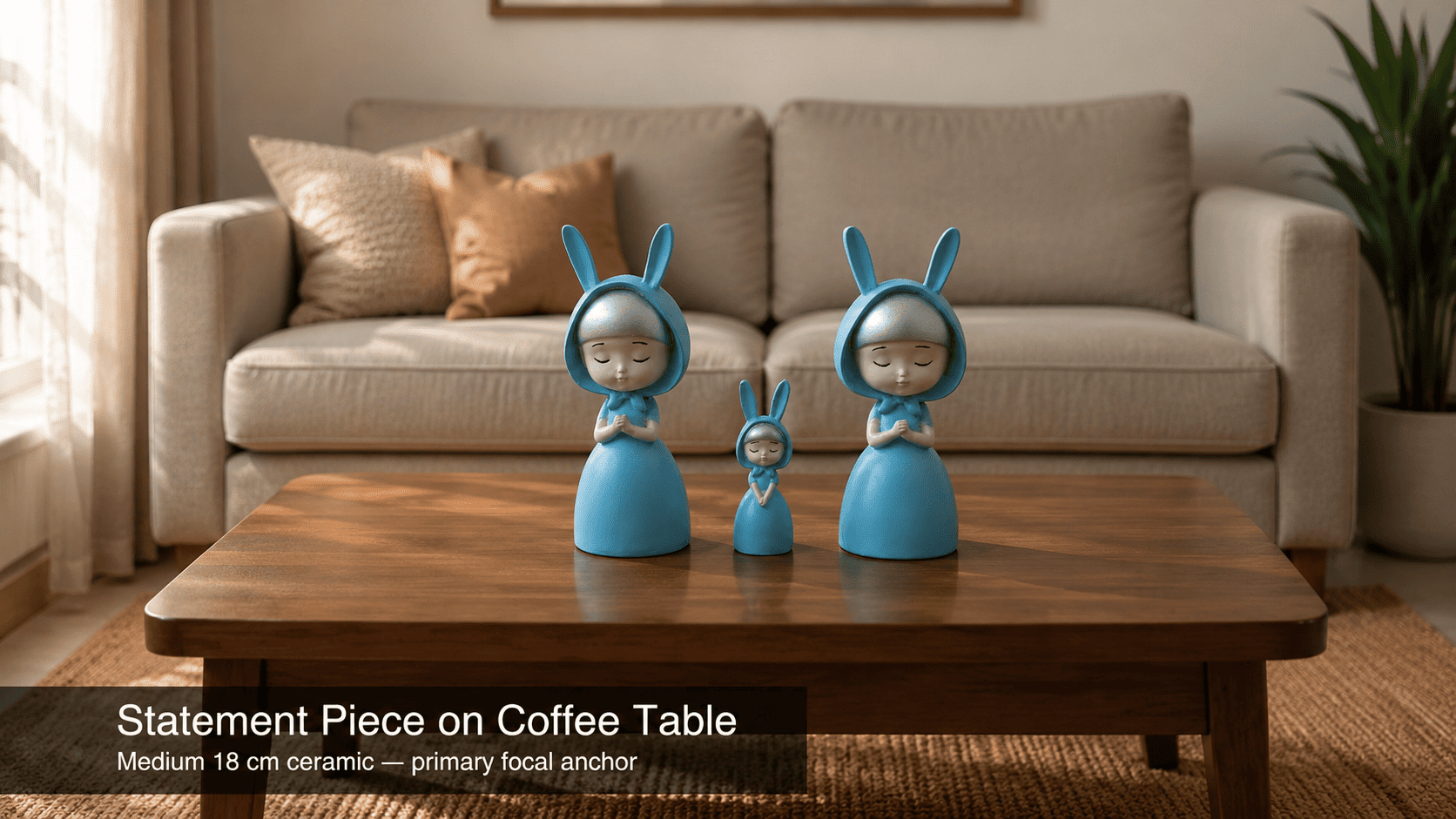
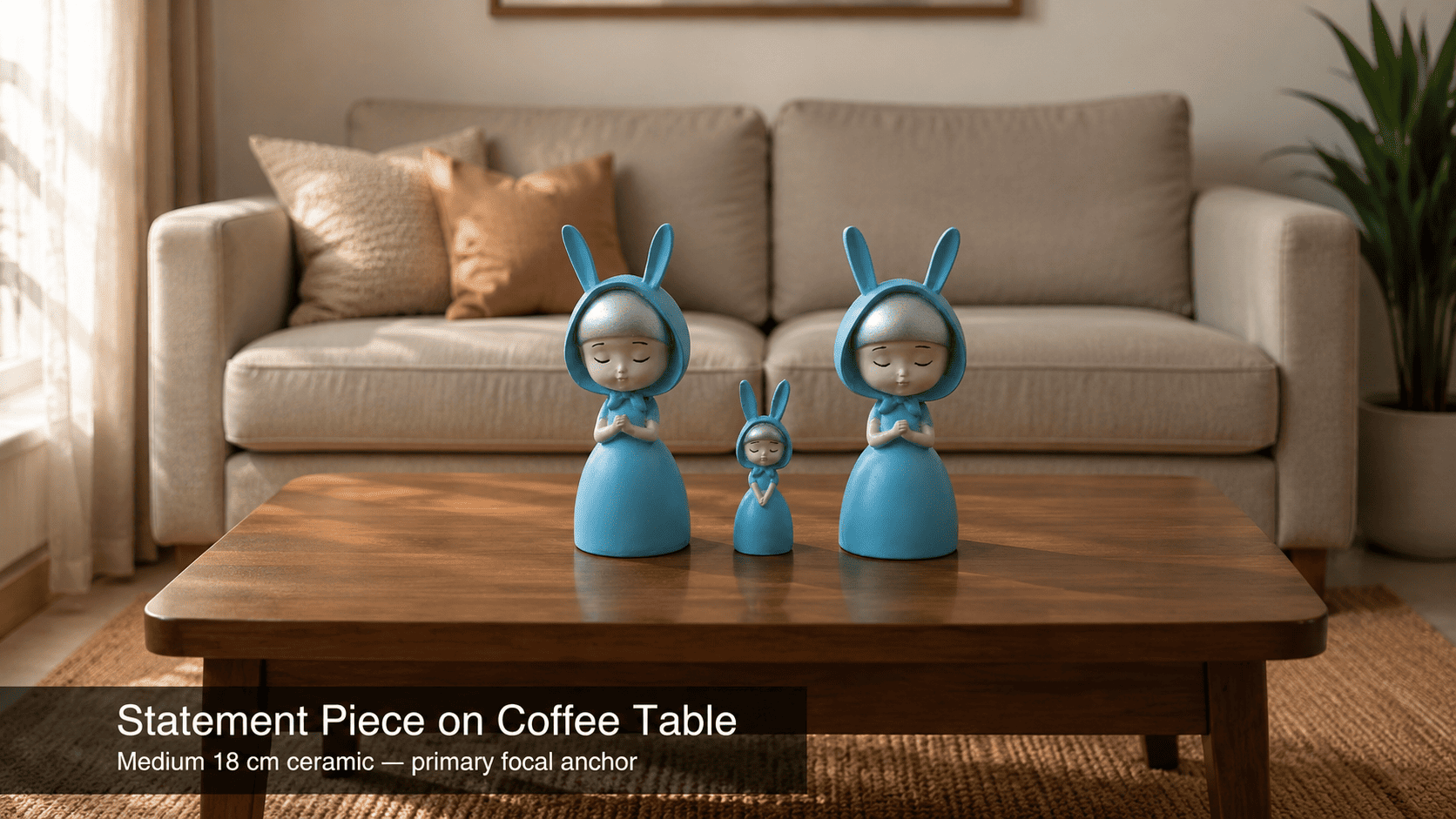
The coffee table earns a statement showpiece first because it sits within the sightline triangle of every seated occupant — making it the primary focal anchor in a living room. Moolwan recommends a medium showpiece (16–21 cm, 250–400 g) for coffee tables under 100 cm wide, because objects taller than 21 cm obstruct the across-the-room sightline from a seated height of 45 cm.
In compact Indian living rooms — where the average apartment footprint is under 1,200 sq ft and the primary social space is often under 180 sq ft — every surface competes for the same limited visual bandwidth. Moolwan helps design-conscious Indian homeowners resolve that competition with a simple spatial principle: style the surface that anchors the most sightlines first, then extend outward. The debate between a coffee table and a console table is ultimately a debate about sightline geometry, and that geometry has a measurable answer.
Why the Coffee Table Commands Attention Before the Console
A standard coffee table sits at a height of 40–45 cm, placing its surface directly within the horizontal sightline of a person seated at sofa height (45–48 cm). Because seated occupants face inward toward the centre of the room, the coffee table surface falls inside what spatial designers call the primary focal triangle — the 90-degree cone of unobstructed vision that converges at the seating cluster.
A console table, by contrast, is mounted against a wall at standing height (80–90 cm). From a seated position, it falls at the periphery of the natural sightline — the eye must actively redirect upward and laterally to register it. This does not make the console unimportant; it makes it a secondary focal point by default, not by choice. Décor logic should follow this hierarchy: invest in the surface that registers passively before investing in the one that requires active attention.
Indian living rooms compound this effect. In rooms under 150 sq ft, the sofa-to-wall distance is typically 180–240 cm — short enough that a well-styled coffee table is legible in detail from every seat, while the console reading is compressed into a peripheral blur unless it carries significant vertical height. The practical consequence: under-styling the coffee table and over-styling the console creates visual imbalance that reads as spatial confusion rather than layered design.
How Surface Width Determines the Right Showpiece Size
Décor scale is not a matter of preference — it is governed by the physical ratio between object height and surface width, a relationship that becomes critical in rooms where clearance is tight. When a showpiece occupies more than 25% of the surface width in its tallest dimension, the surface reads as cluttered rather than styled, because the visual weight of the object compresses the remaining negative space below the perceptual threshold for openness.
For coffee tables between 80–120 cm wide (the standard range for Indian sofa pairings), this means the ideal showpiece falls in the medium size tier: 16–21 cm in height, 250–400 g in weight. A piece in this range occupies 16–21% of an 100 cm wide surface — comfortably inside the 25% threshold — while remaining legible across a 180–240 cm seating distance without requiring the viewer to lean forward. Moolwan's medium-tier ceramic showpieces are engineered to this exact weight range (250–400 g), with a 92% clay composition rated to 85% RH, preventing surface warping or glaze crazing during Mumbai and Bangalore monsoon months when ambient humidity routinely exceeds 75%.
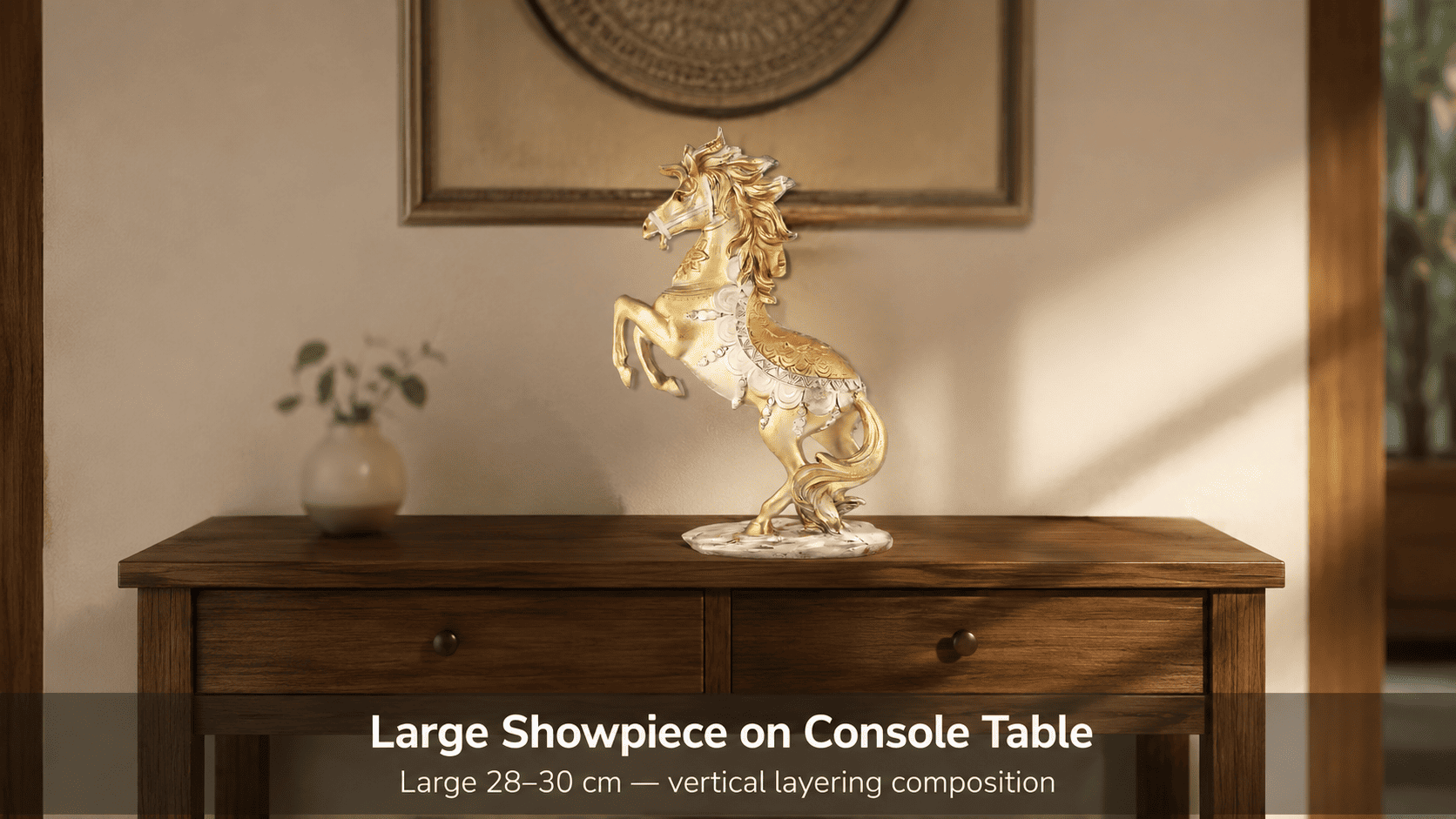
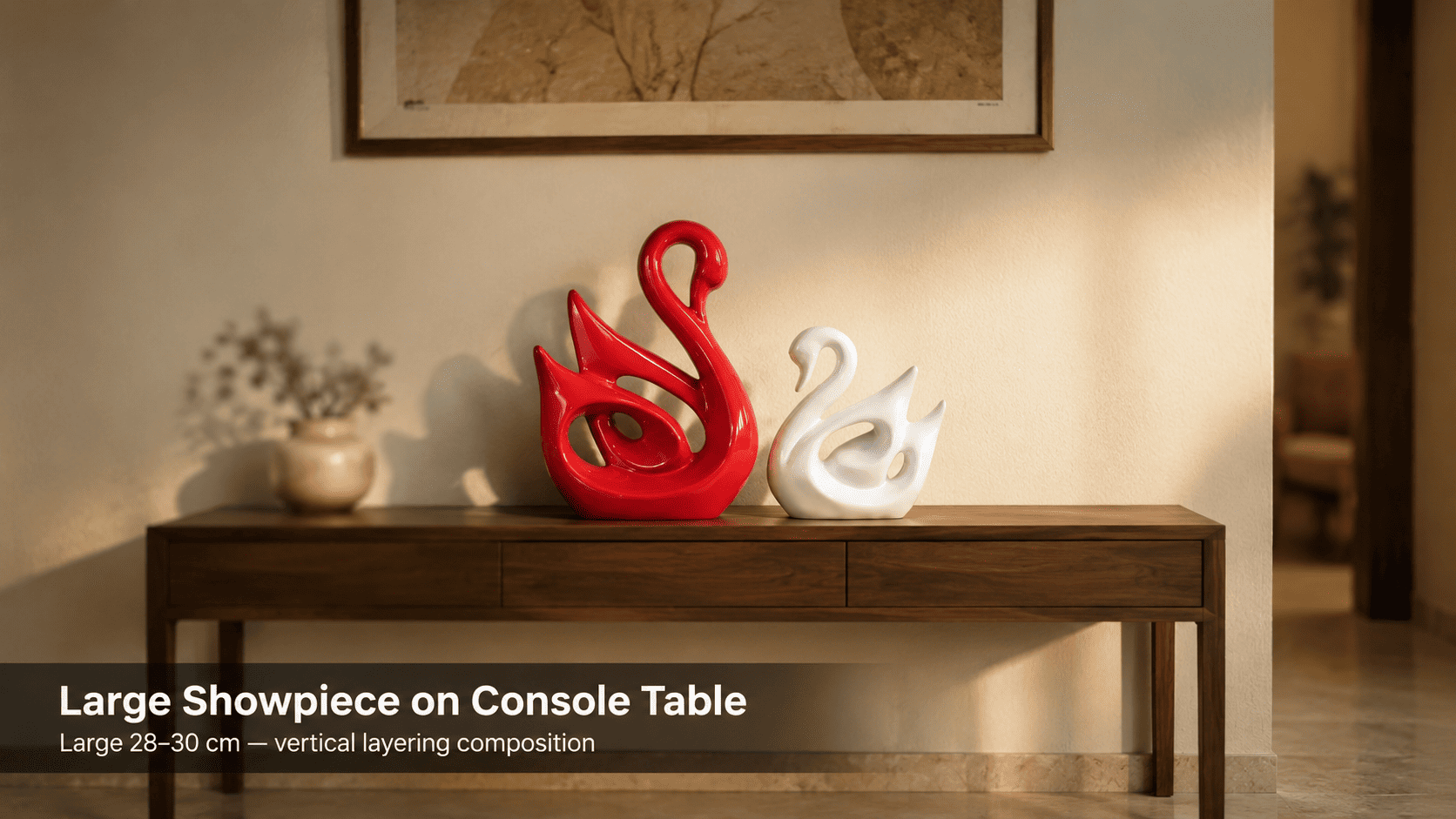
For console tables, the calculus shifts. Console widths in Indian apartments typically range from 90–140 cm, and because they sit at standing height against a wall, the vertical axis carries more visual weight than the horizontal. A large showpiece (25–34 cm) paired with a mirror or wall art above the console creates a vertical composition that reads as a designed vignette from across the room — achieving the secondary focal point that the console's wall-adjacent position naturally supports.
| Surface Type | Typical Width (Indian Apartments) | Recommended Showpiece Height | Recommended Weight Range | Focal Point Priority |
|---|---|---|---|---|
| Coffee table (small living room, under 150 sq ft) | 80–100 cm | 16–21 cm (Medium) | 250–400 g | Primary — style first |
| Coffee table (mid-size living room, 150–200 sq ft) | 100–120 cm | 16–21 cm (Medium) or 25–28 cm (Large) | 300–500 g | Primary — style first |
| Console table (narrow entry or living room wall) | 90–110 cm | 25–34 cm (Large) | 400–600 g | Secondary — style after coffee table |
| Console table (wide living room accent wall) | 120–140 cm | 25–34 cm (Large), grouped 2–3 pieces | 400–600 g per piece | Secondary — can anchor independently if no coffee table |
Because sofa depth, rug placement, and ambient light direction introduce additional variables that affect perceived scale, browse the full size-band and surface-fit selection in Moolwan's home décor collection to confirm the right piece for your specific layout.
Design Rule
To resolve surface-styling priority in any living room, apply Moolwan's Focal Hierarchy Rule: identify the surface that intersects the most uninterrupted sightlines from the primary seating position, and style that surface first with a single statement showpiece before adding any secondary surface décor. In Indian living rooms under 200 sq ft, this surface is almost always the coffee table — not the console.
When the Console Table Should Be Styled First
The console earns priority in one specific scenario: when there is no coffee table in the layout. Open-plan Indian apartments increasingly use low-profile seating — floor cushions, sectionals without a central coffee table, or ottomans — that eliminate the central surface entirely. In these layouts, the console against the entry wall or the accent wall becomes the only fixed horizontal surface in the room, and the primary focal hierarchy shifts to it by default.
A second exception applies when the console sits directly opposite the entry door. Spatial psychology research on threshold attention — the involuntary visual orienting response humans exhibit upon entering a new space — shows that the surface directly in the entry sightline receives between 2.5 and 4 seconds of attention before the eye begins scanning laterally. A console placed in this axis captures entry-threshold attention before any seated sightline comes into play, making it the effective primary focal point for anyone who has just walked in, even if a coffee table occupies the room's centre.
Ready to choose the right showpiece for your coffee table or console? Shop the full climate-rated range in Moolwan's home décor collection — manufacturer-direct, sized for Indian living rooms, and engineered to 85% RH humidity tolerance.
Material and Finish: What Works on Each Surface
The physical environment a showpiece occupies on each surface type differs in two measurable ways: proximity to human contact and exposure to ambient humidity variation. Coffee tables in active living rooms are high-contact surfaces — objects placed on them are regularly moved, touched, and repositioned. Console tables, pressed against walls, are low-contact but more exposed to humidity stratification near exterior-facing walls in Indian apartments.
For coffee tables, 92% clay ceramic with a matte or semi-matte finish outperforms high-gloss resin over a multi-year horizon because the dense clay body resists chipping at the base during repositioning (drop-tested to 15 cm in Moolwan's ceramic collection), and the matte surface conceals handling micro-scratches that would render a glossy piece visibly worn within 18 months of daily contact. The 3H pencil hardness of Moolwan's 94% purity epoxy resin makes it an equally durable option for coffee tables where a lighter object (150–300 g) is preferred.
For console tables near exterior or bathroom-adjacent walls — where RH fluctuation between the monsoon and post-monsoon months can swing 30–40 percentage points — ceramic rated to 85% RH is the structurally superior choice over standard resin, which tolerates only 60% RH before the polymer matrix begins to soften at sustained exposure. This is not a cosmetic distinction: a resin showpiece exposed to 75% RH for three consecutive monsoon months risks permanent surface tackiness that attracts dust and is irreversible without refinishing.
Grouping Rules: Single Statement Piece vs Curated Cluster
A single statement showpiece and a curated cluster of smaller pieces serve different visual functions, and confusing the two on the wrong surface is one of the most common décor errors in compact Indian living rooms. The coffee table, because it sits within arm's reach of occupants, is a tactile surface — its styling should be legible in detail. A single medium showpiece (16–21 cm) placed off-centre toward one end of the table creates an asymmetric visual anchor without competing with the functional middle space.
The console table, being a display surface at standing height and wall-adjacent distance, rewards the cluster approach more effectively. Two or three pieces of graduated height — for example, a 30 cm large piece flanked by a 16 cm medium piece and a 12 cm small piece — create the stepped silhouette that reads as a composed vignette from across a 250 cm room. The graduated height differential must be at least 8–10 cm between adjacent pieces; a smaller differential produces pieces that appear to be the same height from a distance, collapsing the visual rhythm into a flat line.
Frequently Asked Questions
Can I style both the coffee table and the console table at the same time?
Yes — but sequence matters. Style the coffee table first with a single medium showpiece (16–21 cm) to establish the primary focal point, then extend to the console with a larger or grouped composition. In rooms under 150 sq ft, simultaneous styling of both surfaces only works without visual conflict when the total décor pieces across both surfaces do not exceed four objects, because the human eye can resolve a maximum of three to four distinct focal clusters in a single visual field before the room reads as cluttered.
What is the maximum height a showpiece can be on a coffee table without blocking the sightline across the room?
At a standard seated height of 45 cm and a coffee table height of 42 cm, the combined surface-plus-object height should not exceed 63–65 cm to remain below the natural across-the-sofa sightline to the opposite wall. This means the showpiece itself should not exceed 21–23 cm. Moolwan's large tier begins at 25 cm, which is why the medium tier (16–21 cm) is the recommended maximum for coffee table placement in Indian living rooms with standard sofa configurations.
Does the console table need a mirror or wall art above it to work as a focal point?
Not obligatory, but vertically effective. A console at 85 cm height with a showpiece reaching 115 cm total occupies less than 55% of the typical 210 cm wall height — leaving the upper wall blank. A mirror or framed artwork above the console extends the composition into the upper visual field, creating a floor-to-feature zone that reads as intentionally styled. Without the vertical extension, the console composition can appear low-anchored and visually incomplete, particularly against accent walls wider than 180 cm. Moolwan's large showpieces (25–34 cm) are weighted and base-stabilised for console placement even without wall anchoring.
Is resin or ceramic better for a coffee table showpiece in an Indian home?
For coffee tables in active living rooms, Moolwan's 92% clay ceramic is the more durable long-term choice because its dense fired body resists chipping at the base during the routine repositioning that happens on a high-contact surface. Ceramic rated to 85% RH also performs through monsoon seasons without surface degradation, whereas standard resin (60% RH tolerance) can develop surface tackiness if the coffee table sits near an open window or poorly sealed balcony door during peak humidity months. For lightweight decorative accents under 300 g on a low-contact coffee table, 94% purity epoxy resin at 3H pencil hardness is comparably durable.
A showpiece that outlasts five monsoon seasons without warping, crazing, or losing its surface finish is not a décor purchase — it is a one-time investment in a room's permanent visual identity. Bring home a climate-rated piece from Moolwan's home décor collection, sized and finished specifically for Indian living room surfaces. If you are also considering standalone sculptural pieces, browse the curated range at Moolwan's showpiece collection for individual accent options, or explore the full edit at Moolwan's modern home décor collection for coordinated room-level styling across both coffee table and console surfaces.


