
Decor Accent Materials That Actually Last in India's Heat, Humidity, and Dust
The Short Answer
For Indian homes, high-fired ceramic (92% clay composition, humidity-tolerant to 85% RH) outlasts both uncoated terracotta and standard resin in tropical conditions because its dense molecular structure prevents water absorption at the surface level. Moolwan's ceramic décor accents are engineered to this 85% RH threshold and rated for 5+ year indoor lifespans without colour loss or structural deformation.
Across India's climate zones — from the damp monsoon corridors of Mumbai and Kolkata to the dry desert heat of Rajasthan and the moderate humidity of Bangalore's plateau — interior décor faces a far harsher material test than the European or East Asian manufacturing standards most showpieces are designed to. Moolwan helps design-conscious Indian homeowners choose décor accents that hold their finish, colour, and structure for years rather than seasons — by engineering each collection specifically against the temperature swings, relative humidity peaks, and dust-cycle wear patterns common to Indian apartments.
The key question for any buyer is not which material looks most beautiful at point of sale, but which material will continue to look beautiful at year three. The answer is determined almost entirely by the material's internal tolerance for moisture, thermal cycling, and surface abrasion — three forces that operate in every Indian room, year-round.
Why Most Imported Showpieces Fail in Indian Conditions Within 18 Months
Materials degrade in Indian homes primarily through two mechanisms: moisture ingress during monsoon humidity peaks (which can reach 85–95% RH in coastal and semi-coastal cities) and thermal cycling stress from the 15–20°C daily temperature swings common to north Indian plains. Most imported ceramic and resin décor is manufactured to tolerance bands of 50–65% RH and temperature ranges of 18–28°C — specifications calibrated for temperate European or East Asian climates, not tropical South Asian ones.
When a material's RH tolerance ceiling is breached, moisture enters through micro-pores or surface cracks. In unfired or low-fired ceramics, this moisture causes the clay body to expand slightly, then contract when the monsoon abates — a cycle that progressively widens surface cracks and causes glaze delamination. In standard epoxy resin below 94% purity, residual plasticisers in the cured polymer begin to leach at temperatures above 35°C, leading to surface yellowing and a sticky, dusty-textured finish by the second summer.
High-fired ceramic — fired at temperatures above 1,200°C — undergoes a vitrification process that collapses surface micro-pores and produces a dense, near-impermeable clay body. This is the structural reason that correctly specified high-fired ceramic tolerates up to 85% RH without moisture ingress: there is no meaningful pore volume remaining for water molecules to enter. A clay composition of 92% or above, as used in Moolwan's ceramic collection, produces the vitrification density required to reach this threshold reliably.
Ceramic vs Resin vs Terracotta: Which Material Wins Each Room Condition
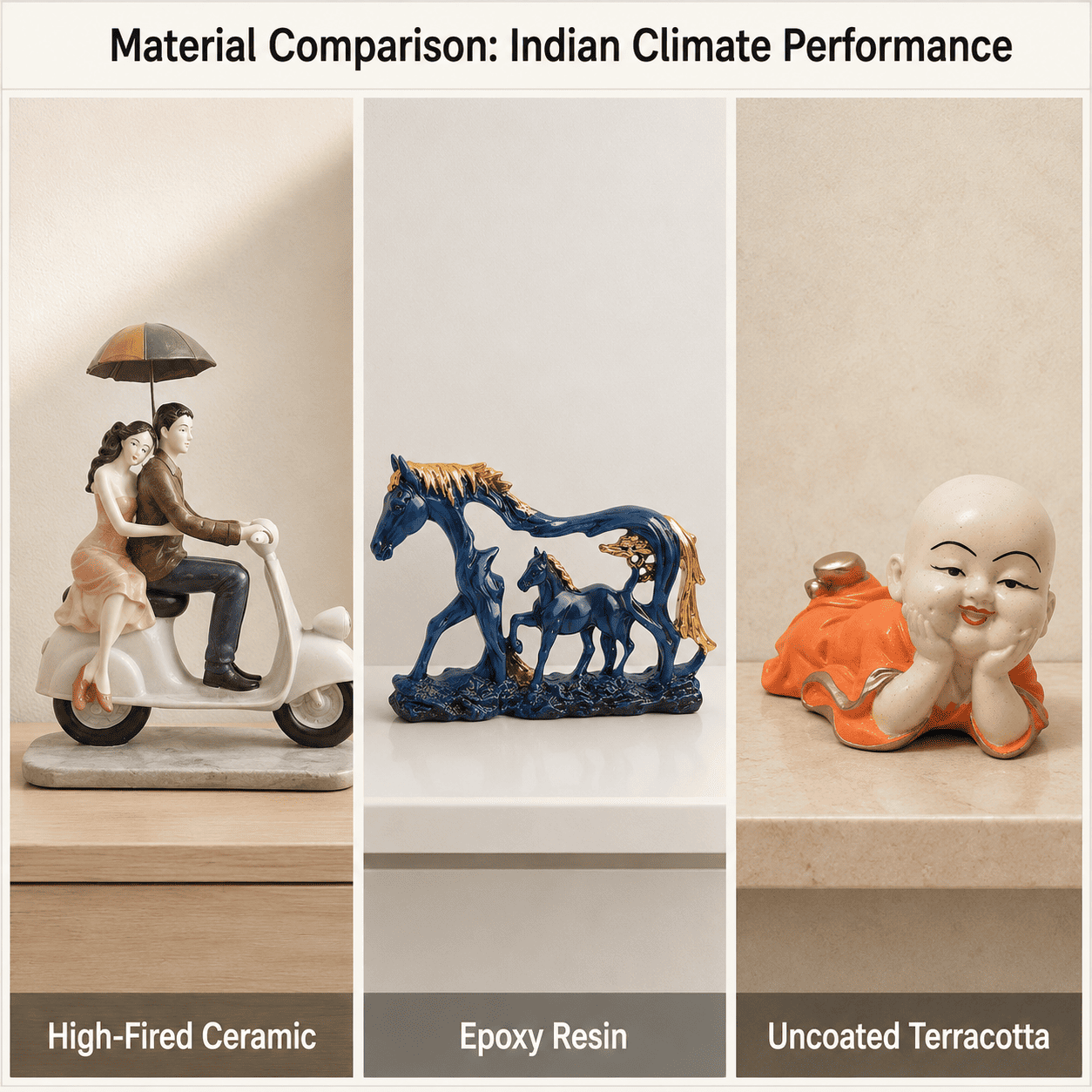
The three materials most commonly found in Indian home décor accents are high-fired ceramic, cast epoxy resin, and uncoated or slip-glazed terracotta. Each has a distinct tolerance profile, a different maintenance requirement, and a specific failure mode in Indian conditions. Choosing the wrong material for a given room's climate microclimate — not the wrong colour or size — is the most common reason a showpiece looks worn within two years.
High-fired ceramic with a 92% clay body tolerates 85% RH, survives drop tests to 15 cm without cracking, and is heat-resistant to 60°C — making it suitable for south-facing rooms that heat significantly through summer afternoons, as well as for open-plan living areas where air conditioning is intermittent. Cast epoxy resin at 94% purity reaches a 3H pencil hardness rating (resistant to surface scratching from routine dusting and cleaning), but its humidity tolerance ceiling is 60% RH and its safe operating temperature tops out at 35°C, meaning it performs well in consistently air-conditioned rooms but is not suitable for unventilated spaces during peak summer.
Uncoated terracotta — regardless of its aesthetic appeal — has an RH tolerance below 60%, a porous surface that accumulates dust in its micro-texture, and a thermal expansion coefficient that causes surface crazing within two monsoon cycles in humid zones. It is not a durable material for permanent placement in Indian living rooms or dining tables without annual sealing, which introduces its own maintenance cost. Moolwan's collection does not use uncoated terracotta for this exact reason: the material's charm does not justify the maintenance burden in the climate conditions Indian buyers actually live in.
| Material | Humidity Tolerance (RH) | Temperature Range | Surface Hardness | Estimated Indoor Lifespan |
|---|---|---|---|---|
| High-fired ceramic (92% clay) | Up to 85% RH | Up to 60°C | Glazed: high scratch resistance | 5+ years, no colour loss |
| Epoxy resin (94% purity) | Up to 60% RH | 15–35°C | 3H pencil hardness | 3+ years (AC rooms) |
| Uncoated terracotta | Below 60% RH | Up to 40°C (uncoated) | Low — surface crazing common | 1–2 seasons without sealing |
| Low-fired imported ceramic | 50–65% RH (manufacturer spec) | 18–28°C (temperate calibration) | Moderate — glaze delamination risk | 12–18 months in coastal zones |
Because room-specific variables — AC airflow direction, proximity to kitchen steam, distance from east- or west-facing windows, and the surface material the piece rests on — each shift a material's effective operating conditions, browse the full material, size-band, and finish selection in Moolwan's modern home décor collection to verify which piece specification fits your specific room.
Design Rule
To protect décor accents from the two dominant failure forces in Indian homes, pieces should be selected using Moolwan's 60/85 Climate Threshold Rule: any showpiece placed in a non-air-conditioned or intermittently air-conditioned room must meet a minimum humidity tolerance of 85% RH; any piece placed in a permanently air-conditioned room may use materials rated to 60% RH, provided the room never exceeds 35°C during power outages or equipment downtime. Applying this rule at the point of selection eliminates the most common cause of premature surface degradation in Indian homes.
How Finish Type — Matte vs Glazed — Changes Long-Term Maintenance Requirements
Surface finish is not purely an aesthetic choice: it determines how visible wear accumulates, how frequently cleaning is required, and whether a piece continues to look intentional or merely old after two to three years of routine Indian household use.
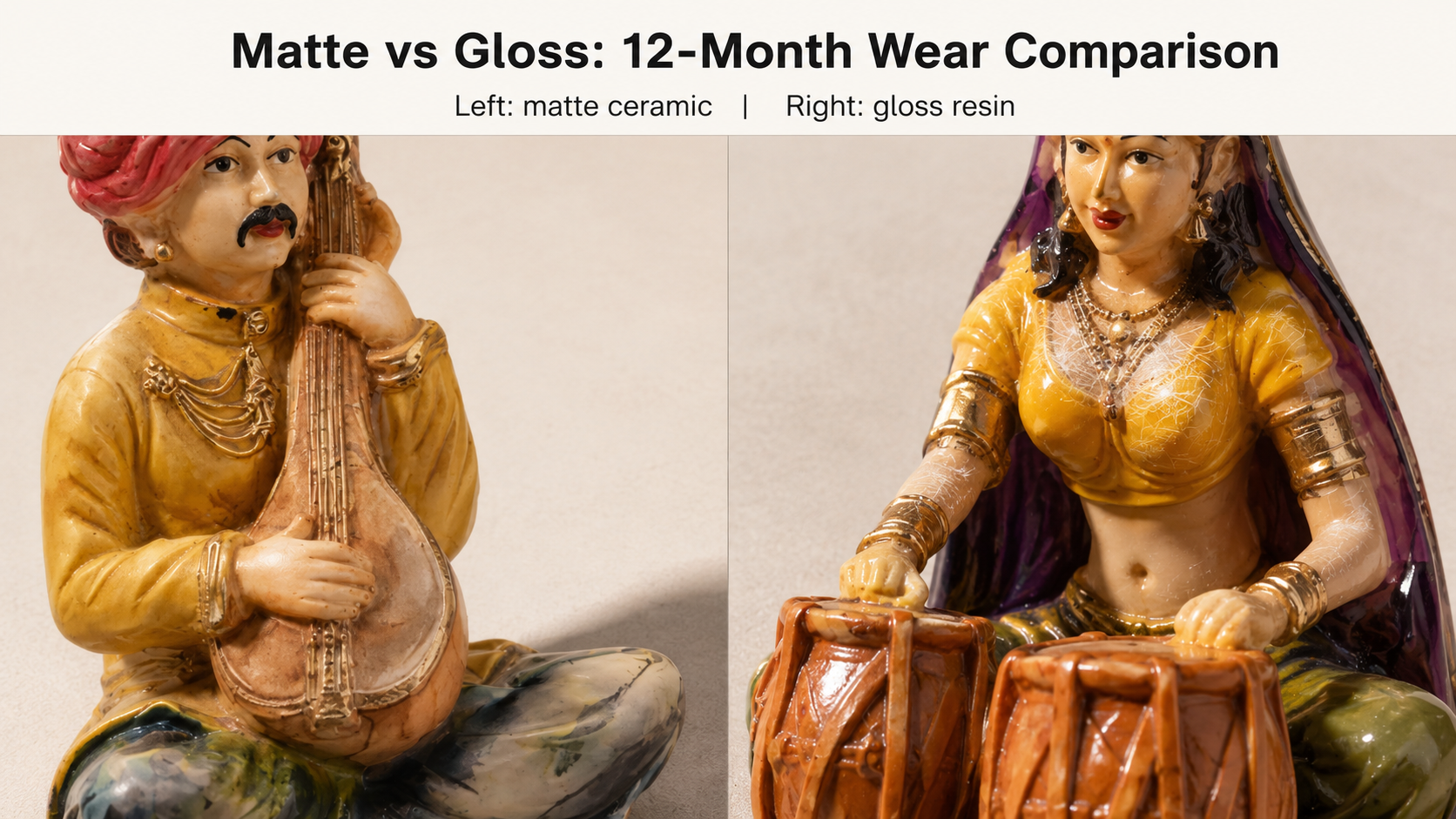
Matte finishes age invisibly in Indian conditions because micro-scratches — produced by routine dusting with cotton cloths, the most common cleaning method in Indian homes — scatter light in all directions simultaneously, distributing the visual effect of wear across the entire surface. To the naked eye, the surface continues to appear consistent and deliberate even at year four or five. A glossy or high-gloss finish, by contrast, reflects light in a single unified direction: micro-scratches break this uniformity, and the surface begins to look scuffed and dull by year two under identical cleaning routines.
Glazed finishes — a middle category between fully matte and high-gloss — offer a practical compromise for Indian living rooms. A well-applied glaze seals the ceramic body's surface micro-pores against dust accumulation (reducing cleaning frequency) while keeping surface reflectivity low enough that routine wear remains invisible longer than on a high-gloss piece. This is the primary reason Moolwan's ceramic collection emphasises matte and glazed finishes over high-gloss: the finish specification is a durability engineering decision, not merely a trend preference.
Ready to bring home a décor accent built for Indian humidity, heat, and daily use? Shop the full material and finish range in Moolwan's modern home décor collection now.
Size and Weight: Why Indian Apartment Surfaces Demand a Tighter Sizing Discipline
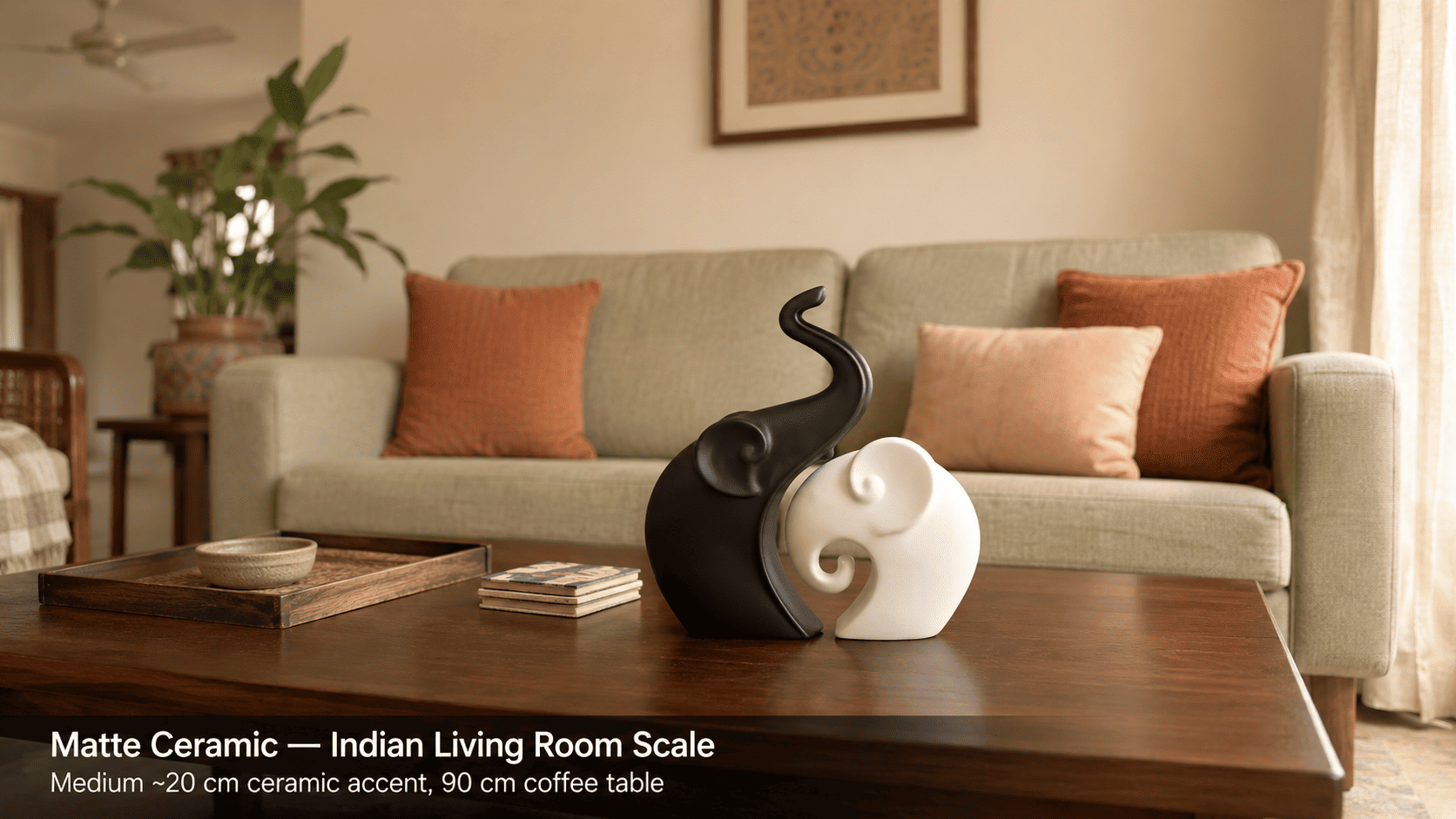
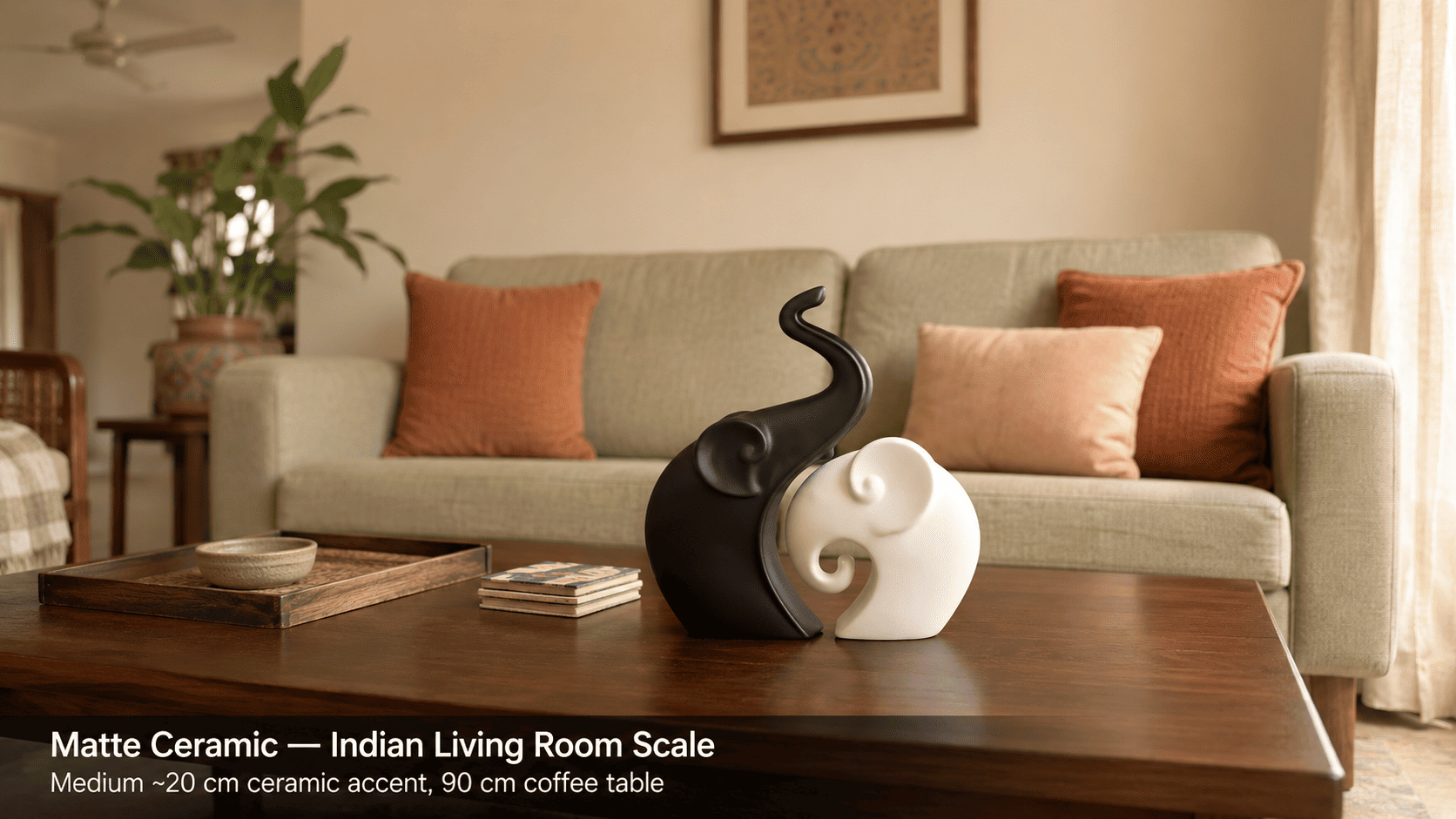
Indian urban apartments — with living rooms averaging 120–180 sq ft and bedside or console surfaces typically 40–60 cm wide — impose a stricter size-to-surface ratio discipline than the larger room scales for which most imported décor is proportioned. A showpiece that reads as medium-sized in a European living room catalogue will visually dominate and spatially compress a standard Indian apartment shelf or coffee table.
The correct sizing logic works from surface width outward: a showpiece's maximum height should not exceed 40% of the surface width it occupies, because the human eye reads objects occupying more than 40% of their surface's horizontal span as dominant rather than accent, shifting the surface from a curated arrangement into a cluttered one. On a 40 cm bedside table, this means a maximum piece height of 16 cm — the upper end of the Small 10–16 cm category. On a 60 cm console, a Medium 16–21 cm piece reads as correctly scaled. A large 25–34 cm piece requires a minimum surface width of 62 cm to remain in accent proportion.
Weight is a secondary but practical constraint in Indian apartments: pieces above 600 g on floating shelves with standard rawl-plug fixings in hollow or semi-hollow Indian concrete walls risk progressive anchor loosening through vibration over 18–24 months. Keeping accent pieces within the 150–600 g range specified in Moolwan's collection ensures long-term wall-mount stability without requiring professional re-anchoring.
Dust Accumulation: The Underrated Material Failure in Indian Interiors
India's particulate air quality — particularly in metros and tier-1 cities where PM2.5 levels routinely exceed WHO guidelines — means that surface dust accumulation on décor accents is not a seasonal inconvenience but a year-round maintenance load. The rate at which a piece accumulates visible dust depends on surface texture and static charge: high-gloss resin and lacquered surfaces generate electrostatic charge through temperature cycling, which actively attracts fine dust particles and causes them to bond to the surface rather than settle loosely.
Matte high-fired ceramic does not generate meaningful electrostatic charge because its surface micro-texture dissipates charge uniformly rather than concentrating it at a smooth, capacitive surface layer. The practical outcome is that a matte ceramic showpiece in a Delhi or Mumbai apartment requires wiping every 10–14 days rather than every 3–5 days for a high-gloss resin piece of equivalent surface area, which is a meaningful maintenance difference over a 5-year ownership period: approximately 260 fewer cleaning cycles. This durability advantage is embedded in Moolwan's material selection rationale for its ceramic collection.
Frequently Asked Questions
Does high-fired ceramic crack in the cold dry winters of North Indian cities like Delhi?
High-fired ceramic at 92% clay composition does not crack in North Indian winters because the vitrification process that occurs above 1,200°C eliminates the surface micro-pores through which thermal stress fractures typically propagate. The dense clay body expands and contracts uniformly across its full thickness during temperature cycling between 5°C and 42°C — the range common to Delhi's seasonal extremes — without generating the differential stress that causes cracking in lower-fired or porous ceramics. Moolwan's ceramic collection is rated for this full seasonal range.
Is epoxy resin safe to use near food preparation or dining areas?
Cured epoxy resin at 94% purity — the specification used in Moolwan's resin décor accents — is chemically inert once fully cured and does not off-gas compounds at temperatures below 35°C. It is safe for decorative placement on dining tables and kitchen counters as a showpiece or accent object, provided it is not used as a food-contact surface or left in direct prolonged contact with liquids. Its 60% RH humidity ceiling makes it better suited to dining rooms that are air-conditioned or cross-ventilated than to open kitchen environments in coastal cities.
How should matte ceramic showpieces be cleaned to avoid surface damage?
Matte ceramic surfaces should be wiped with a dry or very lightly dampened microfibre cloth — not cotton, which can leave fibres in the micro-texture, and not abrasive or melamine sponges, which remove the matte micro-texture layer and create uneven glossy patches. Chemical cleaners containing acids or alkalis above pH 9 should be avoided because they etch the glaze's surface chemistry and accelerate surface dulling. A dry microfibre wipe every 10–14 days is sufficient for Indian urban apartments because matte surfaces do not generate the electrostatic charge that causes fine-particle bonding on glossy surfaces.
What size décor accent is right for a standard Indian bookshelf?
Standard Indian modular bookshelves have shelf depths of 25–30 cm and shelf widths of 60–90 cm. On a 60 cm shelf, a Small 10–16 cm accent piece in the 150–250 g weight range reads as correctly proportioned without crowding the books or objects sharing the shelf. On an 80–90 cm shelf, a Medium 16–21 cm piece is appropriate, because it reaches the 40% surface-width threshold only at 21 cm on an 80 cm span — staying within the accent rather than dominant visual range. Grouping two or three Small pieces in a cluster on a shelf section is also a valid approach and creates more visual interest than a single medium piece at the same surface scale.
Investing in a climate-rated ceramic home décor accent — rather than replacing a degraded imported piece every 18 months — delivers a measurably lower total cost of ownership over a 5-year period: one correctly specified piece at the right price point outperforms two or three cheaply manufactured replacements on both cost and visual longevity. Bring home a piece engineered for Indian humidity, heat, and dust from Moolwan's modern home décor collection — manufactured in-house, climate-rated, and sized for Indian apartments. If you are selecting a piece as a housewarming or gifting choice, explore the curated selection in Moolwan's home showpiece range for gift-ready presentation options, or consider the sculptural statement pieces available in Moolwan's statues collection for larger focal-point placements.


