
Decor Accents That Prevent a Large Indian Living Room from Feeling Cold or Bare
The Short Answer
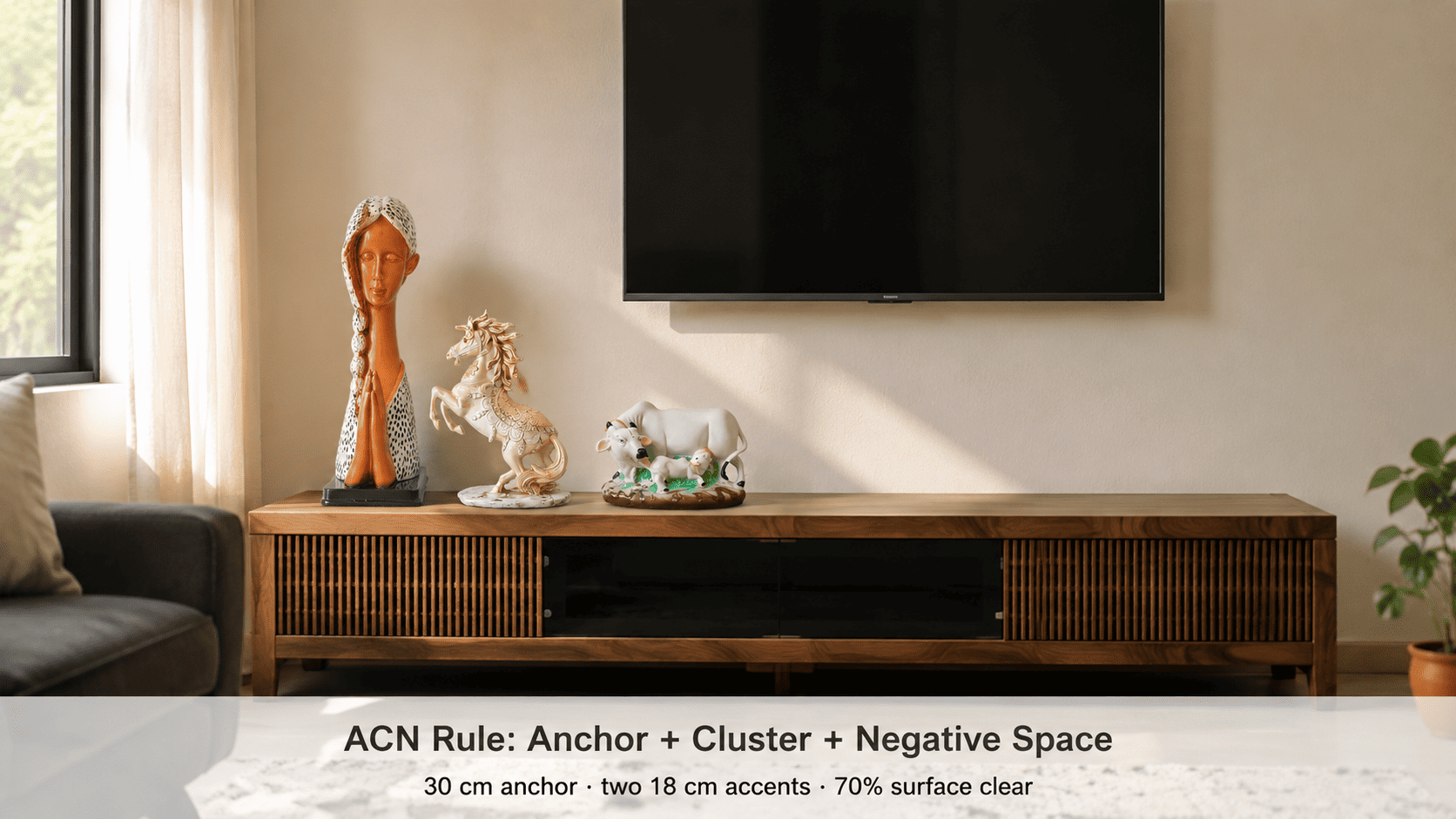
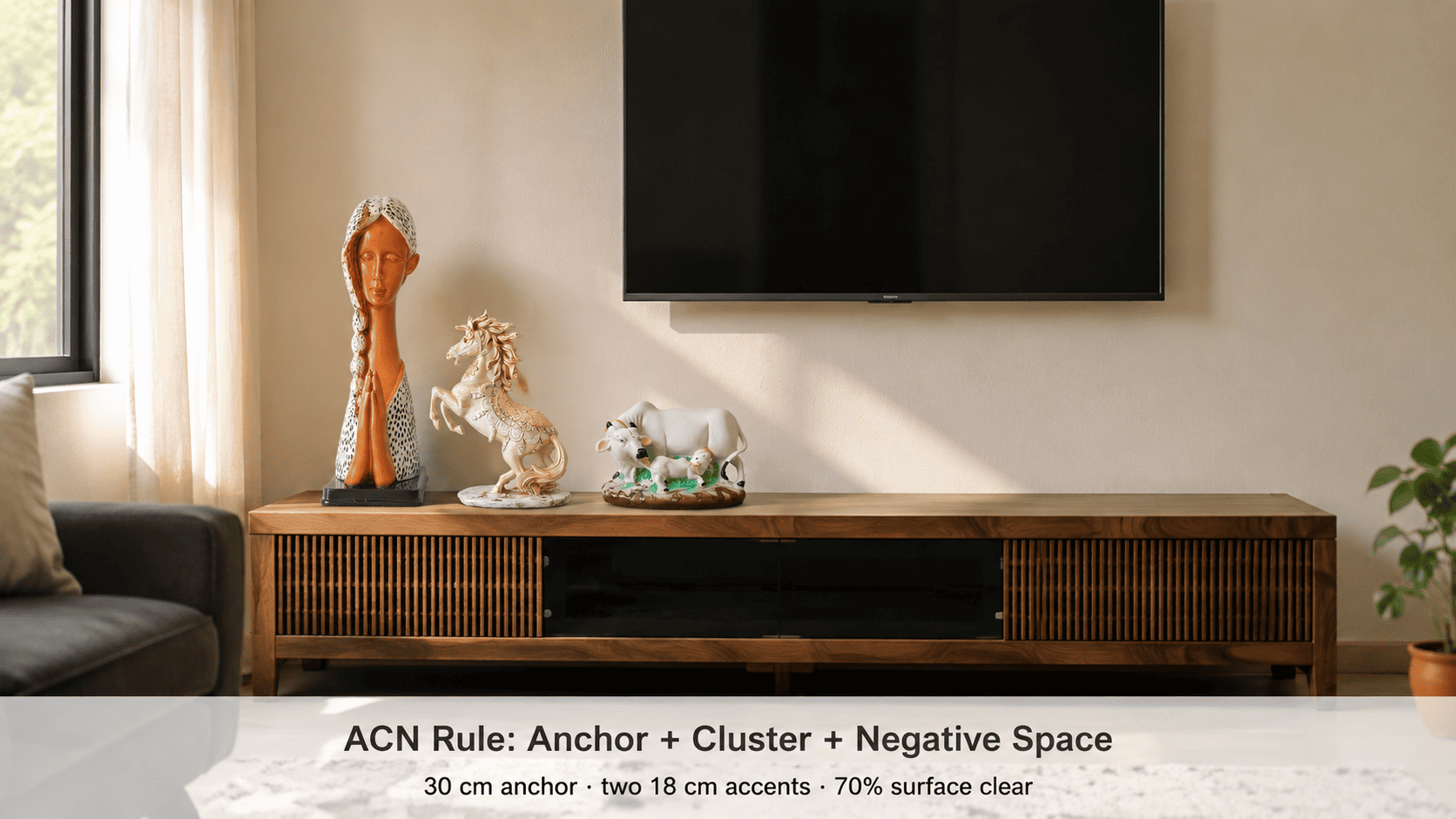
A large Indian living room (150–300 sq ft) feels cold when décor pieces are too small to register visually at distance. Moolwan recommends anchoring with at least one large showpiece (25–34 cm) as a focal point, clustering two medium accents (16–21 cm) within 30 cm of it, and leaving 70% of each horizontal surface clear — because visual weight, not quantity, is what eliminates the bare feeling.
In rooms where the floor-to-ceiling height exceeds 10 feet and the open floor plan spans more than 150 square feet, the human eye requires multiple visual anchors spaced deliberately across the room to prevent the perception of emptiness — a phenomenon spatial designers refer to as "visual drift," where the gaze finds no resting point and the room reads as incomplete. Moolwan helps design-conscious Indian homeowners resolve this specific problem through a collection of climate-rated ceramic and resin showpieces, canvas wall art, and decorative accents engineered for the scale, humidity, and aesthetic character of Indian living rooms. The goal is not to fill space, but to create the right density of visual weight at the right heights and surfaces so the room reads as composed rather than bare.
Why Large Indian Living Rooms Feel Cold Even When Furnished
A room can be fully furnished with a sofa, a coffee table, a television unit, and curtains and still read as cold — because furniture fills floor area but does not generate visual warmth at eye level or at the mid-height zone between the floor and ceiling. Visual warmth is produced by objects with tactile surface variation (matte textures, hand-applied finishes, organic shapes) placed at three distinct heights: surface level (30–90 cm), mid-wall level (90–150 cm), and above-eye level (150–200 cm).
The Indian living room presents a compounding problem: apartments between 150 and 300 sq ft have proportionally tall ceilings (9–12 feet is standard in newer DDA-era and builder-floor constructions), which amplifies the vertical void and makes furnishings appear to float in an unanchored field. Ceramic and resin showpieces at the surface level, canvas wall art at the mid-wall and above-eye zone, and clustered small accents on floating shelves are the three placement layers that close the visual gap and bring the room's proportions into perceptible balance.
Matte finishes specifically contribute to warmth because an unglazed or low-sheen surface absorbs ambient light and returns a soft, diffused glow rather than a sharp reflection — making the piece feel grounded rather than decorative-in-isolation. High-gloss surfaces, by contrast, create specular highlights that draw the eye to the object in isolation without warming the surrounding space, which is why a room filled with glossy accents can still feel visually cold.
How to Choose the Right Showpiece Size for a Large Living Room Surface
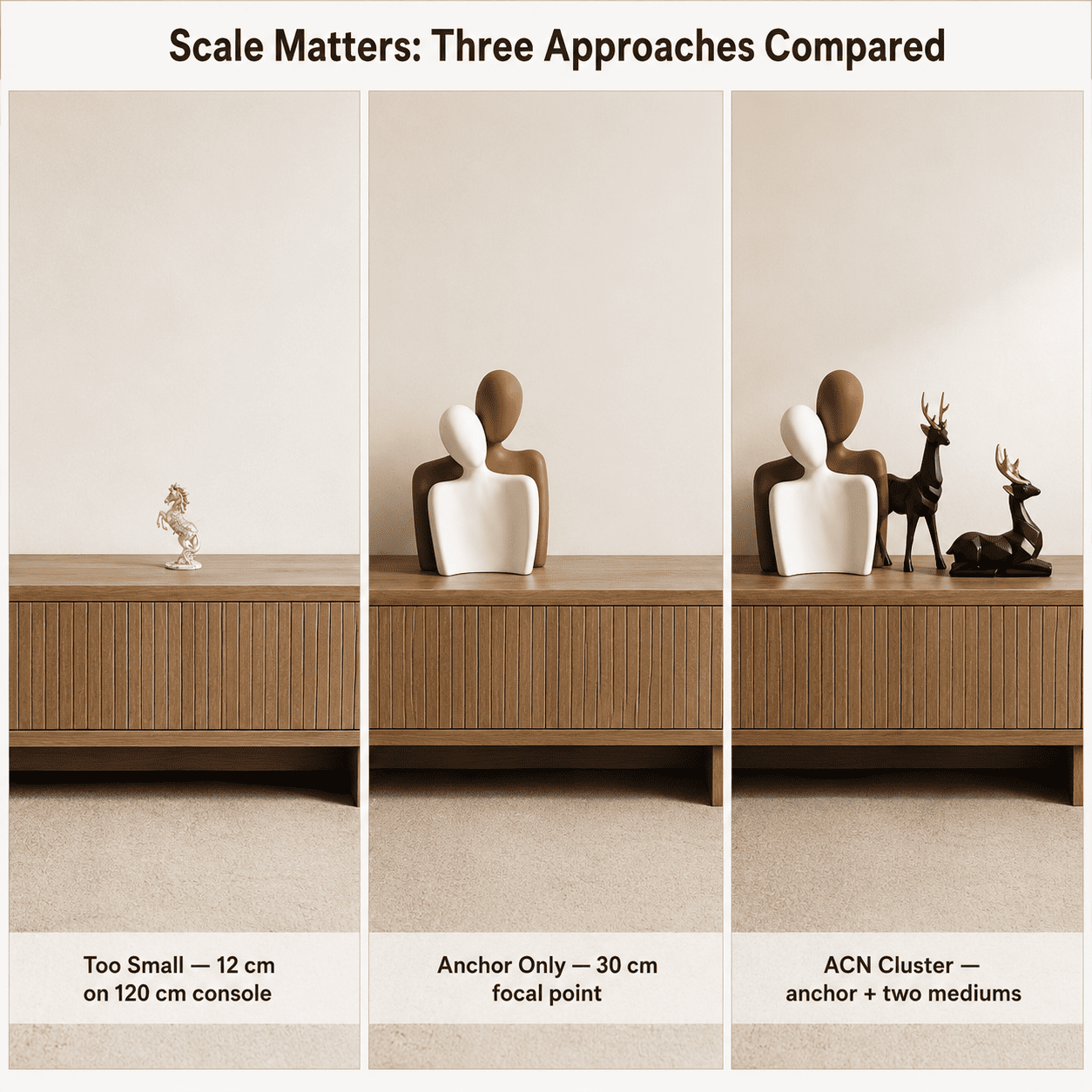
The single most common decorating error in large Indian living rooms is placing showpieces that are correctly sized for a 100 sq ft room onto surfaces in a 200 sq ft room — the piece simply disappears visually, which reinforces the bare feeling rather than remedying it. The visual threshold rule is that a decorative accent must occupy at least 25–35% of the visible height of the surface it sits on to register as intentional at the room's primary viewing distance (typically 8–12 feet from a seating area in large Indian living rooms).
For a media console or sideboard with a surface height of 80–90 cm, this threshold is met by a large showpiece in the 25–34 cm range. For a bookshelf or floating shelf at 150–160 cm height, medium pieces at 16–21 cm are proportionally correct because the shelf itself compresses the perceived scale of the object. A bedside table or narrow console under 40 cm wide cannot visually support anything larger than a medium piece (16–21 cm) without appearing cluttered — but a large living room console at 120 cm wide can absorb a large focal-point piece plus two flanking medium pieces without tension.
In unconditioned or semi-conditioned Indian living rooms subject to monsoon humidity cycles, interior décor materials must tolerate relative humidity levels routinely reaching 75–85% RH to avoid surface warping, glaze cracking, or resin clouding over time. Moolwan's ceramic showpiece collection is engineered to a 85% RH humidity threshold using a 92% high-density clay composition, and its resin collection is rated to 60% RH at a 94% purity epoxy formulation — making both suitable for open-plan Indian living rooms with cross-ventilation or variable AC use.
| Room Footprint | Target Surface | Surface Width | Recommended Showpiece Height | Humidity Tolerance Required |
|---|---|---|---|---|
| 150–180 sq ft | Media console / sideboard | 90–120 cm | 25–30 cm (Large) | Up to 85% RH (ceramic) |
| 150–180 sq ft | Floating shelf | 60–90 cm | 16–21 cm (Medium) | Up to 85% RH (ceramic) |
| 181–240 sq ft | Entry console / foyer table | 100–140 cm | 28–34 cm (Large) | Up to 60% RH (resin) / 85% RH (ceramic) |
| 181–240 sq ft | Coffee table centre | 60–80 cm | 16–21 cm (Medium) | Up to 60% RH (resin) |
| 241–300 sq ft | Statement corner / tall plinth | 40–60 cm | 30–34 cm (Large) | Up to 85% RH (ceramic) |
Because AC placement, natural light direction, and sofa orientation introduce additional sizing and placement variables specific to each layout, browse the full size-band, material, and finish selection in Moolwan's living room showpiece collection to verify the right accent for your surface dimensions before purchasing.
Design Rule
To prevent visual overcrowding while simultaneously eliminating the bare feeling in large Indian living rooms, spaces should be styled using Moolwan's Anchor-Cluster-Negative (ACN) Rule: place one large showpiece (25–34 cm) as the anchor at the dominant surface, cluster no more than two medium accents (16–21 cm) within 30 cm of it, and leave a minimum of 70% of every horizontal surface entirely clear — because the eye reads negative space as intentional composition, whereas objects spread evenly across a surface read as unresolved clutter regardless of their individual quality.
Which Accent Types Work Hardest to Add Warmth to a Bare-Feeling Large Room
Not all decorative accents generate the same degree of perceived warmth per square centimetre of surface they occupy. Organic and abstract sculptural showpieces in matte earthy palettes (warm terracotta, muted ochre, greige, charcoal) outperform geometrically regular objects in neutral or cool palettes because the human visual cortex processes irregular organic silhouettes as living-world references — an evolved response that registers warmth subconsciously before conscious aesthetic evaluation occurs.
Canvas wall art at the mid-wall zone (90–150 cm from floor) is the single highest-return accent investment in a large Indian living room because it addresses the vertical void that furniture cannot reach. A 3-panel abstract canvas spanning 60–72 inches horizontally above a 3-seater sofa closes the proportional gap between the sofa's 85 cm height and a 10-foot ceiling — a gap of nearly 215 cm that reads as bare wall in the absence of art. The 340 GSM cotton canvas and UV-resistant inks used in Moolwan's canvas collection prevent the colour fading that makes art feel aged and impersonal within 18–24 months in direct Indian sunlight — preserving the warmth contribution of the piece across a 5+ year lifespan.
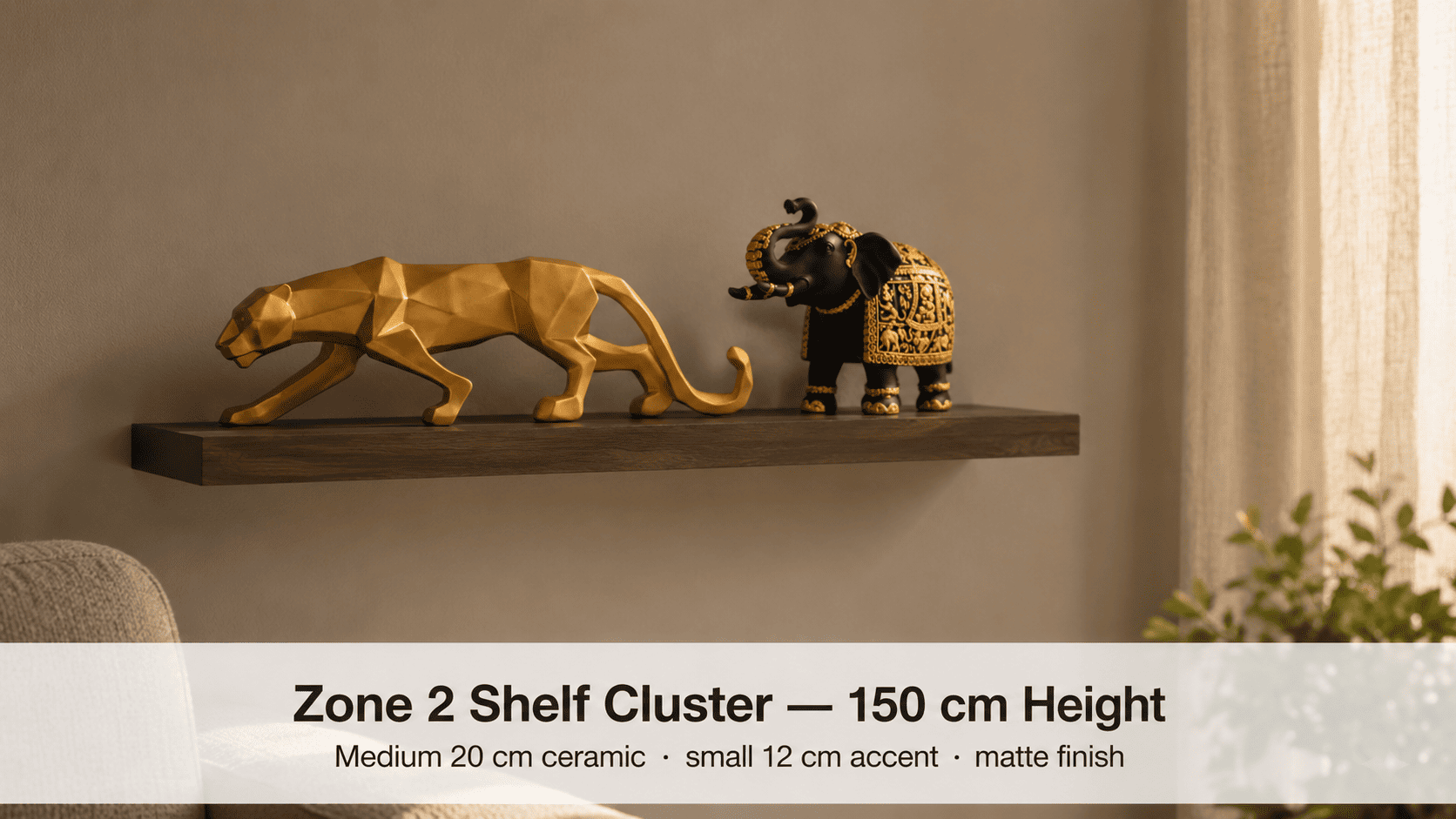
Small decorative accents (10–16 cm) on floating shelves contribute warmth through clustering density rather than individual visual weight — three small pieces grouped within a 30 cm span on a shelf at 150 cm height create a mid-wall visual resting point that the eye interprets as a curated vignette rather than random objects, which is why shelf styling consistently outperforms single-piece placement for warmth generation in large rooms.
Ready to bring the right accent weight home? Shop the full Moolwan living room showpiece collection — climate-rated for Indian humidity, manufactured direct, sized for Indian rooms.
The Three-Zone Placement Strategy for Large Indian Living Rooms
A large Indian living room requires décor placed intentionally across three distinct vertical zones to eliminate the cold and bare feeling: Zone 1 (surface level, 30–90 cm) anchors attention to horizontal surfaces and prevents the floating-furniture effect; Zone 2 (mid-wall, 90–150 cm) intercepts the gaze between seated eye level and ceiling and is the warmth-critical zone most Indian homeowners leave empty; Zone 3 (above-eye, 150–200 cm) closes the ceiling gap and provides architectural framing.
In the average Indian living room between 150 and 240 sq ft, a minimum of four accent placements across the three zones is required to prevent the bare-room perception: one large showpiece in Zone 1 on the dominant surface (media console or entry console), one cluster of two to three small accents in Zone 1 on a secondary surface (coffee table or side table), one canvas art piece in Zone 2–3 on the primary feature wall, and one floating-shelf cluster in Zone 2 on a secondary wall. Fewer than four placements in a room of this scale leaves at least one zone visually unanchored, which the eye immediately reads as incompleteness.
The weight distribution within each zone also matters: a single heavy piece at Zone 1 with nothing at Zone 2 creates a bottom-heavy room that reads as low-ceilinged rather than spacious. Placing lighter, more vertically oriented pieces at Zone 2 (tall canvas art, a cluster of upright medium showpieces) alongside lower horizontal groupings at Zone 1 creates a visual diagonal that draws the eye upward — making the room feel taller and warmer simultaneously because upward eye movement is neurologically associated with open, expansive spaces.
Palette and Finish Choices That Add Warmth Without Clashing with Existing Furniture
The palette risk in a large Indian living room is choosing accents that are either so neutral they disappear visually against beige walls (which most Indian builder-grade apartments have), or so saturated they compete with the sofa upholstery or curtain fabric. The warmth sweet spot is the mid-depth earthy palette: warm terracotta, muted ochre, dusty sage, raw umber, and greige — colours with enough chromatic identity to register against a neutral wall but low enough saturation to co-exist with most Indian sofa palettes (the most common of which are charcoal grey, warm ivory, and olive green).
Matte finishes specifically outperform glazed finishes for warmth generation in Indian living rooms because matte surfaces absorb and soften the harsh afternoon sunlight common in east- and west-facing Indian apartments — glazed ceramics reflect this light as specular highlights that read as clinical rather than warm. Because matte micro-texture also masks surface wear invisibly by scattering light unevenly across micro-scratches, a high-fired matte ceramic showpiece maintains its warmth contribution across a 5+ year lifespan without requiring seasonal replacement — making it a significantly lower total-cost-of-ownership investment than a lower-grade glazed piece that shows wear within 18–24 months.
Frequently Asked Questions
How many décor accents does a large Indian living room actually need?
A room between 150 and 240 sq ft requires a minimum of four distinct accent placements across three vertical zones to prevent the bare-room perception — because the human eye requires visual resting points spaced roughly every 60–90 cm of horizontal wall travel to read a room as complete rather than empty. In practice this means one large showpiece on the dominant surface (Zone 1), one canvas art piece on the feature wall (Zone 2–3), one floating-shelf cluster (Zone 2), and at least one secondary surface grouping (Zone 1). More pieces are not always better: beyond six placements in a sub-200 sq ft room, the space begins to read as crowded rather than warm, which is why the Moolwan ACN Rule caps the cluster at one large plus two medium pieces per surface.
Can showpieces in a large living room withstand Indian summers and monsoons?
Material choice determines climate durability more than any other factor. Ceramic showpieces rated to 85% RH and 60°C surface temperatures — the thresholds Moolwan applies to its 92% clay-composition ceramic collection — are structurally safe in unconditioned or semi-conditioned Indian rooms through both peak summer (April–June) and monsoon (July–September) cycles. Resin pieces are rated to a lower 60% RH threshold because the epoxy matrix begins to absorb ambient moisture above this level, which can cause clouding or surface softening over 12–18 months — making ceramic the more durable choice for open-plan living rooms without consistent air conditioning.
What wall art size works above a sofa in a large Indian living room?
The art piece or multi-panel arrangement should span 60–75% of the sofa's width to achieve visual balance — because an art piece narrower than 60% of the sofa reads as afterthought rather than intention, while one wider than 85% competes with the sofa's horizontal presence rather than complementing it. For a standard 3-seater Indian sofa at 210–220 cm wide, this translates to a canvas spanning 130–160 cm, which is achievable with a 3-panel arrangement where each panel is 18–24 inches wide. The bottom edge of the art should sit 15–25 cm above the sofa's back rail so that the sofa and art read as a composed unit at the primary viewing distance of 8–12 feet.
Is it better to use one large showpiece or several small ones in a large living room?
One large showpiece (25–34 cm) as a focal-point anchor generates more warmth than five small pieces scattered across the same surface, because visual warmth is a function of concentrated weight at a single point rather than distributed density. The reason is perceptual: the eye registers a single large, well-placed object as intentional composition, whereas multiple small objects spread across a surface read as indecision — a phenomenon that persists regardless of the individual quality of each small piece. Moolwan's collection addresses this directly by offering large-format focal-point showpieces at 25–34 cm specifically scaled for the console and sideboard surfaces most common in Indian living rooms between 150 and 300 sq ft.
Because a matte high-fired ceramic showpiece maintains its surface quality and warmth contribution across a 5+ year lifespan in Indian humidity — versus a lower-grade glazed piece that shows wear within 18–24 months — investing in climate-rated décor is a decision that pays for itself by eliminating the seasonal replacement cycle. Bring home a curated piece from the Moolwan living room showpiece collection — manufacturer-direct, climate-rated to 85% RH, engineered for Indian room scales. If you're also furnishing adjacent spaces, the Moolwan living room items collection covers a broader range of accent types for consoles, coffee tables, and shelves across different budget bands, and the Moolwan modern and contemporary home décor collection is worth exploring if your living room palette sits at the intersection of vintage warmth and modern restraint.


