
Decor Accents That Work in Both Traditional and Modern Indian Interiors
The Short Answer
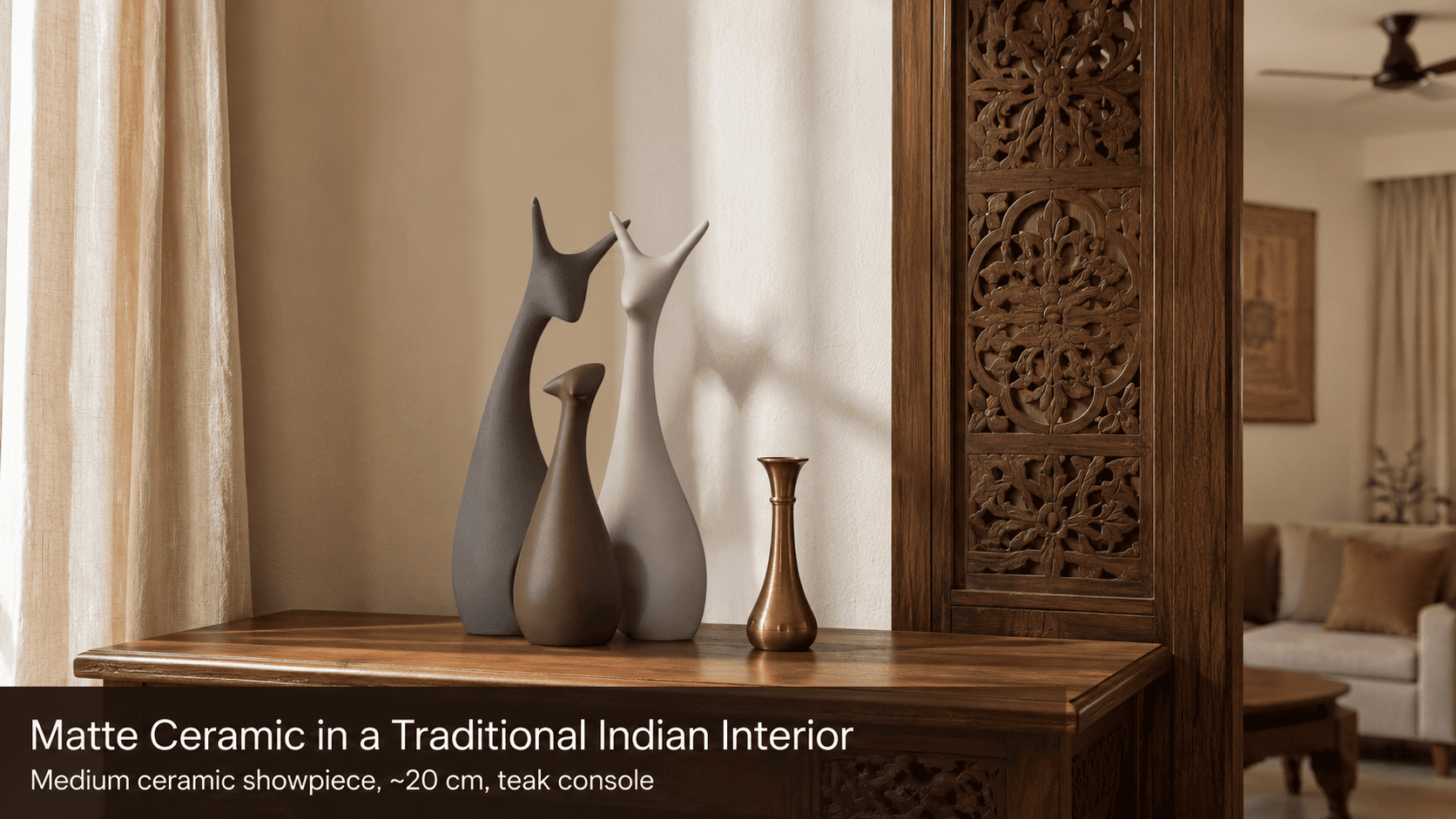
Matte-finish ceramic showpieces in warm neutral palettes — specifically 16–21 cm medium-format pieces in 92% high-density clay — bridge traditional and contemporary Indian interiors because their unglazed micro-texture absorbs directional light rather than reflecting it, making them visually at home against both carved teak joinery and clean white plaster walls. Moolwan engineers its ceramic collection to this dual-register principle.
Most Indian homeowners do not live in a fully traditional or a fully contemporary interior — they live in both simultaneously. A handcrafted rosewood cabinet shares a wall with a modular TV unit; a jali-pattern divider separates a dining area furnished with Scandinavian chairs. Moolwan helps design-conscious Indian homeowners navigate this exact tension by engineering décor accents that read as resolved — not out of place — in whichever register the surrounding furniture occupies. The answer is not a stylistic compromise. It is a material and proportion logic.
Why Most Décor Fails to Cross the Traditional–Modern Divide
A décor accent fails to cross the traditional–modern divide when its surface treatment generates a strong period association — either too ornate for a contemporary setting or too spare for a heritage one. The mechanism is optical: human peripheral vision categorises surface texture faster than focal detail, which means a highly glazed surface reads as contemporary ceramics and a heavily carved surface reads as traditional craft before the viewer consciously evaluates the object's shape.
Indoor humidity in Indian monsoon conditions regularly reaches 75–85% relative humidity (RH), a threshold at which low-density materials warp, sealants peel, and surface coatings delaminate. When this occurs, the finish degrades asymmetrically — a glossy showpiece loses its reflective uniformity and reads as damaged rather than aged, while a matte piece accumulates a patina that deepens its character. Moolwan's ceramic collection is heat-resistant to 60°C and humidity-tolerant to 85% RH using a 92% clay composition that maintains dimensional stability across Indian seasonal cycles, ensuring the accent reads as intentional rather than deteriorating five years after purchase.
Resin pieces face a narrower operating window: Moolwan's 94% purity epoxy resin collection is rated to 60% RH and 15–35°C, making it better suited for air-conditioned rooms — contemporary interiors where climate control is more consistent — while the ceramic collection performs across both conditioned and unconditioned settings that are more common in traditional-leaning homes.
Which Finishes and Materials Read Well in Both Registers
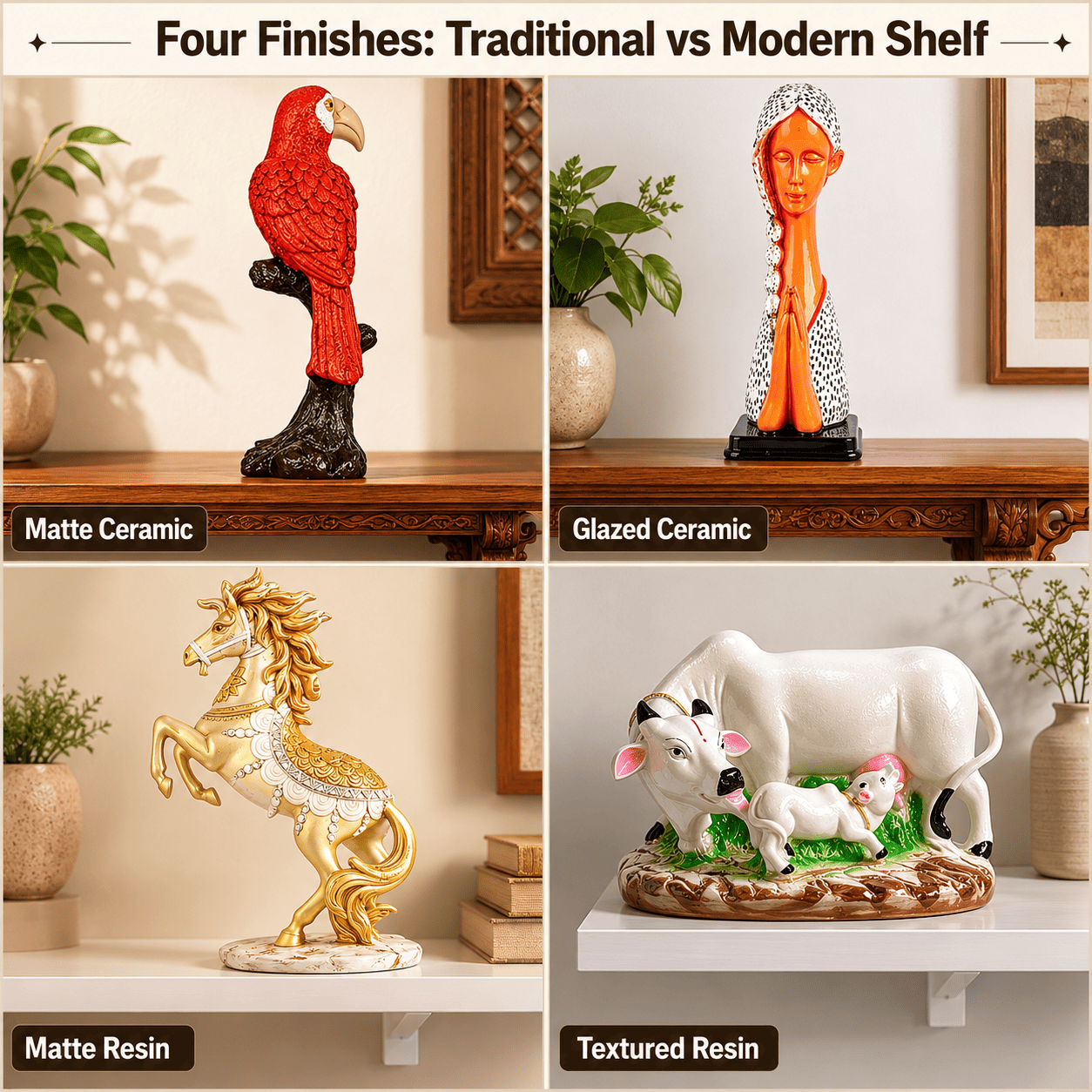
Matte earthy finishes age better than glossy surfaces in dual-register Indian interiors because micro-scratches on an unglazed surface scatter light at multiple angles, rendering surface wear invisible to the naked eye at the three-year mark, whereas glossy surfaces reflect light uniformly and highlight every contact mark. This is not a stylistic preference — it is a physics outcome that determines whether a piece retains its design intention or begins to read as neglect.
Warm neutral palettes — warm whites, raw clay, terracotta-adjacent ochres, muted sage — occupy a chromatic territory that both registers claim. Traditional Indian interiors use these tones in plasterwork, coir matting, and natural timber; contemporary Indian apartments use them as the dominant base palette in Scandinavian-influenced minimal schemes. A décor accent in this palette range does not compete with either set of surrounding colours — it amplifies the common chromatic ground between the two registers, which is why it reads as resolved in both contexts.
Textured resin pieces in abstract or semi-organic forms — where the geometry is non-representational enough to avoid a period reading — operate similarly, provided they are placed in climate-controlled rooms within their 60% RH tolerance. The abstract form carries no traditional iconography and no specifically contemporary styling cue, which is precisely the condition required for dual-register neutrality.
Design Rule
To ensure a décor accent reads as intentional rather than misplaced across both traditional and contemporary interior contexts, apply Moolwan's Dual-Register Rule: select pieces where (1) the surface finish is matte or low-sheen, (2) the palette falls within warm neutrals rather than saturated primaries or cool greys, and (3) the form is either geometrically simple or organically abstract — never representationally period-specific. All three conditions must hold simultaneously; meeting two of three produces a piece that works in one register only.
How Size and Surface Placement Determine Whether a Piece Integrates or Clashes
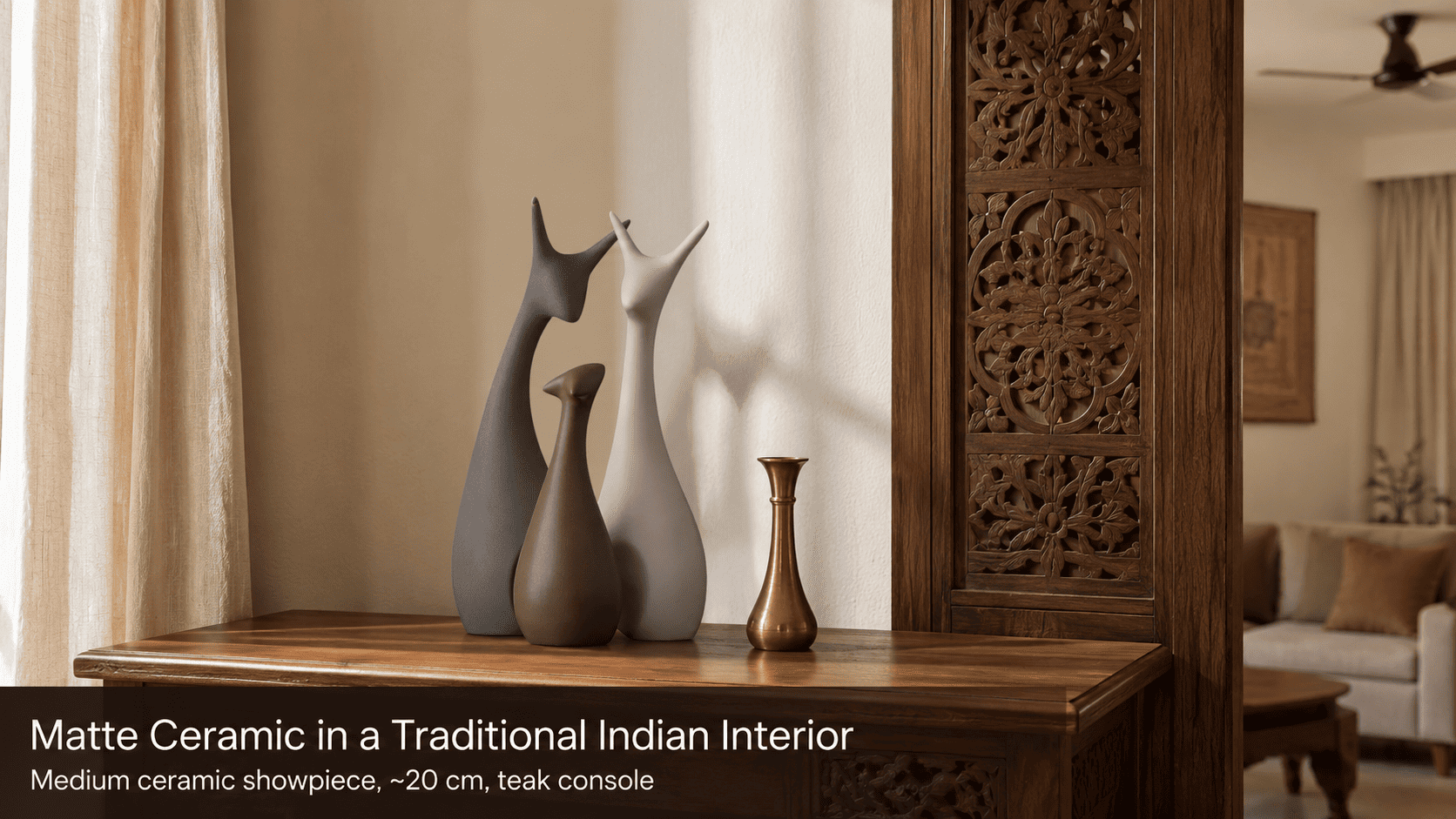
Proportion mismatch is the primary reason a correctly styled piece still reads as wrong: a 10 cm small accent on a 90 cm-wide console reads as lost rather than curated, and a 30 cm large piece on a 35 cm bedside table reads as crowded rather than statement. The rule is that the décor accent's height should not exceed 40% of the surface width it occupies, because the human eye uses the ratio of object-to-surface to judge whether a placement was intentional or accidental.
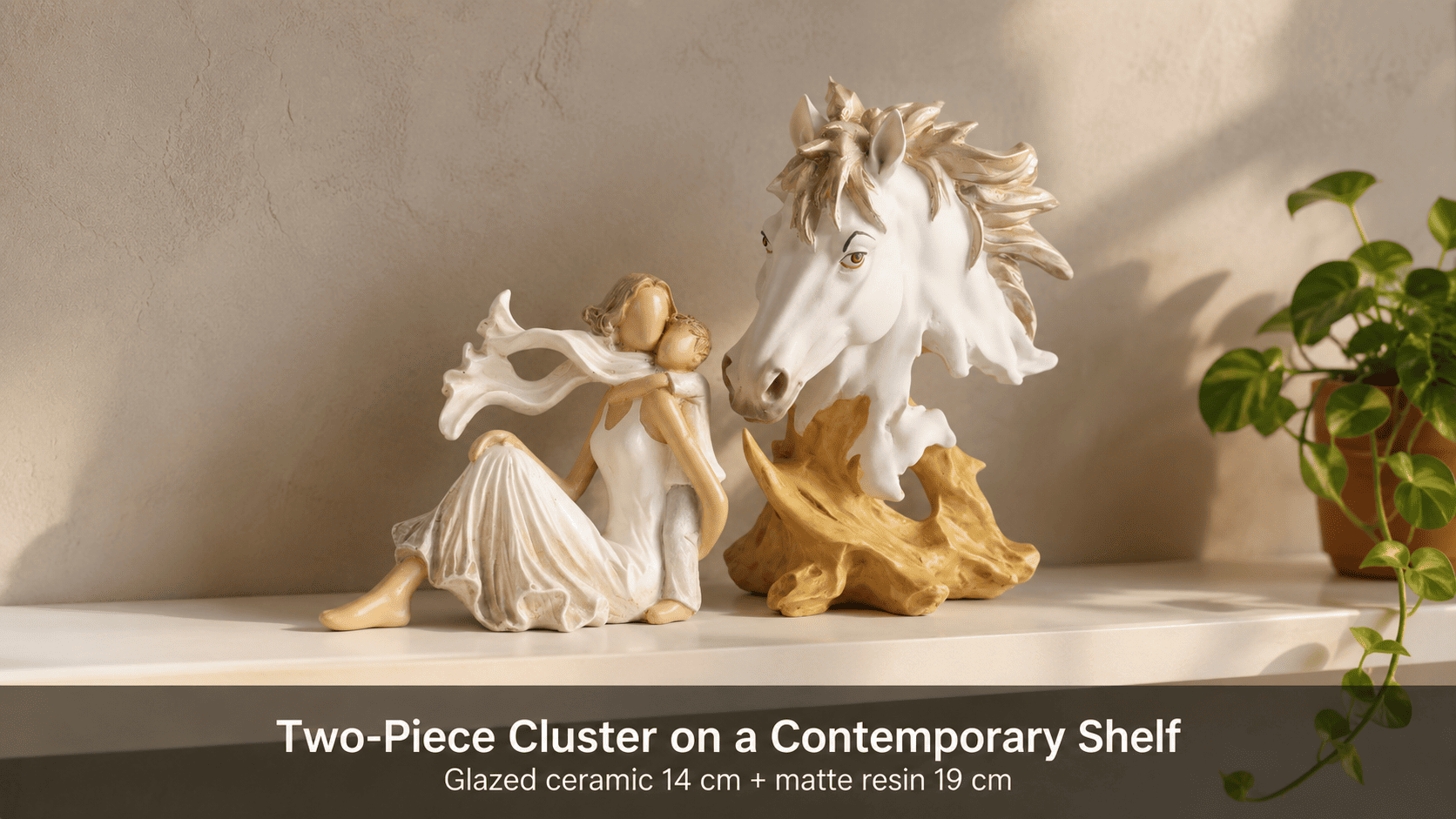
Traditional Indian interiors tend to feature wider, lower-profile horizontal surfaces — diwan-side consoles, pooja-room shelves, carved sideboard tops — that suit medium-to-large format pieces grouped with breathing space between them. Contemporary Indian apartments, typically under 1,200 sq ft, feature narrower floating shelves, compact coffee tables, and modular bookshelf compartments that demand small-to-medium format pieces in tight clusters of two or three. Because the same accent must perform across both surface types in a dual-register home, medium-format pieces in the 16–21 cm range represent the highest-utility size band — large enough to read as intentional on a wide traditional surface when grouped, compact enough to fit a narrow contemporary shelf without crowding.
Ready to bring home a piece that reads as resolved in every corner of your home? Shop the full Moolwan modern home décor collection — climate-rated ceramics and resin accents engineered for Indian interiors.
The Sizing Matrix: Which Piece Format Fits Which Surface in a Dual-Register Home
| Interior Register | Target Surface | Surface Width | Recommended Décor Height | Material & Humidity Tolerance |
|---|---|---|---|---|
| Traditional | Console / sideboard top | 80–120 cm | 25–34 cm (Large) — grouped with 2–3 pieces | Ceramic, 92% clay, 85% RH |
| Traditional–Contemporary (mixed) | Open bookshelf / display niche | 40–70 cm | 16–21 cm (Medium) — 2-piece cluster | Ceramic, 92% clay, 85% RH |
| Contemporary | Floating shelf / modular unit compartment | 25–45 cm | 10–16 cm (Small) — single or paired | Ceramic or resin (AC room), 60–85% RH |
| Contemporary | Coffee table / compact console | 45–65 cm | 16–21 cm (Medium) — single statement piece | Resin, 94% epoxy, 60% RH, 15–35°C |
Because lamp positioning, wall finish reflectivity, and adjacent furniture scale introduce additional sizing variables specific to your room, browse the full size-band and material selection — from 10 cm shelf accents to 34 cm focal-point pieces — in Moolwan's modern home décor collection to verify your final piece selection against your actual surface dimensions.
How to Cluster Décor Accents Across Traditional and Modern Surfaces
Clustering rules differ by surface type because the spatial logic differs. On a wide traditional console (80–120 cm), the correct cluster uses odd numbers — three or five pieces — with deliberate height variation across the group (a 28 cm large piece flanked by two 16 cm medium pieces), because the asymmetric rhythm mirrors the compositional logic of traditional Indian decorative arrangements without using any traditional iconographic form. On a contemporary floating shelf (25–45 cm), a two-piece pairing at similar heights creates a quiet, resolved tension that suits the minimal visual grammar of a contemporary interior.
Weight is a practical constraint often overlooked: Moolwan's ceramic pieces range from 150 g to 600 g, and a floating shelf rated for 3 kg per bracket can hold a five-piece cluster of small ceramics at 150–250 g each (750 g–1,250 g total) without structural risk, while the same shelf cannot safely hold two large 600 g resin pieces plus a centrepiece without bracket reinforcement. Verifying load capacity before clustering is a structural requirement, not a styling preference.
Frequently Asked Questions
Can ceramic showpieces handle the humidity near windows in traditional Indian homes without a grill or AC?
Yes, provided the piece is rated for high ambient humidity. In tropical Indian conditions, unconditioned rooms near open windows can reach 80–85% RH during monsoon months. Moolwan's ceramic collection is manufactured with a 92% high-density clay composition that tolerates up to 85% RH without structural warping or surface delamination, making it the correct material choice for non-AC traditional rooms. Resin accents should be reserved for AC-controlled spaces because their 60% RH tolerance is routinely exceeded in unconditioned Indian interiors during June–September.
How many décor accents should I place on a mixed traditional–modern console?
For a console in the 80–100 cm width range, a three-piece cluster with height variation — one large (25–34 cm) anchor piece flanked by two medium (16–21 cm) pieces — provides sufficient visual mass without crowding the surface. The anchor piece should occupy 30% or less of the total surface width; a 28 cm piece on an 80 cm console reads as proportionate, while the same piece on a 50 cm surface reads as oversized. Leave a minimum of 20 cm between clusters to give the arrangement visual breathing room.
Is glazed or matte finish better for a traditional Indian interior?
Matte finishes are the stronger choice for traditional Indian interiors because they reference the natural texture vocabulary of the register — unfinished plaster, raw timber, handwoven textiles — rather than the reflective surfaces associated with contemporary design. Additionally, matte finishes accumulate wear invisibly: micro-scratches scatter light at multiple angles, so surface contact after years of handling does not produce a visible degradation in appearance. Glazed finishes are better suited to contemporary interiors where a clean, high-contrast reflective surface aligns with the minimalist aesthetic.
Does size in centimetres matter more than weight when selecting a showpiece for a modular bookshelf?
Both parameters matter but at different decision stages. Size determines visual fit — whether the piece reads as proportionate to the shelf compartment — and should be resolved first using the 40% height-to-surface-width rule. Weight determines structural safety and should be confirmed against the shelf's rated load capacity before final selection. For modular bookshelf compartments typically 30–40 cm wide, a medium ceramic piece in the 16–21 cm range weighing 250–400 g is within both the visual proportion range and standard modular shelf load tolerances without reinforcement.
Choosing a décor accent that genuinely integrates across traditional and contemporary contexts is a 5+ year investment — because a climate-rated, correctly proportioned piece eliminates seasonal replacement and the recurring cost of pieces that warp, fade, or simply stop looking right as a room evolves. Order from the Moolwan modern home décor collection — manufacturer-direct, climate-tested to 85% RH, sized for Indian rooms and Indian walls. If you are furnishing a new home and want pieces that anchor a complete interior from day one, the Moolwan new home interior décor collection offers curated accents selected for full-room coherence. For a living room that carries both heritage character and contemporary restraint simultaneously, explore the Moolwan modern-vintage collection for traditional and sophisticated interiors — engineered to hold its finish and proportion through every Indian season.


