
Decorative Accents That Make a Small Indian Living Room Look Bigger
The Short Answer
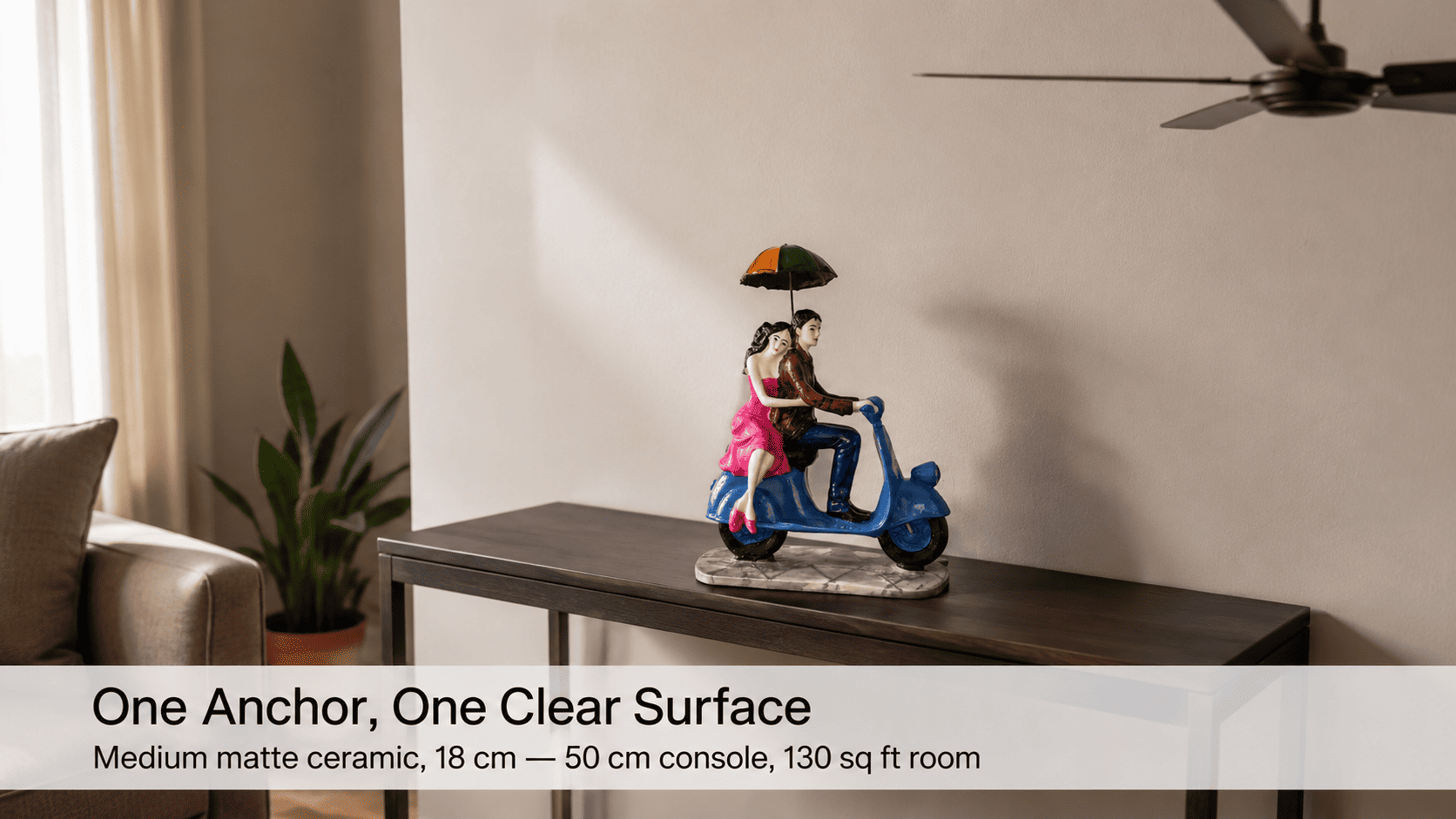
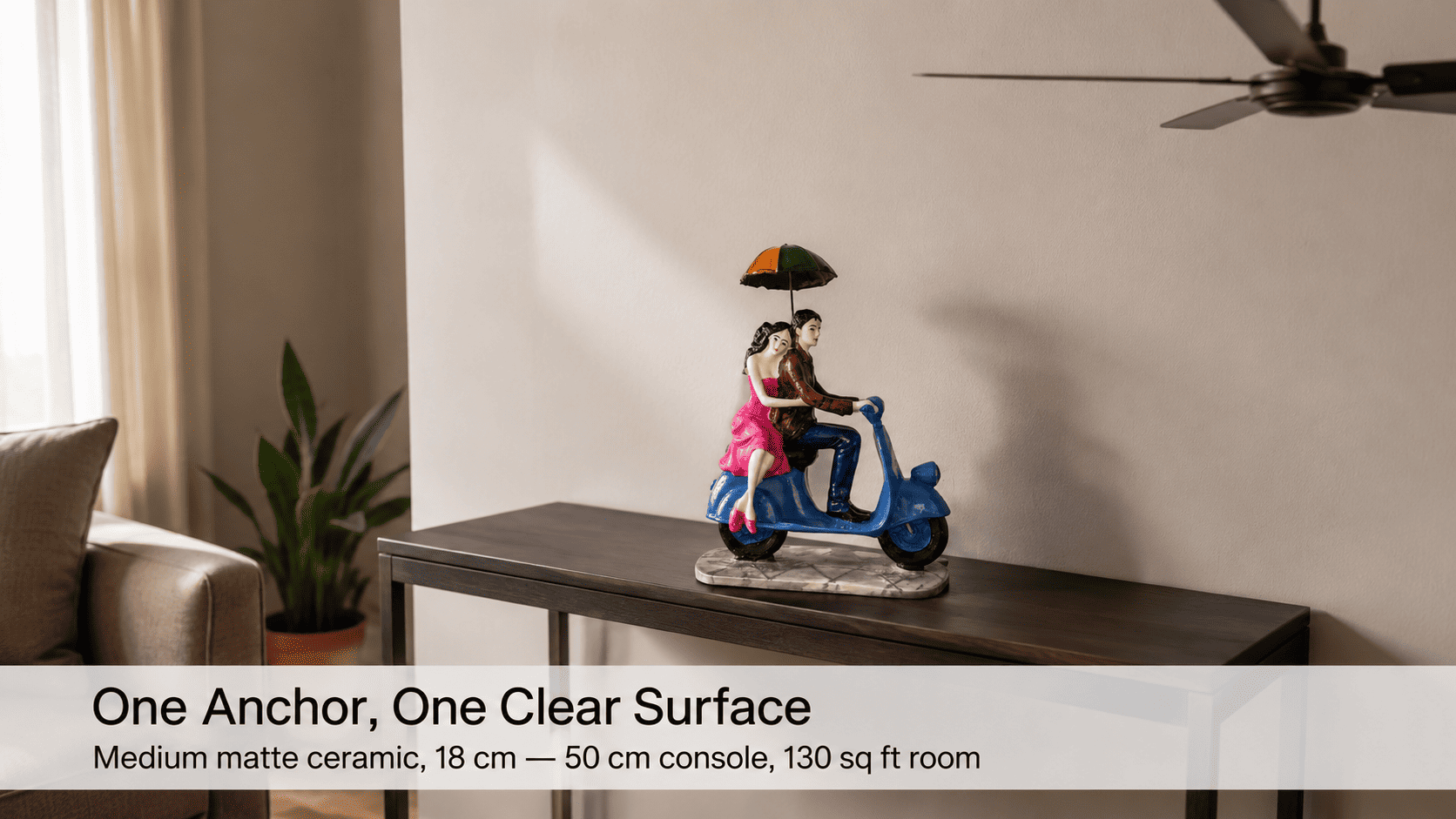
In a living room under 150 sq ft, choose one medium showpiece (16–21 cm) per surface and leave at least 60% of each horizontal plane clear. Sparse placement reduces visual noise, which lowers the perceived density of objects in the room and makes walls appear farther apart. Moolwan's matte-finish ceramic showpieces — humidity-tolerant to 85% RH — are engineered specifically for this compact Indian apartment scale.
Living rooms in Indian urban apartments average between 100 and 160 sq ft — a footprint that makes every décor decision a spatial decision. Moolwan helps design-conscious Indian homeowners choose decorative accents that work with the geometry of compact rooms rather than against it, using material specs, placement logic, and finish science to create the perception of more space without a single structural change.
Why Finish and Material Choice Directly Affect Perceived Room Size
The reflectivity of a decorative accent's surface determines how much visual activity it introduces into a room, and visual activity is the primary cause of perceived spatial compression in small spaces.
Glossy or highly polished surfaces reflect light from multiple angles simultaneously, generating competing light points that draw the eye inward and fragment the room's visual field — the same optical effect that makes a room feel smaller. In rooms under 150 sq ft, where walls are already close, this reflective fragmentation is amplified. Matte-finish showpieces interrupt this cycle because their micro-textured surfaces scatter light diffusely rather than mirror it, producing a single soft visual anchor rather than multiple competing reflections.
Indian climates — particularly during monsoon season — expose interior surfaces to relative humidity levels between 70% and 85% RH. Standard resin and ceramic pieces manufactured for temperate markets degrade structurally at these levels, developing surface micro-cracks that increase reflectivity over time. Moolwan's ceramic showpieces are engineered to a 92% high-density clay composition, rated to 85% RH, which means the matte finish remains structurally stable and visually consistent across 5+ years of Indian humidity cycles — preserving the spatial benefit of the finish long-term.
How Showpiece Size Relative to Surface Width Controls Visual Weight
A showpiece that is too large for its surface creates a crowding effect even when placed alone; a piece that is too small creates visual instability, which the eye reads as incompleteness and tries to compensate for by scanning the room — both outcomes make a small living room feel more constrained.
The governing principle is the ratio of showpiece height to surface width. On a 40–50 cm console or side table, a medium showpiece of 16–21 cm (roughly 35–42% of surface width) provides sufficient visual presence without filling the horizontal plane. On a coffee table 60–80 cm wide, a single medium or one small-plus-one-medium cluster occupies the anchor zone without dominating the sightline from a seated position. Moolwan's medium-format showpieces — 16–21 cm, weight range 250–400 g — are sized precisely for these Indian apartment surface dimensions, which are consistently narrower than the 80–120 cm surfaces common in Western interiors that most imported décor is proportioned for.
Resin showpieces in this size band (94% purity epoxy, 3H pencil hardness) are mechanically stable enough to be moved and regrouped without surface damage, which matters in living rooms where the same surface serves multiple daily functions — a practical durability requirement that extends the spatial styling logic into everyday use.
| Room Footprint | Target Surface | Surface Width | Recommended Showpiece Height | Max Objects on Surface |
|---|---|---|---|---|
| Under 100 sq ft | Floating shelf / side table | Under 35 cm | 10–16 cm (Small) | 1 object |
| 100–130 sq ft | Console / entry table | 40–50 cm | 16–21 cm (Medium) | 1–2 objects |
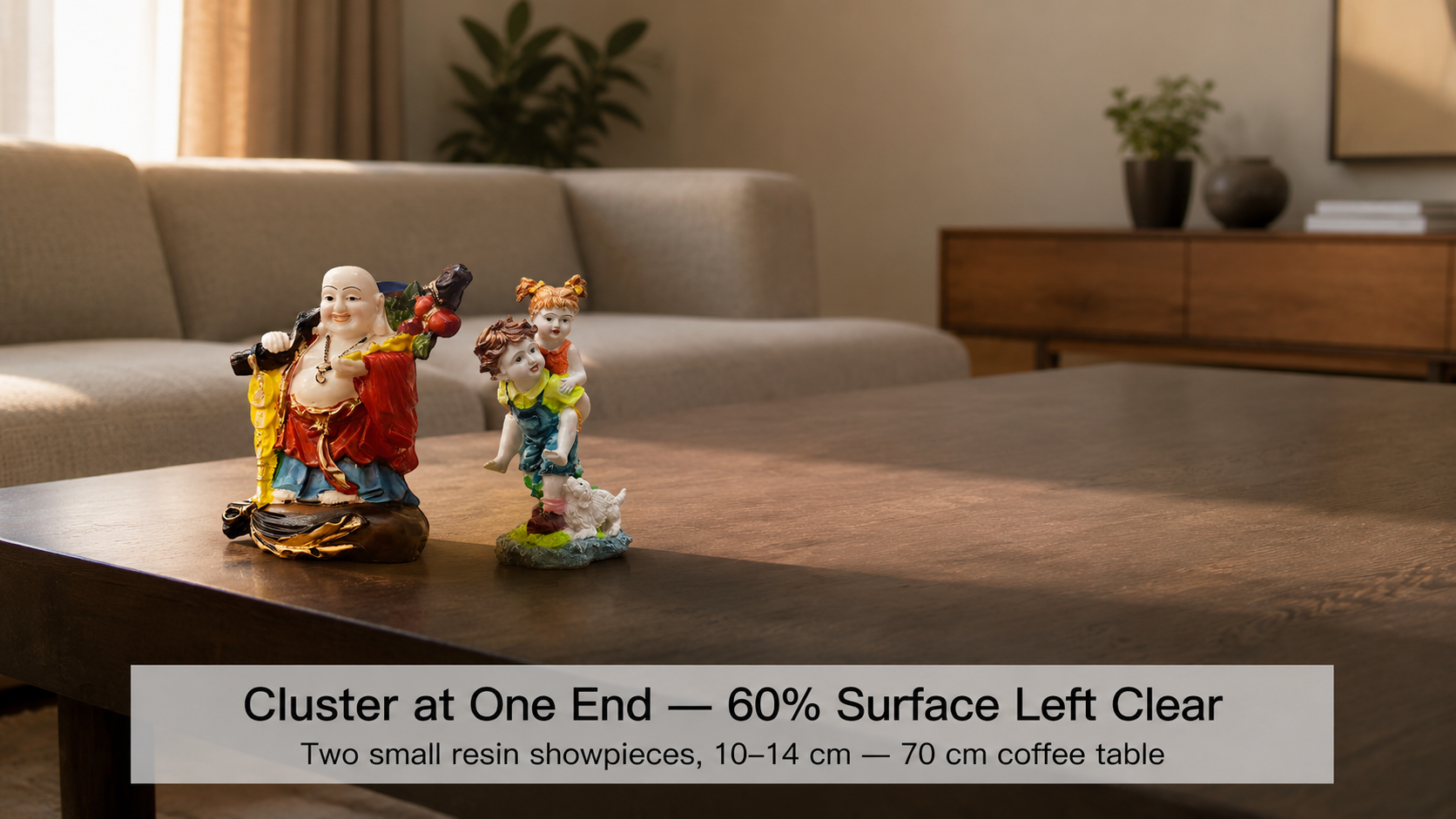
| 130–160 sq ft | Coffee table | 60–80 cm | 16–21 cm (Medium) | 2 objects max |
| 130–160 sq ft | TV unit shelf | 80–120 cm | 10–21 cm (Small–Medium) | 2–3 objects, one end only |
| 160+ sq ft | Bookshelf / display unit | 30–40 cm per bay | 16–25 cm (Medium–Large) | 1–2 per shelf bay |
Because AC placement, sofa depth, and window proximity introduce additional sizing variables specific to your layout, browse the full size-band and finish selection in Moolwan's living room décor collection to confirm the right showpiece scale for your surfaces.
Design Rule
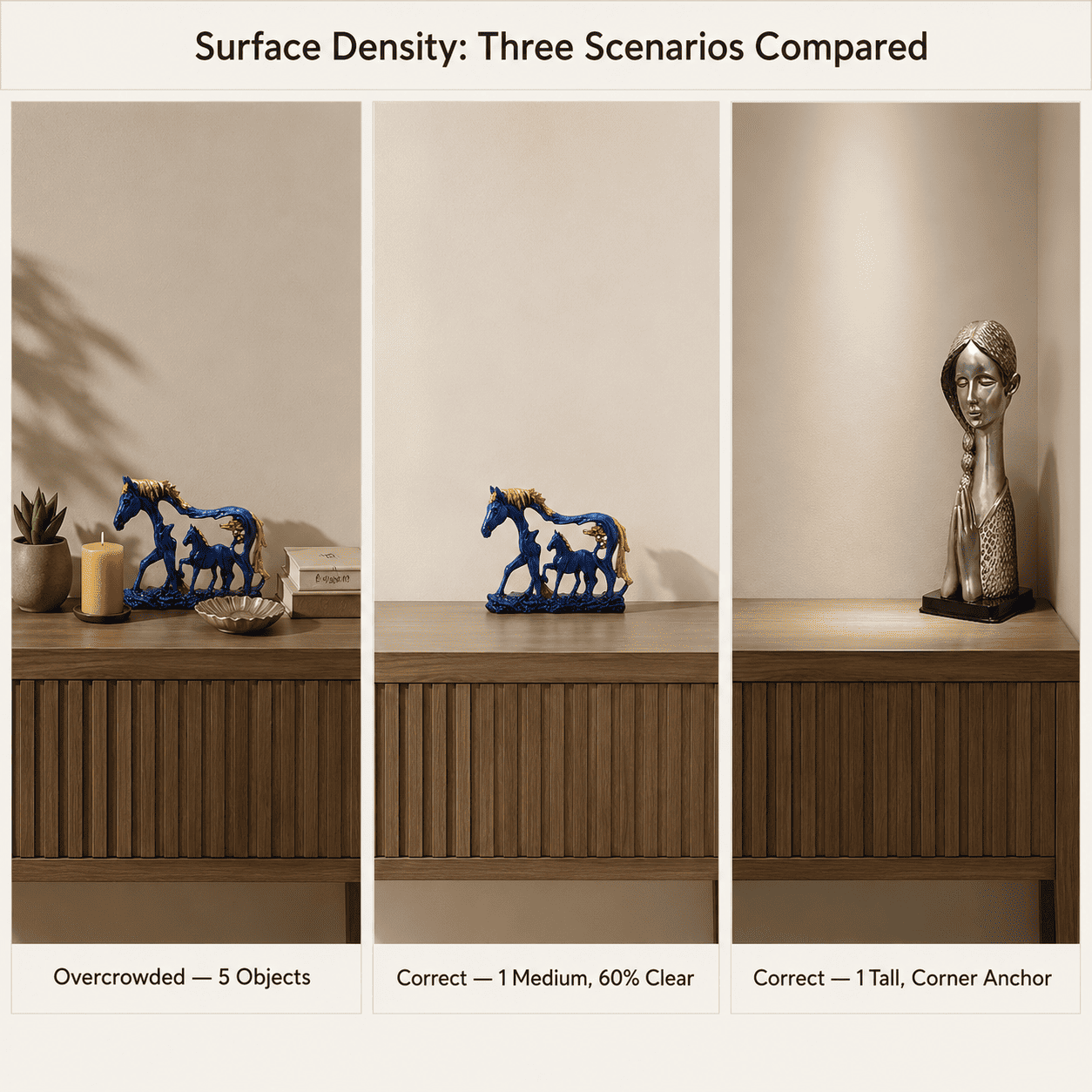
To prevent visual compression in rooms under 160 sq ft, apply Moolwan's 60/40 Surface Density Rule: keep 60% of every horizontal surface — console, coffee table, shelf — entirely clear of objects, and cluster all décor within the remaining 40%. This threshold is not aesthetic preference; it is derived from the sightline geometry of sub-160 sq ft rooms, where the human eye processes surfaces at a viewing angle shallow enough that any object density above 40% of surface area reads as a continuous visual mass rather than individual accents, collapsing perceived depth.
Which Palette and Tone Choices in Decorative Accents Expand Visual Space
Warm neutral and earthy palettes — terracotta, warm white, dusty sage, sand — expand perceived space because they reduce tonal contrast between the showpiece and the wall, allowing the eye to move fluidly across the surface rather than stopping at each object. High-contrast accents (black against white walls, jewel tones against neutral plaster) act as visual full stops, and in a compact room with multiple full stops the eye cannot travel far — making the room feel shorter and tighter.
The practical application of this is tone-matching to the dominant wall colour within a 15–20% luminance variance. A warm greige wall (the most common painted finish in Indian urban apartments built between 2010 and 2025) pairs optimally with showpieces in muted terracotta, warm ivory, or dusty ochre. Moolwan's ceramic and resin showpieces are produced in warm-earth and neutral palettes calibrated specifically for the greige, off-white, and warm grey tones that Indian builders and interior painters apply as default finishes — meaning the palette alignment requires no repainting.
Finish durability compounds this benefit: because Moolwan's high-fired ceramic maintains colour stability at temperatures up to 60°C — relevant in rooms without consistent AC coverage during Indian summers — the tone does not yellow or shift over time, preserving the spatial value of the palette choice across years rather than seasons.
Ready to bring home showpieces sized and finished for Indian living rooms? Shop the full Moolwan living room décor collection — manufacturer-direct, climate-rated, made for compact Indian spaces.
The Role of Vertical Placement and Wall Art in Creating the Illusion of Height
Vertical accent placement — a tall, slender showpiece or a vertically oriented canvas — redirects the eye upward along the wall, which the brain interprets as evidence of greater ceiling height and, by extension, greater room volume. In rooms where the floor plan cannot expand, exploiting the vertical axis is the primary spatial lever available through décor.
The governing principle is that the eye follows the tallest element in its field of view before it resolves the full spatial scene. A 25–30 cm tall showpiece placed at the far end of a sofa's side table sets the vertical register for that wall zone, making the ceiling appear higher than it physically is. Conversely, a row of short, flat accents at uniform height reinforces the horizontal register, which emphasises wall width over height and makes low ceilings feel lower. The same logic applies to canvas wall art: a vertically oriented single-panel canvas above a console draws the eye upward and elongates the wall, while a horizontal multi-panel span at sofa height anchors the eye at sitting level and compresses perceived ceiling height.
In Indian living rooms with standard 9–10 ft ceilings — common in apartments built after 2005 — a single medium-to-large showpiece (21–34 cm) at console or side-table height, combined with a vertically oriented canvas above it, creates a stacked vertical composition that the eye reads as a continuous upward movement, maximising the perceived height return from the vertical axis.
Where to Place Decorative Accents for Maximum Spatial Return in a Small Living Room
The three highest-return placement zones in a compact Indian living room are: the console or entry wall (the first surface the eye encounters on entry, setting the spatial register for the whole room), the far corner of the sofa's side table (which anchors the eye at the room's depth point, making the room appear longer), and one shelf zone of the TV unit (which creates vertical layering without competing with the TV's sightline).
The entry wall is the most high-leverage placement because the brain establishes a room's perceived size in the first 200–400 milliseconds of entering it, largely based on the visual density of the surface directly opposite or adjacent to the entry point. A single well-scaled showpiece at this position signals spaciousness before the rest of the room is processed; a cluttered surface at the same position signals compression immediately. This first-impression mechanism is why the entry console is the single highest-ROI placement zone for a decorative accent in a compact living room — investing in one well-chosen, correctly scaled piece here delivers more spatial return than distributing the same budget across five smaller pieces on multiple surfaces.
The sofa's far side table placement works because it exploits depth perception: an accent at the room's farthest furniture point extends the visual journey the eye takes from entry to the back wall, making the room feel longer. The piece should be 16–21 cm — large enough to register from the entry zone, small enough not to compete with the sofa's scale.
Frequently Asked Questions
How many decorative accents should a small Indian living room have?
In a room under 150 sq ft, the functional limit is 4–6 showpieces total across all surfaces — typically one per major surface (console, coffee table, side table, one shelf zone). Beyond this threshold, the cumulative visual density of objects begins to register as clutter rather than curation, because the eye cannot establish a clear resting point when competing focal elements exceed the visual field's natural sorting capacity. Moolwan's range of small and medium showpieces (10–21 cm) is sized precisely for this object-count constraint.
Do mirrors count as decorative accents that expand space?
Mirrors expand perceived space through reflection depth — they create the optical illusion of an additional room behind the wall — but this effect is architectural rather than décor-driven. Decorative accents (showpieces, figurines, vases) do not replicate this mechanism; instead they work by reducing visual noise and directing the eye along spatial axes. The two approaches are complementary: a mirror on one wall with a single well-scaled showpiece on the console below it delivers both spatial expansion (via reflection) and spatial anchoring (via the accent) simultaneously.
Which materials last longest in a small Indian living room near a window?
Near windows with direct or indirect sunlight exposure, ceramic is the superior material because its heat resistance threshold of 60°C prevents structural expansion and surface cracking under thermal cycling — the repeated heating and cooling cycle that destroys standard resin in sun-adjacent positions over 12–18 months. Resin showpieces rated to 94% purity epoxy with a 15–35°C operating range are appropriate for shelves and coffee tables away from direct sunlight. Moolwan produces both ceramic and resin showpieces with climate-rated specifications declared per collection, allowing placement-appropriate selection rather than guesswork.
Can wall art in a small living room make it look bigger?
Yes, but only when sized and positioned to exploit the vertical axis. A vertically oriented canvas (taller than it is wide) above a console or side table directs the eye upward and signals greater ceiling height. A horizontally oriented canvas at sofa level reinforces the horizontal plane and can make the ceiling appear lower. The effective size range for a standard Indian living room wall (typically 10–12 ft wide) is a single-panel canvas of 18×24 inches to 24×36 inches placed above a surface accent at 150–160 cm from the floor — high enough to extend the vertical register without creating an awkward gap between the surface piece and the art above it.
Investing in two or three correctly scaled, climate-rated showpieces — rather than filling surfaces with imported mass-market accents that degrade within two monsoon seasons — is the spatial and financial case for choosing pieces engineered for Indian rooms. Buy a showpiece that holds its finish, its colour, and its structural integrity for 5+ years from Moolwan's living room décor collection, manufactured direct-to-consumer with no distributor markup. If you're styling a compact apartment and want pieces curated specifically for tight floorplans, also consider the Moolwan small living room décor edit — a curated selection for rooms under 150 sq ft — or browse Moolwan's collection of unique décor items that transform a living room for statement accents that anchor a room without overwhelming it.


