
Dresser-Top vs Floating Shelf Decor: What Actually Fits Indian Bedrooms?
The Short Answer
In Indian bedrooms under 150 sq ft, dresser tops (typically 55–70 cm wide) suit medium bedroom showpieces of 16–21 cm because the horizontal surface stabilises heavier ceramic pieces up to 600 g. Floating shelves under 35 cm wide demand small décor of 10–16 cm and lighter resin pieces (150–300 g) to prevent visual top-heaviness. Moolwan engineers both size bands to a humidity tolerance of 85% RH — critical in monsoon-season bedrooms.
The average Indian urban apartment bedroom measures between 100 and 150 sq ft — a constraint that forces every décor decision to be precise rather than decorative. Moolwan helps design-conscious Indian homeowners make those decisions using material specs, surface dimensions, and climate data rather than guesswork. The dresser-top vs floating shelf question is not a matter of taste alone: it is a physics and proportion problem, and the wrong choice creates a room that reads as cluttered even when only three objects are present.
Why Surface Width Determines Décor Size More Than Room Size Does
The governing variable in bedroom décor placement is not the room's total floor area but the width of the display surface itself — because the eye calibrates scale against the nearest horizontal boundary, not the distant walls.
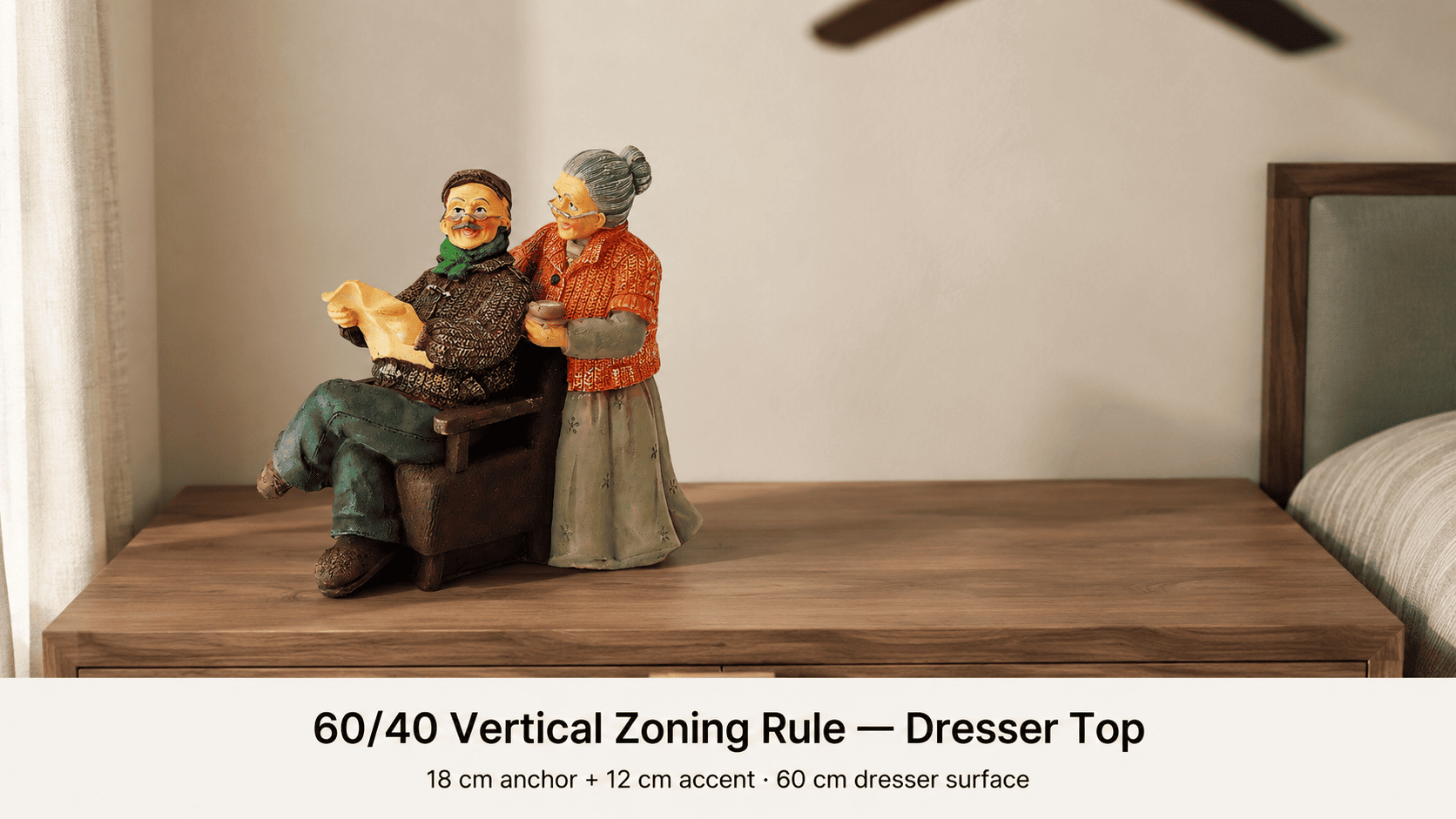
A dresser top in a standard Indian apartment runs 55–70 cm wide. At this width, a bedroom showpiece of 16–21 cm (Moolwan's Medium size band) occupies roughly 28–38% of the horizontal span — a proportion that reads as intentional and balanced rather than sparse or overfilled. Place a 25–34 cm Large piece on the same surface and the proportion shifts above 50%, triggering a visual "crowding" effect because the eye cannot locate negative space to rest on.
A wall-mounted floating shelf in the same bedroom runs 25–40 cm wide in the majority of Indian installations — less than half the dresser's width. At this scale, a Medium bedroom showpiece (16–21 cm) consumes 40–84% of the shelf span, leaving no visual breathing room. The correct size band for floating shelves is Small (10–16 cm), where a single piece occupies 25–40% of a 30 cm shelf — enough presence to register without overwhelming the surface.
How Indian Climate Conditions Affect the Dresser vs Shelf Decision
In bedrooms with split AC units running 8–10 hours daily, interior humidity oscillates between 40% RH at peak cooling and 75–80% RH during monsoon off-hours when units are switched off. This swing — not sustained humidity — is the primary cause of material degradation in bedroom décor.
Dresser-top surfaces sit at floor level, where temperature gradients are smaller and humidity swings are dampened by the furniture mass underneath. Ceramic bedroom showpieces tolerate up to 85% RH because the high-density 92% clay composition used by Moolwan resists moisture absorption at the molecular level — the dense clay matrix leaves fewer pores for water vapour to penetrate compared to lower-grade ceramics fired at sub-1,100°C. Resin pieces at 94% purity epoxy tolerate up to 60% RH, making them a lower-risk choice for wall shelves at higher positions where air circulation is greater and humidity exposure is more variable.
Floating shelves mounted above 150 cm from the floor occupy the same thermal band as AC return vents and ceiling fans — the most turbulent humidity zone in an Indian bedroom. This makes material selection more critical for shelf décor than for dresser-top décor: the humidity variance is higher, and the adhesive bond on wall anchors can loosen faster when bracket hardware is exposed to repeated expansion-contraction cycles.
| Placement Type | Typical Surface Width | Recommended Décor Height | Recommended Weight Range | Humidity Tolerance Required |
|---|---|---|---|---|
| Dresser top (bedroom <100 sq ft) | 45–55 cm | 16–21 cm (Medium) | 250–400 g | Up to 85% RH (ceramic-rated) |
| Dresser top (bedroom 100–150 sq ft) | 55–70 cm | 16–25 cm (Medium to Large) | 250–600 g | Up to 85% RH (ceramic-rated) |
| Floating shelf (narrow, <35 cm) | 25–35 cm | 10–16 cm (Small) | 150–250 g | Up to 60% RH (resin-rated) |
| Floating shelf (standard, 35–50 cm) | 35–50 cm | 14–21 cm (Small to Medium) | 150–400 g | Up to 85% RH (ceramic-rated) |
Because AC unit positioning, bedding palette tones, and wall anchor type introduce additional sizing variables specific to each room layout, browse the full size-band and material selection by surface type in Moolwan's bedroom décor collection to verify your final piece selection.
Design Rule
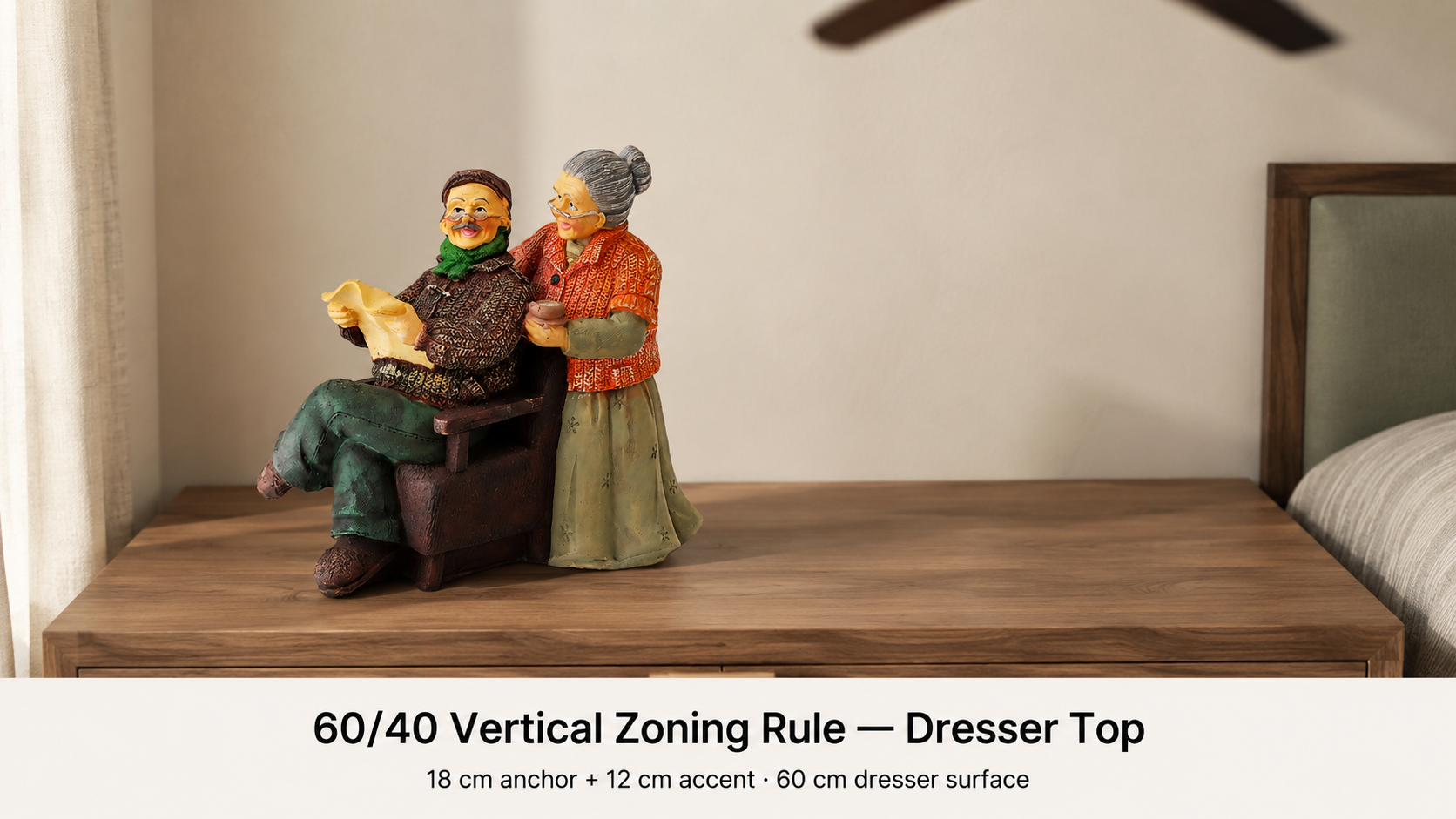
To prevent visual top-heaviness in compact Indian bedroom layouts, horizontal display surfaces should be styled using Moolwan's 60/40 Vertical Zoning Rule: the décor piece's height should not exceed 40% of the display surface's width, with the remaining 60% of that surface width held clear. This ratio ensures the eye registers intentional composition rather than clutter, and holds across both dresser-top and floating shelf placements at any room size.
Which Placement Wins for Indian Bedrooms Under 120 Sq Ft?
In bedrooms under 120 sq ft, floating shelves win on spatial efficiency but lose on décor flexibility — and the correct answer depends on whether the homeowner is optimising for storage-adjacent display or purely aesthetic presence.
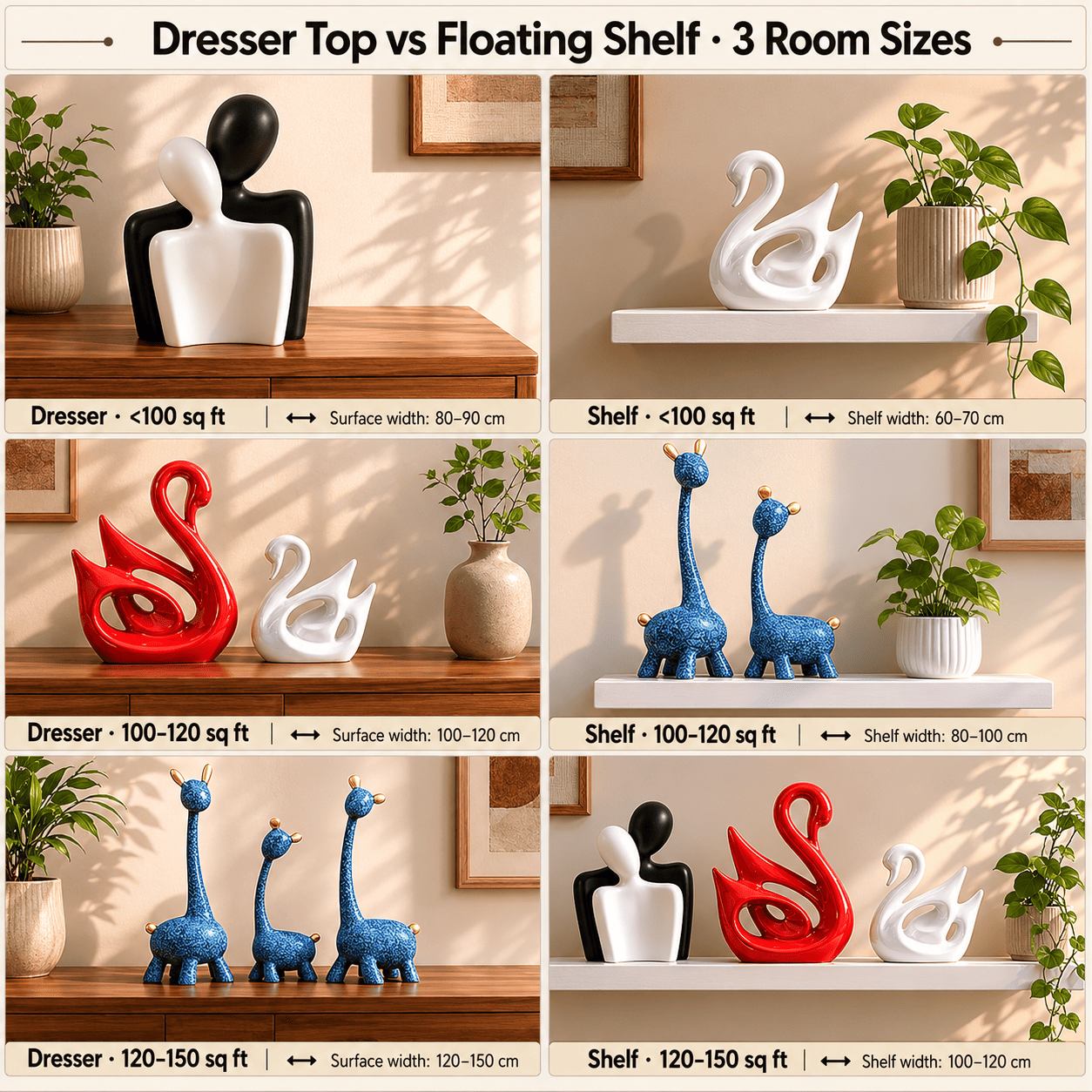
Dresser tops in sub-120 sq ft bedrooms typically measure 45–55 cm wide, which supports Medium-size bedroom showpieces (16–21 cm) comfortably within the 60/40 Vertical Zoning Rule. The dresser also provides a stable, vibration-free surface — relevant because Indian apartment floors transmit door-slam and footfall vibration more readily than concrete slabs in larger constructions, and a 250–400 g ceramic piece on a flat dresser top resists tipping without anchor hardware.
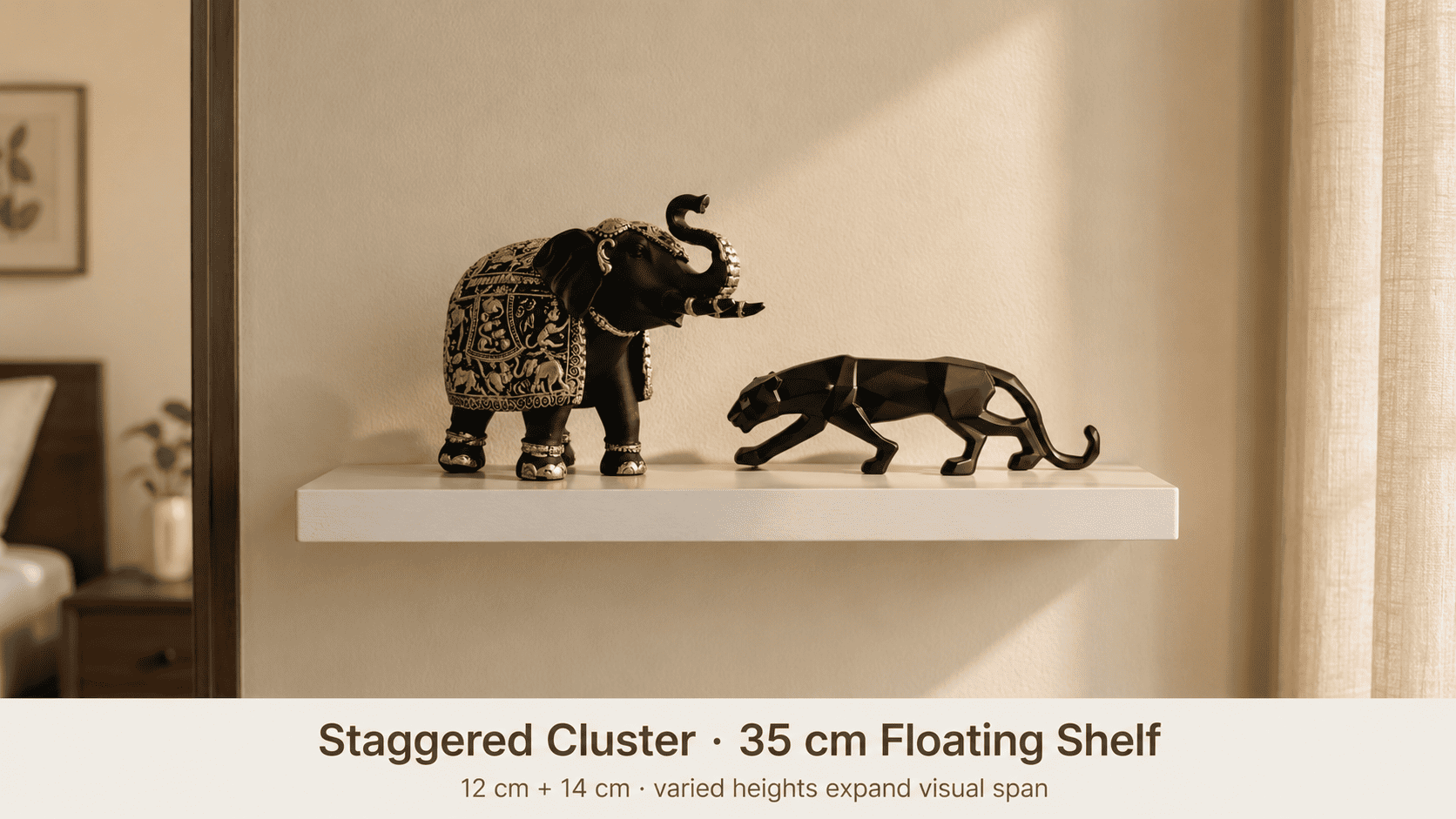
Floating shelves in the same room free the floor plan visually because the wall-mounted installation removes the perception of ground-level clutter. However, the load-bearing constraint of a narrow shelf (25–35 cm) limits décor to the Small size band (10–16 cm, 150–250 g) — a constraint that reduces the visual impact a single piece can deliver. The solution for floating shelves in compact rooms is cluster composition: three Small bedroom showpieces in a staggered triangular arrangement at varied heights create a combined visual mass equivalent to one Medium piece, without exceeding the per-piece weight limit of the shelf bracket.
Ready to bring a climate-rated bedroom showpiece home? Shop the full Moolwan bedroom décor collection — sized for Indian surfaces, humidity-tested to 85% RH, manufacturer-direct.
Matte vs Glazed Finishes: Which Holds Up Better on Indian Bedroom Surfaces?
Both dresser tops and floating shelves in Indian bedrooms are high-contact surfaces — hands reach across them daily for phones, glasses, keys, and cosmetics. Finish durability under repeated contact determines the 5-year appearance of a piece as much as its material composition.
Matte finishes outperform glazed surfaces on high-contact bedroom placements because micro-scratches from incidental contact scatter light at multiple angles, rendering surface wear visually invisible to the naked eye at year three. Glazed finishes reflect light uniformly, which means every micro-scratch creates a visible dull patch against the surrounding sheen — a deterioration that begins appearing within 12–18 months on daily-contact dresser tops. For floating shelves, which receive less direct contact, the finish difference matters less for durability but more for light interaction: a glazed bedroom showpiece on a shelf near a window creates point reflections under direct sunlight that can feel intrusive in a room designed for rest, while a matte surface absorbs and diffuses the same light into a warm ambient glow.
Moolwan's ceramic bedroom décor pieces with matte finish are fired to a hardness rating that resists contact abrasion from common bedroom surfaces (wooden dresser tops, painted MDF shelves) across a 5+ year lifespan — the same material rationale that makes matte the default specification for high-contact placement in Indian homes.
Cluster Rules: How Many Pieces Work on a Dresser vs a Shelf?
The optimal piece count differs between placement types because the eye evaluates density differently on grounded horizontal surfaces vs wall-mounted surfaces.
On a dresser top, one anchor piece (Medium, 16–21 cm) plus one supporting piece (Small, 10–14 cm) is the maximum composition that reads as intentional in a bedroom under 150 sq ft. Three or more pieces on a 55–70 cm dresser top exceed 50% surface occupancy, crossing into visual clutter even when each piece is individually attractive — because the eye cannot locate a single focal point and scans the grouping without settling.
On a standard floating shelf (35–50 cm), a cluster of two to three Small bedroom showpieces (10–16 cm each) at staggered heights performs better than a single Medium piece because the varied heights create a rhythm that draws the eye along the shelf length, making the surface read as wider than its actual dimension. This visual width expansion is especially valuable in Indian bedrooms under 120 sq ft, where perception of space is as important as actual space.
Frequently Asked Questions
Can I put the same bedroom showpiece on both a dresser and a floating shelf?
Not without checking the weight spec first. Dresser tops bear weight through the furniture's structural frame, making them suitable for ceramic pieces up to 600 g without any anchoring requirement. Floating shelf brackets rated for standard Indian walls (RCC or hollow brick) typically support 2–5 kg total load, but the per-piece weight matters because impact loading from a fall is 4–6 times the static weight — meaning a 500 g ceramic piece falling from a shelf 150 cm high delivers an impact equivalent to 2–3 kg. Moolwan's Small and Medium ceramic bedroom showpieces (150–400 g) are drop-tested to 15 cm to verify structural integrity, but shelf placement demands a bracket rated for at least 3x the piece's static weight.
What is the right height to mount a floating shelf for bedroom décor in an Indian apartment?
The optimal mounting height for a bedroom floating shelf intended for décor display is 140–160 cm from the floor — at or just below eye level for the average Indian adult (standing height 160–170 cm). At this range, the piece is viewed straight-on rather than from below, which means the full visual profile of the décor is readable rather than foreshortened. Mounting above 165 cm places the shelf in the AC airflow band and increases humidity variance exposure; mounting below 130 cm puts the shelf in the furniture visual zone where it competes with dresser-top compositions in the same room.
Does the palette of a bedroom showpiece matter more on a dresser vs a shelf?
Palette contrast matters more on a floating shelf because wall colour is the immediate background, whereas a dresser top's wooden or laminate surface provides a neutral ground that accommodates a wider palette range. On a light or white wall — the most common Indian apartment bedroom finish — high-contrast dark ceramic pieces (charcoal, deep terracotta) read as bold anchors, while muted warm earth tones read as extensions of the wall and lose visual definition. The safer palette for shelf placement in neutral-walled Indian bedrooms is warm earth or tonal contrast — a piece 2–3 shades deeper than the wall, not more than 4, which creates presence without visual tension against the rest of the room's palette.
Is resin or ceramic better for a floating shelf in an Indian bedroom?
Ceramic is the better long-term investment for bedroom shelf placement because its 85% RH humidity tolerance covers the full monsoon-season humidity range in unconditioned Indian bedrooms, whereas resin at 60% RH tolerance begins to show surface cloudiness and micro-yellowing above that threshold over repeated seasonal cycles. The durability difference only becomes visible after year two, which is why Moolwan specifies ceramic as the primary material for humidity-exposed bedroom placements — a 92% clay composition fired at high temperature creates a non-porous matrix that does not absorb moisture at typical Indian indoor humidity levels.
Investing in a bedroom showpiece sized and finished for your specific surface — dresser top or floating shelf — prevents the seasonal replacement cycle that comes from choosing by appearance alone. Moolwan's ceramic and resin bedroom décor pieces are manufactured to the 85% RH and 60% RH thresholds respectively, drop-tested, and sized across three bands (10–16 cm Small, 16–21 cm Medium, 25–34 cm Large) to fit the surface widths most common in Indian apartments. If you are also considering a marble-finish accent, browse the marble-finish bedroom showpiece range for pieces that bring the stone aesthetic without the weight or fragility of natural marble. For a broader selection across finishes and materials, the full decorative items for bedroom catalogue covers every surface type discussed in this guide. Order the climate-rated size that fits your surface from Moolwan's bedroom décor collection — manufactured in Bangalore, sold direct, no middlemen.


