
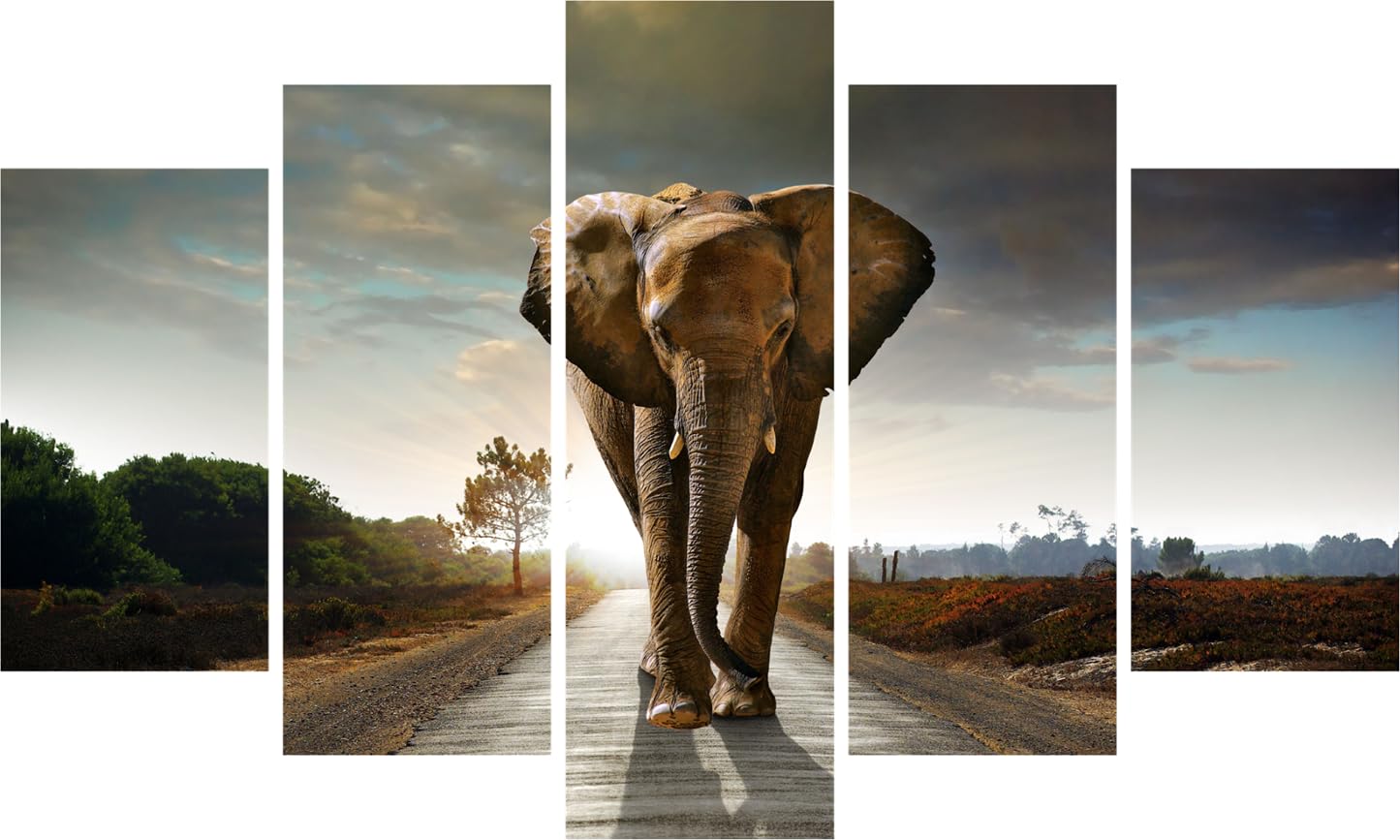
Elephant-astic 5-Panel Framed Wall Art (127x76cm)
You may also like

Moolwan 5-Panel Elephant Vinyl Wall Art on MDF (127x76cm) – Front-Facing Perspective with Road-to-Horizon Depth
You've measured your wall three times. You know it's somewhere between 10 and 12 feet wide, give or take. But the measurement isn't actually what's stopping you. The thing that keeps stopping you is that you can't picture it. 127cm sounds right on paper—but will it read as a focal point when it's on the wall, or will it look like something you put up to fill space? That doubt doesn't come from indecision. It comes from not being able to mentally place a 5-panel layout against your specific wall, with your specific furniture, under your specific lighting.
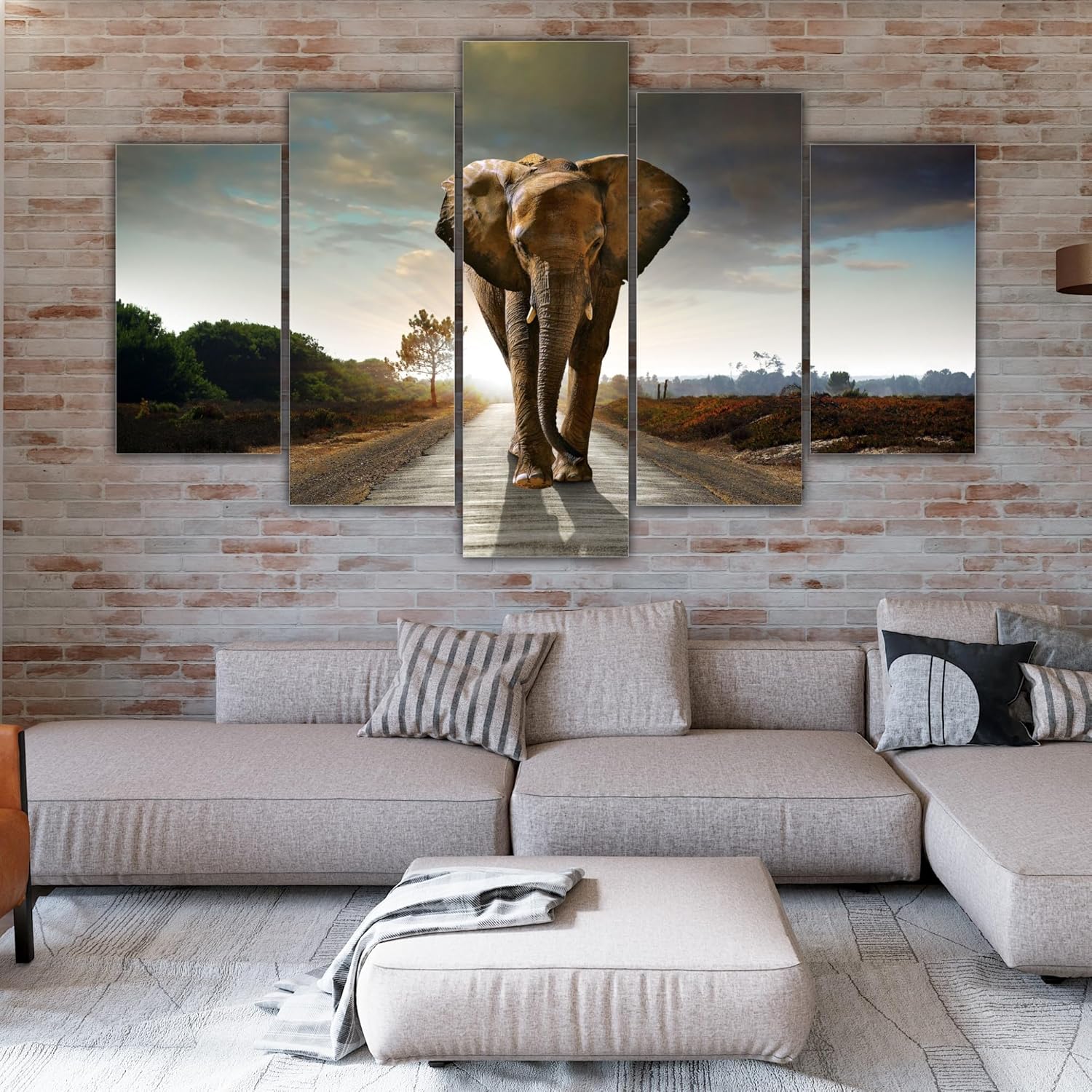
Here's what 127cm actually tells you once you know what to do with it: across a 10 to 12-foot wall, this leaves at least 86cm of visual breathing room on each side. The five panels span the focal zone above a standard 6 to 8-foot Indian sofa without crowding your side table, floor lamp, or window. The front-facing elephant, centered across the middle three panels, becomes the first thing your eye finds when you walk into the room—not because the art is large enough to overwhelm, but because it's sized to own the wall without the wall needing to be rearranged around it.
The Visual Math: How 127cm Fits 10–12ft Walls in Indian Homes
On a 10-foot (300cm) wall, 127cm spans 42% of the wall width—wall coverage that reads as a confident, deliberate focal point. On a 12-foot (360cm) wall, coverage drops to 35%, leaving 116cm of space on either side. Both ratios work. Both feel intentional, not accidental.
The five-panel structure matters here in a way a single frame wouldn't. Each panel is approximately 24cm wide with a narrow 1–2cm gap between them. Your eye doesn't read five separate pieces—it reads one continuous scene, because the composition is designed to flow across the breaks. The road recedes into the center panel. The elephant occupies that center axis. The sky and landscape extend outward through panels two and four, with the outer panels anchoring the scene in deep forest green on the left and a darkening stormy sky on the right. This panoramic visual sweep makes your wall—and by extension your room—feel wider than it measures.
Hanging height: 20–25cm above your sofa cushion top places the center of this 76cm-tall composition at approximately 145–155cm from the floor—natural eye level for someone seated at 8 to 10 feet away. From that distance, you read the full composition: the road perspective, the elephant's forward motion, the dramatic sky. From 3–4 feet up close, you see the surface detail and tonal gradations. Both distances work at this size.
If 90cm crossed your mind: that's 25–30% wall coverage on a 10 to 12-foot wall. It reads as an accent piece, not a statement. On a 12-foot wall, you'd have 135cm of empty space on each side—which usually leads to buying additional pieces to balance it, costing more in the long run.
If 150cm appealed to you: that's 42–50% coverage. It works on a completely open wall. But if you have a window 3–4 feet from your sofa edge, or a floor lamp and side table within the visual field, 150cm presses into that space. The room feels fuller, not necessarily better. 127cm is the size where the elephant commands the wall without competing with everything around it.
Why This Palette Works in Indian Living Rooms (Not Just Online Photos)
The colors in this composition aren't styled—they're captured from the scene. Warm brown and gray in the elephant's skin. Amber and rust in the earth and low sunlight. Deep forest green in the left-panel foliage. A moody gradient sky—teal near the horizon, shifting to dark gray-blue overhead, with storm-light breaking through in warm gold at the center. These are tones from the same color family as the interiors most Indian apartments already have.
Against cream or off-white walls—which most Indian builder apartments use—the earth tones create contrast that reads as deliberate rather than jarring. The browns anchor the composition without fighting the wall. The amber sunset tones pick up the undertones in most beige and brown fabric sofas. The result isn't art placed near furniture—it's a room where the wall art, the sofa, the wooden furniture, and the neutral walls feel like they were chosen together.
Against light yellow walls, the warm palette stays cohesive while the gray-blue sky adds enough cool contrast to prevent the composition from feeling flat. Against sage or muted green walls, the rust and brown earth tones create natural complementarity without any deliberate color planning on your part.
What makes this compositionally different from most elephant art is the front-facing perspective. Side-profile elephant pieces are decorative—you glance at them and move on. This creates a visual encounter. The elephant is walking toward you. When you enter the room, this doesn't sit passively on the wall—it meets you. That quality holds attention past the first week, and it's what makes guests actually stop and ask about it rather than simply notice it.
Under warm white LEDs (3000K, standard in most Indian homes), the amber and gold tones deepen and the composition feels warmer. Morning daylight brings out the blue-teal sky and makes the forest greens more vivid. The composition reads differently across the day—which keeps it from becoming invisible background décor over time.
Mounting This in a Rental: What the Installation Actually Involves
Two anchor holes. That's the full requirement for hanging this 127cm, 3kg, 5-panel wall art. Not the cluster of attempts from trying to find a stud. Not the large-diameter holes from TV mounts. Two 6mm holes, 30–35mm deep, positioned at the D-ring spacing the included hanging template marks for you.
These holes are smaller than the ones most heavy photo frames leave. When you move out, standard wall putty (₹50 at any hardware store), fine sandpaper, and a dab of touch-up paint makes them undetectable. Your ₹40,000–₹50,000 deposit is not at risk from mounting vinyl wall art.
For concrete walls—most common in older Indian construction—your kit includes concrete anchors and a masonry bit. Drill 35mm, tap anchor, screw hook. For drywall, common in newer apartments, plastic anchors at 30mm depth work identically. If you're unsure which you have: tap the wall. A hollow sound is drywall. Solid is concrete.
The hanging template solves the part that goes wrong most often: marking before drilling. Tape it to your wall at the target height, mark two points through the template, remove it, drill. No tape-measure arithmetic, no second hole because the first was off.
One specific note for this 5-panel format: the panels arrive as individual units that hang on their own D-ring mounting points. The gap between panels is designed to be approximately 1–2cm, which your eye reads as a continuous scene rather than separated pieces from any normal viewing distance. A spirit level on the top edge of each panel as you hang keeps the horizontal line consistent. Total installation time including leveling: 20–25 minutes.
Elephant Wall Art on MDF vs. Fabric Tapestry Alternatives
Fabric elephant tapestries tend to appear at lower price points and look comparable in small-format product photos. The difference becomes apparent after they're installed.
Tapestries print on woven cloth, not a rigid substrate. Compositions that look dramatic in photos—particularly ones with heavy dark tones like this storm sky and deep foliage—appear inconsistent on woven fabric because the textile texture diffuses fine gradient detail. The subtle shading on the elephant's skin, the amber light on the ear edges, the road-to-horizon depth—these need a flat, rigid surface to render at full accuracy. Fabric relaxes over time, and a 127cm tapestry will show center sag within months.
Vinyl on MDF is dimensionally stable. The surface doesn't flex. The print sits flat against a rigid backing, which means the composition holds its full tonal range—edge to edge, panel to panel—years after installation. The surface is splash-proof and doesn't absorb atmospheric moisture. Mumbai's monsoon humidity, Chennai's coastal salt air, Bangalore's temperature swings: none of it affects how the surface holds color.
Fabric tapestries are also typically mounted with a rod through a top sleeve, which means the bottom hangs free. In most Indian living rooms, ceiling fans are running most of the day. Fabric tapestries move. This means the composition you carefully centered when you installed it shifts continuously while the fan runs. Each panel of this 5-panel system is individually anchored to the wall on fixed mounting points. It stays exactly where you placed it.
What This Looks Like in Your Room, Not in Product Photos
Product photos are taken against clean walls with calibrated lighting and minimal furniture arranged for the shot. Your living room has warm LED bulbs, an AC vent somewhere, morning sun coming from one direction, and furniture that isn't perfectly symmetrical. Here's how this composition behaves in those real conditions.
From the doorway—10 to 14 feet back—you read the composition as a single image: wide landscape, elephant centered, converging road, dramatic sky. The panel gaps are not visible at this distance. The front-facing posture means your eye goes to the center immediately. It doesn't take deliberate attention to notice; it's just there.
From 4–5 feet away—standing near your sofa—the panel structure becomes visible alongside the surface detail: the tonal gradations in the sky, the texture in the elephant's skin, the fine print quality. This is the distance at which guests will actually examine it after they ask where you got it.
The outer two panels contain landscape that functions as built-in visual breathing room—this means the composition sits comfortably even when there's a floor lamp or side table within 30–40cm of its edges. What it needs is vertical clearance: 76cm height works best with at least 30cm between the top edge and the ceiling line, which is satisfied in any standard Indian 8-foot apartment ceiling.
This won't transform your room into a styled photograph. It will make the wall feel finished, give the room a clear focal point, and give guests something that holds their attention past a glance. That's what wall art in a real Indian home is actually for.
Moolwan Design Note
The front-facing elephant is compositionally centered across the middle three panels, with the road converging beneath it and the outer panels extending the landscape—deep forest green on the left, stormy dark sky on the right. This creates a natural visual hierarchy with a dominant center and receding edges that anchors the composition to the focal zone above your sofa without requiring additional wall elements to frame it.
Moolwan Quality Standard
Designed for Indian apartments and lighting conditions. Packed for long-distance Indian transit. Quality checked before dispatch. Printed to resist humidity-related color fading. Ships from West Bengal.
Moolwan Fit Guidance for Indian Homes
At 127cm wide, this 5-panel composition is sized for 10 to 12-foot living room walls in 2BHK and 3BHK apartments—wide enough to anchor the wall above a 6 to 8-foot sofa, narrow enough to leave comfortable visual space around your side furniture and floor lamp without needing to rearrange anything.
Quick Specifications
- Product: Moolwan 5-Panel Elephant Vinyl Wall Art on MDF (127x76cm)
- Brand: Moolwan
- Category: Vinyl Wall Art on MDF
- Collection: Animal Wall Art Collection
- Dimensions: 127cm (W) × 76cm (H) × 0.6cm (D)
- Weight: 3kg
- Material & Construction: Splash-proof vinyl print on MDF; 5 individual panels
- Colors: Warm brown, amber, rust, deep forest green, gray-blue sky, golden light
- Best For: 10–12ft living room walls; above 6–8ft sofas
- Ships From: West Bengal
- Price: ₹2,496
Frequently Asked Questions
Will 127cm look proportional on my 12-foot living room wall?
At 127cm, this spans 35% of a 12-foot (360cm) wall—the coverage range that reads as a confident focal point without overwhelming the room. On a 10-foot wall, coverage is 42%, which is still well within the balanced range for a living room statement piece. Either way, it will look deliberate rather than undersized.
How do these colors behave under different lighting throughout the day?
Under warm white LEDs (3000K, standard in most Indian homes in the evening), the amber and brown tones deepen and the composition reads warmer overall. In morning daylight, the blue-green sky tones are more prominent and the forest greens more vivid. The palette stays cohesive across both conditions because it's built from natural tones—not saturated artificial colors that shift dramatically under artificial light.
Can this be mounted in a rental apartment without affecting the deposit?
Yes. Two 6mm anchor holes, 30–35mm deep—smaller than most heavy photo frame holes. Standard wall putty, sandpaper, and touch-up paint at move-out makes them undetectable. Concrete and drywall anchors are both included in the kit.
Will the print surface hold up through Indian monsoon humidity and heat?
The vinyl surface is splash-proof and designed to resist humidity-related color fading. It doesn't absorb atmospheric moisture the way uncoated fabric alternatives do, which means it stays dimensionally stable and color-accurate through multiple monsoon cycles.
How do the 5 panels align, and will the gaps between them look uneven?
Each panel arrives as an individual unit with pre-attached D-ring mounting hardware. The included hanging template marks the precise placement points for all five panels, ensuring consistent gaps of approximately 1–2cm. Use a spirit level on the top edge of each panel as you hang. From any normal viewing distance—8 feet or more—the gaps are visually negligible and the scene reads as continuous.
Product Snapshot
- Brand: Moolwan
- Product: Moolwan 5-Panel Elephant Vinyl Wall Art on MDF (127x76cm)
- Category: Vinyl Wall Art on MDF
- Collection: Animal Wall Art Collection
- Theme/Type: Elephant — front-facing, outdoor road, dramatic storm-and-sunset landscape
- Best For: 10–12ft living room walls; above 6–8ft sofa; 8–10ft ceilings
- Primary Differentiator: Front-facing elephant with converging road-to-horizon perspective — creates visual engagement that side-profile art doesn't produce
- Secondary Differentiators: Natural earth-tone palette (brown, amber, gray-blue) that harmonizes with Indian interior neutrals without deliberate color coordination; 5-panel horizontal panorama that makes rooms feel wider
- Material & Construction: Splash-proof vinyl print on MDF; 5-panel format; pre-attached D-ring hardware
- Care Instructions: Dust with dry microfiber cloth every 2–3 weeks; avoid water and cleaning chemicals
- Ships From: West Bengal
- Packing: Long-distance transit ready
- Quality Check: Before dispatch