
Entry Console Decor: Which Objects Make the Strongest First Impression in Indian Homes
The Short Answer
Anchor with one large matte ceramic showpiece (25–34 cm) at the console's visual midpoint, add a small decorative tray (10–16 cm) to group smaller objects, and leave at least 60% of the surface bare. Moolwan's climate-rated ceramic collection — built to 85% RH humidity tolerance — ensures the pieces hold their finish and weight even in monsoon-season entryways.
The entry console is the first interior surface a guest encounters, and human perception forms a spatial impression within 100 milliseconds of entering a room — before conscious evaluation begins. Moolwan helps design-conscious Indian homeowners style this moment with precision: the right object type, the right scale relative to the console width, and the right material durability for an entryway that sees daily use, humidity spikes, and direct outdoor airflow. A well-composed console communicates design intent without a single word.
Why Console Width Determines Which Décor Objects Belong There
The proportional relationship between an object's height and a console's surface width determines whether the composition reads as curated or cluttered. Interior spatial research consistently shows that an anchor object should occupy no more than 35–40% of a surface's total width to preserve the visual breathing room the eye needs to register each element as intentional rather than incidental.
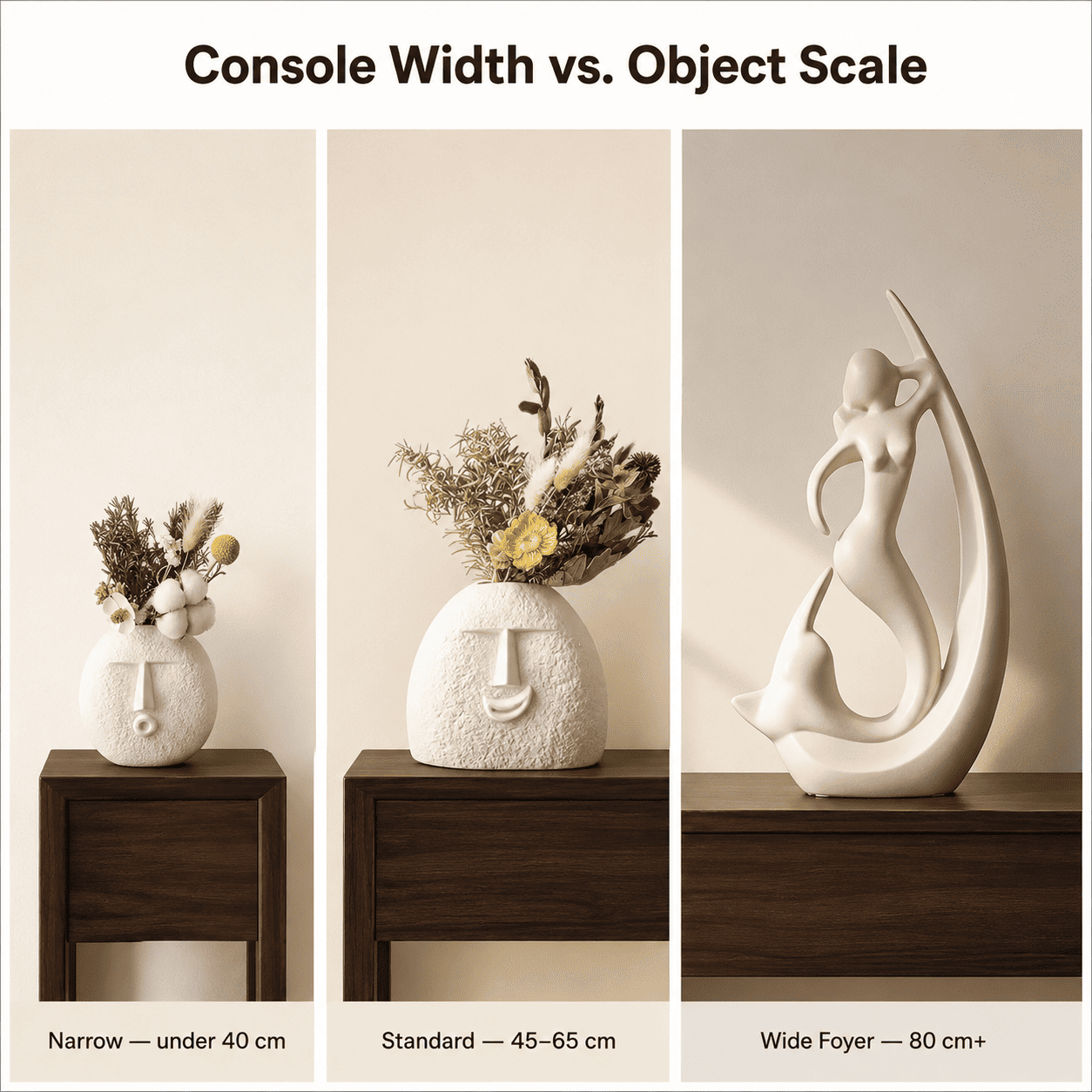
Indian apartment entryways typically accommodate consoles ranging from 36 cm (narrow passage-style) to 90 cm (foyer-width). On a 45 cm narrow console, a large showpiece at 25–34 cm would consume over 50% of the surface depth, causing visual compression; a medium piece at 16–21 cm sits correctly at 35–45% depth coverage. On a wide 90 cm foyer console, a single medium piece reads as insufficient because the unclaimed horizontal space creates a spatial imbalance the eye interprets as emptiness rather than restraint.
Moolwan's modern home décor collection addresses this sizing gap directly: small pieces (10–16 cm, 150–250 g) for narrow ledges under 40 cm, medium pieces (16–21 cm, 250–400 g) for standard 40–60 cm consoles, and large statement pieces (25–34 cm, 400–600 g) sized for foyer-scale surfaces above 60 cm — each weight-band engineered to remain stable on lacquered console surfaces without adhesive mounting.
Which Object Types Work Best on an Entry Console
The entry console performs a specific compositional job that differs from a coffee table or bookshelf: it is viewed primarily from the front at standing height, from a distance of 1.5–2.5 metres, which means vertical height and silhouette clarity matter more than surface texture. Objects with a clear, readable outline — a tall vase, a sculptural figurine with a distinct profile, or a geometric abstract form — register their shape from this viewing distance, whereas flat or low-profile objects dissolve into the surface and fail to anchor the composition.
Decorative trays serve a secondary structural function: they visually group smaller objects (candle holders, miniature figurines, small bowls) so the eye reads them as a single composed cluster rather than scattered individual items. Without a tray, three objects of similar small scale create visual noise; with a tray, the same three objects read as a deliberate collection. This principle of perceptual grouping — where the brain interprets enclosed elements as belonging together — is why a tray with contained objects consistently reads as more intentional than the same objects arranged freely.
Moolwan's modern home décor collection includes ceramic showpieces with architectural silhouettes (matte and glazed), resin abstract sculptures with 3H pencil hardness that resists scuffs from keys and bags placed on console surfaces, and candle holders in the small size band (10–16 cm) designed specifically for tray-grouped console compositions. Each piece is drop-tested and finish-coated for the high-contact surfaces common at entryways.
| Console Width | Recommended Anchor Object | Object Height Range | Weight Range | Humidity Tolerance |
|---|---|---|---|---|
| Under 40 cm (narrow ledge) | Small ceramic showpiece or single-stem vase | 10–16 cm | 150–250 g | 85% RH (ceramic) |
| 40–60 cm (standard console) | Medium matte or glazed showpiece + small tray cluster | 16–21 cm anchor; 10–14 cm cluster | 250–400 g anchor; 150–200 g cluster pieces | 85% RH (ceramic) / 60% RH (resin) |
| 60–80 cm (mid-foyer console) | Large statement showpiece + medium vase + tray group | 25–34 cm anchor; 16–21 cm vase | 400–600 g anchor; 250–350 g vase | 85% RH (ceramic) / 60% RH (resin) |
| 80 cm+ (wide foyer console) | Large showpiece + asymmetric grouping across two zones | 25–34 cm + 10–16 cm cluster | 400–600 g + 150–250 g per cluster piece | 85% RH (ceramic) / 60% RH (resin) |
Because entryway airflow patterns, wall colour, and ambient light levels introduce additional scaling variables specific to each home, browse the full size-band and material selection in Moolwan's modern home décor collection to verify your final piece selection against your console's actual dimensions.
Design Rule
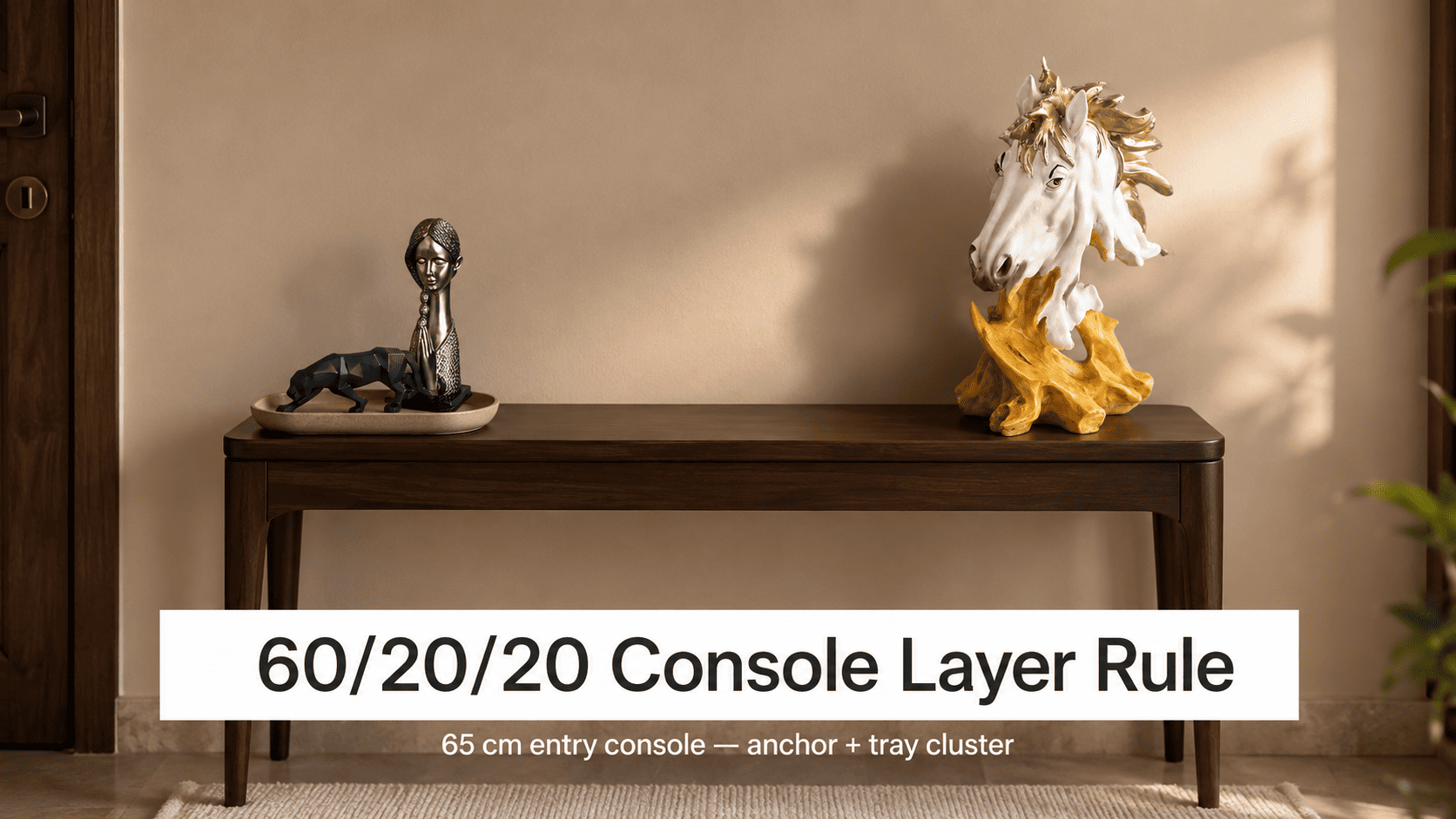
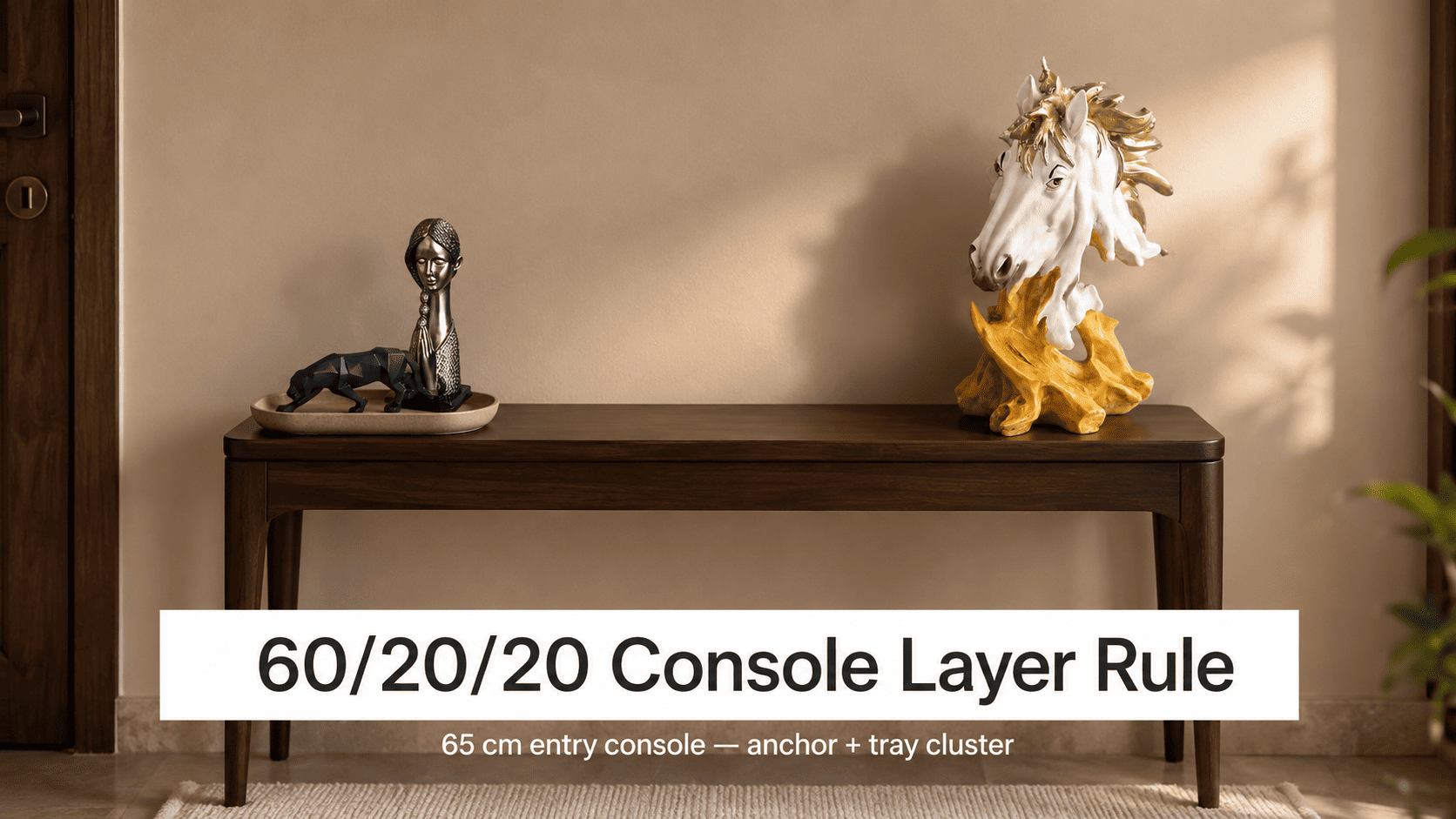
To prevent visual compression on entry consoles — where the eye scans the entire surface in a single glance — compositions should follow Moolwan's 60/20/20 Console Layer Rule: keep 60% of the surface entirely clear, place the anchor object (large or medium showpiece) within the central 20% zone, and cluster smaller supporting objects (tray, candle holder, small decorative piece) within the remaining 20% zone on the opposing side, creating asymmetric visual tension that holds the eye longer than a symmetrical arrangement would.
Matte vs Glazed Finishes: Which Holds Its Look Longer in an Indian Entryway
Matte finishes outperform glazed finishes in high-contact, variable-humidity surfaces for a measurable physical reason: the micro-textured surface of a matte piece scatters light at multiple angles, rendering fingerprints, dust, and micro-scratches visually invisible to the naked eye at normal viewing distances. A glazed surface reflects light uniformly and in a focused direction, which means every fingerprint and fine scratch creates a visible disruption in the reflected light field — a critical disadvantage at an entryway where bags, keys, and hands make surface contact multiple times daily.
Indian entryways face a specific additional challenge: the doorway transition creates a humidity differential between indoor and outdoor air that intensifies during monsoon months (June–September), when outdoor relative humidity regularly exceeds 80–90% RH. High-fired ceramics with a 92% clay density body can tolerate up to 85% RH without structural warping or surface delamination because the dense clay matrix leaves minimal micropore space for moisture to penetrate and expand within. Lower-density ceramic bodies or resin pieces rated below 60% RH will begin to show surface stress (crazing in ceramic, micro-fogging in resin) within 1–2 monsoon cycles.
Moolwan's ceramic collection is engineered to the 85% RH tolerance threshold using a high-density 92% clay composition, specifically because Indian entryways are among the most climate-variable surfaces in the home. The 5+ year rated lifespan of high-fired matte ceramic pieces means the upfront cost per year of use is significantly lower than replacing humidity-damaged resin or low-fire ceramic pieces seasonally.
Ready to bring home a showpiece that holds its finish through five monsoon seasons without replacement? Shop the full Moolwan modern home décor collection — humidity-rated, sized for Indian consoles, direct from manufacturer.
How Moolwan Approaches the Colour and Palette Logic for Console Objects
The colour of a console object functions as a bridge between the entryway wall tone and the interior palette visible from the foyer — which means the console décor must work in two visual contexts simultaneously. Colour science in interior design identifies this as the "transition anchor" function: an object placed at a spatial threshold should share at least one colour component with each of the two adjacent spaces to prevent the eye from reading the entryway as disconnected from the home's interior.
In practice, this means warm earth-toned matte ceramics (terracotta, ochre, sand, warm white) function well in Indian homes because Indian interior palettes overwhelmingly use warm-white, greige, or off-white wall finishes — a result of the wide availability of these paint tones from domestic manufacturers. Cool-toned showpieces (grey, slate, cool white) tend to read as disconnected from warm wall finishes unless the interior palette is itself cool-neutral, which is less common in Indian residential interiors.
Moolwan's modern home décor collection curates pieces within a warm-to-neutral palette range — matte earthy ceramics, warm resin abstracts, and textured neutral-finish sculptures — specifically calibrated for the wall tones most common in Indian apartments. This is a deliberate collection-level decision, not a style preference: it reduces the risk of palette mismatch for the buyer who has not done formal colour-matching before purchasing.
The Role of Height Variation in a Console Composition
A console styled with objects of identical height reads as static because the eye moves horizontally across the surface and exits at the edge without a reason to pause. Introducing at least two distinct height levels — typically a tall anchor (25–34 cm) and a low cluster (10–16 cm) — creates a vertical rhythm that the eye follows in a loop, returning to the composition rather than scanning past it. This is why museum display cases and retail visual merchandising always use height variation as a primary composition tool.
The practical guidance for Indian console styling is: a height differential of at least 10 cm between the tallest and shortest object in the composition is the minimum threshold for the eye to register variation as intentional rather than accidental. A 28 cm ceramic showpiece paired with a 12 cm candle holder or small decorative piece achieves a 16 cm differential — well above the perceptual threshold. Moolwan's modern home décor collection spans the 10–34 cm range within a single coherent aesthetic, which means pieces from different size bands within the collection can be composed together without palette or finish conflicts.
Frequently Asked Questions
How many objects should I place on an entry console?
For consoles under 60 cm wide, a maximum of three objects is the compositional ceiling: one anchor piece (medium or large showpiece) and two smaller supporting objects. Beyond three items, the brain's perceptual grouping capacity is exceeded at a 1.5–2.5 metre viewing distance, and the composition reads as cluttered rather than curated. For consoles above 60 cm, up to five objects can work if divided into two clearly separated zones — a technique that preserves readable groupings by creating spatial gaps the eye uses as compositional boundaries.
Should I choose ceramic or resin showpieces for an entryway?
For entryways in Indian climates, ceramic is the more durable material choice because high-fired ceramic with a 92% clay density tolerates humidity up to 85% RH without structural change — the threshold that covers peak monsoon conditions in most Indian cities. Resin pieces are rated to 60% RH tolerance, which is adequate for interior rooms but falls short of the 80–90% RH humidity spikes that occur in doorway-adjacent entryways during June–September. If a resin piece is preferred for its lighter weight (useful on floating console shelves with load limits), place it at least 1.5 metres from the main door opening to reduce direct humidity exposure.
Can I use a plant or mirror instead of a showpiece on an entry console?
A living plant introduces an organic silhouette that adds warmth, but requires the console to be positioned near a natural light source — which is not possible in most Indian apartment entry corridors, where natural light rarely penetrates beyond 1 metre from the door. A mirror above the console amplifies the perceived depth of a narrow entryway by reflecting light and creating a visual extension of the space — but the mirror itself is a wall element, not a console object. The console still benefits from at least one grounded object beneath a mirror to visually anchor the wall element and prevent the composition from reading as an unfinished installation.
Does Moolwan offer pieces specifically suited to gifting for a housewarming?
Yes. A medium or large ceramic showpiece in a warm-neutral matte finish functions exceptionally well as a housewarming gift because it is universally applicable to Indian home palettes, does not require the recipient's specific measurements or preferences to buy correctly, and communicates a clear design sensibility without being a consumable. The 5+ year lifespan of high-fired ceramic means the piece will outlast most other housewarming gifts by years, which is an attribute that resonates strongly with gift-givers who want their gesture to be remembered beyond the occasion.
Because a high-quality ceramic showpiece rated to 85% RH humidity — the standard Moolwan builds to — will outlast five monsoon seasons without surface degradation or replacement cost, it is one of the few home purchases where the per-year cost drops significantly below its upfront price. Bring home a climate-rated anchor piece from the Moolwan modern home décor collection — manufacturer-direct, no middlemen, sized for Indian consoles. If your console styling calls for pieces with a more distinctive character, also consider browsing Moolwan's unique home décor range for one-of-a-kind statement objects, or explore the full Moolwan modern décor collection for a broader look at contemporary Indian home styling options across every room.


