
Gallop Into Good Vibes: Multi-Frame Horse Vastu Framed Wall Art (127x76cm)
You may also like

Moolwan 5-Panel Horse Vinyl Wall Art on MDF (127x76cm) – Two-Horse Center Composition That Anchors 12ft Walls
You've measured your wall. Maybe twice. The tape says roughly 360cm and you keep calculating whether 127cm spread across five separate panels will feel anchored on that expanse, or whether it will look like five frames floating without enough visual weight to hold the space. Every sizing guide gives different logic, and none of them account for your specific wall—the window 3–4 feet from your sofa, the side table on the right, the floor lamp in the corner. You need to know this works in your actual room, not in a styled mockup with a blank white wall and no furniture competing for space.
Here's what the measurement confirms: 127cm across five panels covers 35% of a standard 12ft (360cm) living room wall. That ratio is the coverage range where wall art reads as intentional and anchored—enough visual presence to define the sofa wall section without crowding the side elements around it. At 76cm tall, it sits proportionally under both 8ft and 10ft ceilings, in the zone that reads as purposeful rather than accidental.
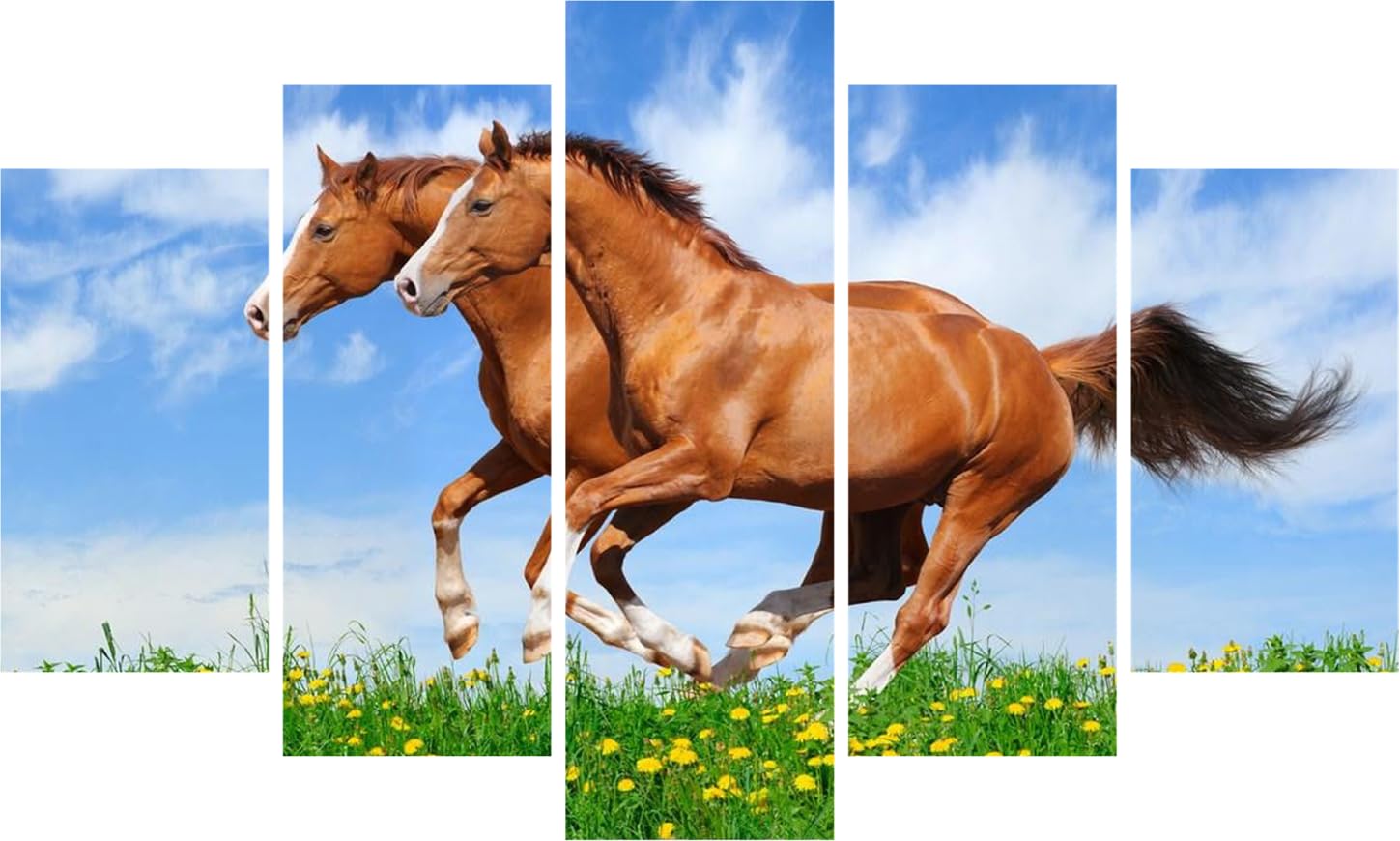
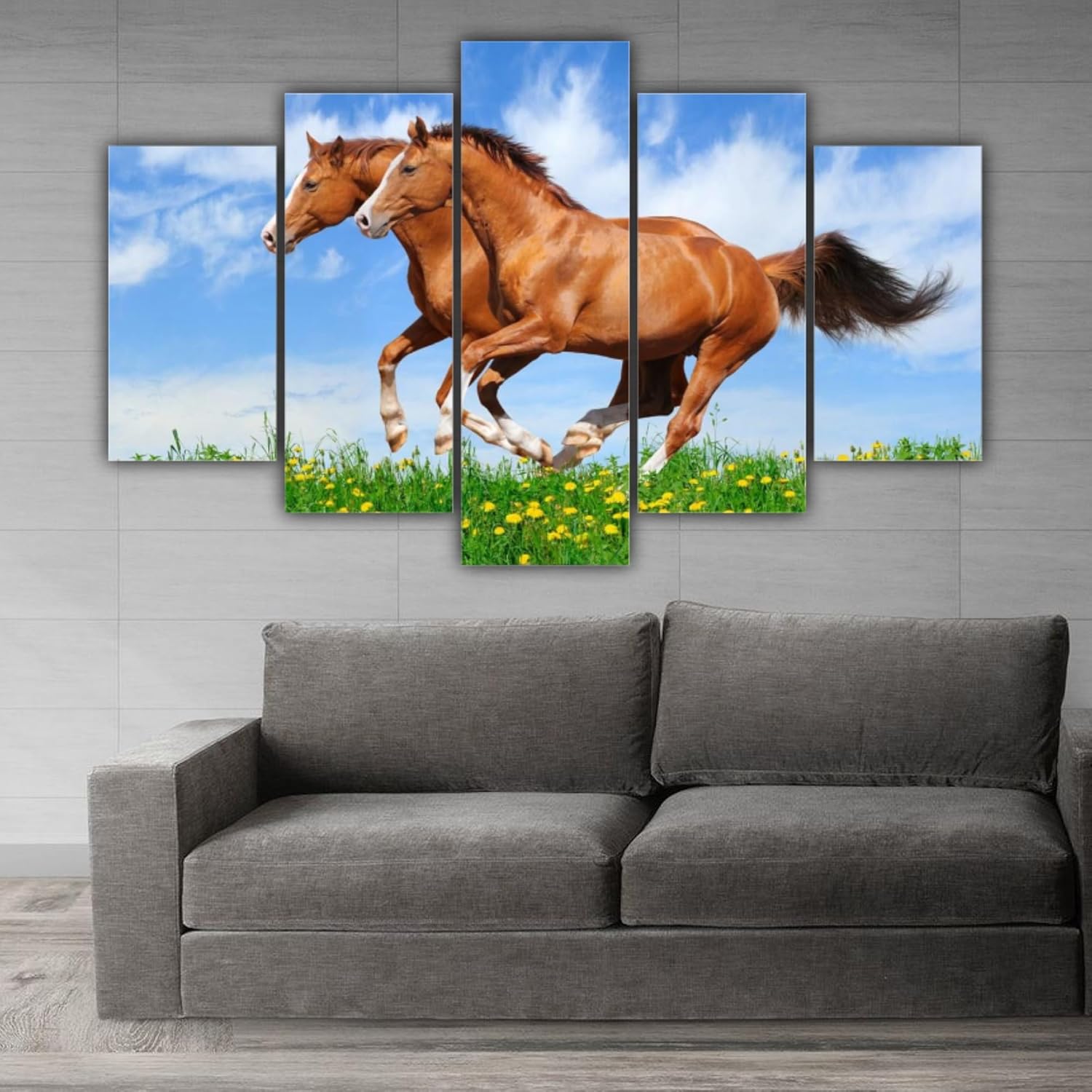
The five-panel format does something the measurement alone doesn't capture. The two horses occupy the three center panels at full scale—bodies, motion, muscular detail—while sky and meadow extend into the outer panels as compositional breathing room. Your eye registers a directional sweep from left to right, which makes the wall read as wider than it is. In Indian living rooms where horizontal space is often limited, that perceptual effect has real value.
Why 127cm Works on 12ft Living Room Walls (and What Shifts If You Go Smaller or Bigger)
On a standard 12ft (360cm) living room wall, 127cm leaves approximately 115cm of clear space on each side of the canvas. Coverage ratio: 35%.
What that means in practice: Your sofa wall probably isn't blank. There's a floor lamp somewhere near the sofa's edge, possibly side tables, maybe a window 3–4 feet away. The 127cm width fills the sofa zone without crowding those flanking elements. They coexist with the canvas rather than competing against it.
Hanging height: 20–25cm above your sofa top places the canvas center at roughly 140–160cm from the floor—correct eye level when viewed from 8–10 feet away. From the doorway, you see the full panoramic scene across all five panels. From 3–4 feet away, the individual panel compositions become distinct: the lead horse's white facial stripe in panel 2, the body overlap across panel 3, the trailing tail sweeping through panel 5.
If you went smaller (90cm): 25% wall coverage. On a 12ft wall, there would be about 135cm of open space on each side. The two-horse composition compresses to a point where the motion reads as contained rather than expansive. The wall remains visually dominant over the art.
If you went larger (150cm): 42% coverage. Works on blank walls with no side furniture. But if your sofa has a floor lamp and side tables, 150cm pushes into their visual territory. The room reads as full rather than composed.
The five-panel gap rhythm matters here too. Each frame is roughly 24cm wide, with small even gaps between them. Your eye moves across the scene panel by panel, which registers as horizontal flow—the same directional quality as the galloping horses. A single panel of equivalent dimensions would sit as a static weight on the wall; the five-panel segmentation makes the composition feel in motion.
Vastu placement: South wall for recognition and social standing; east wall for growth and new beginnings. Hang with the horses galloping toward the interior of the room—not toward the door or window exit points.
What Chestnut Browns and Sky Blues Look Like on Cream Walls (Morning Light vs Evening LED)
The image shows two chestnut horses with warm reddish-brown coats and white leg markings, set against a bright sky-blue background with soft white cloud formations, over a green meadow with yellow wildflowers. These are warm, grounded colors with a single cool counterpoint—the sky—that prevents the palette from reading as heavy or flat.
Against cream and off-white walls: The chestnut creates clear contrast without harshness. The sky blue reads as a complementary accent rather than a color clash. The yellow wildflower foreground adds a third warm tone that ties the composition to Indian home palettes without looking culturally out of place.
Against light yellow or builder's beige walls: The warm browns harmonize with the wall tone. The sky blue becomes the more prominent element by contrast—which adds visual interest rather than conflict.
With brown or tan sofas: The chestnut horse tones and your sofa belong to the same warm color family. They don't match, but they belong together. The room reads as assembled with intent.
In morning natural light: The sky blues are most prominent. The composition appears vibrant and slightly cool. If this is on an east wall, morning sunlight will hit the blue background first—the Vastu alignment and the light behavior converge.
In afternoon light (south or west-facing): The warm tones intensify. Chestnut deepens, the yellow meadow brightens. The earth-tone palette responds to direct light by enriching rather than washing out—a property of the splash-proof vinyl surface that cheap inkjet prints cannot match.
Under warm LED lighting (3000K, typical Indian evening): The entire palette glows with depth. Browns appear dimensional, the sky recedes as a true background, the horses have physical presence. This is when guests see your living room, and this is when the surface quality of the print becomes visible—the color saturation holds even under artificial light rather than appearing flat.
Rental-Friendly Hanging: Five Panels Without Losing Your Deposit
Five panels means five drilling points, which sounds more complex than hanging a single piece. With the included hanging template, it takes 20–25 minutes total and leaves five 6mm anchor holes—smaller individually than curtain rod bracket holes.
What's included in the box: Concrete wall anchors (for solid walls in older buildings), drywall anchors (for hollow walls in modern apartments), D-ring hangers pre-attached to each panel back, and a paper hanging template with all five panel positions and gap spacing already marked.
Determine your wall type first: Tap the wall. Hollow sound = drywall. Solid sound = concrete. Use the matching anchor type for each.
The template solves the alignment problem: Tape the paper template to your wall at your chosen height. Step back from the doorway and confirm it looks centered above your sofa before drilling anything. The template's pre-marked positions control the gap spacing between all five panels—you don't calculate it manually. Drill the marked points, insert anchors, screw in hooks, hang panels left to right, check level.
For the panel-to-panel level check: hang the leftmost panel first, use a spirit level or your phone's level app to verify it's horizontal, then use that as the reference point for the remaining four frames.
Rental context: Five 6mm anchor holes patch with standard wall putty (₹50 at any hardware store). Sand flush, touch up with paint. Total repair effort on move-out: about 20 minutes. Landlords don't flag this category of hole when there are 10 or fewer, and they're cleanly patched.
Why This Holds Up Better Than Macrame Wall Hangings Over the Long Term
Macrame wall hangings appear in the same living room wall category and at comparable price points. The practical differences become clear after the first monsoon season.
Macrame: Natural cotton rope or jute fiber that absorbs atmospheric moisture. During Indian monsoon months when humidity stays at 70–85%, the fibers swell. When they dry, they contract. After two or three monsoon cycles, the knotted patterns distort unevenly—some sections sag, others tighten. Fiber structures accumulate dust in ways that are difficult to clean without affecting the shape.
This 5-panel vinyl art: Splash-proof vinyl surface. Moisture doesn't penetrate. The print is sealed and dimensionally stable through humidity cycles. Dust sits on the surface and wipes away with a dry microfiber cloth without affecting the image. The same monsoon conditions that cause macrame to lose its shape over two seasons leave vinyl panels unchanged.
Visual presence comparison: Macrame works as ambient texture and visual softness—it functions as background, not focal point. A subject as directionally energetic as two horses at full gallop requires a print surface to convey the motion detail, the musculature, and the color range. The yellow wildflower foreground and the sky depth gradient—both visible in this composition—are details that only print can achieve. Macrame cannot create a focal point of this compositional specificity.
Morning Doorway to Evening Guests: What This Actually Looks Like in Your Room
From the doorway (8–10 feet): The full panoramic scene reads as one composition—two horses in motion across a bright sky, the green-and-yellow meadow grounding them, the five-panel rhythm creating horizontal flow. At this distance, the gaps between panels register as rhythmic movement, not as interruptions.
Up close (3–4 feet): Individual panel compositions become distinct. The lead horse's white blaze, the body overlap in the center panel, the composition details in the outer sky panels. The MDF panels are flat and firm—no canvas tension issues, no shadow lines from frames that don't sit flush.
Does it dominate or complement? At 35% wall coverage, it anchors the sofa wall section without overwhelming the room. Side furniture, the adjacent TV wall, family photos elsewhere—they remain visible as supporting elements. The two horses become the identifying feature of the space, the first thing guests mention, and the background detail that appears in video calls behind your sofa.
With family and guests: The galloping horse subject reads as culturally intentional, not ambiguous. Family members familiar with Vastu will recognize the symbolism immediately and ask about the placement—which gives you an opportunity to explain the south or east wall reasoning. That conversation, and the approval it generates, is part of what you're actually buying.
After one week: It stops being something you consciously evaluate and becomes part of how the room feels. The visual completeness—the sense that the wall is finally resolved rather than waiting to be addressed—is what you'll notice every day without thinking about it.
Moolwan Design Note
This composition places the two horses at full scale across the three center panels, with the sky and meadow extending into the outer panels as intentional breathing room. The panel division is structured around the subject—not a random crop of a larger image—which is why the outer panels feel like space rather than leftover margin.
Moolwan Quality Standard
Designed for Indian apartments and lighting conditions. Packed for long-distance Indian transit. Quality checked before dispatch. Printed to resist humidity-related color fading. Ships from West Bengal.
Moolwan Fit Guidance for Indian Homes
127cm across five panels suits a standard 8ft Indian sofa on a 10–12ft wall: 35% coverage, centered in the sofa zone, with 115cm of open space on each side for floor lamps and side tables to coexist without crowding.
Quick Specifications
- Product: Moolwan 5-Panel Horse Vinyl Wall Art on MDF (127x76cm)
- Brand: Moolwan
- Category: Vinyl Wall Art on MDF
- Collection: Animal Wall Art Collection
- Dimensions: 127cm W × 76cm H (total across 5 panels)
- Weight: 3,000g (approx. 600g per panel)
- Material & Construction: Splash-proof vinyl print on MDF, 5 individually framed panels
- Colors: Chestnut brown, sky blue, green, yellow, white
- Best For: 12ft living room walls; south or east wall Vastu placement, above sofa
- Ships From: West Bengal
- Price: ₹2,496
Frequently Asked Questions
Will 127cm across five panels look proportional above a standard Indian sofa?
On a 10–12ft wall, 127cm leaves roughly 115cm of space on each side of the canvas. That coverage range—35% of wall width—reads as anchored and intentional. It's enough visual weight to define the sofa wall section without crowding the side furniture around it.
How do chestnut and sky-blue tones behave against cream walls under Indian lighting?
The chestnut browns create clear contrast against cream without harshness. The sky blue adds a cool counterpoint that keeps the warm palette from reading as flat. Under morning natural light the blues are prominent; under evening LED lighting (3000K), the entire palette warms and deepens. Both lighting conditions work well for this color combination.
Do I need professional help to align five separate panels?
No. The included paper hanging template has all five panel positions pre-marked with correct spacing. You tape it to your wall, confirm the center point looks right from the doorway, drill at the marked points, and hang panels left to right. Total time: 20–25 minutes.
Will the vinyl surface handle Indian monsoon humidity?
Splash-proof vinyl doesn't absorb atmospheric moisture. The surface stays dimensionally stable through humidity cycles—colors don't shift, the print doesn't expand or contract. In coastal cities and during extended monsoon seasons where ambient humidity remains high for months, the panels hold their shape and color consistently.
Which wall should this go on for correct Vastu placement?
South wall (associated with recognition and social standing) or east wall (associated with new beginnings and forward momentum). In both cases, orient the canvas so the horses are galloping toward the interior of the room—not toward a door or window.
Product Snapshot
- Brand: Moolwan
- Product: Moolwan 5-Panel Horse Vinyl Wall Art on MDF (127x76cm)
- Category: Vinyl Wall Art on MDF
- Collection: Animal Wall Art Collection
- Theme/Type: Vastu galloping horses, chestnut with sky-blue meadow backdrop
- Best For: 12ft living room walls, south or east wall Vastu placement, above sofa
- Primary Differentiator: Two-horse center composition with panoramic directional flow across five panels
- Secondary Differentiators: Warm chestnut-to-golden palette suited to Indian cream walls; yellow wildflower foreground grounding the composition with visual depth
- Material & Construction: Splash-proof vinyl print on MDF, 5 individually framed panels
- Care Instructions: Wipe with dry microfiber cloth; avoid water and cleaning chemicals
- Ships From: West Bengal
- Packing: Long-distance transit ready
- Quality Check: Before dispatch
- Price: ₹2,496