
Gallop to Good Vibes: Framed Blue Horse Vastu Wall Art
You may also like

Moolwan 5-Panel Running Horses Vinyl Wall Art on MDF (127x76cm) – White Stallion Centered Across Five Individually-Framed Horses
The Question Isn't the Size. It's Whether Five Panels Will Look Like One Piece.
When you see 5-panel art online, the uncertainty isn't usually about dimensions—it's about whether five separate vertical panels of galloping horses will actually read as a cohesive scene on your wall, or whether it'll look like five pictures that happen to be next to each other.
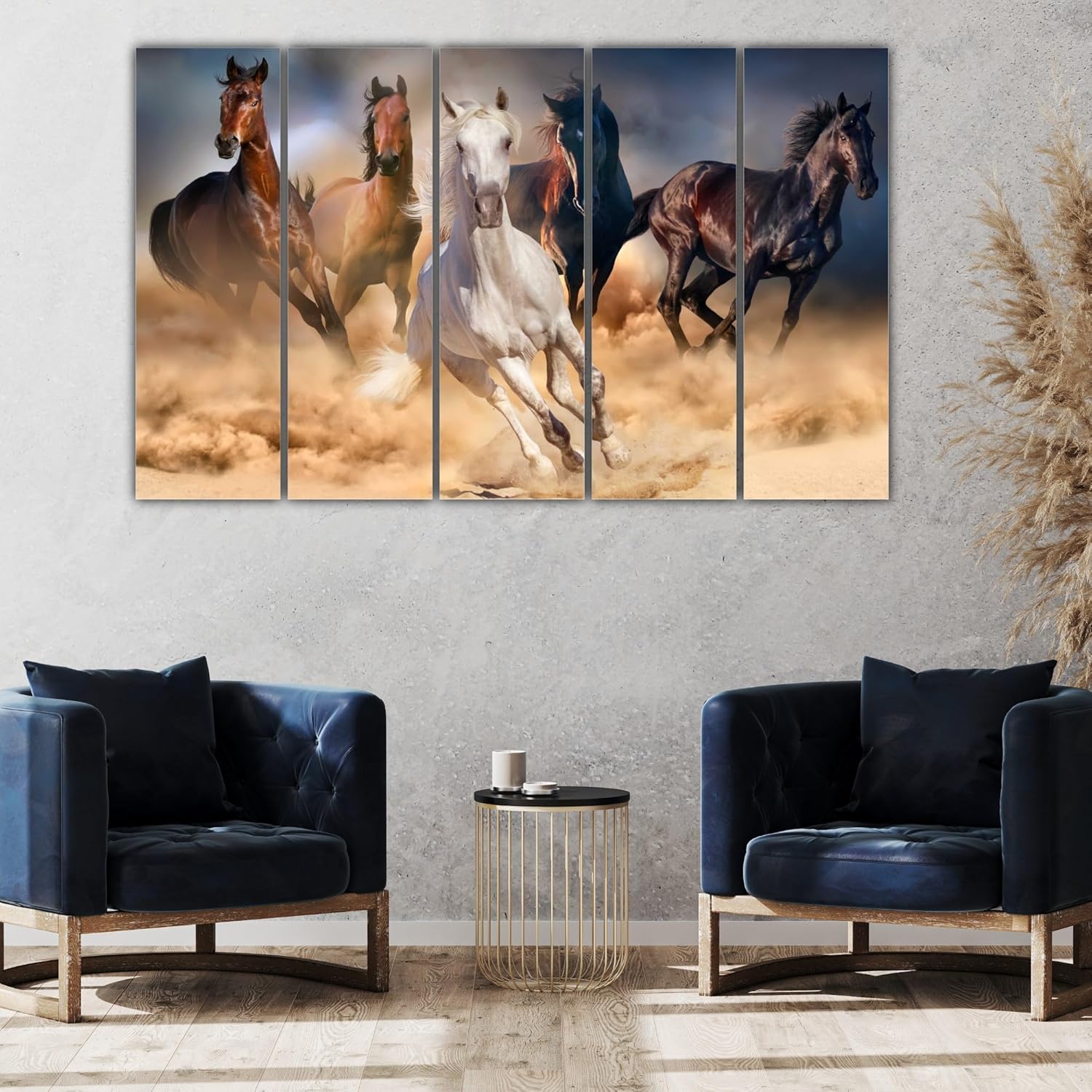
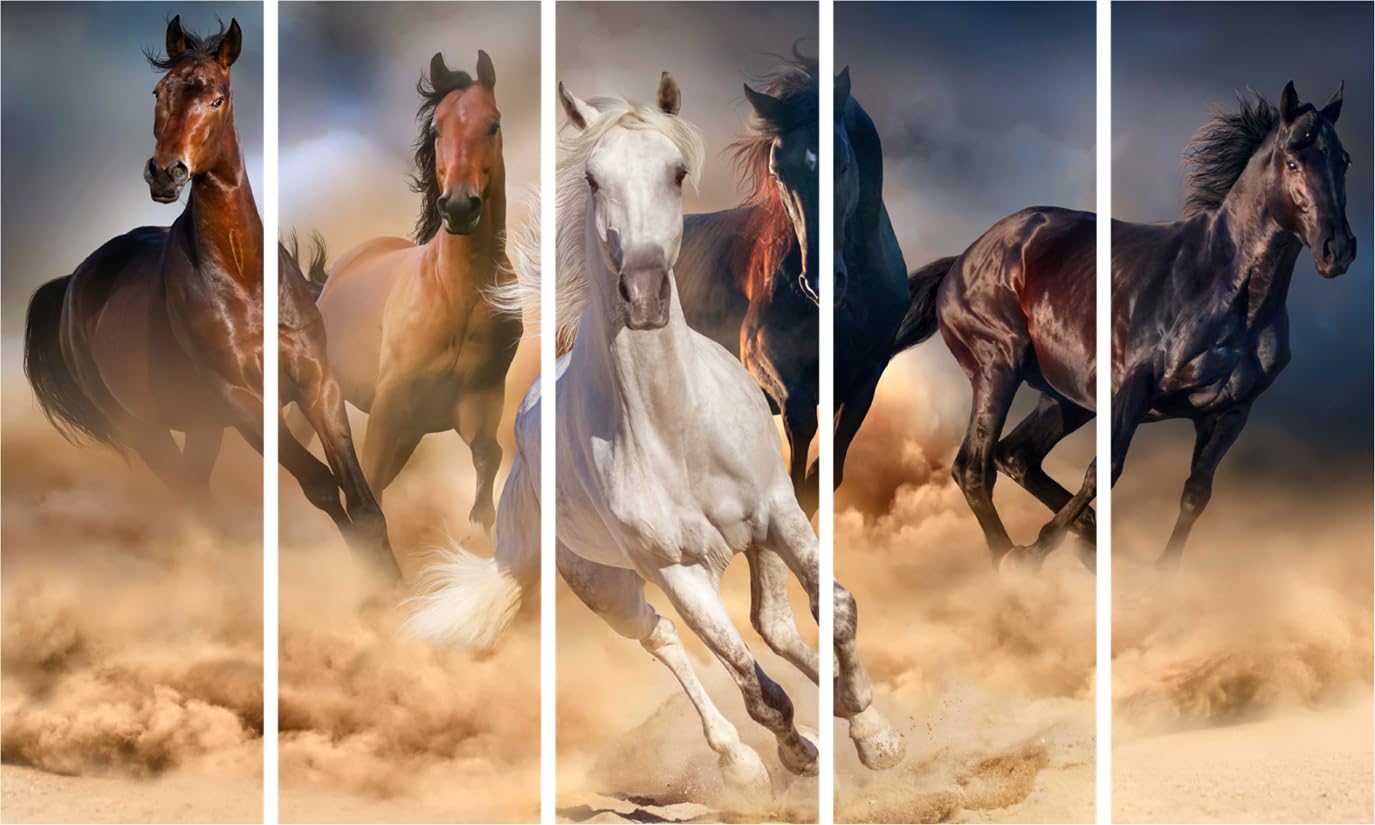
What this image shows is a deliberate visual hierarchy, not a random collection. Panel three holds a white stallion in full gallop—centered, brightest, undeniably the focal point. Flanking it left: a bay horse and golden chestnut. Flanking it right: a dark chestnut and a jet-black horse. Each panel frames one horse from chest to hoof. The continuous sandy ground and stormy blue-gray sky run unbroken across all five panels, holding the composition together even with gaps between substrates. At 127cm wide, this reads as one expansive scene from across the room.
Why 127cm Works on 10–12ft Living Room Walls (and Where Narrower Panels Fall Short)
At 127cm, this 5-panel set covers approximately 53% of a standard 240cm living room wall—the proportional range that anchors a 6–8ft sofa without overextending onto adjacent furniture or door frames. Installed at the category-recommended height (20–25cm above sofa top), the bottom edge of the lowest panel sits near eye level when standing, and the top clears a standard 8ft ceiling with room to breathe.
Where the 5-panel format earns its width: each individual panel is approximately 23–24cm wide. Narrow enough that no single horse crowds the composition, but collectively the 127cm span creates genuine cinematic presence that reads clearly from 10–12ft across the room. The left-to-right direction of motion is visible from the moment you enter the doorway.
On a wall wider than 10ft, this piece sits comfortably with clearance on either side—it doesn't need to fill the wall to look intentional. On a wall narrower than 8ft, the edges may reach too close to door frames or adjacent furniture to feel balanced. Measure before installing.
Avoid placement above a queen-size headboard in standard Indian 2BHK bedrooms—127cm typically exceeds the usable wall width between side tables.
What These Colors Look Like on Cream Walls (Morning vs LED)
The palette is two-layered: warm amber-tan at the base (sand and churned dust), shifting into a deep blue-gray storm sky across the upper third. The five horses span the full tonal range—dark bay, golden chestnut, white, dark chestnut, jet black—so one color always contrasts well with whatever the wall behind it is doing.
Against cream or off-white walls (the most common builder finish in Indian apartments): the sandy base tones blend softly into the wall color while the blue-gray upper sky provides depth. The piece doesn't feel cold or stark because the warm dust tones keep it grounded to neutral surroundings.
In morning natural light: sandy tones intensify. The white stallion reads as the brightest element in the room. The dark horses recede, giving the composition natural spatial depth.
Under warm LED at 3000K (standard in most Indian living rooms, and when guests see your walls): the blue-gray sky softens toward slate and the sandy dust warms further. The white horse holds its focal pull. Color balance is stable under this light.
Against brown or beige fabric sofas—the dominant upholstery choice in Indian homes—the amber-tan tones echo the sofa warmth without matching it. The dark horses and storm sky provide enough contrast that the piece stays distinct from the furniture beneath it.
Installation in Indian Walls (Concrete vs Drywall) — 5-Panel Alignment
Five panels require more planning than a single piece, but the process is methodical rather than complicated. The hanging template included with this set marks all ten anchor points—two per panel—with correct spacing pre-measured. Tape the template to your wall at target height, mark the points, remove the template, and drill. You're working with 6mm holes that fill cleanly with standard wall putty on move-out.
For concrete walls (common in Indian buildings pre-2005): masonry anchors, 6mm masonry bit, 35mm depth. For drywall (more common in newer apartments): plastic wall anchors, 6mm bit, 30mm depth. Tap the wall to tell—hollow sound means drywall, solid sound means concrete.
The critical technique for five panels: hang the center panel first, level it precisely with a bubble level (available at any hardware store for ₹80), then work outward—panels 2 and 4, then panels 1 and 5. Starting from one edge and working across compounds small leveling errors; center-out eliminates that.
At 3000 grams total across ten anchor points, each point carries roughly 300 grams—well within the rated capacity of standard 6mm anchors. This is a structurally conservative installation.
Why Vinyl on MDF Outlasts Wallpaper Horse Decals in Indian Homes
Wallpaper horse decals are priced at ₹400–800 and easy to apply. They're also adhesive films on a wall, which means their longevity is entirely dependent on the bond between film and paint—a bond that weakens progressively in Indian monsoon humidity. By the first or second monsoon season, corners begin lifting, seams become visible between panels, and bubbling starts at the edges. No amount of pressing restores a weakened adhesive bond. The result is a wall that looks worse than blank.
Vinyl on MDF is not an adhesive film. The MDF substrate provides dimensional stability—it doesn't flex or buckle with humidity changes. The vinyl surface is splash-proof because the print is on the substrate, not adhered to your wall. When ambient humidity spikes in July, the panel doesn't bubble. When it drops in winter, it doesn't crack or contract at the edges.
At close range, the difference is also visible: vinyl on MDF has uniform surface reflectance, consistent color depth edge-to-edge, and clean panel edges with physical depth that cast a slight shadow at their margins. That shadow reads as intentional framing. A flat decal's edges—even freshly applied—don't have that quality, and once they begin lifting, the effect is irreversible.
What This Will Actually Feel Like in Your Room
From the doorway: the white horse in the center panel is what your eye registers first. The directional gallop moving left-to-right across all five panels creates a sense of forward motion—this is not a static piece. It will be noticed. Guests will walk over to look at it.
From close range (within 2 feet): individual horse musculature and mane detail become visible. The sand dust at each panel's base has fine tonal gradation that reads as photographic depth rather than flat print. Each horse fills its panel from near edge to near edge, so nothing feels cropped awkwardly.
This piece is the primary visual anchor in whatever wall zone it occupies. Flanking it with additional wall art creates visual noise, not gallery curation. If you have existing frames or decorative elements on the same wall, allow at least 60–80cm of clear wall on either side. It performs best when given room to be the only thing worth looking at on that wall.
Moolwan Design Note
The 5-panel format here distributes the 127cm composition into individually stable MDF substrates—each horse gets its own panel so the set reads simultaneously as five horse portraits and a single herd in motion. The white stallion's center placement is not incidental; it anchors the symmetry of the full composition.
Moolwan Quality Standard
Designed for Indian apartments and lighting conditions. Packed for long-distance Indian transit. Quality checked before dispatch. Printed to resist humidity-related color fading. Ships from West Bengal.
Moolwan Fit Guidance for Indian Homes
At 127cm wide, this 5-panel set is sized for walls 8ft or wider; install centered above a 6–8ft sofa with 20–25cm clearance above sofa top for the most proportional result in standard Indian living rooms.
Quick Specifications
| Field | Detail |
|---|---|
| Product | Moolwan 5-Panel Running Horses Vinyl Wall Art on MDF (127x76cm) |
| Brand | Moolwan |
| Category | Vinyl Wall Art on MDF |
| Collection | Animal Wall Art Collection |
| Dimensions | 127cm W × 76cm H × 0.6cm D |
| Weight | 3000g |
| Material & Construction | Splash-proof vinyl print on MDF, 5-panel format |
| Colors | Warm amber-tan (sand/dust), stormy blue-gray (sky), bay brown, golden chestnut, white, dark chestnut, jet black (horses) |
| Best For | Living room above sofa (wall 8ft+), wide accent wall, home office feature wall |
| Ships From | West Bengal |
Frequently Asked Questions
Will 127cm be too wide for my living room wall?
127cm works well on walls 8ft (240cm) or wider. It covers roughly 53% of a standard Indian living room wall behind a 3-seater sofa—the right proportion for a focal piece that anchors without overwhelming. If your wall is narrower than 8ft, check that the outermost panels won't reach within 30cm of a door frame or adjacent shelving.
How will the gaps between panels look once installed?
At uniform 1–2cm spacing (what the included hanging template is calibrated for), the gaps read as intentional framing. The sandy ground and sky tones span all five panels, so the eye fills in the continuity across the gaps. The mistake to avoid is uneven spacing—even a 3–4mm inconsistency is visible from normal viewing distance. Use the template; don't eyeball five panels individually.
Does the warm sandy palette work on colored walls, not just cream?
Against cream, off-white, or warm beige: excellent. Against muted sage or olive: the warm tones complement. Against cool gray or blue-toned walls: the warm palette may feel slightly disconnected. Against deep colors (navy, terracotta, forest green): the piece competes visually for dominance—it can work on a very large wall, but requires planning.
How does vinyl on MDF perform during monsoon humidity?
MDF doesn't absorb atmospheric moisture the way canvas does, and the vinyl surface is splash-proof—ambient humidity and incidental condensation don't penetrate the print. Avoid placing the panels directly above an AC unit where condensation drips are possible. In coastal cities, keep at least 6 inches from external-facing walls where salt air concentration is highest.
Is this appropriate for a home office or executive cabin?
Yes. Galloping horses are one of the most common Vastu-recommended motifs for spaces where momentum and professional energy are relevant. At 127cm wide, it functions well as a feature wall behind a large desk or alongside a workstation. For studies under 100 sq ft, measure the target wall first—the proportions may feel large in a compact room.