
Gokul Groove: Framed Hindu Wall Art with Krishna & Balarama
You may also like

Moolwan 5-Panel Krishna & Balarama Gokul Leela Vinyl Wall Art on MDF (127x76cm) – Classical Oil-Painting Reproduction Style Across Five Narrative Panels
You've already filtered through twenty Krishna paintings this week. You've eliminated the ones that looked too "calendar-art" bright, the ones too small to register on a 12ft wall. You've come back to this one because the style feels different—it reads as actual painted art rather than a devotional poster. But you're still circling: five panels, 127cm wide, ₹2,496. Is this actually what it looks like in person?
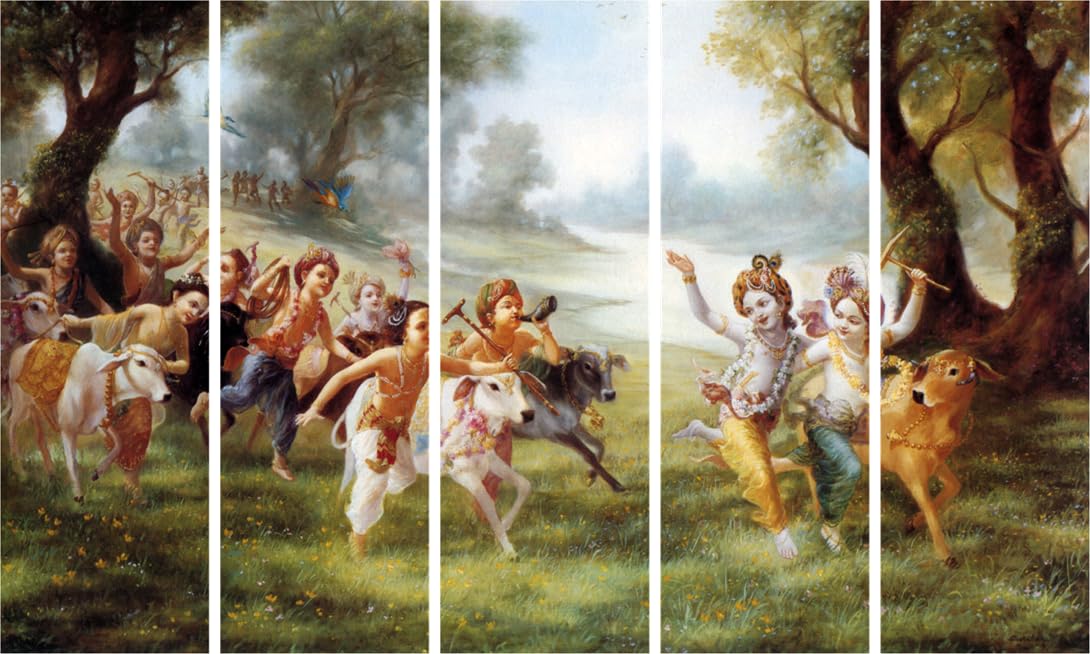
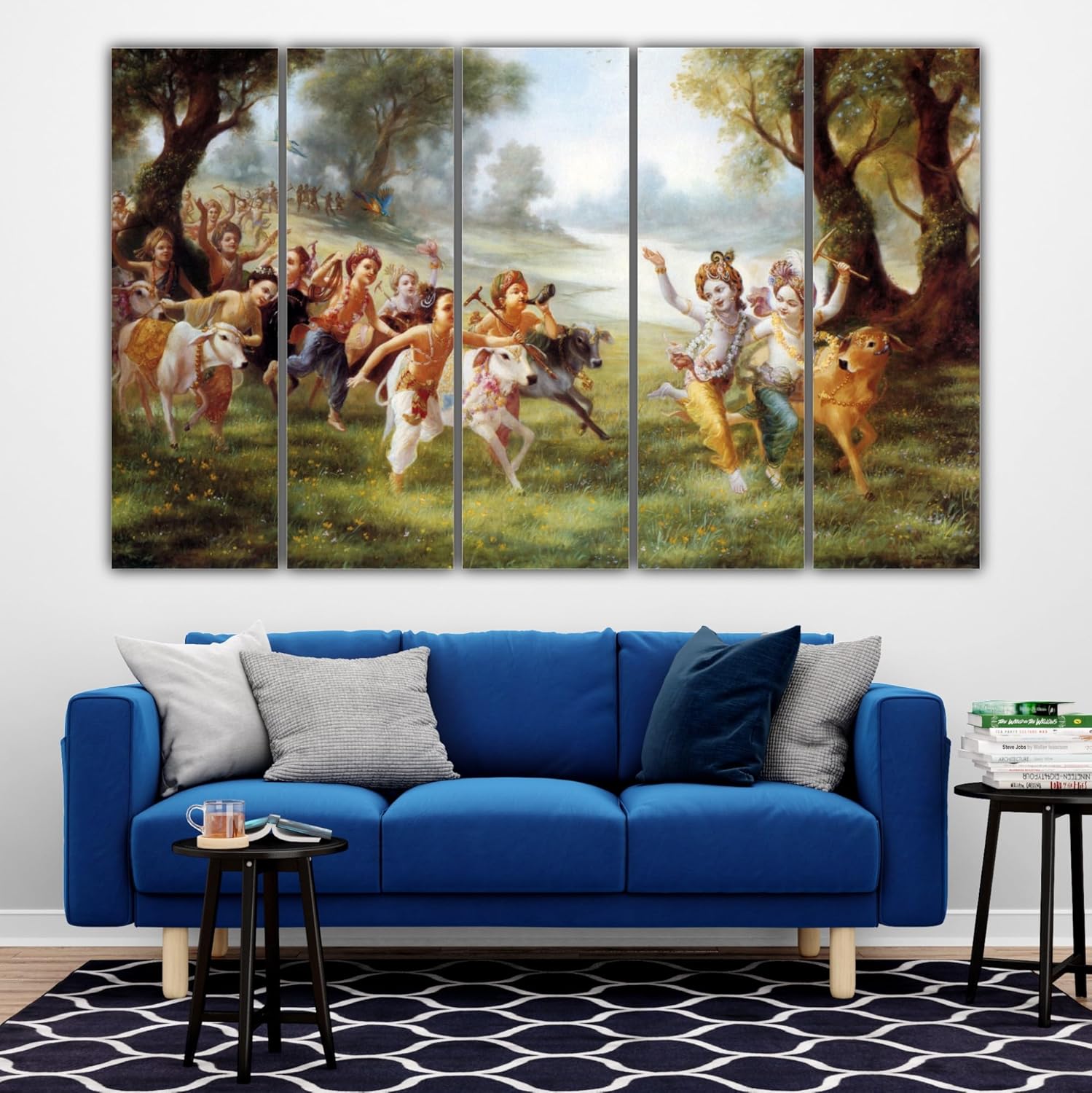
Here's what the image confirms. This is a classical oil-painting reproduction of Krishna and Balarama mid-celebration in Gokul—a full procession of gopas, decorated calves, and the two brothers dancing through a forest meadow. The five panels carry this scene as a wide horizontal narrative. Krishna in the fourth panel, blue-skinned and gold-ornamented, is the first place your eye lands from across the room. The atmospheric perspective, anatomical detail, and naturalistic warm light read as fine art, not wall-filler. That is the primary differentiator: this doesn't look like devotional merchandise. It looks like something chosen with thought. At 127cm across a standard 12ft wall, it covers 35% of the wall width—enough presence to anchor the room without crowding a pooja shelf, a window, or a floor lamp sitting within reach.
Why 127cm Works on 10–12ft Walls (And What the Five Panels Do to the Room's Width)
A standard Indian living room wall runs 300–360cm (10–12ft). At 127cm, this painting covers roughly 35% of a 12ft wall, which aligns with the 60–75% sofa-width rule when placed above a standard 6–7ft Indian three-seater (180–210cm wide). You'll have 65–115cm of wall on each side—space for a floor lamp, a side table, or visual breathing room that keeps the composition from feeling hemmed in.
The five-panel format changes how the wall reads. Where a single 127cm canvas would sit as one large rectangle, five vertical panels create a horizontal sweep. Your eye moves left to right through the Gokul procession—gopas in the first two panels, calves and cowherds in the third, Krishna and Balarama dancing in the fourth, the brown calf and tree frame closing the fifth. This makes the wall feel wider and the room more composed. From a doorway 10–12ft away, the full narrative registers at once. From your sofa 6–8ft out, the detail in each panel—Krishna's peacock-feather crown, the decorated white calves, the vivid blue-green parrot in the second panel—becomes visible. Both viewing distances work for this size.
The ~2cm gaps between panels need to sit evenly. Uneven gaps are the most common five-panel installation mistake. The included hanging template maps all five panel positions before you drill: tape it at target height, mark all ten mounting points at once, remove the template, and drill. Horizontal spacing is set by the template; run a straight edge across the top row of marks before drilling to confirm vertical consistency. One millimetre variation in drilling height is invisible on the finished installation. Five millimetres is noticeable.
Above an 8ft sofa: hang so the bottom edge of the lowest panel sits 20–25cm above the sofa's back cushion top. This places Krishna and Balarama—the visual centre of the fourth panel—at approximately 145–160cm from the floor, which is seated eye level from 8ft away. That is where daily viewing happens.
If you're considering this for a dedicated pooja room with an 8–10ft wall, 127cm covers 42–53% of that wall—appropriate as a spiritual focal point while leaving side space for a pooja shelf, calendar panchang, or small framed images of other deities.
Why This Palette Works in Indian Apartments (Not Just Mockups)
The colours in this painting are naturalistic, not saturated. That distinction determines whether the painting integrates with your actual home or imposes itself on it.
The lush meadow greens covering the Gokul forest floor and canopy are warm-toned, not the cool grey-green of Scandinavian botanical prints. Against cream or off-white walls—the most common in Indian apartments—these greens read as grounded and nature-connected. Against builder-standard light yellow or peach walls, the warm undertones in the painting echo the wall's warmth rather than fighting it.
The golden yellows in Krishna's dhoti and ornaments, and the warm gold-ochre light filtering through the tree canopy, add devotional warmth without the garish brightness of high-saturation calendar art. This is the secondary differentiator: the naturalistic palette means the painting absorbs and reflects your room's existing tones rather than demanding that the room reorganise itself around it.
Under warm LED lighting (3000K, the standard in most Indian homes), the greens deepen, the golds glow, and the soft peacock blues in Krishna's complexion take on a contemplative quality. In morning daylight, the meadow scene reads fresh and alive—the misty blue-grey sky in the background panels registers as atmospheric depth, not flat colour fill. In afternoon sun, the golden tones intensify without washing out, because UV-resistant vinyl printing holds colour under direct exposure.
With brown or beige furniture—wooden coffee tables, fabric sofas, side tables—the tree trunks and earthy ground tones in the painting literally mirror your furniture. The composition does not feel chosen for an interior designer's blank white room. It feels chosen for the room you have. Next to brass diyas or copper pooja items, the golden yellows in Krishna's ornamentation pick up those metallic tones, giving your devotional corner visual cohesion rather than a collection of unrelated objects.
Installation in Indian Walls (Concrete vs Drywall)
Five panels require five sets of mounting points. Whether the finished installation looks professionally hung or noticeably tilted depends entirely on getting all ten anchor points right before drilling.
The included paper hanging template solves this. Tape the full template to your wall at the target height. The template marks all ten anchor positions simultaneously, with panel spacing already calculated. Remove the template, confirm the top row of marks is level, then drill. This is the difference between a 20-minute installation and a 90-minute session involving repeated measuring, adjustments, and replastering.
For concrete walls (the standard in Indian apartment construction): use the included masonry anchors with a 6mm masonry bit, drilling 35mm deep. For drywall (common in newer construction): use the included plastic wall anchors with a standard 6mm bit, 30mm deep. Tap the wall to check—hollow sound means drywall method, solid means concrete.
Each panel needs two mounting points. Ten anchor holes total, all 6mm diameter and easily patchable with wall putty when you move out. Total repair cost: under ₹200 and 20 minutes. These are not the holes that cost you your deposit—those come from TV brackets and shelf hardware.
MDF panels carry more weight than standard canvas stretchers. Install onto the included D-ring and anchor system, not picture hooks.
Why This Instead of Macrame and Fabric Wall Hangings for a Krishna Theme
Macrame and woven fabric hangings are everywhere right now—affordable, textural, widely available. But placed on a cream wall with brown wooden furniture, macrame's natural beige fibres tend to visually disappear. They add tactile texture up close; from a doorway, they read as neutral and faint. For devotional subject matter—art that carries meaning for your family and communicates something to guests about your household—presence from a viewing distance matters.
This five-panel Krishna composition does the opposite. From the doorway, the horizontal sweep of forest greens, warm golds, and figures in motion registers immediately. Guests do not need to walk up to it to understand what it is and what it means. The classical oil-painting reproduction style makes the subject immediately recognisable and culturally legible across generations—elders, children, and guests without a design background all read this the same way.
Macrame also collects dust in its woven fibres over time. Proper cleaning requires washing (which risks distorting the shape) or careful vacuuming. The splash-proof vinyl surface here wipes clean with a dry microfiber cloth. In a living room adjacent to a kitchen, or in any home with young children, that difference in maintenance is material.
Fabric tapestries with devotional prints share a similar limitation: the printing on woven fabric loses edge sharpness at larger sizes. The oil-painting reproduction detail in this vinyl print—the individual facial expressions, the leafwork in the trees, the atmospheric sky—does not degrade at 127cm. The detail at the doorway viewing distance is what creates the fine-art impression.
What This Will Actually Feel Like in Your Room
The painting's energy is celebratory, not meditative. This is a joyful Gokul procession in full motion—gopas dancing, calves running alongside, Krishna and Balarama with lifted hands. If you want calming, serene devotional art—a single seated Krishna in soft contemplative light—this is not that composition. If you want the room to feel alive when you walk in, and you want your morning prayers to begin with joyful recognition rather than stillness, this is.
From the doorway (10–12ft away), the five panels read as a single panoramic scene. The blue complexion and gold ornaments of Krishna in the fourth panel create the clearest focal point against the misty background. The procession sweeping left to right registers as movement and energy—first impression: devotional but joyful.
From your sofa (6–8ft away), the narrative detail opens. The blue-green parrot in the second panel. The white decorated calf in the third. Krishna's lifted hand and Balarama's calm expression beside him. The brown calf closing the fifth panel. These details emerge over repeated daily viewing. This composition does not exhaust itself in one look.
Up close (2–3ft), the atmospheric layering in the sky shows visible depth. Foliage in the trees has brushwork texture. The misty river visible through the centre panels recedes into the distance. This is what classical oil-painting reproduction printing achieves that flat digital poster printing does not.
One thing to set expectations on: five panels have visible gaps. The ~2cm gaps between panels are a visible feature of the format at close range, not an installation flaw. From 6ft or more, the gaps read as intentional vertical framing that gives each panel compositional weight. If a fully seamless, edge-to-edge image is important to you, a single-panel canvas serves that preference. If you want the narrative rhythm of a five-panel sweep, this is how it looks.
Moolwan Design Note
This painting was selected for its classical oil-painting reproduction quality—the atmospheric perspective and anatomical detail in the Gokul procession scene are what separate it from flat devotional poster printing. The five-panel format was chosen specifically to carry the wide horizontal sweep of the celebration scene, which would require significant cropping in a single panel at this width.
Moolwan Quality Standard
Designed for Indian apartments and lighting conditions. Packed for long-distance Indian transit. Quality checked before dispatch. Printed to resist humidity-related colour fading. Ships from West Bengal.
Moolwan Fit Guidance for Indian Homes
At 127cm across five panels, this set is proportioned for 10–12ft living room walls or dedicated pooja room feature walls with 8–10ft ceilings. Place the bottom panel edge 20–25cm above sofa-top for living room placement, or at standing eye level (bottom edge 145–160cm from floor) for a pooja room focal point.
Quick Specifications
Product: Moolwan 5-Panel Krishna & Balarama Gokul Leela Vinyl Wall Art on MDF (127x76cm)
Brand: Moolwan
Category: Vinyl Wall Art on MDF
Collection: Krishna Wall Art Collection
Dimensions: 127cm W x 76cm H (5 panels, each approx. 24cm wide, ~2cm gaps between panels)
Weight: 3kg
Material & Construction: Splash-proof vinyl print on MDF
Colours: Forest greens, warm golden yellows, soft peacock blues, earthy browns, ivory whites, atmospheric misty blues, meadow yellow wildflowers
Best For: 10–12ft living room feature walls or pooja room walls; 8–10ft ceilings; cream/off-white or light yellow walls; brown/beige wooden or fabric furniture
Ships From: West Bengal
Price: ₹2,496
Frequently Asked Questions
Will 127cm look proportional on my 12ft living room wall?
Yes. At 127cm, the five-panel set covers approximately 35% of a 12ft (360cm) wall—the right presence to anchor a room without crowding adjacent elements. Above a standard 6–7ft Indian three-seater sofa, it spans 60–70% of the sofa width, which falls within the ideal 60–75% proportion for wall art placement.
How do the colours look under warm LED lighting compared to morning daylight?
Under warm LED (3000K), the golden yellows deepen and the forest greens become richer—the painting reads as warm and devotional. In morning daylight, the meadow greens appear fresher and the misty sky background shows more atmospheric depth. The UV-resistant vinyl printing holds colour in both conditions; the shift between them is natural light behaviour, not fading.
How do I align five panels evenly? This seems complicated.
The included paper hanging template marks all ten anchor points simultaneously before you drill. Tape the template at your target height, mark all points, remove the template, confirm the top row of marks is level with a straight edge, then drill. This eliminates the most common five-panel error—uneven spacing between panels. Total installation time is 15–20 minutes.
Will the MDF panels handle Mumbai-level humidity without warping?
Splash-proof vinyl on MDF responds to humidity differently from canvas on pine. The vinyl surface resists moisture penetration, and MDF panels at this size do not undergo the same expansion-contraction cycle as large wood-frame canvases. The vinyl printing is also humidity-resistant, tested for colour stability in Indian climate conditions.
Can I hang this in a rental without risking my deposit?
Yes. The installation requires ten anchor holes across five panels—each 6mm diameter, 30–35mm deep. Fill with standard wall putty when you move out, sand smooth, touch up with paint. Total repair cost is under ₹200. These holes are smaller than the holes left by standard picture frame nails.
Product Snapshot
Brand: Moolwan
Product: Moolwan 5-Panel Krishna & Balarama Gokul Leela Vinyl Wall Art on MDF (127x76cm)
Category: Vinyl Wall Art on MDF
Collection: Krishna Wall Art Collection
Theme/Type: Classical devotional — Gokul leela, joyful procession of Krishna and Balarama with gopas and calves in a forest meadow
Best For: 10–12ft living room feature walls or dedicated pooja room walls; 8–10ft ceilings; cream/off-white walls; brown/beige furniture
Primary Differentiator: Classical oil-painting reproduction style — atmospheric perspective, anatomical detail, and warm naturalistic light distinguishable from flat calendar-art printing
Secondary Differentiators: (1) Joyful Gokul procession composition — celebratory left-to-right movement across five panels creates narrative rhythm distinct from static single-figure devotional portraits; (2) Naturalistic meadow palette — forest greens, warm golds, and atmospheric blues integrate with Indian cream walls and wooden furniture without imposing a foreign aesthetic
Material & Construction: Splash-proof vinyl print on MDF
Care Instructions: Wipe with dry microfiber cloth; avoid water and chemical cleaners
Ships From: West Bengal
Packing: Long-distance transit ready
Quality Check: Before dispatch
Price: ₹2,496