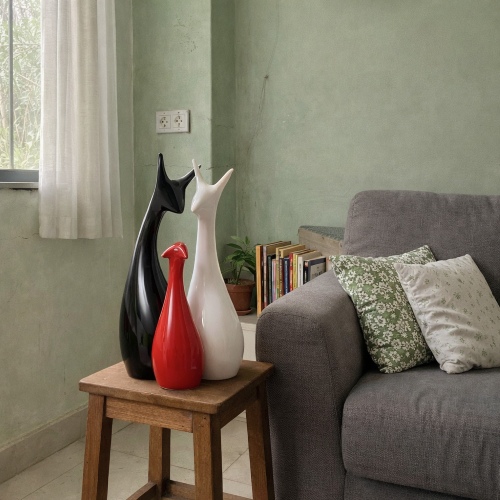
We help design-conscious Indian homeowners turn everyday leftovers — old trunks, brass vessels, wooden ladders, fabric, glass bottles — into decor that feels intentional, not cluttered. The rule that separates "charming vintage corner" from "hoarder pile" is simple: repurpose only what still functions structurally, and pair it with one or two anchor pieces that are clearly new. That contrast is what makes reused items read as styled rather than accidental.
Old items succeed as decor because they carry texture and history that new pieces can't replicate — a hand-stitched dupatta or a dented brass diya has visible age, and visible age reads as authenticity in a room. This works specifically because Indian interiors are increasingly mixing heritage textures with modern layouts, and a single aged object against a clean modern backdrop creates contrast that a room full of new items can't.
It stops working when the item is structurally compromised. Humidity above 70% RH causes untreated wood to warp and metal to corrode within a single monsoon season in most Indian coastal cities — which is why an old wooden chest displayed as-is in a humid room will crack within a year, while a sealed, moisture-resistant piece won't. If an old item has already started warping, rusting, or attracting pests, it should be retired and replaced with a piece engineered for the climate rather than restored and redisplayed.
This is the sequence we recommend for reusing old items without the result looking mismatched:
Sort old items into three piles: structurally sound (keep), repairable with cleaning or minor fixing (fix first), and compromised by rust, rot, or cracking (retire). Only the first two piles move forward. Styling a compromised item just relocates the problem to your living room.
Assign each salvaged item exactly one new function: an old suitcase becomes a side table, not a side table and a storage unit and a plant stand simultaneously. One function per item keeps the room legible instead of busy.
Every reused corner needs one clearly modern anchor piece so the space reads as curated, not accumulated. This is where a piece from Moolwan's modern home decor collection earns its place — a sleek ceramic or resin showpiece next to a weathered brass urn creates the old-meets-new tension that Indian interior stylists build entire rooms around.
Not every old item is equally suited to Indian homes. Climate tolerance and structural integrity determine the outcome more than aesthetics do:
| Old Item | Best New Use | Climate Risk in India | Reuse Verdict |
|---|---|---|---|
| Wooden trunk / suitcase | Coffee table or side table | High — warps above 70% RH | Reuse if sealed/treated |
| Brass or copper vessels | Planters, candle holders | Low — tarnishes but doesn't degrade | Reuse freely |
| Glass bottles / jars | Vases, table lighting | None | Reuse freely |
| Old sarees / dupattas | Wall hangings, cushion covers | Moderate — fades in direct sun | Reuse away from windows |
| Wooden ladders / crates | Plant stands, bookshelves | High — termite risk untreated | Reuse if pest-treated |
| Rusted metal frames | — | Severe — active corrosion | Retire; do not reuse |
For the "retire" category, replace with a piece built for Indian humidity rather than repeating the same failure. This is a good moment to browse Moolwan's showpiece collection — every ceramic piece is engineered with 92% clay composition, tolerates humidity up to 85% RH, and resists a 15cm drop, which is exactly the failure mode that damages reused decor in the first place.
Have items worth retiring but want the corner to still look styled?
Shop Showpieces for Home DecorRestoring a damaged old item — stripping rust, resealing wood, re-dyeing fabric — often costs more in materials and time than a single durable new piece, and it still carries residual risk of failure. Moolwan's resin decor items use 94% purity epoxy resin with 3H pencil hardness scratch resistance and a 3+ year indoor lifespan, which outlasts most "restored" wooden or metal pieces in humid Indian conditions without repeat maintenance.
If you're building a full display shelf or entryway console, mixing two or three reused items with one or two unique decor items for an elegant living room gives you the heritage texture without the maintenance burden of an all-vintage setup. Use Moolwan's size guide to keep proportions right: Small (10–16cm) pieces work on shelves alongside reused jars or frames, Medium (16–21cm) pieces anchor a coffee table next to a repurposed trunk, and Large (25–34cm) pieces become the single focal point a reused corner needs.
Yes. Warm water with dish soap removes most residue; for stubborn labels, rice and vinegar shaken inside the bottle works without harsh chemicals. Air-dry fully before styling to prevent mold in humid weather.
Cracked wood can be reused for light decor like a plant stand but should not bear weight as a table or shelf. Structural cracks widen with humidity changes across Indian seasons, so load-bearing use is not recommended.
Limit each surface to one reused item and one new item. The contrast reads as intentional styling; three or more mismatched pieces on one surface reads as clutter regardless of how good each item looks individually.
Rusted metal with active corrosion, wood with visible termite trails, and fabric with mold spotting should be discarded, not displayed. These conditions actively worsen once brought indoors and can damage nearby items.
Yes. Most reused items lack the protective coatings built into new decor, so they need more frequent dusting, humidity monitoring, and periodic resealing — maintenance that engineered pieces with moisture-resistant coatings are designed to avoid.
Start with what you already have, then fill the gaps with pieces built for Indian homes.
Shop Modern Home Decor ItemsWritten and reviewed by Ruchi Malhotra, Founder & CEO, Moolwan (Euphorica Ventures Pvt Ltd), Bangalore.
Quick View



