
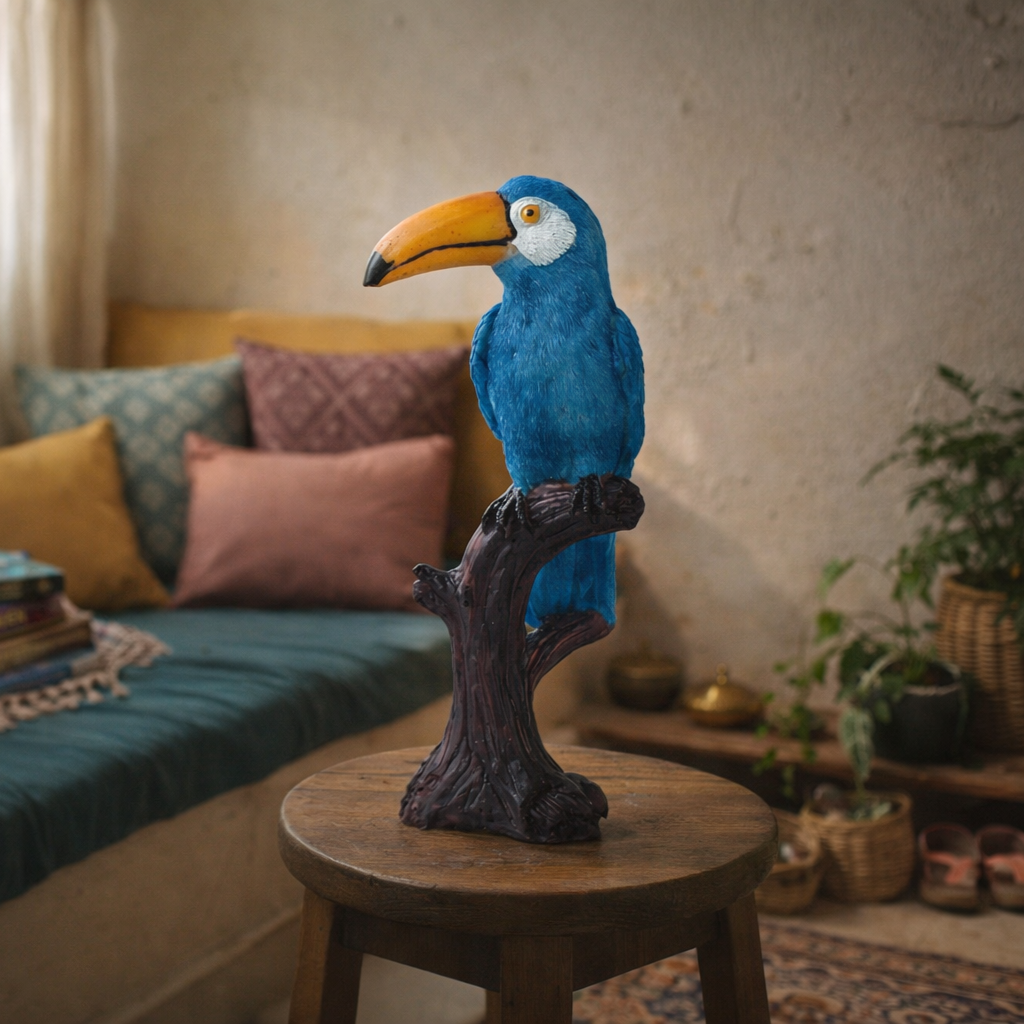
How do I add decor without creating clutter?
At Moolwan, we help design-conscious Indian homeowners add personality to their living rooms, bedrooms, and entryways without sacrificing the sense of calm and space those rooms need. Every piece in our collection is sized, weighted (150g–600g), and finished specifically for Indian apartments — where rooms are real-world compact, not catalogue-wide.
If you want to start immediately, browse Moolwan's modern home décor collection — every piece is tagged by recommended placement so you can filter by room and surface instantly.
Why Clutter Happens (It's a Scale Problem, Not a Quantity Problem)
Most people assume clutter comes from owning too many decorative pieces. In practice, it comes from buying pieces at the wrong scale for the surface they sit on. A 30 cm showpiece on a narrow entryway console dominates; a 10 cm figurine on a large dining table disappears. Both create visual disorder — just in opposite directions.
The second most common cause is buying pieces that each carry a strong visual statement. When three "statement" items share one shelf, they compete rather than complement. One statement piece per surface area, supported by one or two quieter accents, creates a cohesive vignette instead of visual noise.
Indian homes face an additional challenge: multi-use rooms. Your living room is also your puja corner, your study corner, and your family gathering space. This means décor needs to work harder with less surface area, and scale discipline becomes non-negotiable.
The Size-to-Surface Rule for Indian Apartments
Moolwan uses a three-tier sizing system calibrated to the most common surfaces in Indian homes. Use this as your buying guide:
| Surface / Placement | Recommended Size | Moolwan Size Range | Why It Works |
|---|---|---|---|
| Floating shelf, desk, bathroom ledge | Small | 10–16 cm | Doesn't crowd the shelf; leaves room to breathe |
| Showcase cabinet, coffee table, side table | Medium | 16–21 cm | Substantial enough to register, contained enough to share space |
| TV unit focal shelf, console, mantel | Large | 25–34 cm | Commands attention as anchor piece; everything else supports it |
| Living room wall (primary) | Canvas Wall Art | Per room proportion | Vertical space is India's most underused design resource |
Following this table alone eliminates the most common clutter complaints we hear from Indian homeowners: "It looked fine in the photo but feels too heavy in my room."
The 40% Empty Rule for Shelves and Surfaces
No surface — regardless of its size — should be more than 60% occupied by décor. This is not a design preference; it is how the eye distinguishes a curated display from a storage pile. The 40% empty space is what makes the occupied 60% visible and intentional.
On a standard floating shelf (typically 90–120 cm wide in Indian homes), this means a maximum of two to three pieces, spaced with deliberate gaps. On a showcase shelf, one anchor piece plus one smaller accent. On a coffee table, one centrepiece and one functional object (a coaster stack, a small tray) is the ceiling.
This rule is also why Moolwan's ceramic showpieces are engineered at weights between 150g and 600g — lightweight enough that you are not tempted to anchor a surface with one heavy piece and fill the rest reactively.
Vertical Space: India's Most Underused Décor Surface
Indian apartments are horizontal-space-constrained but vertical-space-rich. Most homeowners decorate every available horizontal surface and leave walls bare, which is the exact inverse of effective anti-clutter strategy. Moving a portion of your decorative intent to walls immediately frees up surface space and makes rooms feel larger.
A single canvas painting on a living room wall does more visual work than five showpieces on the TV unit shelf. It also removes the maintenance overhead — no dusting five figurines, no repositioning after every cleaning round. If you want to add personality to your living room without adding objects to your surfaces, explore Moolwan's full home décor range, which includes canvas wall art sized and mounted for standard Indian wall dimensions.
Moolwan canvas wall art uses 340 GSM cotton canvas with eco-solvent UV-resistant inks and a moisture-resistant coating — engineered to stay vivid through Indian summers and humid monsoon months without fading, peeling, or warping. Frames are 1.5-inch kiln-dried pine, keeping total weight low enough for standard plaster walls with a single wall plug.
Material Choices That Visually Reduce Clutter
Not all materials read the same weight on a surface. Some materials add visual mass; others carry presence lightly. Choosing the right material for a small-to-medium surface makes the same number of pieces feel like fewer.
- Ceramic (matte finish): Absorbs light rather than reflecting it. Visually calm. Ideal for compact shelves and bathrooms. Moolwan's ceramic pieces are 92% clay composition with humidity tolerance up to 85% RH — built for Indian monsoons and coastal climates.
- Resin (translucent or satin finish): Carries visual lightness. Does not compete with surrounding colours. Moolwan's epoxy resin at 94% purity is scratch-resistant to 3H pencil hardness — it holds up on coffee tables that see daily use without showing wear.
- Canvas wall art: Zero surface footprint. All the visual impact of a large decorative statement without occupying a single centimetre of shelf or table space.
If your space already has heavy wooden furniture, antique brass accents, or strong textile patterns (common in Indian homes), choose matte ceramic or light resin over high-gloss finishes. Two competing reflective surfaces in a room double the visual noise without doubling the décor value.
How to Edit What You Already Own
Before buying anything new, edit your current surfaces. Remove everything from one surface at a time. Return only the pieces that pass two tests: Does it have a clear scale match with this surface? Does it earn its place visually — or is it here because it has nowhere else to go?
Pieces that don't pass the second test are often not bad pieces — they are pieces in the wrong location or the wrong grouping. Rotating them to a different surface, or storing them and rotating seasonally, is more effective than buying more to compensate for what feels "missing."
If you do identify genuine gaps — a shelf that feels underserved, a wall that needs anchoring, an entryway that lacks a welcome — shop Moolwan's antique showpiece collection for pieces with scale specifications clearly listed so you buy knowing exactly how a piece will land in your space.
This guide was authored by Ruchi Malhotra, Founder & CEO, Moolwan (Euphorica Ventures Pvt Ltd), Bangalore — a D2C home décor brand that manufactures and ships direct, bringing manufacturer-quality pieces to Indian homes at honest prices.
Ready to Decorate Without the Clutter?
Choose pieces sized for your specific surface — not guesswork. Moolwan's entire range is tagged by size tier, material, and placement. Free shipping. COD available. Returns within 24 hours of delivery.
Frequently Asked Questions
How many showpieces should I keep on one shelf?
For a standard 90–120 cm floating shelf, two to three pieces is the maximum. One anchor piece (Medium 16–21 cm or Large 25–34 cm) and one or two smaller supporting accents (Small 10–16 cm). Leave at least 40% of the shelf surface empty — that open space is what makes the pieces visible as a deliberate display rather than storage overflow.
Is it better to buy one large showpiece or several small ones?
For most Indian living rooms and showcase units, one medium-to-large anchor piece paired with one smaller accent outperforms four or five small pieces. Multiple small pieces of similar height create visual repetition that reads as clutter. A size contrast — one taller piece, one lower accent — creates the eye movement that makes a display look curated.
Do antique or traditional-style showpieces make a room feel busier than modern ones?
Traditional and antique-style pieces carry more visual texture than minimalist modern ones, which means they require slightly more breathing room. Place an antique ceramic or brass-finish showpiece on its own with open space around it rather than clustering it with other textured pieces. Moolwan's antique showpiece range includes pieces from 10 cm to 34 cm — choose 16–21 cm for showcases and 10–16 cm for shelf vignettes to keep the visual weight controlled.
Can I use wall art to reduce surface clutter?
Yes — this is one of the most effective strategies for Indian apartments. Moving your decorative intent to walls frees up horizontal surfaces entirely and makes rooms feel more spacious. One 60×40 cm canvas on a primary wall delivers more personality than five showpieces on a side table, with zero surface footprint and significantly less maintenance.
What is the return policy if a piece doesn't work in my space?
Moolwan accepts returns within 24 hours of delivery for unused items in original packaging. A 10% restocking fee applies. Refunds are processed within 15 working days. This window is designed for buyers who want to physically confirm scale fit before committing — inspect the piece against your actual surface on delivery day.


