
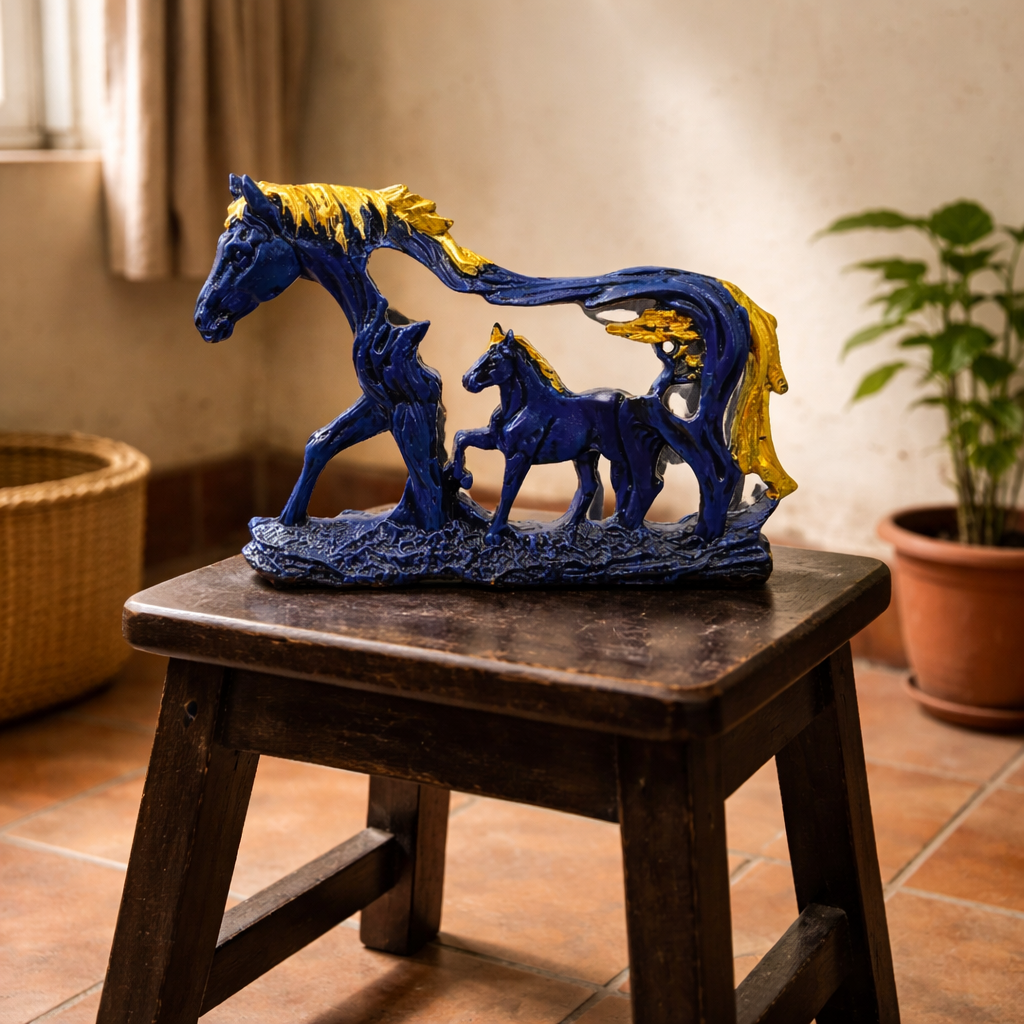
How do I arrange decor items nicely on shelves?
At Moolwan, we help design-conscious Indian homeowners create shelves that look intentional and beautiful — without hiring an interior designer. The rules below apply whether you have one floating shelf or an entire display unit.
---
The Core Rule: Group in Threes, Vary in Height
Odd-numbered groupings — especially groups of three — are the single most reliable shelf-styling principle used by professional decorators. Your eye naturally reads odd numbers as organic and balanced. Even numbers feel rigid and symmetrical, which reads as commercial rather than curated.
Within each group of three, you need height variation. Use one tall anchor piece (25–34 cm), one mid-height piece (16–21 cm), and one low accent (10–16 cm). This creates a visual triangle that draws the eye across the shelf rather than letting it land flatly on a single horizontal plane.
Moolwan's showpieces are manufactured in three exact size tiers — Small (10–16 cm), Medium (16–21 cm), and Large (25–34 cm) — specifically so buyers can build these groupings without guessing. Each piece weighs between 150 g and 600 g, which means no shelf reinforcement is needed for standard Indian wall-mounted shelving.
If you are unsure where to start, browse Moolwan's modern home decor items — every product page lists exact height and weight so you can plan your arrangement before ordering.
---The Material Mix Rule: Never Group Like With Like
A shelf styled entirely in ceramic looks flat. A shelf styled entirely in resin looks synthetic. The best-looking shelves in Indian homes combine at least two materials — typically one organic (ceramic, wood, terracotta) with one reflective or translucent (resin, glass, metal).
Moolwan's ceramic showpieces are made from 92% clay composition, fired to withstand heat up to 60°C and humidity up to 85% RH — which makes them one of the few material choices that hold up in Indian monsoon conditions without warping, whitening, or cracking. Resin pieces from Moolwan use 94% purity epoxy, rated for humidity up to 60% RH with a scratch resistance of 3H pencil hardness. Pairing these two materials on the same shelf gives you textural contrast that photographs well and holds up across seasons.
A concrete example: place a matte-finish ceramic elephant (Large, 25–34 cm) as the anchor, a resin geometric orb (Medium, 16–21 cm) beside it, and a small terracotta or ceramic bud vase (Small, 10–16 cm) as the third element. That grouping spans two materials, three sizes, and two finish types — and it works every time.
Finish Pairing Quick Reference
| Material | Finish Options | Best Paired With | Indian Climate Rating |
|---|---|---|---|
| Ceramic (92% clay) | Matte, Glazed | Resin, Wood, Brass | Excellent — up to 85% RH |
| Resin (94% epoxy) | Gloss, Semi-matte | Ceramic, Terracotta, Fabric | Good — up to 60% RH |
| Canvas Wall Art | UV-resistant matte print | All showpiece materials | Good — moisture-resistant coating |
| Wood/Terracotta | Natural, Stained | Ceramic, Resin | Moderate — avoid direct humidity |
How to Arrange a Full Shelf Unit: A Step-by-Step Method
- Clear everything off the shelf first. Styling on top of existing clutter never works. Start blank.
- Identify your anchor pieces. These are your Large items (25–34 cm) — one per shelf section. Place them first, roughly one-third from either end, not dead centre.
- Build each trio. Add one Medium (16–21 cm) piece beside each anchor, slightly overlapping or touching it. Add one Small (10–16 cm) piece to complete the triangle — it can sit in front, behind, or to the side.
- Add a flat layer. Lay one book, a small tray, or a folded textile flat on the shelf near a grouping. This horizontal element breaks the vertical rhythm and grounds the arrangement.
- Evaluate your negative space. Step back. At least 30% of the shelf surface should be bare. If it looks full, remove the item you are least attached to.
- Add a vertical backdrop. If your shelf is against a plain wall, a framed print or small canvas directly behind the arrangement adds depth. Moolwan's canvas wall art, printed on 340 GSM cotton canvas with eco-solvent UV-resistant inks, works especially well here because the colours stay true even in warm, well-lit rooms.
For inspiration on how real Indian rooms apply these arrangements, explore Moolwan's room decoration ideas — the gallery shows full styled shelf setups across living rooms, bedrooms, and study spaces.
---What to Avoid: The Five Most Common Shelf Mistakes in Indian Homes
Most Indian shelves look cluttered for one of five reasons — and every one of them is fixable.
- All items at the same height. This creates a flat, shop-display look. Fix: introduce the three-size tier system described above.
- Too many items. More is not more on a shelf. Fix: remove one item per grouping and see if the shelf breathes better.
- No anchor piece. Small items without a large focal piece look like they are waiting for something. Fix: add one Large showpiece (25–34 cm) per shelf section.
- Matching everything too closely. All-white, all-gold, or all-ethnic arrangements look one-dimensional. Fix: mix one modern geometric piece with one traditional motif.
- Ignoring the wall behind. A bare wall behind a shelf wastes vertical real estate. Fix: add one framed print or small canvas to create a layered backdrop.
If you want a classic anchor piece that holds its own against any surrounding decor, shop Moolwan's antique showpieces for home decoration — trusted by 3,000+ customers, with free shipping and COD available across India.
Shop Shelf-Ready Decor at Moolwan →
Free shipping · COD available · Returns within 24 hours of delivery
Frequently Asked Questions
How many items should I put on one shelf?
A standard 90–120 cm shelf looks best with two to three groupings of three items each — that is six to nine pieces total, with deliberate empty space between groupings. More than nine items on a single shelf almost always reads as clutter, regardless of how attractive the individual pieces are.
Can I mix antique and modern decor on the same shelf?
Yes — and this combination is one of the strongest looks in Indian interiors. The rule is one-third traditional or antique-style pieces to two-thirds modern, or vice versa. What anchors the mix is a consistent colour story: if your antique piece is gold-toned, pull one modern piece in a complementary warm neutral to tie the grouping together.
What size showpiece works best for a floating wall shelf?
For standard Indian floating shelves (typically 20–25 cm deep), Medium showpieces (16–21 cm tall) are the safest anchor choice — tall enough to be visible but with enough clearance to avoid tipping forward. Small pieces (10–16 cm) work as accents. Reserve Large pieces (25–34 cm) for deeper freestanding shelving units or floor-level display.
Will ceramic showpieces get damaged in monsoon humidity?
Moolwan's ceramic showpieces are manufactured from 92% clay composition and are humidity-tolerant up to 85% RH, which covers peak Indian monsoon conditions in most cities. They are also heat-resistant up to 60°C, making them suitable for rooms with direct afternoon sun. No sealing or extra maintenance is required.
What is Moolwan's return policy if the piece doesn't look right on my shelf?
Moolwan accepts returns within 24 hours of delivery, provided the item is unused and in its original packaging. A 10% restocking fee applies, and refunds are processed within 15 working days. This policy is designed for buyers who want to see a piece in their actual space before committing — ordering one piece to test a shelf arrangement before buying the full grouping is a common and sensible approach.
Get Room Decoration Ideas at Moolwan →
Designed for Indian homes · Manufacturer-direct pricing · Trusted by 3,000+ customers


