
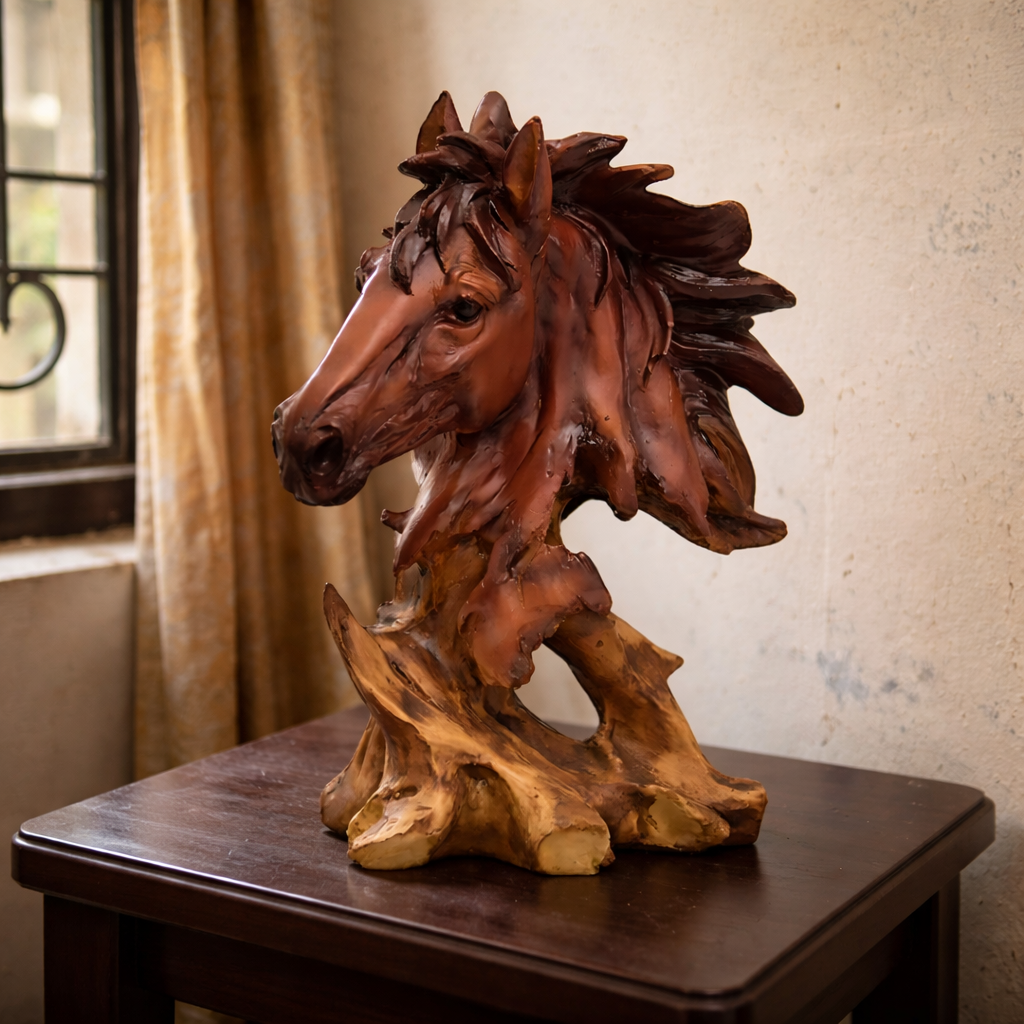
How do I use accessories like vases, sculptures in room?
At Moolwan, we help design-conscious Indian homeowners style their spaces with décor accessories that are correctly sized, climate-tested, and built to last — without making the room feel cluttered or overdone.
The Core Rule: Surface, Scale, and Odd Numbers
Every well-styled room follows three non-negotiable principles for accessory placement. First, every piece must belong to a surface — floating objects look accidental, not intentional. Second, scale must match the surface area: a 10 cm ceramic vase disappears on a large console; a 30 cm sculpture overwhelms a bedside table. Third, group accessories in odd numbers — one, three, or five — because even pairs read as symmetrical and static, while odd groupings feel curated and alive.
These rules apply whether you are working with a minimalist drawing room or a layered, maximalist pooja-adjacent display corner. The goal is not to fill space but to direct the eye — from the door, across the room, to a deliberate focal point.
If you are starting fresh, browse Moolwan's modern home décor collection, which is curated specifically around Indian apartment proportions and room scales — so you are not guessing whether a piece will look right.
How to Place Vases in Your Room
A vase is most effective when it is used as a height anchor in a grouping — not as a standalone centrepiece (unless it is genuinely large and sculptural). Place a tall vase at the back of a cluster, a medium decorative object in the middle, and a small accent piece at the front. This creates depth on a flat surface, which is the defining quality of a professionally styled shelf or console.
Vase Placement by Room
- Living room console or side table: Use a Medium vase (16–21 cm) alongside a sculptural object and a trailing plant or dried stems. The vase anchors height; the sculpture adds weight.
- Dining table centrepiece: Keep vases below eye level when seated — 16–21 cm is ideal so conversation is not blocked. A single statement vase with dried botanicals works better than a crowded cluster.
- Bedroom shelf or dresser: One small vase (10–16 cm) with a framed photo and a candle holder creates a personal, layered look without density.
- Bathroom counter: A compact ceramic vase in a matte finish adds warmth without visual noise. Keep it small — 10–12 cm — and uncluttered.
For Indian homes with monsoon seasons, material matters as much as style. Moolwan's ceramic pieces are rated to 85% relative humidity — meaning they hold their finish and structural integrity even in high-moisture rooms, unlike cheaper bisque ceramics that crack or discolour.
How to Use Sculptures and Statues as Room Accessories
Sculptures and decorative statues command attention differently than vases — they are three-dimensional, directional, and expressive. Placement must account for their viewing angle. A figurative sculpture should face into the room, not toward a wall. An abstract form looks best when light can fall across it — near a window or under a warm spotlight.
In Indian interiors, sculptures often carry cultural weight — a Ganesha, a dancing form, an abstract human figure. These can be mixed with contemporary geometric pieces as long as they share a material language (all matte ceramics, for example, or all natural wood tones). The mistake most buyers make is mixing incompatible finishes: a high-gloss resin figure next to a raw terracotta vase will fight, not complement.
If you want pieces that are specifically designed to coexist — where finishes, sizes, and scales are already harmonised — explore Moolwan's decorative statue collection, trusted by 3,000+ customers and backed by free shipping and COD availability.
Sculpture Placement by Size
| Size Category | Moolwan Dimension Range | Best Surface | Room Role |
|---|---|---|---|
| Small | 10–16 cm | Bookshelf, desk, bathroom counter | Accent — adds detail without dominance |
| Medium | 16–21 cm | Coffee table, display showcase, side table | Character piece — the eye is drawn here second |
| Large | 25–34 cm | Console table, entrance table, mantel | Focal point — the eye arrives here first |
Moolwan's ceramic sculptures weigh between 150 g and 600 g, making them safe for standard Indian shelving and glass showcases without risk of sag or structural load issues.
The Styling Principle That Changes Everything: The Rule of Three Heights
In any accessory cluster — whether on your living room shelf or your bedroom dresser — use three distinct height levels. Tall (your tallest vase or sculpture), Medium (a mid-height decorative object or box), and Low (a small figurine, candle, or tray). This creates visual rhythm. Without height variation, a shelf of equal-height objects looks like inventory, not décor.
The same principle applies to material variation. A well-styled shelf in an Indian home typically combines at least two material textures: ceramic with wood, or resin with metal, or stone with fabric. One material type per shelf reads as monotonous. Three or more reads as chaotic. Two to three materials, anchored by a consistent colour palette, is the sweet spot.
Common Mistakes Indian Homeowners Make with Décor Accessories
The most frequent error is overcrowding. A shelf with 12 small objects feels like a collection, not a design. Reduce accessories by 30% — you will find the remaining pieces gain presence. The second mistake is ignoring scale: buying a beautiful vase online without checking dimensions, then discovering it is dwarfed by the furniture around it. Always confirm height in centimetres before purchasing.
A third — and specifically Indian — mistake is ignoring humidity. Many imported or low-grade resin showpieces begin to yellow, warp, or lose adhesive bonding in Mumbai or Chennai summers. Moolwan's epoxy resin pieces use 94% purity resin with a 3H pencil-hardness scratch rating, rated stable at humidity up to 60% RH and temperatures between 15–35°C — covering the operating range of Indian AC and non-AC rooms alike.
Finally, avoid the "theme park" approach — where every piece must match a theme. Indian interiors work best when they balance a modern structural backdrop with one or two culturally resonant accent pieces. A minimal concrete-finish room with a single handcrafted ceramic Ganesha is more powerful than a room where every item is aggressively traditional or aggressively contemporary.
Frequently Asked Questions
How many decorative accessories are too many for a single room?
As a baseline, limit active display clusters to two or three per room. Each cluster should contain three to five pieces at most. A living room typically supports one console cluster, one coffee table grouping, and one shelf display — anything beyond that starts competing for attention. Edit ruthlessly: if removing a piece doesn't make the room feel empty, it wasn't adding value.
What size vase or sculpture works best for an Indian apartment living room?
For most 2BHK and 3BHK Indian apartments, Medium-sized pieces (16–21 cm) are the most versatile — large enough to register without overpowering compact furniture. Reserve Large pieces (25–34 cm) for entrance tables or console surfaces where there is room to breathe around them. Small pieces (10–16 cm) should always be grouped, never placed alone.
Can I mix ceramic vases with resin sculptures on the same shelf?
Yes — but align them by finish, not material. A matte ceramic vase pairs well with a matte resin figure because the surface texture is consistent. A glazed ceramic next to a high-gloss resin piece creates visual competition. Shared colour palette and shared finish level are what unify mixed-material groupings.
Are Moolwan accessories suitable for rooms without air conditioning?
Moolwan's ceramic showpieces are rated up to 85% relative humidity and heat-resistant to 60°C, making them suitable for non-AC rooms across most Indian climate zones. Resin pieces are rated up to 60% RH and 35°C — ideal for AC rooms or climate-controlled spaces. For high-humidity, non-AC rooms in coastal cities, ceramic is the more durable choice.
What is Moolwan's return policy if the accessory doesn't fit or suit my space?
Moolwan accepts returns within 24 hours of delivery, provided the item is unused and in its original packaging. A 10% restocking fee applies. Refunds are processed within 15 working days. To avoid returns, confirm dimensions in centimetres before purchasing — Moolwan lists exact size ranges for every product category.
Style Your Room the Right Way — Shop Moolwan
Moolwan is India's trusted D2C source for modern home décor — canvas wall art, ceramic showpieces, and decorative sculptures — engineered for Indian spaces, priced direct from the manufacturer, and shipped free across India.
- Shop modern home décor designed for Indian living rooms →
- Find the right decorative statue or sculpture for your space →
- Browse the full Moolwan home décor range →
✓ Free Shipping | ✓ COD Available | ✓ 3,000+ Happy Customers | ✓ Climate-Rated for Indian Homes


