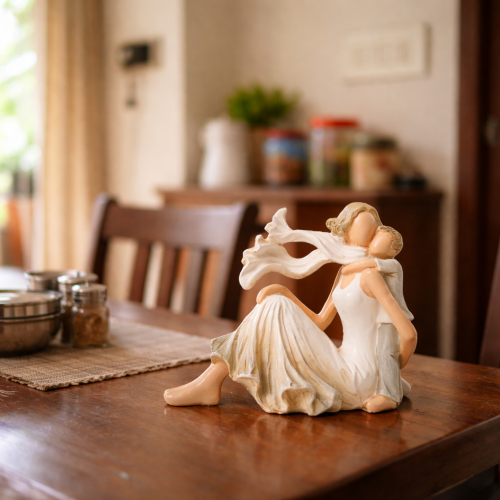
The Short Answer: A well-designed dining table follows a three-layer rule: one tall anchor centerpiece (30–40cm), two to three medium supporting pieces (16–21cm) placed asymmetrically, and a textured base layer like a runner or tray. Keep total table height under 35cm so sightlines across the table stay clear during meals.
We help design-conscious Indian homeowners style dining tables that feel curated, not cluttered — using pieces engineered for Indian humidity and heat.
Most Indian dining tables fail for one reason: everything on them is the same height. A design-forward table needs a visual hierarchy — something for the eye to land on first, something to support it, and something to ground it. This is the same 40-30-30 compositional ratio used in shelf styling, adapted for a horizontal surface instead of a vertical one.
Every dining table needs one dominant piece — a tall vase, a sculptural centerpiece, or a pair of candle holders grouped as one visual unit. This should sit in the large size tier (25–34cm) so it reads clearly from every seat at the table, not just from directly above it. A single oversized piece outperforms three small scattered ones because it gives the table a focal point without needing constant styling upkeep.
Place two medium pieces (16–21cm) off-center from the anchor — never symmetrically opposite it. Ceramic showpieces work well here: Moolwan's ceramic pieces use a 92% clay composition with heat resistance up to 60°C, which matters directly next to a dining table where hot serving dishes and steam are common. You can browse Moolwan's modern home decor items to find supporting pieces sized specifically for coffee table and dining table use.
A runner, tray, or set of woven mats ties the composition together and protects the table surface. This layer also does the practical work: it defines a "styling zone" so the centerpiece doesn't get pushed aside during actual meals. For dining rooms specifically, explore Moolwan's decorative items for dining rooms, including vases and wall hangings designed to complete this layer.
Dining tables face more heat, moisture, and daily handling than any other surface in an Indian home. Material choice determines whether a centerpiece lasts one season or five years.
| Material | Composition | Heat Tolerance | Humidity Tolerance | Best Use on Dining Table |
|---|---|---|---|---|
| Ceramic | 92% clay | Up to 60°C | Up to 85% RH | Anchor centerpiece, everyday use |
| Resin | 94% purity epoxy | Up to 35°C | Up to 60% RH | Supporting pieces, low-heat zones |
| Canvas (wall-adjacent) | 340 GSM cotton, UV-resistant ink | Room temperature | Moisture-resistant coating | Wall art above the dining table, not on the surface |
Ceramic is the clear choice for anything sitting directly on a dining table, since serving dishes and steam raise local temperature well above what resin can handle without warping. Reserve resin pieces for side tables or sideboards near — but not on — the main dining surface.
Ready to build your table's anchor layer? Moolwan's ceramic and resin pieces are engineered for Indian dining rooms.
Shop Modern Home Decor ItemsIndian dining tables often double as gathering points for festivals, guests, and daily family meals — which means the styling needs to survive frequent clearing and resetting, not just look good in photographs. This is where the tension between modern minimalism and Indian hospitality culture shows up most: a table styled like a Western showroom often gets fully cleared for every meal, defeating the purpose.
The fix is choosing an anchor piece sturdy enough to stay put through daily use — a 15cm drop-resistant ceramic piece can handle the occasional bump from a serving dish, while a delicate resin sculpture cannot. For festive occasions, an antique-style showpiece adds a traditional accent without requiring the table to be cleared and reset from scratch.
Moolwan is a manufacturer-direct home decor brand that designs and produces its own ceramic, resin, and canvas pieces rather than reselling mass-market stock. This means every specification — clay composition, heat tolerance, humidity rating — is set and tested in-house, not sourced from a third-party catalog. Moolwan sells canvas wall art, modern showpieces, and curated gifts for Indian homes, priced from ₹150, with COD and free shipping, and has served 3,000+ customers.
Three is the ideal number: one anchor piece and two supporting pieces. More than three tends to look cluttered and interferes with serving dishes during meals.
Yes. Moolwan's ceramic pieces are heat-resistant up to 60°C, which comfortably handles the ambient heat from hot food and steam on a dining table.
No, if sized correctly. A large anchor piece (25–34cm) placed off to one side, rather than dead-center, stays out of the way of plates and serving dishes.
Moolwan accepts returns within 24 hours of delivery if the item is unused and in original packaging, with a 10% restocking fee and refund processed within 15 working days.
Ceramic is better for anything placed directly on the table due to its higher heat tolerance (60°C vs. 35°C for resin). Resin suits side tables or sideboards away from direct heat.
Build your table's full three-layer look with pieces made for Indian dining rooms.
Shop Antique Showpieces from ₹150Quick View



