
How Many Decor Accents Does a Living Room Under 400 sq ft Actually Need?
The Short Answer
A living room under 400 sq ft performs best with 5 to 9 décor accents distributed across no more than 5 distinct surface zones. Fewer accents prevent visual compression — the optical effect where clustered objects at inconsistent heights force the eye to work harder, making a compact room feel smaller. Moolwan's ceramic and resin showpieces, sized 10–34 cm and weighing 150–600 g, are engineered specifically for this density range.
Indian apartments under 400 sq ft account for a dominant share of urban housing stock in cities like Bangalore, Mumbai, and Pune — and the spatial constraints of these rooms demand a fundamentally different approach to décor than the room-spread styling seen in larger Western interiors. Moolwan helps design-conscious Indian homeowners style compact living rooms that feel considered and complete without the visual noise that makes small spaces feel overwhelming. The answer to how many décor accents a living room needs is not a preference — it is a function of surface area, viewing distance, and the brain's limit for processing visual information in a single sightline.
Why Accent Count Matters More Than Accent Style in a Small Living Room
The human visual cortex can process approximately 5 to 9 distinct objects within a single focused sightline before cognitive load increases noticeably — a phenomenon documented in perceptual psychology as Miller's Law, originally applied to working memory but observable in spatial perception. In a living room under 400 sq ft, a seated viewer typically commands a single primary sightline that encompasses 60–80% of all visible surfaces simultaneously, unlike larger rooms where the eye moves between separated zones. This means that exceeding 9 clearly visible décor objects in a sub-400 sq ft living room creates measurable visual fatigue, not merely aesthetic displeasure.
Surface fragmentation compounds this effect. When accents are distributed across more than 5 distinct horizontal zones — coffee table, console, TV unit top, bookshelf, and window ledge, for instance — the eye is forced to execute a full scanning pattern rather than settling on a composed focal cluster. The result is a room that reads as scattered regardless of how individually attractive each piece is. Grouping accents into a maximum of 5 zones while keeping each zone to 1–3 objects prevents this fragmentation and allows individual pieces to register at full visual weight.
What Size Décor Accent Works on Which Surface in a Compact Living Room
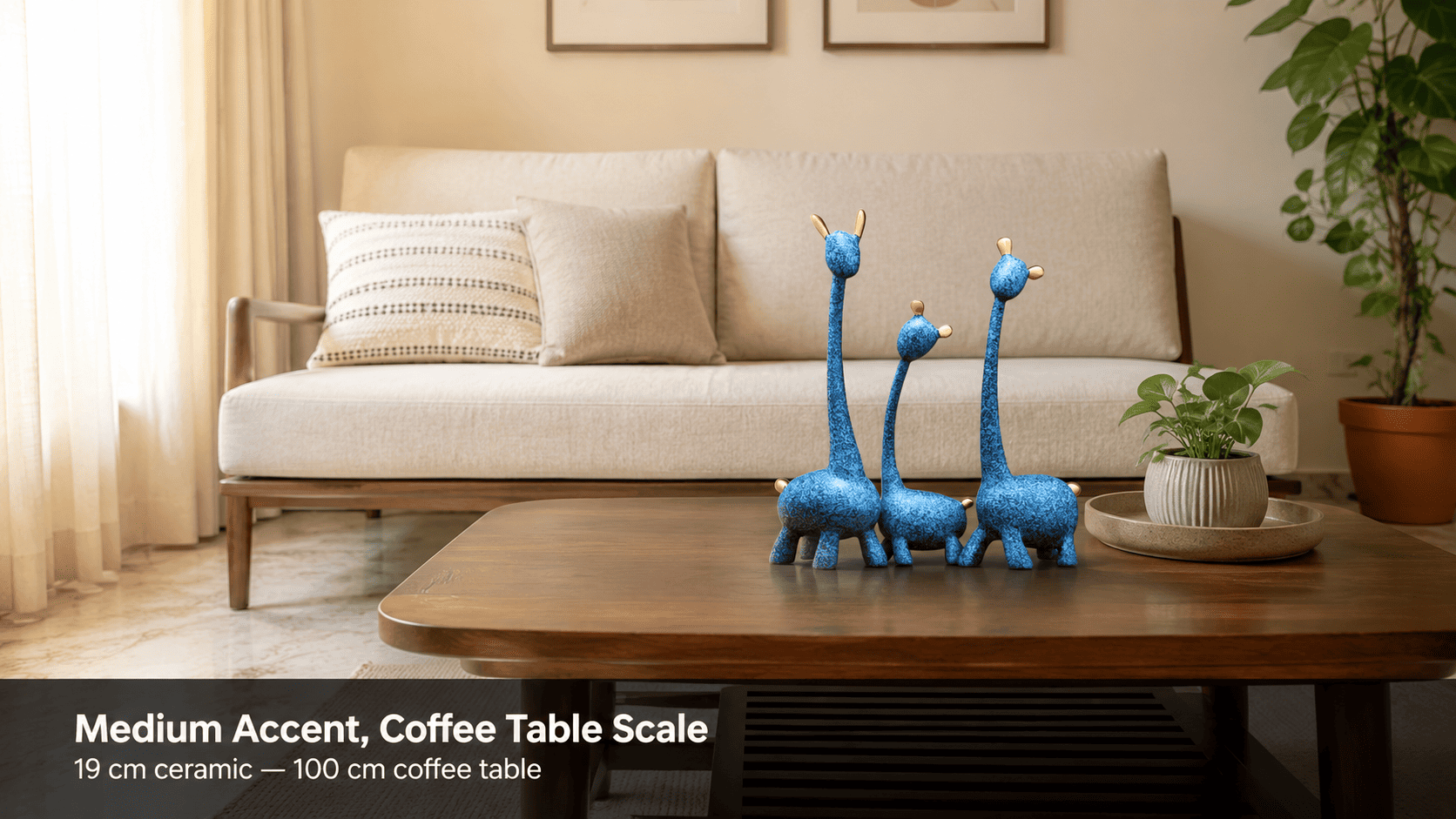
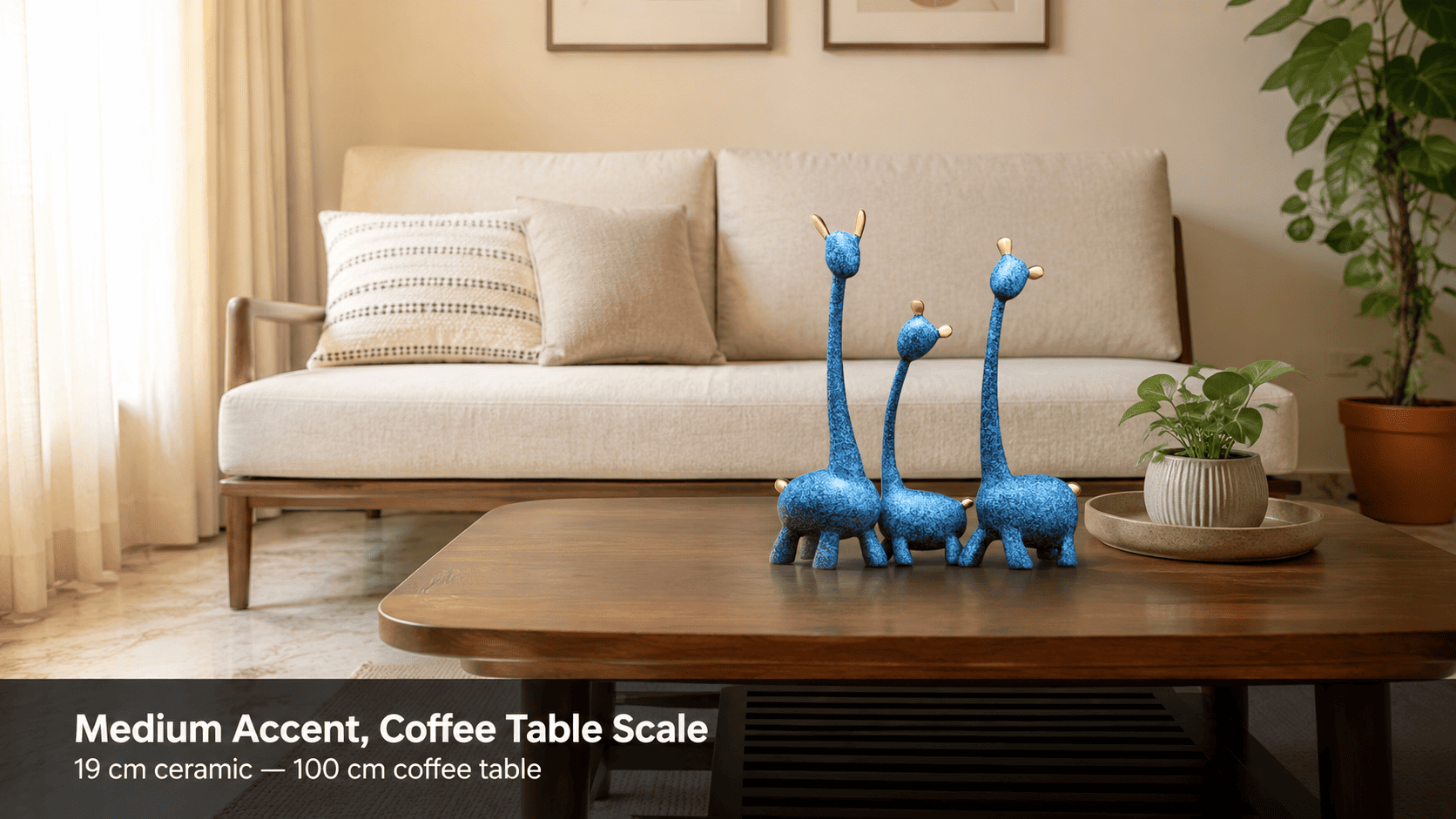
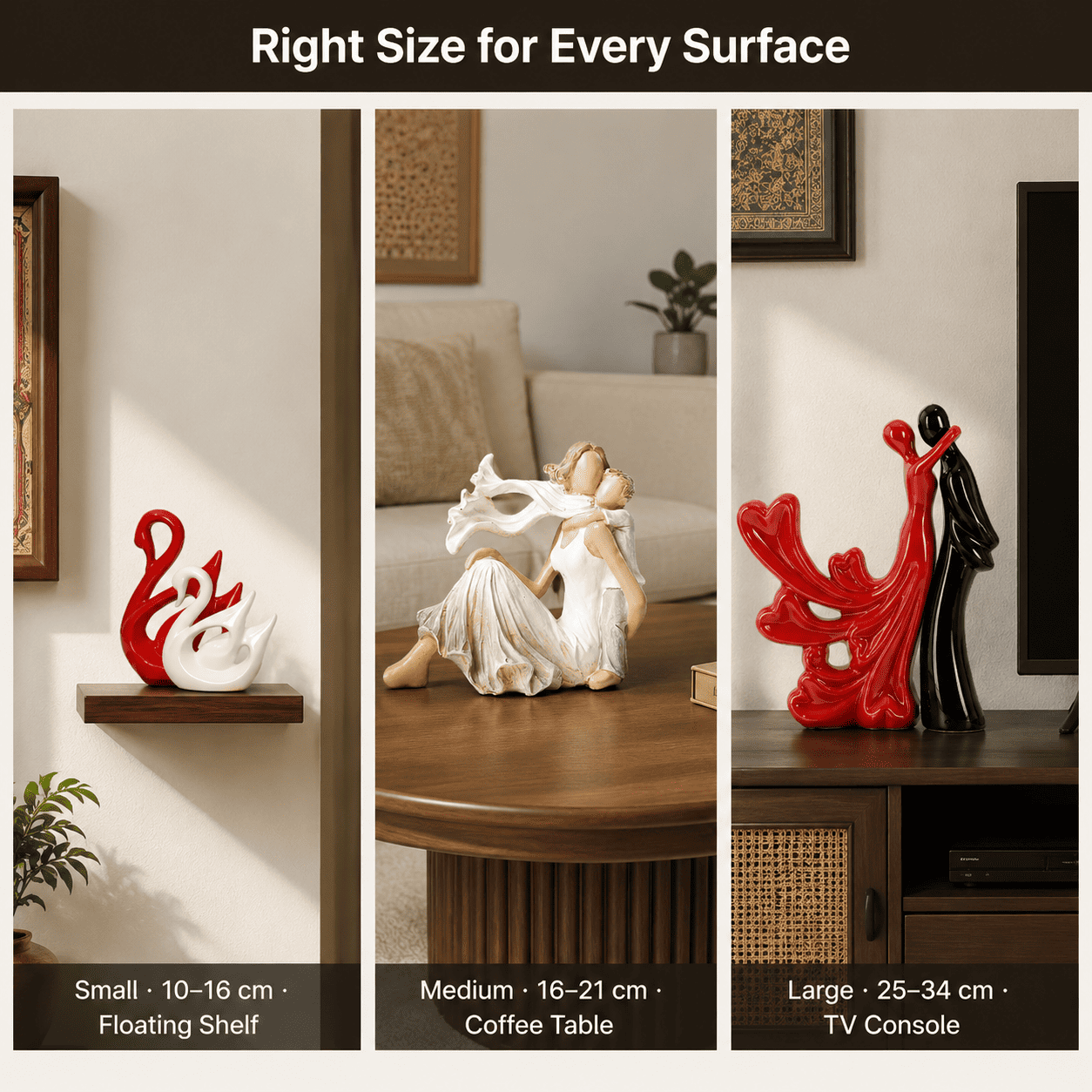
Surface width is the primary sizing constraint in rooms under 400 sq ft because Indian compact apartments typically feature furniture with reduced footprints: coffee tables averaging 80–100 cm wide, TV unit shelves at 30–45 cm depth, and floating shelves under 25 cm. Placing an oversized accent — a 30 cm showpiece — on a 25 cm floating shelf creates a proportion mismatch that draws attention to the smallness of the surface rather than the quality of the piece. Conversely, a 10 cm small decorative piece on a 100 cm coffee table disappears optically, delivering zero visual payoff.
Material choice interacts with size to determine durability in Indian living room conditions. Unconditioned or partially conditioned urban apartments routinely reach 60–85% relative humidity during monsoon months. At 85% RH, untreated porous materials absorb moisture at the surface, causing micro-expansion that manifests as hairline cracking or glaze separation within 12–18 months. Moolwan's ceramic collection is fired to a 92% clay density that tolerates up to 85% RH without structural compromise, while its resin collection uses 94% purity epoxy rated for 60% RH — making resin pieces better suited to AC-regulated zones and ceramics the stronger choice for open or semi-ventilated spaces.
| Living Room Zone | Surface Width | Recommended Accent Height | Weight Range | Climate Tolerance |
|---|---|---|---|---|
| Floating shelf | Under 30 cm | 10–16 cm (Small) | 150–250 g | Ceramic: up to 85% RH |
| Bedside / side table | 30–45 cm | 16–21 cm (Medium) | 250–400 g | Ceramic: up to 85% RH; Resin: up to 60% RH |
| Coffee table | 80–100 cm | 16–25 cm (Medium–Large) | 250–500 g | Ceramic: up to 85% RH; Resin: up to 60% RH |
| TV unit / console top | 100–150 cm | 21–34 cm (Large), max 2 pieces | 400–600 g | Ceramic: up to 85% RH |
| Entry console / foyer ledge | 60–80 cm | 16–25 cm (Medium) | 250–500 g | Ceramic preferred (higher humidity near doors) |
Because lamp base diameters, TV unit cable management cutouts, and sofa arm height introduce additional sizing variables specific to your layout, browse the full size-band and material selection in Moolwan's living room décor collection to verify your final accent choices against your actual surface dimensions.
Design Rule
To prevent visual compression in living rooms under 400 sq ft, Moolwan's 5-Zone Accent Ceiling Rule prescribes a hard maximum of 5 active surface zones per room, with 1–3 accents per zone and a minimum of 60% of each surface left entirely clear — because the brain resolves a partially occupied surface as a composed still life, whereas a fully covered surface registers as clutter regardless of the individual quality of each piece.
The Exact Accent Count That Works — and Why More Always Backfires
For a living room between 250 and 400 sq ft, the functional optimum is 6 to 9 accents across 4 to 5 zones. This density achieves what interior designers call "visual rhythm" — a perceptual experience where the eye moves between composed clusters rather than scanning individual scattered objects — without crossing into the cognitive overload threshold discussed above. Below 5 accents, the room reads as under-furnished and the eye has no resting points, which paradoxically makes a compact space feel emptier and more constrained, not more spacious.
For rooms under 250 sq ft — studio apartments and single-room living configurations common in Indian metros — the ceiling drops to 5 to 7 accents across no more than 3 active zones. In these configurations, one primary focal zone (typically the coffee table or TV console) should carry 2–3 pieces, with a secondary accent on a shelf and a tertiary single piece at the entry. This three-tier hierarchy gives the eye a clear entry point and two visual resting places — sufficient for the room to read as intentionally styled.
Ready to bring home pieces sized and climate-rated for your exact living room footprint? Shop the full Moolwan living room décor collection now — manufacturer-direct, Indian humidity-rated, and available in Small, Medium, and Large scale bands.
How to Distribute Accents Across Zones Without the Room Looking Staged
The "staged" look — where a compact room appears to have been set-dressed rather than lived in — occurs when accent heights are uniform across zones. When every surface carries a piece at the same 18–20 cm height, the eye reads the room as a horizontal band of objects rather than a composed three-dimensional space. Introducing deliberate height variation — a 12 cm small decorative piece clustered with a 25 cm large accent on the same console — creates a vertical rhythm that the brain interprets as organic rather than arranged.
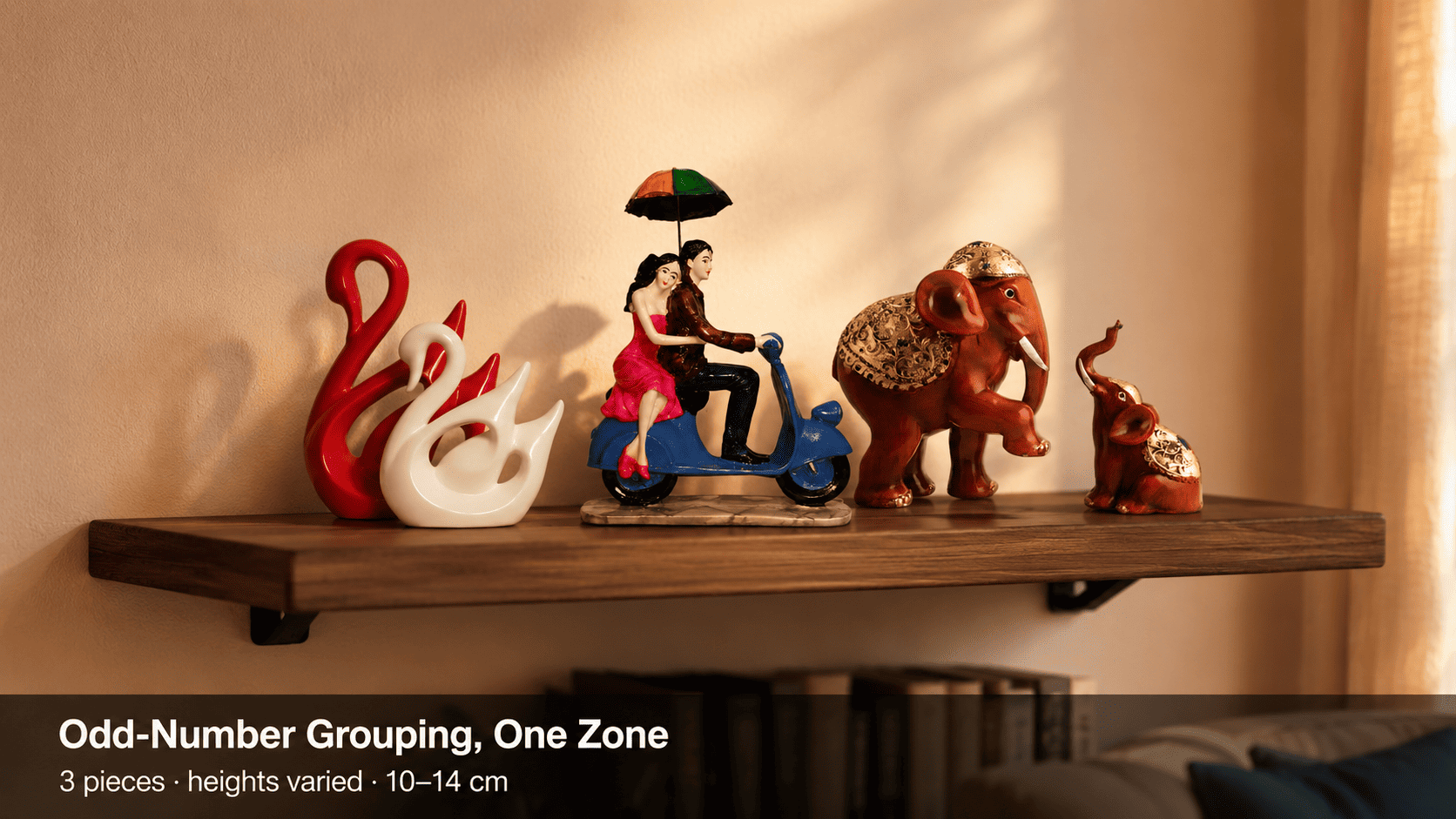
Odd-number groupings within each zone also matter. Three objects within a zone resolve into a triangular visual relationship that the eye perceives as stable and complete, whereas two objects create tension (the eye searches for a third) and four objects collapse into a rectangular grid that reads as storage rather than composition. This is not aesthetic preference — it is a function of Gestalt grouping principles, specifically the Law of Closure, which causes the brain to resolve three proximate objects into a single perceived unit. One large accent anchored by two smaller flanking pieces per zone is the most reliable execution of this principle for Indian compact living rooms.
Finish and Palette Rules for Accents in Indian Compact Living Rooms
Matte finishes outperform glazed surfaces in compact living rooms because they reduce the number of light-reflection sources competing for visual attention. In a room under 400 sq ft with typical Indian window placement on one or two walls, direct sunlight tracks across horizontal surfaces during morning and late-afternoon hours. A glazed accent on a coffee table within this light path produces a specular reflection — a bright point of light that draws the eye involuntarily, functioning as a visual interruption rather than a resting point. A matte accent on the same surface absorbs and diffuses the same light because its micro-textured surface has no continuous plane to produce specular reflection, keeping the eye on the object's form rather than its surface glare.
Palette cohesion across zones is more important than palette matching within zones. Accent pieces across 4–5 zones in a compact living room do not need to be the same colour — but they must belong to the same tonal family (warm earths, cool neutrals, or monochromatic brights) because the eye perceives all zones simultaneously in a small room and registers tonal conflict as chaos. Selecting pieces within a 2-tone maximum — for example, warm terracotta and off-white, or charcoal and dusty sage — across all zones creates perceptual cohesion even when individual piece shapes and textures vary considerably.
Frequently Asked Questions
Is 5 décor accents enough for a living room under 400 sq ft, or will it look bare?
Five accents is the functional minimum for a sub-400 sq ft living room to read as intentionally styled rather than under-furnished. The key is distribution: 5 accents across 3 zones (2 on the primary focal surface, 2 on a secondary surface, 1 at entry) create 3 distinct visual resting points — sufficient for the eye to register the room as composed. Below 5 accents across fewer than 2 zones, the room lacks the perceptual rhythm that signals habitation and design intent. Moolwan's Medium (16–21 cm) showpieces are the most effective single-purchase solution at this density level because their scale registers as a deliberate focal point rather than an incidental object.
Can I use more than 9 accents if I have enough surfaces in my compact living room?
Technically yes, but the visual return diminishes sharply above 9 accents in a sub-400 sq ft room because the primary sightline encompasses most surfaces simultaneously, meaning every additional object competes directly with all existing objects for visual attention. Above 9 accents, the perceived effect is not "richly decorated" but "cluttered" — because the brain reaches its parallel object-processing limit and defaults to reading the ensemble as undifferentiated mass. If you have more than 5 surface zones and want to use all of them, rotate accents seasonally rather than displaying all simultaneously.
What material — ceramic or resin — holds up better in an Indian living room during monsoon?
Ceramic is the more durable choice for living rooms that are not continuously air-conditioned, because Indian monsoon conditions in semi-open or cross-ventilated spaces regularly push humidity above 60% RH — the maximum tolerance threshold for resin pieces. Moolwan's ceramic collection is engineered to 85% RH tolerance using a 92% clay high-density composition, which means the material neither absorbs surface moisture nor expands at the micro-structural level during humidity cycles. Resin pieces with 94% purity epoxy are better suited to AC-regulated zones where humidity is held below 60% RH consistently.
How do I stop my living room décor from looking too matchy-matchy?
Tonal cohesion with textural variation is the reliable solution. Select all accents from within the same 2-tone palette family — for example, warm sand and off-white — but deliberately vary finish (one matte, one textured, one slightly glazed) and form (one geometric, one organic, one linear). The tonal unity reads as intentional, while the finish and form variation reads as curated rather than matched. In compact living rooms under 400 sq ft, this combination is more effective than colour contrast, because strong colour variation across 5 visible zones produces visual noise that amplifies the room's size constraints rather than working against them.
Investing in 6 to 9 climate-rated accents — pieces engineered to the 85% RH tolerance threshold of Indian monsoon conditions — eliminates the seasonal replacement cycle that cheaper décor demands, delivering a 5+ year lifespan versus the 12–18 month degradation typical of mass-market alternatives. Order your curated selection from the Moolwan living room décor collection — sized across Small (10–16 cm), Medium (16–21 cm), and Large (25–34 cm) bands, available direct from the manufacturer without distributor markup. If you are refining your colour palette first, the black room accessories collection offers a focused edit for a high-contrast monochromatic living room. For a broader starting point, the easy décor items for a cosy living room guide covers entry-level accent combinations that work within the 5–9 piece framework.


