
How Many Decor Accents Does a Minimalist Indian Living Room Actually Need?
The Short Answer
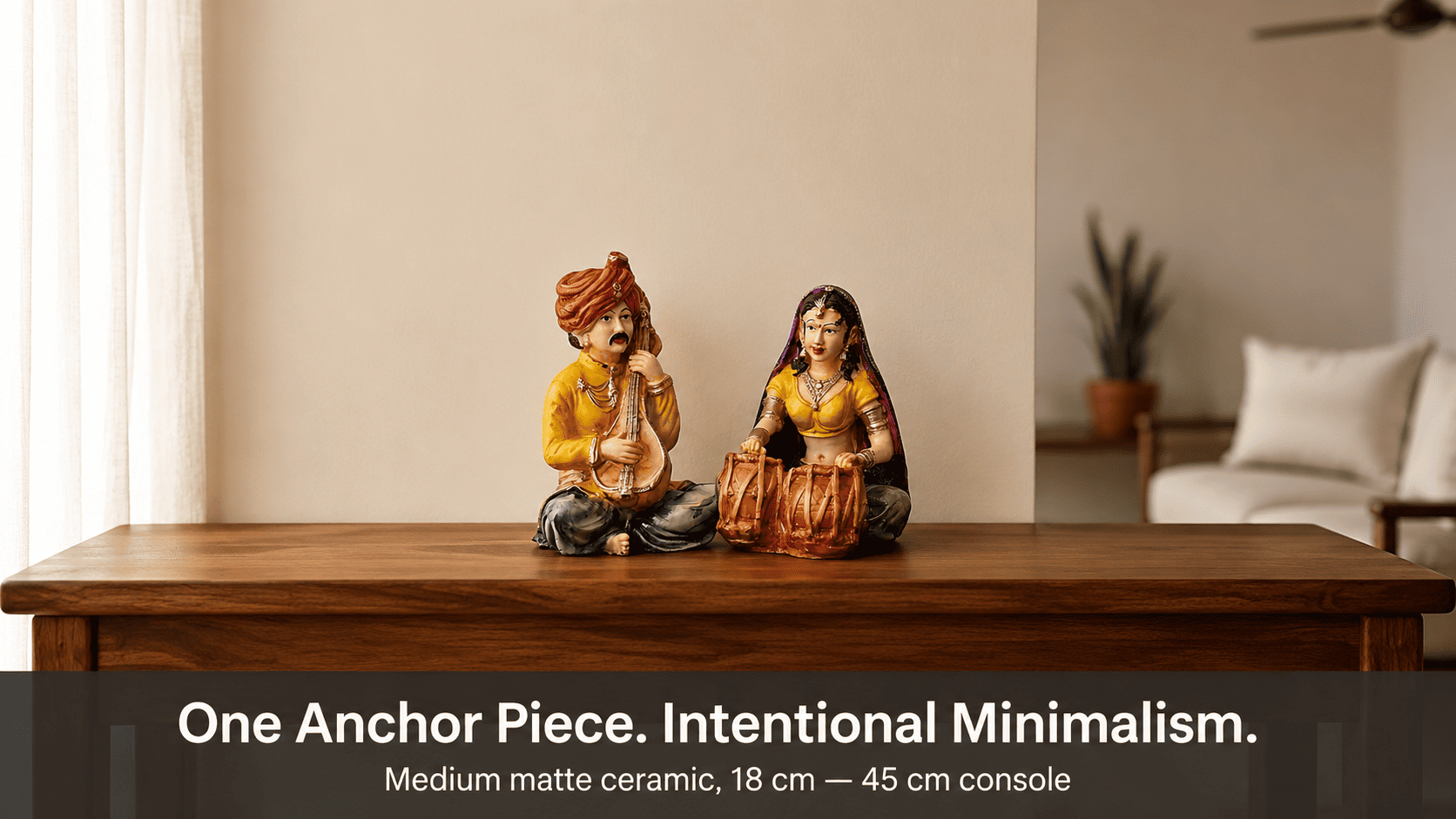
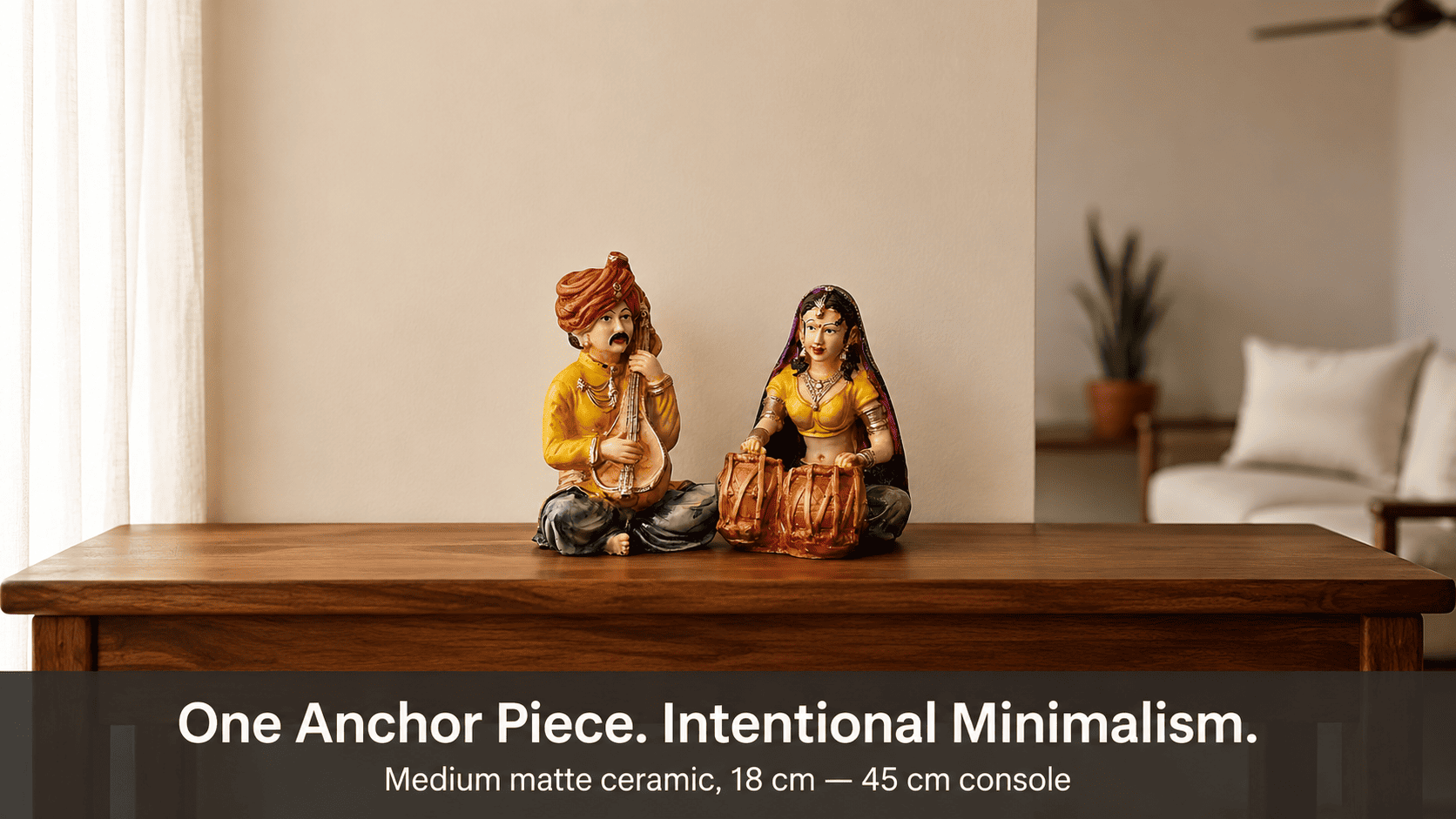
A minimalist Indian living room needs 5–7 décor accents total, distributed across no more than 3 surfaces. Moolwan recommends anchoring each surface with 1 medium piece (16–21 cm) and no more than 2 small pieces (10–16 cm) per cluster — because the human eye resolves groups of three before registering individual items, so exceeding three pieces per surface triggers the perception of clutter even in a well-organised room.
Indian urban apartments average under 1,200 sq ft, and living rooms within them typically occupy 150–300 sq ft — a spatial constraint that punishes over-decoration far more severely than larger Western living spaces. Moolwan helps design-conscious Indian homeowners achieve a visually calm, curated living room by engineering showpieces and décor accents specifically sized and finish-rated for Indian room scales, surface dimensions, and seasonal humidity levels. The question isn't whether to decorate — it's how few well-chosen pieces can do the most visual work.
Why "minimalist" in an Indian living room doesn't mean empty
A living room with zero décor reads as unfinished, not minimal — because the human visual system interprets bare horizontal surfaces as incomplete environments. Genuine minimalism means intentional placement of a small number of high-quality pieces that anchor the room's focal points without competing with each other for attention.
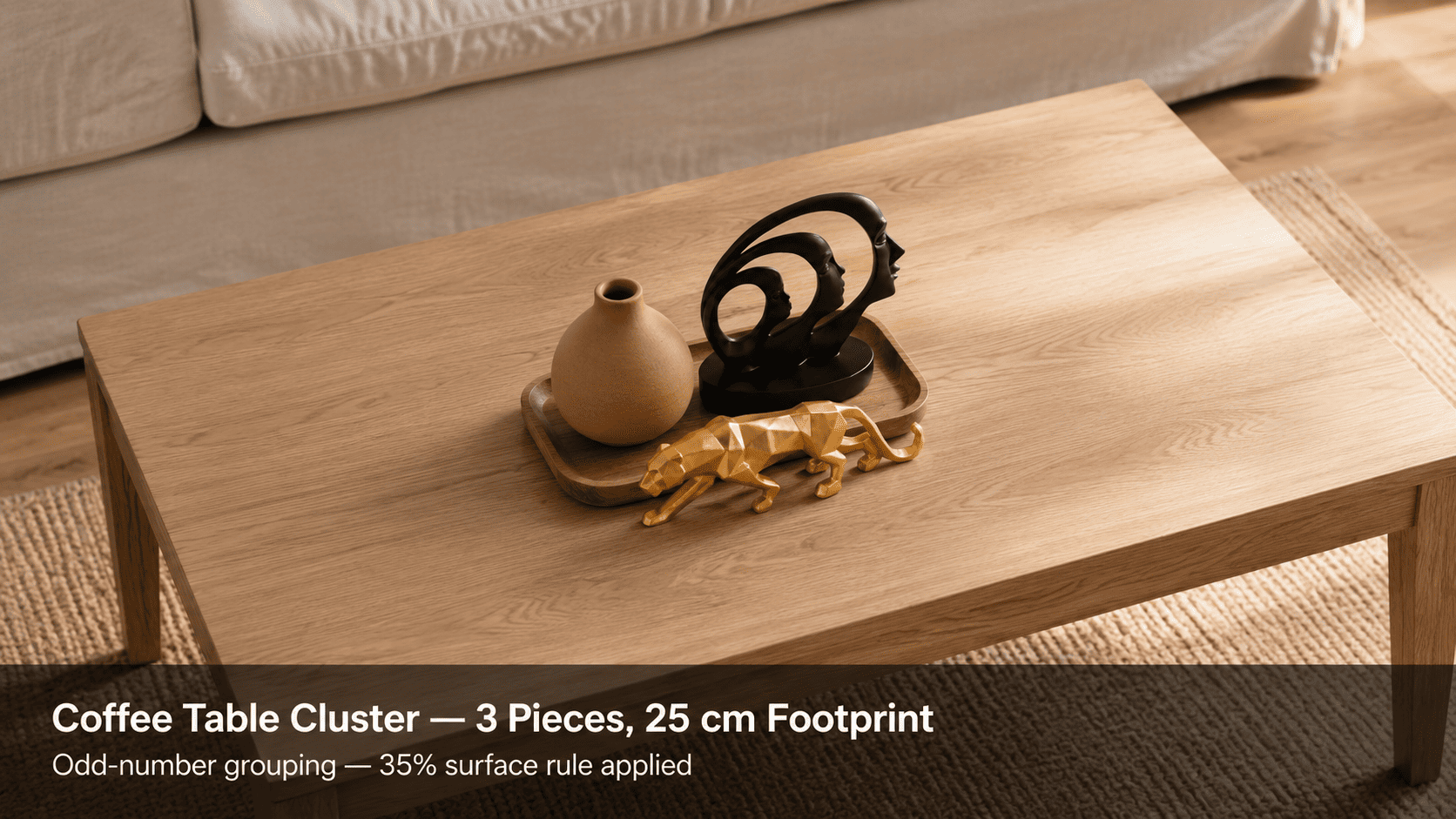
The key spatial principle is visual rest: approximately 65–70% of every styled surface should remain clear and unoccupied. This proportion is not aesthetic preference — it is a function of how the eye tracks a surface. When more than 35% of a surface is covered, the eye loses a natural "rest point" and begins to perceive the surface as cluttered regardless of how beautiful the individual objects are. For sub-150 sq ft Indian living rooms, where surface areas are already compressed, this threshold drops further: a 40 cm-wide console accommodates at most one medium showpiece before exceeding the visual threshold.
In practice, this means 5–7 total accents for the average Indian living room — distributed strategically, not scattered. A ceramic showpiece on the console, a small accent or candle holder on the coffee table, and 2–3 pieces on a display shelf or bookcase represents a fully furnished, visually complete minimalist room.
Which surfaces in a minimalist Indian living room should hold décor?
Minimalist styling works by choosing surfaces deliberately — not every horizontal surface in a living room should carry décor. The three surfaces that carry décor most effectively in Indian living rooms are the entry console or side table, the coffee table, and a single display shelf or TV unit top.
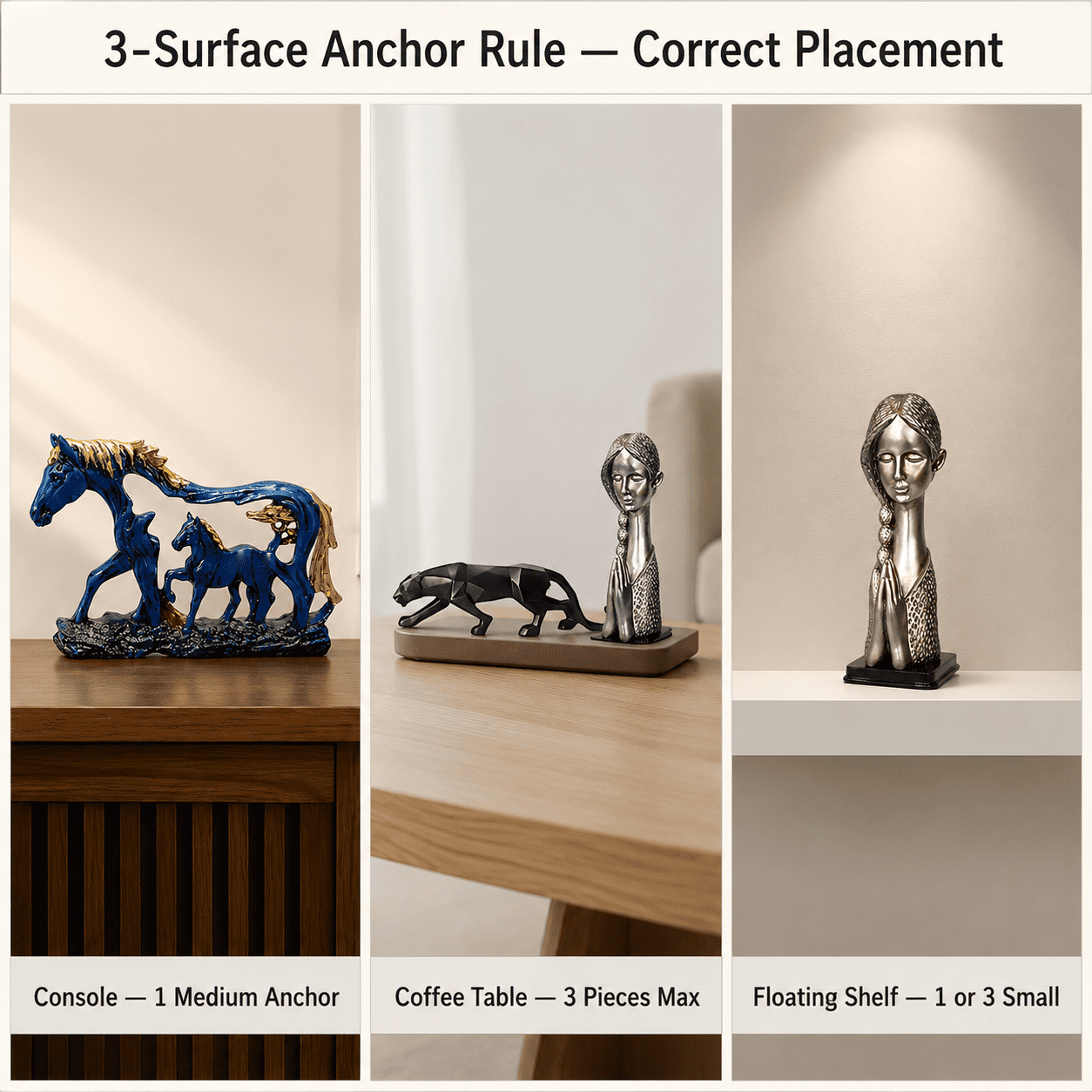
The entry console or side table anchors the room's first impression. A single medium showpiece (16–21 cm, 250–400 g) placed here operates as a visual full stop — the first thing a visitor sees, and the clearest signal that the room is intentionally styled. In humid coastal or monsoon-affected Indian climates, material selection here matters: ceramic pieces with a 92% clay composition tolerate up to 85% relative humidity without warping or surface degradation, making them significantly more durable than lower-density ceramics or untreated resin.
The coffee table is the room's social focal point. It benefits from a small cluster — a maximum of 3 pieces including a tray — kept within a footprint no larger than 25 cm in diameter. The tray is a tool, not purely decorative: it groups small items visually and prevents individual pieces from appearing stranded on a large surface.
The display shelf or TV unit top is the room's accent zone. This is where small pieces (10–16 cm) earn their place — grouped in odd numbers (1 or 3, not 2 or 4) because symmetrical even-numbered groupings read as formal and rigid, while odd-numbered groupings create a sense of organic curation that aligns with minimalist visual language.
Design Rule
To prevent visual overload in compact Indian living rooms, Moolwan recommends the 3-Surface Anchor Rule: select exactly three surfaces to carry décor, assign one "anchor piece" per surface (medium, 16–21 cm), and allow a maximum of two supporting small pieces (10–16 cm) per surface — leaving all remaining surfaces completely clear. This constraint forces every piece to earn its place and eliminates the incremental accumulation of accents that slowly dissolves a minimalist aesthetic.
How do you size décor accents correctly for an Indian living room?
Sizing errors are the single most common reason a minimalist room accumulates visual noise: a piece that is too small for its surface disappears and prompts the owner to add more pieces to compensate, while a piece that is too large dominates and forces the eye to choose between the object and the room. Correct sizing is a function of surface width, not room size.
The functional rule is that a single accent piece should occupy no more than 40% of the surface width it sits on. On a 40 cm console, that means a piece no wider than 16 cm at its base — placing it squarely in the Small category (10–16 cm). On a 55 cm console, a Medium piece (16–21 cm) is proportionally correct. On a 75 cm+ console or sideboard, a Large piece (25–34 cm, 400–600 g) anchors without overwhelming. Moolwan's ceramic collection — produced at a 92% clay composition specifically for density consistency across size categories — maintains proportional visual weight across all three size bands, which means a Large piece reads as scaled, not heavy, on wider Indian console and sideboard surfaces.
| Living Room Surface | Surface Width | Recommended Accent Size | Max Pieces per Surface | Material & Climate Tolerance |
|---|---|---|---|---|
| Entry console / side table | 35–50 cm | Small–Medium (10–21 cm) | 1 anchor piece | Ceramic 92% clay, 85% RH tolerance |
| Coffee table | 60–90 cm (typical) | Small (10–16 cm) + tray | 3 pieces max incl. tray | Resin 94% epoxy, 60% RH / 15–35°C |
| Display shelf (floating) | Under 30 cm depth | Small (10–16 cm), 150–250 g | 1 or 3 (odd grouping) | Ceramic 92% clay, drop-tested to 15 cm |
| TV unit top / media console | 80–120 cm | Medium–Large (16–34 cm) | 1–2 pieces max | Ceramic or resin; keep away from direct AC airflow |
Because surface dimensions vary with furniture choice and room layout, browse the full size-band and material selection across surface types in Moolwan's living room items collection to verify which pieces suit your specific console width and shelf depth before purchasing.
Does material choice matter for minimalist Indian living rooms?
In minimalist interiors, material finish carries more visual weight than it does in maximalist rooms — because with fewer pieces, every surface texture and light-interaction is unobstructed by surrounding objects. The two primary materials in Moolwan's modern home décor collection — high-fired ceramic and cast epoxy resin — serve different functions within a minimalist scheme.
Ceramic pieces (92% clay composition, heat-resistant to 60°C) are the better anchor material because their weight-to-size ratio (250–600 g across Medium and Large) prevents accidental displacement and their matte glazed finishes do not develop micro-scratches visibly over a 5+ year lifespan — a direct durability advantage in Indian living rooms where daily cleaning and humidity fluctuation accelerate surface wear on lower-density materials. The investment in a correctly sized, high-fired matte ceramic piece eliminates the cost of seasonal replacement that lower-density decoratives typically require.
Resin pieces (94% purity epoxy, 3H pencil hardness) are better suited to the coffee table and display shelf — the higher-touch, more visible surfaces where their lighter weight (150–400 g) makes occasional repositioning practical. Resin's operating tolerance of 60% RH and 15–35°C makes it ideal for air-conditioned Indian living rooms, but it is not recommended in rooms without climate control during peak monsoon months when ambient RH consistently exceeds 70%.
Ready to bring exactly the right number of pieces home? Shop climate-rated, size-correct décor for your minimalist living room in Moolwan's living room collection — manufacturer-direct, no middlemen, engineered for Indian conditions.
How to choose a palette for minimalist décor accents in Indian living rooms
Palette coherence is the mechanism by which a small number of pieces — 5 to 7 — read as a curated collection rather than a random assortment. The operative rule is chromatic compression: all accent pieces across all three surfaces should share no more than two colour families, with a maximum tonal range of three values (light, mid, dark) within each family.
For Indian living rooms with white or greige walls — the dominant wall treatment in Indian urban apartments built after 2010 — warm earth tones (terracotta, ochre, warm stone) paired with one neutral (off-white, slate, muted olive) produce the most stable minimalist palette because they absorb rather than reflect harsh afternoon sunlight. Glossy finishes in this context work against the minimalist intent: high-gloss surfaces reflect point-source light uniformly, making each piece appear to compete for attention under direct sunlight, whereas matte and satin finishes scatter light diffusely and allow the eye to move between pieces without jarring transitions.
In rooms with darker accent walls or teak furniture — common in older Indian housing stock — cooler neutrals (warm grey, stone white, dusty sage) perform better because they provide luminous contrast without creating the visual noise that warm earthy tones can introduce against already-warm wood tones.
Frequently Asked Questions
Can I use more than 7 décor accents in a minimalist Indian living room?
Technically yes, but the risk increases sharply beyond 7 pieces in rooms under 200 sq ft. Research in environmental psychology shows that the human visual system begins registering "clutter" when more than 35% of visible horizontal surfaces are covered — a threshold that 7+ pieces across three surfaces typically exceeds in Indian apartment-scale living rooms. If additional pieces are desired, the correct approach is to rotate accents seasonally rather than display all simultaneously, treating the room as a curated exhibition that changes rather than accumulates.
What is the right size for a showpiece on an Indian living room console?
On a console between 35–50 cm wide — the most common width in Indian apartments — a single piece in the Small-to-Medium range (10–21 cm, 150–400 g) is proportionally correct. Pieces wider than 40% of the console surface appear oversized because they eliminate the visual "breathing room" on either side that the eye uses to confirm intentional placement. Moolwan's ceramic collection covers this size band at a consistent 92% clay composition, ensuring proportional visual weight across the range.
Does Moolwan's décor work in living rooms without air conditioning?
Moolwan's ceramic pieces — engineered to a 92% clay composition with humidity tolerance rated to 85% RH — are explicitly designed for unconditioned Indian interiors subject to monsoon humidity cycles. Resin pieces in the collection (94% purity epoxy) are rated to 60% RH and 15–35°C, making them suited to air-conditioned rooms or dryer climates. In non-AC coastal or monsoon-belt rooms, the recommendation is to prioritise ceramic over resin for all three anchor surfaces.
How do I avoid a minimalist living room looking "too bare" over time?
The most durable solution is intentional negative space combined with a seasonal rotation discipline. Rather than adding pieces when the room feels sparse, the correct adjustment is to verify that each of the three anchor surfaces has exactly one Medium piece visible — because the eye reads a single well-placed piece on a clear surface as intentional, whereas a bare surface with no piece at all reads as incomplete. Moolwan's size-graded collections are designed to allow piece-for-piece swaps within a size band without disrupting surface proportions.
A minimalist Indian living room earns its calm by doing more with less — and every piece in it needs to pull its weight across material durability, correct sizing, and climate resilience. Order from Moolwan's living room items collection to bring home manufacturer-direct, climate-rated décor accents sized specifically for Indian console widths, coffee tables, and display shelves — pieces engineered to last 5+ years without seasonal replacement. If you are refining a more statement-driven living room, also browse Moolwan's unique décor items that transform elegant living rooms for accent-level upgrades that introduce character without breaking a minimalist foundation; and for apartments under 500 sq ft, Moolwan's luxury interior décor for small living rooms presents a curated selection scaled and priced for compact Indian spaces.


