
How Many Decorative Accents Does a Beginner Need for One Room?
The Short Answer
A beginner needs exactly 3–5 decorative accents per room — never fewer, never more. Moolwan's design framework establishes one Large anchor piece (25–34 cm) per focal surface, supported by no more than two Medium accents (16–21 cm) on secondary surfaces. Beyond five pieces, visual competition between objects overloads the eye's resting points, reducing perceived room size by up to 20% in layouts under 150 sq ft.
Most first-time decorators make one of two identical mistakes: they either buy nothing and live with bare surfaces, or they buy everything at once and wonder why the room still feels wrong. The answer is neither quantity nor price — it is spatial logic. Moolwan helps design-conscious Indian homeowners solve exactly this problem: choosing the right number of accents, at the right scale, for surfaces that were never designed for Western décor proportions. In a sub-150 sq ft Indian living room, the difference between three accents and eight accents is not a style preference — it is the difference between a room that reads as intentional and one that reads as crowded.
Why Fewer Accents Create More Visual Impact in Indian Apartments
A single well-scaled showpiece placed on a clear surface commands more visual attention than five pieces competing for the same sightline, because the human eye resolves focal points in sequence — it cannot rest on multiple objects simultaneously without fatigue.
Interior spatial research consistently shows that rooms under 150 sq ft — the median living room footprint in Indian metro apartments — reach visual saturation at five decorative objects. Beyond this threshold, the brain begins to register the accumulation as clutter rather than curation, because there are no clear resting points between objects. The optical mechanism is straightforward: empty space around an object increases its perceived mass and importance; remove that empty space and the object's visual weight collapses into background noise. Moolwan's ceramic collection is sized specifically for this spatial reality, with three distinct height tiers — Small (10–16 cm), Medium (16–21 cm), and Large (25–34 cm) — calibrated against the surface dimensions most common in Indian apartment furniture.
The weight specification matters as much as the height. At 150–600 g, Moolwan's ceramic and resin showpieces sit within the stability threshold for laminate and glass-top coffee tables common in Indian apartments, where a piece heavier than 700 g on a glass surface creates a subtle anxiety response in inhabitants — an unconscious awareness of fragility that undermines the room's sense of calm.
The Right Number of Accents Per Surface Type
Each surface type in a room has a maximum carrying capacity for decorative objects — determined by surface width, viewing distance, and the number of competing objects already in the sightline.
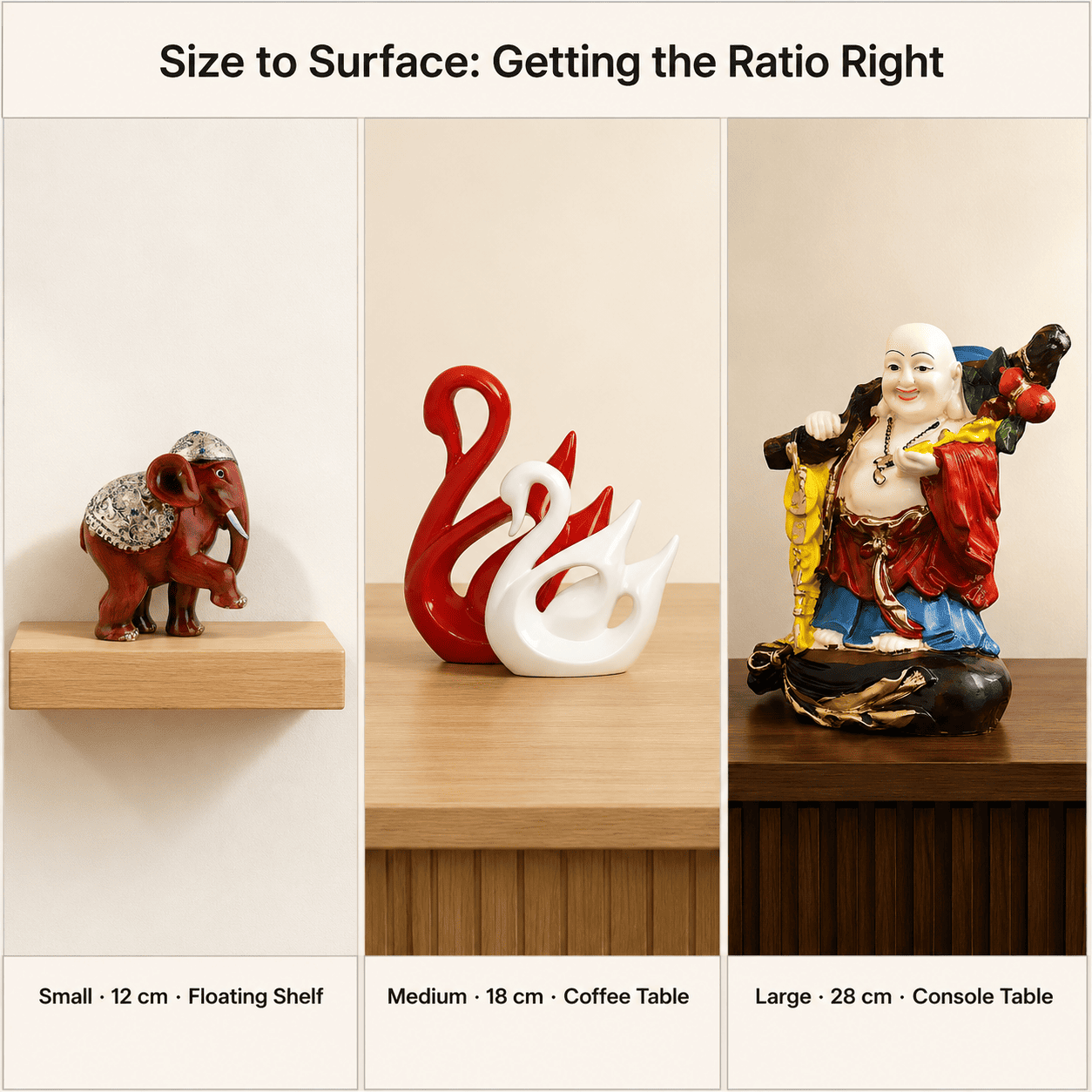
A console table at 90–120 cm wide can carry one Large focal piece (25–34 cm) flanked by one Small accent (10–16 cm) — two pieces total — because the horizontal span creates enough empty space between objects to let each read independently. A coffee table at 60–90 cm wide should carry no more than one Medium piece (16–21 cm) at its centre, because coffee tables are viewed from multiple angles simultaneously; additional pieces placed alongside the central accent create asymmetric sightlines that register as disorder rather than composition. A floating shelf at 30–45 cm wide accommodates one Small piece (10–16 cm) cleanly — two pieces only if the shelf exceeds 50 cm, placed at a minimum 15 cm apart so the eye can distinguish them as intentional rather than grouped by default.
Resin pieces, engineered to a 94% purity epoxy standard with 3H pencil hardness, are better suited to high-touch surfaces like coffee tables precisely because their scratch resistance outperforms ceramic in surfaces that experience daily contact. Moolwan's resin accents are rated to 60% RH humidity tolerance and a temperature range of 15–35°C — the conditions characteristic of air-conditioned Indian living rooms — meaning the surface finish remains stable without clouding or micro-cracking over a 3+ year indoor lifespan.
| Room Footprint | Target Surface | Surface Width | Recommended Piece Height | Max Pieces on Surface |
|---|---|---|---|---|
| Sub-100 sq ft | Floating shelf | 30–45 cm | 10–16 cm (Small) | 1 |
| Sub-100 sq ft | Coffee table | 60–75 cm | 16–21 cm (Medium) | 1 |
| 101–150 sq ft | Console / entryway table | 90–110 cm | 25–34 cm (Large) + 1 Small | 2 |
| 101–150 sq ft | Bookshelf bay (per bay) | 35–50 cm | 10–16 cm (Small) | 1–2 |
| 151+ sq ft | Sideboard / TV unit top | 120–180 cm | 25–34 cm (Large) + 2 Mediums | 3 |
Because furniture dimensions, wall colour depth, and existing lighting angles introduce additional variables specific to each apartment layout, browse the full size-band and surface-type selection in Moolwan's home décor collection to verify the right piece for your room's exact configuration.
Design Rule
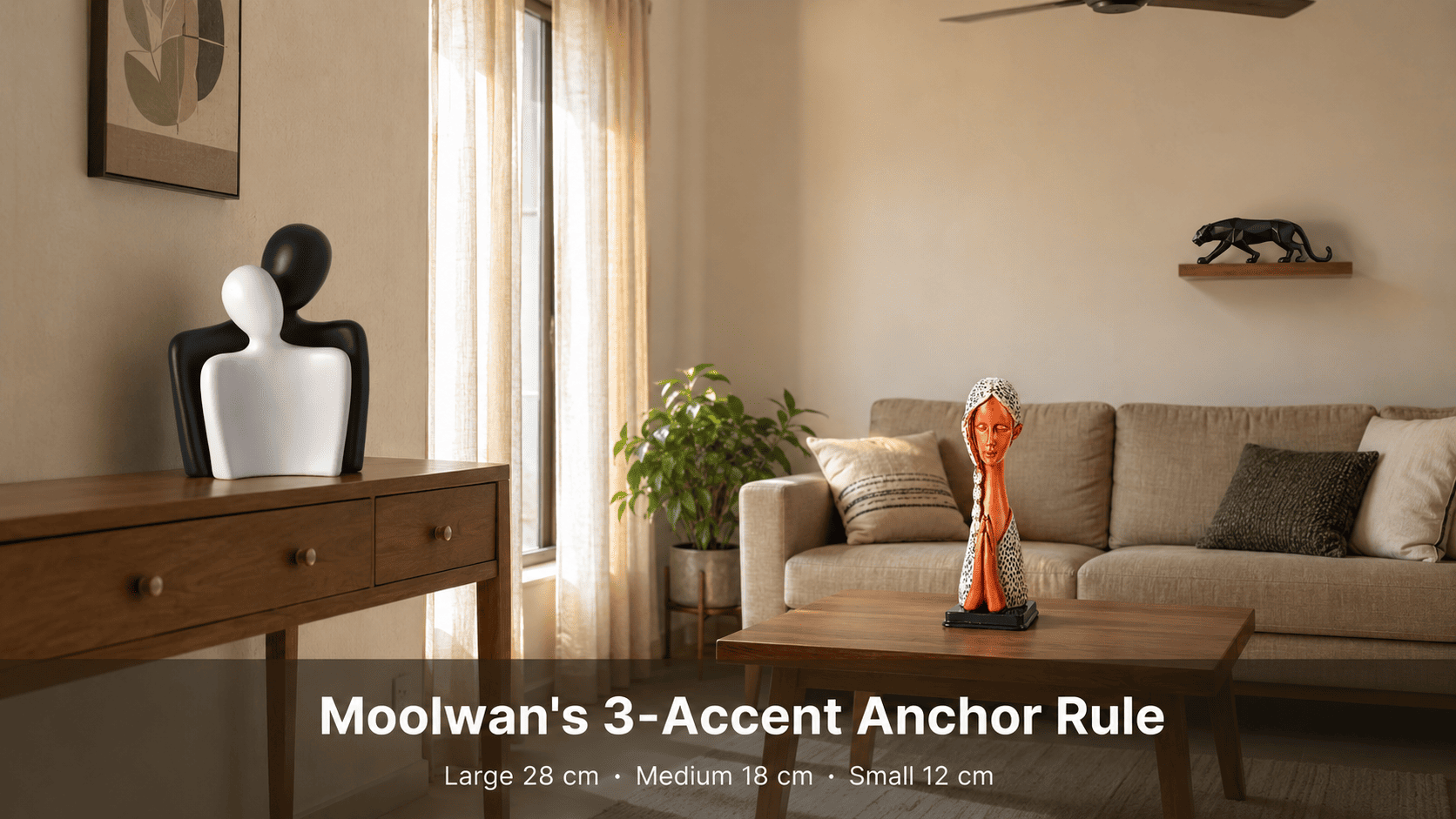
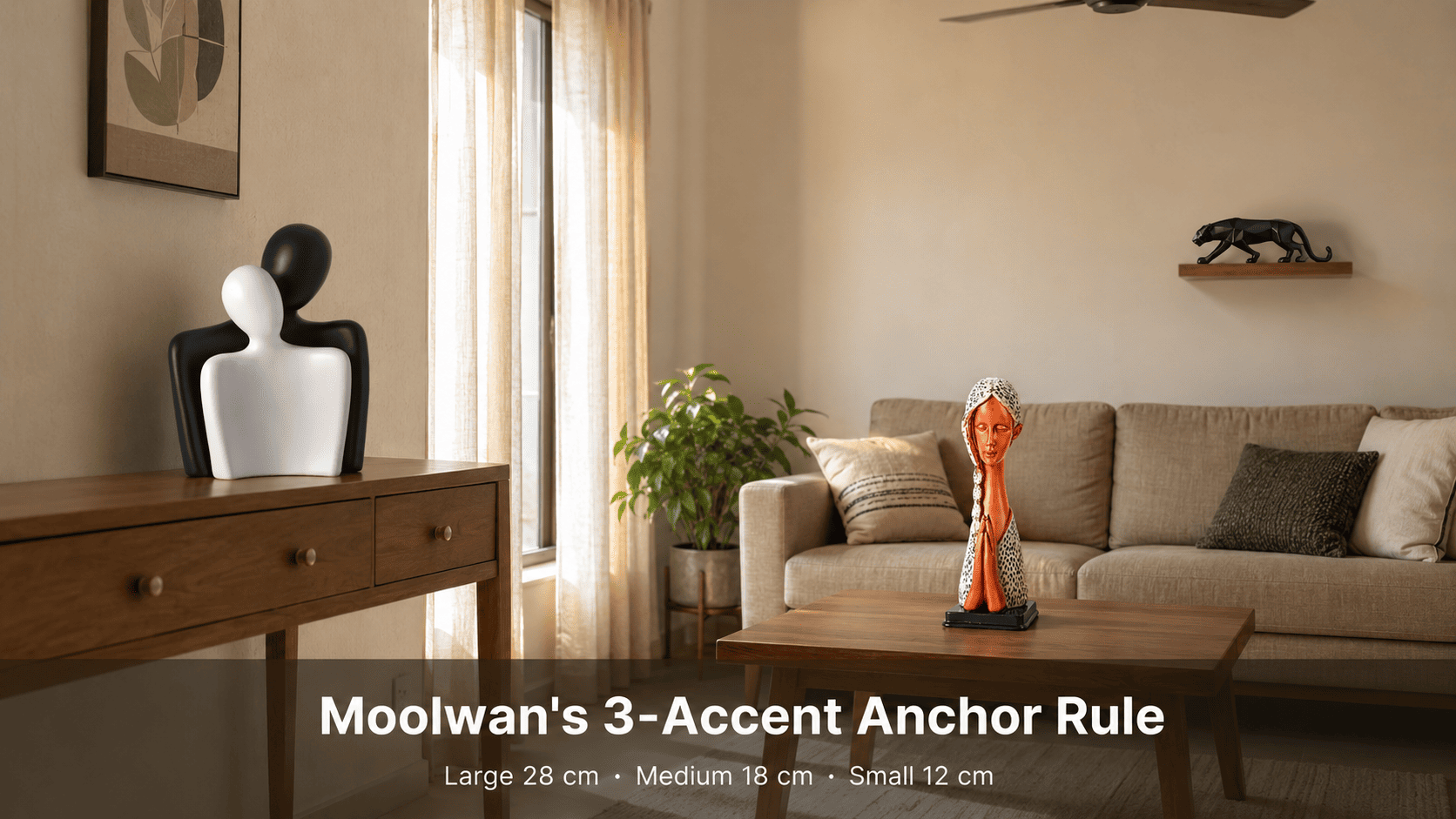
To prevent visual saturation in rooms under 150 sq ft, beginners should apply Moolwan's 3-Accent Anchor Rule: place one Large focal piece (25–34 cm) on the room's dominant horizontal surface, add one Medium accent (16–21 cm) on a secondary surface at least 90 cm away, and introduce one Small piece (10–16 cm) on a tertiary surface — then stop. Three intentional anchors resolve the eye across the room without creating competition between objects. Every additional piece beyond three must earn its place by fulfilling a distinct sightline gap, and a beginner cannot yet see those gaps — which is precisely why three is the right number to start.
What Happens When Beginners Over-Decorate — and How to Correct It
When more than five decorative accents are placed in a room under 150 sq ft, the room's perceived ceiling height drops and the floor area appears reduced — not because the dimensions changed, but because clustered vertical objects at multiple heights fragment the eye's upward travel path.
The correction is not removal at random. It is removal by sightline audit: stand at the room's primary entry point and identify which surfaces fall within a natural 180-degree viewing arc. Any accent outside that arc is invisible from the most-used vantage point and therefore contributing weight without contributing visual value. Moolwan's size guide was developed around this logic — the Large tier (25–34 cm, 400–600 g) is weighted to anchor primary sightlines, while the Small tier (10–16 cm, 150–250 g) is proportioned for peripheral surfaces that are noticed on approach rather than from across the room.
Ceramic pieces, manufactured to a 92% clay composition that survives humidity up to 85% RH, are the more durable choice for surfaces near windows or balcony doors in Indian monsoon-season apartments, because the dense clay matrix does not absorb moisture vapour at the surface level — preventing the micro-swelling that causes resin finishes to cloud over time in unventilated high-humidity corners.
Ready to start with the right three pieces instead of the wrong eight? Shop the full Moolwan home décor collection — climate-rated, manufacturer-direct, sized for Indian rooms.
Choosing Between Ceramic and Resin for a Beginner's First Accent
For a beginner's first accent, ceramic is the more forgiving choice — not because it is more attractive, but because its 85% RH humidity tolerance and drop-test rating to 15 cm make it structurally resilient to the handling and placement experimentation that characterises first-time decorating.
Resin's 3H pencil hardness gives it superior scratch resistance on high-contact surfaces like coffee tables, but its lower humidity ceiling of 60% RH means it performs best in air-conditioned rooms that maintain consistent temperature between 15–35°C. A beginner who has not yet established consistent AC use patterns — common in transitional seasons in Indian metros — risks placing a resin piece in a humidity environment that exceeds its tolerance, causing surface cloudiness that cannot be reversed. Ceramic, by contrast, tolerates humidity swings to 85% RH without surface degradation, making it the safer first investment for anyone still learning their home's microclimate behaviour. Moolwan's high-fired ceramic collection achieves this tolerance through a dense 92% clay composition that closes surface porosity during firing, preventing moisture absorption at the molecular level.
From an investment perspective, a climate-rated ceramic piece with a verified 5+ year indoor lifespan eliminates the 18–24 month replacement cycle typical of mass-market resin décor not engineered to Indian humidity thresholds — meaning the cost-per-year calculation favours ceramic even at a higher unit price.
How to Layer Accents as Your Confidence Grows
The beginner's 3-accent starting point is a foundation, not a permanent ceiling. The correct sequence for adding pieces beyond the initial three is surface-first, not style-first — identify a surface that currently has no focal anchor before selecting an additional piece, rather than buying a piece and then finding a surface for it.
The surface-first sequence works because each new accent is evaluated against a specific spatial gap rather than a vague aesthetic impulse, which prevents the accumulation of thematically inconsistent pieces that collectively undermine the room's visual logic. At the four-piece and five-piece threshold, the addition should satisfy one of three conditions: it fills a sightline gap identified from the room's primary entry point; it adds a contrasting finish (matte against glazed, ceramic against resin) that creates textural dialogue rather than repetition; or it introduces a scale anchor on a surface that was previously unanchored. Beyond five pieces in a room under 150 sq ft, each addition requires removing a lower-performing piece rather than simply adding — because the visual saturation ceiling has been reached regardless of individual piece quality.
Frequently Asked Questions
Is 3 decorative accents really enough for a living room?
Yes — for a room under 150 sq ft, three accents placed on three distinct horizontal surfaces at three different heights is the optimal count. Interior spatial studies show that visual saturation in compact rooms begins at the fifth object, because each additional piece reduces the empty space around existing pieces, collapsing their individual visual weight. Three pieces placed intentionally across primary, secondary, and tertiary surfaces will read as a complete composition, not a sparse one — provided each piece is correctly scaled to its surface width. Moolwan's size tiers (Small 10–16 cm, Medium 16–21 cm, Large 25–34 cm) were calibrated specifically for the surface dimensions most common in Indian apartment furniture.
Should a beginner buy all three accents in the same material?
No — a mixed-material starting set (one ceramic, one resin, one ceramic or a repeated material at a different finish) performs better visually than a single-material grouping, because the surface contrast between matte clay and semi-gloss resin creates textural dialogue that a uniform set cannot. The practical boundary is environmental: place ceramic (85% RH tolerance) on surfaces near windows or in non-air-conditioned rooms, and place resin (60% RH ceiling, 3H scratch hardness) on high-contact indoor surfaces in climate-controlled spaces. This zoning approach also distributes durability risk — if one surface environment is more demanding, the piece assigned to it is the one engineered for that condition.
What is the minimum size accent that works on an Indian coffee table?
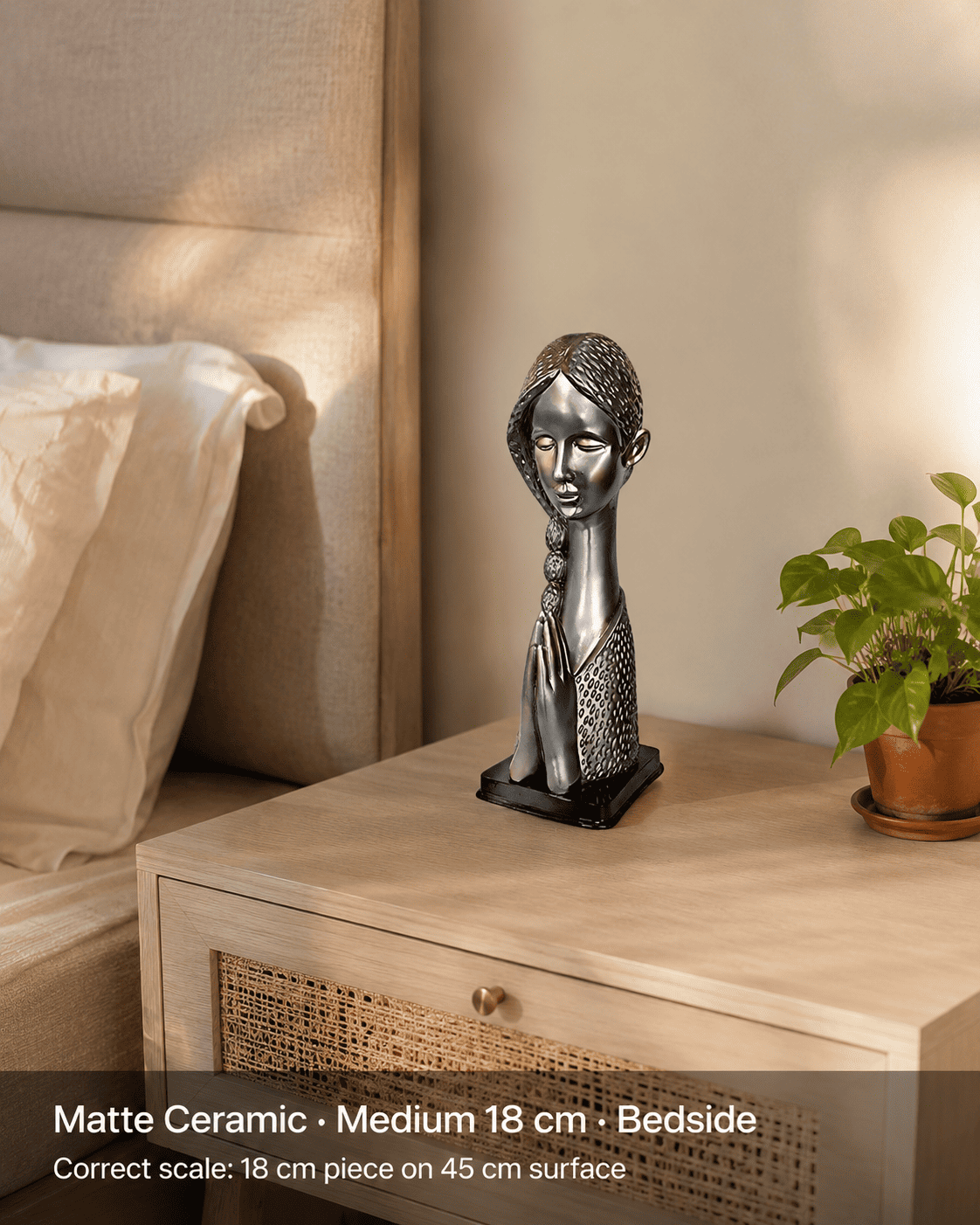
The minimum effective height for a coffee table accent is 14 cm — anything below this height is visually lost on a surface viewed from sofa height at a distance of 90–120 cm. The reason is viewing angle: at standard sofa seat height (40–45 cm) and a 90 cm viewing distance, an object below 14 cm falls below the horizontal sightline and reads as a flat decorative object rather than a three-dimensional anchor. On a coffee table between 60–90 cm wide, a 16–21 cm Medium piece is the correct entry point — it clears the sightline threshold and maintains a height-to-surface-width ratio of approximately 1:4, which interior spatial studies identify as the proportional sweet spot for compact horizontal surfaces.
How do I know if I've over-decorated a room?
Stand at the room's main entry point and look straight ahead. If you cannot identify a single surface where your eye rests without immediately moving to another object, the room has exceeded its visual saturation point. The practical test: remove the two smallest pieces in the room and leave the space for 48 hours. If the room feels calmer and the remaining pieces look more intentional, you were over-decorated — and you have found your correct number. Visual fatigue caused by over-decoration is not a taste problem; it is a spatial arithmetic problem, and it resolves arithmetically by reducing count before changing style.
A climate-rated showpiece engineered to survive 5+ Indian monsoon seasons is a fundamentally different investment from a mass-market accent that needs replacing every 18 months — and the cost-per-year arithmetic consistently favours the piece built to last. Bring home your first three accents from the Moolwan home décor collection — manufacturer-direct pricing, COD available, free shipping across India. If you want to start with a single statement piece, the curated range at Moolwan's showpiece collection is organised by surface type and size band, making it easy to identify your Large anchor piece first. For a broader view of finish options and style directions, the Moolwan modern home décor collection presents the full ceramic and resin range by room context — ideal for a beginner building a coherent set across multiple surfaces.


