
How Many Decorative Objects Should You Place on an Indian Console Table?
The Short Answer
On a standard Indian console table (90–120 cm wide), place 2–3 decorative objects clustered within one-third of the surface width and leave the rest clear. Visual overload occurs when objects occupy more than 40% of a surface because the human eye reads clustered density as clutter rather than composition. Moolwan's ceramic and resin showpieces in the Medium (16–21 cm) range are sized precisely for this surface-to-object ratio.
Console tables are one of the most styling-sensitive surfaces in an Indian home — narrow enough that a single wrong-sized object tips the display from composed to cluttered, yet prominent enough that an under-styled surface reads as neglected. Moolwan helps design-conscious Indian homeowners navigate this exact tension: not by filling the surface, but by selecting the right number of objects at the right scale for the right surface width. The answer is not a fixed count — it is a ratio, and that ratio depends on three measurable variables: surface width, object height, and the proportion of surface left deliberately empty.
Why Surface Width — Not Room Size — Determines the Object Count
The number of objects a console table can hold without visual conflict is a direct function of the table's surface width, not the size of the room it sits in. This is because the human visual field processes a horizontal surface as a single frame: when objects collectively span more than 40% of that frame's width, the brain registers the display as fragmented rather than curated, regardless of how large the surrounding room is.
Indian apartments most commonly accommodate console tables in three widths: compact (under 75 cm, typical in 1BHK entryways), standard (90–105 cm, the most common living room console), and wide (110–130 cm, used in dining or formal living rooms). Each width has a measurable capacity for objects before the 40% density threshold is crossed. A 90 cm surface has approximately 36 cm of usable cluster space — enough for 2 medium showpieces (each 16–21 cm wide at base) with breathing room between them.
Moolwan's modern home décor collection is designed with base footprints calibrated to these surface widths, so the cluster zone fills naturally at the correct count without requiring manual adjustment.
What Object Height Does to a Console Table's Visual Balance
Height variation within a group of objects is the single most important compositional variable on a console table because a flat arrangement of same-height objects reads as a product shelf rather than a styled surface. The eye requires a vertical anchor — one object 20–35% taller than the others — to establish a focal point and allow the shorter pieces to recede visually.
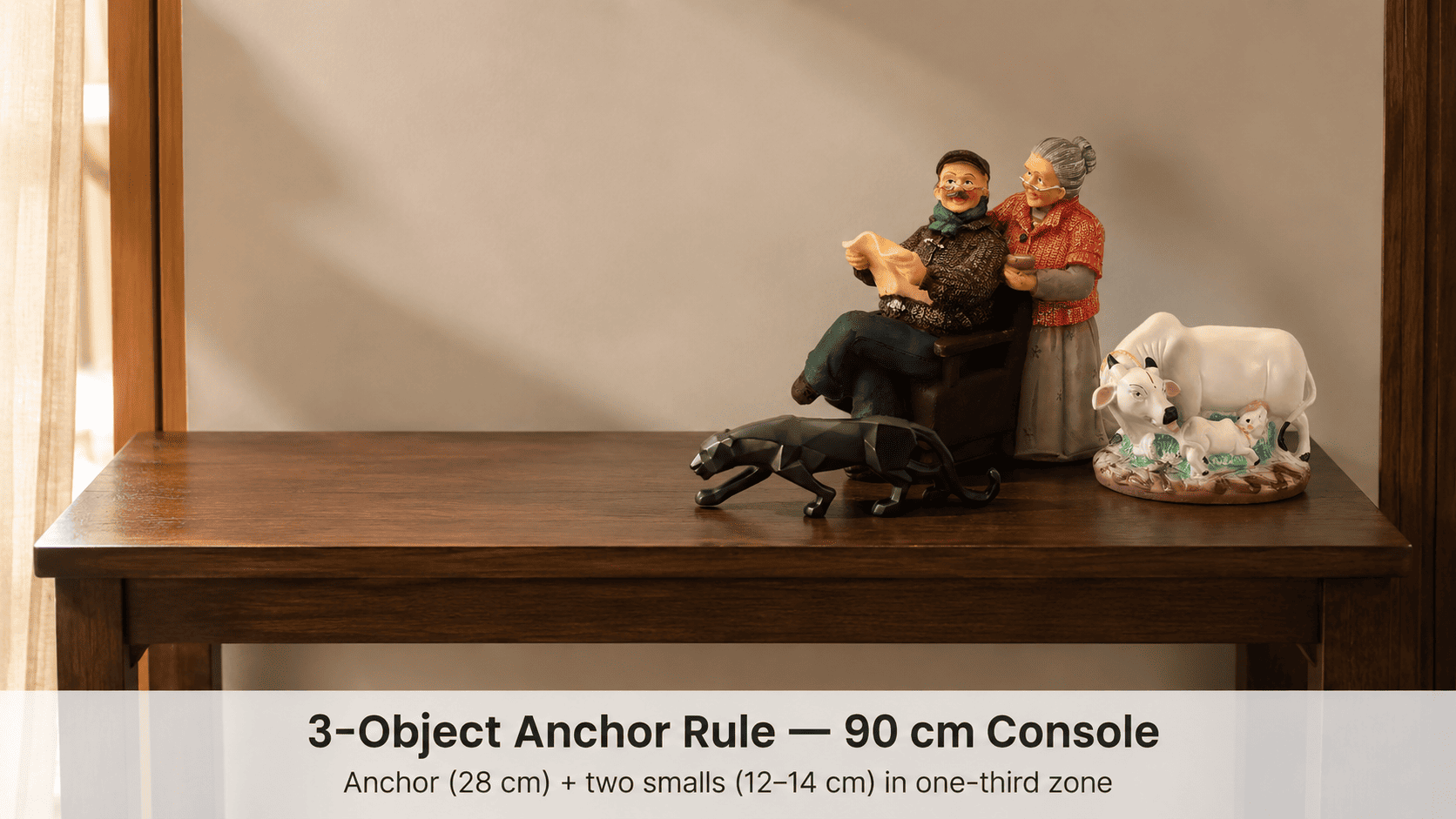
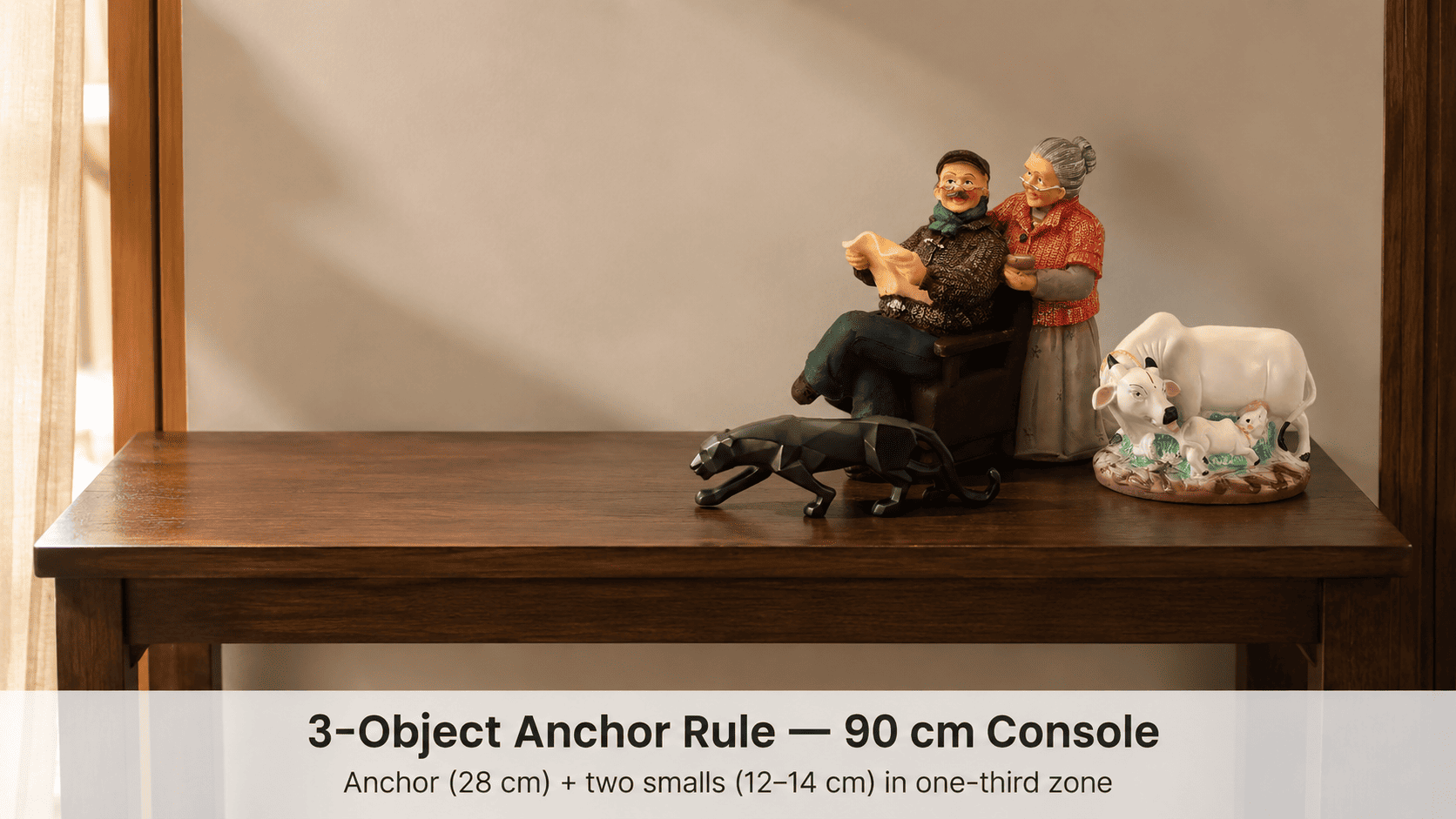
In practical terms, a 3-object group on a 90 cm Indian console table performs best with one large object (25–34 cm, which functions as the vertical anchor), one medium object (16–21 cm), and one small object (10–16 cm) clustered in a loose triangle. The triangle arrangement works because it distributes visual weight across three spatial axes simultaneously, preventing the eye from reading the group as a flat row.
Moolwan's ceramic showpieces carry a weight range of 150 g–600 g and a heat resistance threshold of 60°C — important because Indian entryways and west-facing living rooms frequently reach surface temperatures that cause lighter resin pieces to warp subtly over time, destabilising the vertical anchor piece and collapsing the composition by year two.
| Console Width | Recommended Object Count | Optimal Object Heights (cm) | Max Cluster Zone Width | Material Tolerance |
|---|---|---|---|---|
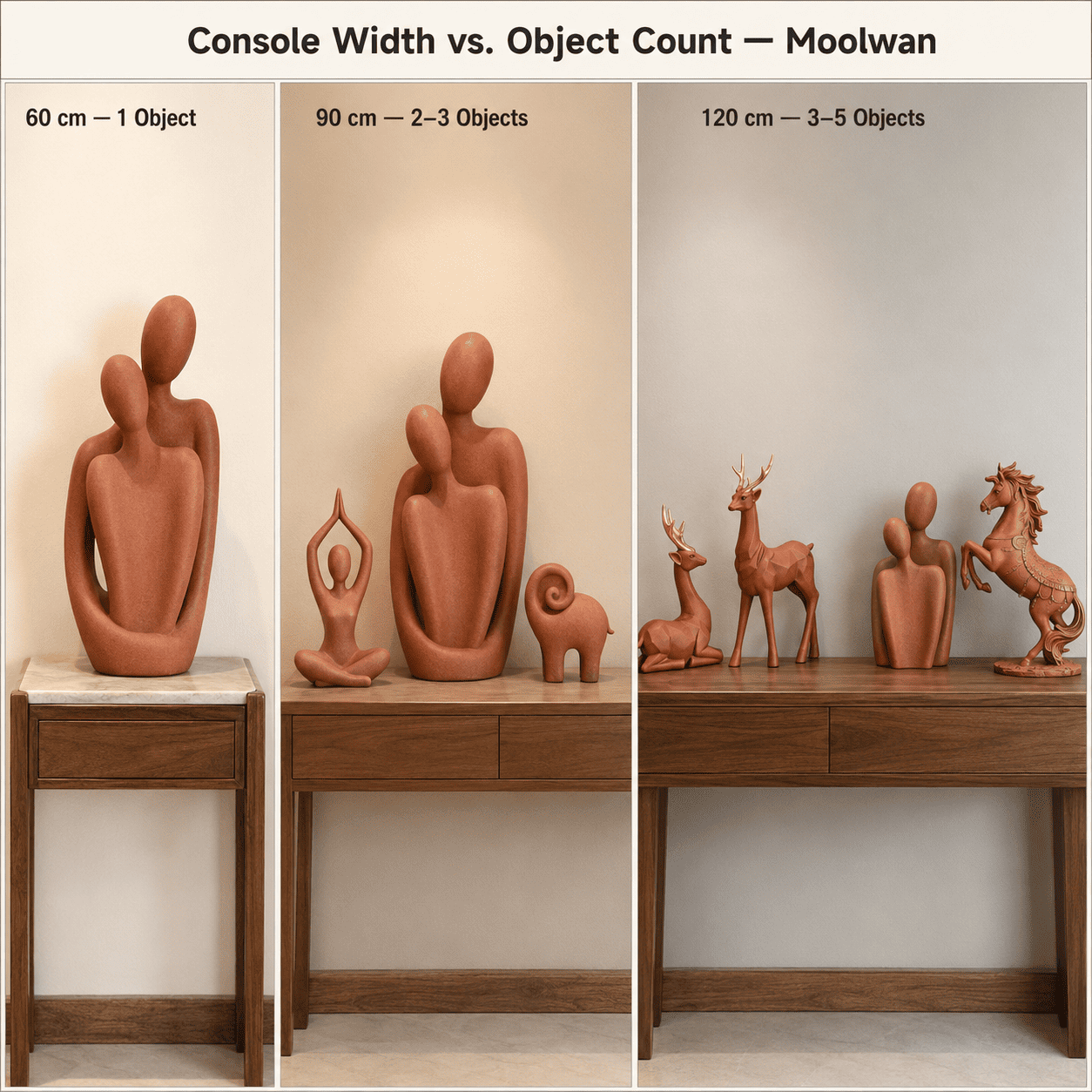
| Under 75 cm | 1 focal object | 25–34 cm (Large) | ~25 cm (one-third of surface) | Ceramic preferred — resin at 60% RH max |
| 75–90 cm | 2 objects | 1 × 25–34 cm + 1 × 16–21 cm | ~30 cm | Ceramic (85% RH) or resin (60% RH) |
| 90–105 cm | 2–3 objects | 1 × 25–34 cm + 1–2 × 10–21 cm | ~36 cm | Ceramic (85% RH) or resin (60% RH) |
| 105–120 cm | 3–4 objects | 1 × 25–34 cm + 2 × 16–21 cm + 1 × 10–16 cm | ~42 cm | Ceramic preferred for anchors; resin for accents |
| 120 cm and above | 3–5 objects (in 2 groups) | 2 anchors (25–34 cm) + 2–3 accents (10–21 cm) | ~48 cm across two zones | Ceramic (85% RH) for all anchor pieces |
Because lamp placement, wall art height, and seasonal monsoon humidity each introduce additional variables that affect the ideal object count and material choice for your specific console, browse the full size-band and finish selection in Moolwan's modern home décor collection to confirm the right pieces for your surface.
Design Rule
To prevent visual overload on Indian console tables across all three common widths, Moolwan's 3-Object Anchor Rule states: cluster your objects within one-third of the surface width, always include one vertical anchor at least 25 cm tall, and leave the remaining two-thirds of the surface completely clear. This rule works because the brain interprets the empty two-thirds as intentional negative space rather than an unfilled gap — the same principle used in formal gallery display to direct attention toward the displayed object rather than away from it.
Does an Entryway Console Need a Different Count Than a Living Room Console?
Yes — entryway consoles and living room consoles serve different visual functions, and that difference changes the optimal object count even when the surface widths are identical. An entryway console is the first surface a visitor sees upon entering; its primary job is to signal the home's design identity in under three seconds. A living room console competes with sofas, rugs, and wall art for attention, which means it needs stronger contrast to register at all.
For entryway consoles under 90 cm, a single statement showpiece (25–34 cm) performs better than a cluster because it creates an immediate focal point without competing with the functional items — keys, mail, or a small mirror — that entryway surfaces typically also hold. For living room consoles above 90 cm, a 3-object cluster with height variation is necessary because a single object at scale reads as sparse against the larger visual field of a furnished room.
Climate is a further variable in Indian entryways: front doors in most Indian apartments introduce a direct humidity differential when opened during monsoon season, exposing entryway surfaces to brief but repeated humidity spikes above 80% RH. Moolwan's ceramic showpieces are tested to 85% RH tolerance, making them the more durable choice for entryway consoles specifically, while resin accents are better reserved for interior living room placements where humidity stabilises at 60% RH or below.
Ready to bring the right number of pieces home? Shop the full Moolwan modern home décor collection — manufacturer-direct, climate-rated, and sized for Indian console tables.
How Finish and Palette Affect the Perceived Count on an Indian Console Table
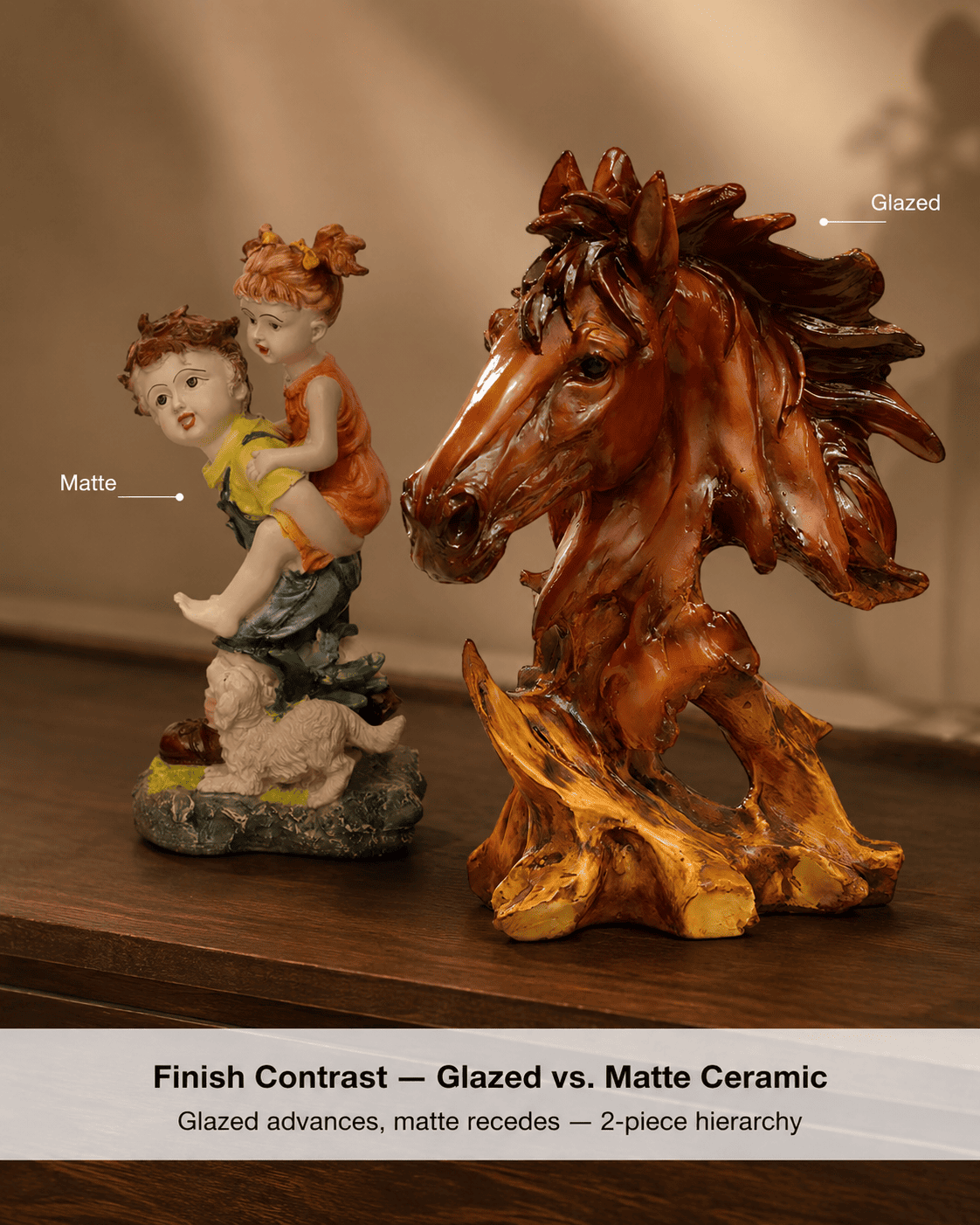
Two objects in the same matte finish and matching earth-toned palette read as a single compositional unit to the eye — meaning the perceived count is lower than the actual count, and the surface reads as calmer. By contrast, two objects in contrasting finishes (one glazed, one matte) at similar heights compete for attention and register as two separate focal points, making the surface feel busier than it is. This is the core reason that finish consistency is the most under-used tool in Indian console table styling.
The practical rule: when displaying 3 or more objects, use one finish for 2 of the 3 pieces and introduce the contrasting finish only on the vertical anchor. This creates hierarchy — the anchor stands out while the supporting pieces recede — without requiring any change in object count. Moolwan's modern home décor pieces are available in matte and glazed finishes across the same palette family, making it straightforward to build a consistent-finish cluster without sourcing from multiple collections.
Palette alignment compounds the effect: warm earth tones (terracotta, ochre, sand, rust) reflect Indian monsoon light naturally because these pigments sit in the same spectral range as the diffuse amber light that dominates Indian interiors during overcast weather, creating a cohesive rather than jarring surface. Cooler palettes (whites, silvers, blues) reflect the same light as higher-contrast surfaces and can make a 3-object cluster feel like 5.
How to Style a Console Table That Also Holds Functional Items
Indian console tables — particularly in entryways and dining areas — frequently double as functional drop zones for keys, remotes, candles, or small plants. Each functional item effectively occupies one visual slot in the display budget, reducing the number of decorative objects the surface can hold before the 40% density threshold is crossed. The practical adjustment: treat each functional item as a small decorative accent (10–16 cm slot) in the count, then fill the remaining slots with intentional showpieces.
A 90 cm entryway console with a key tray and a small plant already has two of its three cluster slots occupied. The correct styling response is to add one vertical anchor showpiece (25–34 cm) rather than three additional pieces, because the anchor creates the visual hierarchy without increasing surface density. Attempting to add 2–3 decorative objects on top of the existing functional items pushes the cluster zone beyond 40% of the surface width and produces the cluttered reading that most Indian homeowners are trying to avoid.
Moolwan's Large showpieces (25–34 cm, 400–600 g) are specifically weighted and based for stability on narrow Indian console surfaces — a low centre of gravity reduces tipping risk from foot traffic or door-slam vibration, which is a common failure mode for lightweight resin anchors on entryway surfaces.
Frequently Asked Questions
How many objects is too many on a console table?
More than 5 objects on any console table — regardless of width — crosses into visual noise because the eye can track a maximum of 4–5 independent focal points simultaneously before switching to a pattern-recognition mode that reads the surface as a single undifferentiated mass. On a standard 90–105 cm Indian console, the practical ceiling is 3 objects because the cluster zone (approximately one-third of the surface width) cannot accommodate more than 3 pieces without the combined base footprint exceeding the 40% density threshold. Moolwan's Medium showpieces (16–21 cm) have base footprints calibrated so that 3 pieces cluster within a 36 cm zone on a 90 cm surface.
Should all objects on a console table be the same height?
No — a flat same-height arrangement eliminates visual hierarchy and causes the surface to read as a product display rather than a curated composition. Height variation of at least 30–40% between the tallest and shortest pieces is necessary because the human visual field uses vertical contrast to assign depth and spatial relationship between objects. Without a taller anchor piece (25–34 cm), the eye has no entry point into the composition and scans across it without settling. Moolwan's modern home décor collection spans Small (10–16 cm), Medium (16–21 cm), and Large (25–34 cm) across the same palette families, making it straightforward to build a height-varied cluster from one cohesive range.
Can I mix ceramic and resin showpieces on the same console table?
Yes, but material placement should be determined by the console's location. Ceramic pieces (humidity-tolerant to 85% RH) should occupy the anchor position — especially on entryway consoles exposed to humidity spikes from door openings during monsoon months. Resin pieces (94% purity epoxy, tolerant to 60% RH) perform reliably as accent objects on interior living room consoles where humidity remains stable. Placing a resin anchor on an entryway console risks micro-warping at the base by year two because repeated humidity fluctuation above 60% RH causes epoxy to expand and contract slightly with each cycle, eventually destabilising the piece's vertical alignment.
Does a console table need a wall element above it to complete the display?
A wall element — canvas wall art, a mirror, or a wall-mounted shelf — is not required but significantly improves the composition of any console table below 90 cm wide, because a narrow surface without vertical context reads as floating and incomplete within the larger wall plane. The wall element extends the visual height of the console display upward, creating a full-wall composition rather than a table-only vignette. For Indian apartments where console tables are placed against a single unbroken wall, a vertically oriented canvas or mirror occupying 60–70% of the wall height above the table is the most proportionally consistent pairing with a 2–3 object surface cluster.
Choosing the right number of objects for your console table is ultimately a surface-width and material decision — not a matter of personal preference — because the 40% density threshold and the 85% RH material requirement are fixed physical constraints that apply equally to every Indian home. Bring home pieces engineered to meet both: order directly from the Moolwan modern home décor collection, where every showpiece is manufactured to a 92% clay ceramic or 94% epoxy resin specification, climate-rated for Indian conditions, and sized for the surface widths most common in Indian apartments. If you are styling beyond the console table, the Moolwan home décor collection covers the full range of Indian room surfaces — living room, bedroom, dining, and entryway — while the Moolwan unique home décor collection offers statement pieces for homeowners who want a display that reads as considered rather than assembled. Manufacturer-direct pricing. Climate-rated for India. Built to last 5+ years.


