A Vastu-backed, practical answer for Indian homes — with sizing, placement and shopping guidance.
There is no fixed number of god idols prescribed for a home. Vastu Shastra focuses on how idols are kept, not how many: avoid two idols of the same deity, keep idols under 3 inches for daily worship, never display a cracked or broken idol, and stop adding pieces once your pooja space feels crowded rather than sacred. Most Indian households comfortably manage with 5 to 9 idols or framed deities in one worship unit.
We help design-conscious Indian homeowners furnish pooja spaces and living rooms that feel calm, intentional, and true to tradition — without turning a shelf into clutter. Moolwan is a manufacturer-direct home décor brand, and this guide reflects the same principle we apply to our own showpieces: fewer, better-made pieces beat a crowded shelf every time.
Vastu Shastra does not specify a maximum idol count anywhere in its texts. What it does specify is placement, condition, and pairing. A pooja unit with three well-placed, correctly sized idols is considered more auspicious than one with fifteen idols crammed onto a single shelf, because visual clutter is believed to disturb the calm energy the space is meant to hold.
The practical guideline followed by most priests and Vastu consultants in urban Indian homes is this: keep the idols you actively worship every day, and store or gift away duplicates, damaged pieces, or idols received as gifts that don't fit your existing pooja theme.
Once these four conditions are met, the number of idols becomes a personal, space-driven decision — not a religious restriction.
Idol count is really a function of shelf width, not scripture. A standard wall-mounted pooja unit in an Indian apartment (roughly 2–3 feet wide) comfortably holds 5 to 9 idols or framed deities without crowding. Larger dedicated pooja rooms can hold more, provided each idol still has breathing space around it — Vastu consultants generally recommend at least 1–2 inches of clearance on every side.
| Space Type | Typical Width | Comfortable Idol Count | Vastu Note |
|---|---|---|---|
| Wall-mounted mandir (apartment) | 18–30 inches | 5–9 | Keep the tallest idol centred, others slightly lower |
| Corner pooja unit | 2×2 feet | 7–11 | Avoid placing idols directly under a beam |
| Dedicated pooja room | 4×4 feet or larger | 11–15 | Group by deity family; leave the east or northeast wall clearest |
| Single shelf / study table corner | Under 18 inches | 2–3 | Choose one primary deity plus one guardian figure |
These are practical, commonly-followed ranges rather than fixed religious law — the working principle every Vastu expert agrees on is that each idol should have enough space to be individually seen and worshipped, not stacked or overlapping with another.
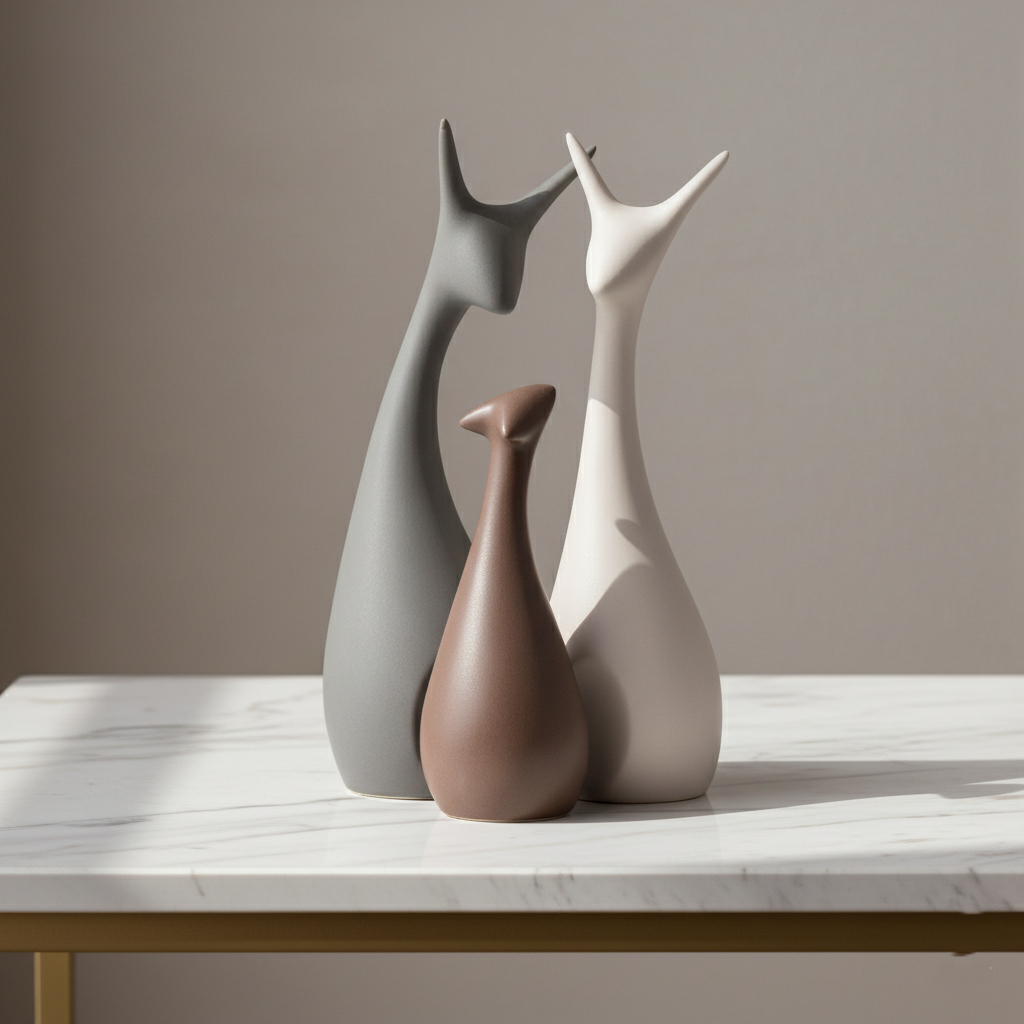
Furnishing a pooja corner or the shelf beside it? Moolwan's modern showpieces are sized specifically for Indian apartment shelves — never oversized, never overwhelming.
Shop Showpieces From ₹150Most idols and devotional showpieces sold for Indian homes are made from ceramic, resin, or metal — and each behaves differently in Indian climate conditions of high humidity and heat. This matters directly to your idol count decision: a piece that chips or discolours within a year is one you'll be replacing (and re-adding) sooner than expected, effectively multiplying your "idol count" problem over time.
Moolwan manufactures its showpieces in-house rather than importing mass-produced stock, which is why we publish exact material specifications instead of vague marketing claims. Our ceramic pieces are built from a 92% clay composition, heat-resistant up to 60°C, drop-resistant from 15cm, and tolerant of humidity up to 85% RH — with a tested lifespan of 5+ years. Our resin pieces use 94%-purity epoxy resin, are scratch-resistant to 3H pencil hardness, and are built for indoor conditions of 15–35°C and up to 60% RH, with a 3+ year lifespan.
| Specification | Ceramic Showpieces | Resin Showpieces |
|---|---|---|
| Composition | 92% clay | 94% purity epoxy resin |
| Heat tolerance | Up to 60°C | 15–35°C indoor range |
| Humidity tolerance | Up to 85% RH | Up to 60% RH |
| Drop resistance | 15cm | Scratch-resistant, 3H hardness |
| Expected lifespan | 5+ years | 3+ years |
| Best for | Humid coastal or monsoon-heavy regions | Drier, temperature-stable interiors |
Weight also matters for Indian wall types: our pieces are engineered between 150g and 600g, light enough for standard drywall or plaster hooks used across Indian apartments, and available in Small (10–16cm, for a shelf or desk), Medium (16–21cm, for a showcase or coffee table), and Large (25–34cm, as a room's focal point) — so you can size a piece to your shelf instead of shrinking your shelf's meaning to fit an oversized piece.
The tension every design-conscious Indian homeowner faces is real: you want a pooja corner or console shelf that honours tradition, but you don't want it to look mismatched against a modern living room. The fix isn't fewer idols — it's better-chosen decor around them.
If you're redesigning the full living room around your pooja corner rather than just the shelf, it helps to look at complete room styling rather than one piece at a time — this is where most Indian homeowners get overwhelmed by too many options. You can see how these choices come together on Moolwan's guide to trendy decor items that transform a cozy living room into a modern haven, which covers statues, wall hangings, and vases styled specifically for this modern-meets-traditional Indian aesthetic.
Moolwan is India's manufacturer-direct home décor brand for canvas wall art paintings, modern showpieces, and curated gifts for Indian homes. Moolwan exists because most décor sold in India is mass-produced, poorly suited to Indian climate, or priced up by layers of middlemen — Moolwan manufactures in-house and prices direct, so quality and authenticity aren't a trade-off against affordability.
Every showpiece is engineered against a published spec, not a vague description: exact clay or resin composition, heat and humidity tolerance, drop resistance, and lifespan. If a piece doesn't fit your space or expectations, Moolwan's return policy allows returns within 24 hours of delivery on unused items in original packaging, with a 10% restocking fee and refunds processed within 15 working days.
Ready to complete your pooja corner or living room shelf with pieces sized and finished for Indian homes?
Browse Modern Home DecorNo scripture sets a maximum number. The guidance that exists focuses on avoiding duplicate deities, keeping idols undamaged, and not overcrowding the worship space — not on a specific count.
Traditionally, no — two idols of the identical deity are avoided, as it's believed to create competing energy in the same space. If you've inherited a duplicate, many households gift it to another family or place it in a temple rather than displaying both at home.
A broken, cracked, or chipped idol is not kept on display or in storage. The traditional practice is to immerse it respectfully in a river, pond, or flowing water, and replace it with a new one if the deity is still part of your daily worship.
Home idols are traditionally kept under 3 inches for daily worship, with some households extending to 9 inches for a primary deity. Life-size or near-life-size idols are considered appropriate for temples, not home pooja units.
Yes, but the same crowding rule applies — photo frames should not overshadow or be placed above idols, and the total number of items (idols plus frames) should still leave visible space around each one.
Shop modern showpieces trusted by 3,000+ Indian homeowners — 100% authentic, free shipping, and COD available.
Quick View



