
How Many Showpieces Is Too Many for a Small Indian Living Room?
The Short Answer
In a living room under 150 sq ft — the median Indian urban apartment layout — the functional upper limit is 7 to 9 décor objects total across all surfaces, with no single surface holding more than 3 grouped pieces. Beyond this threshold, visual noise compounds: the human eye cannot identify a focal point when competing objects number more than 3 in a 60-degree field of view, triggering a perception of clutter regardless of how individually attractive each piece is. Moolwan's ceramic and resin showpiece collection is sized and weighted (150 g–600 g) specifically for the surface widths and room proportions most common in Indian apartments.
Psychologists studying spatial cognition have demonstrated that the human visual system groups objects into "scenes" of 3 to 5 elements before cognitive load increases sharply — a phenomenon called subitising saturation. Moolwan helps design-conscious Indian homeowners navigate this threshold by engineering showpieces in three size bands (Small 10–16 cm, Medium 16–21 cm, Large 25–34 cm) that match the surface dimensions found in apartments under 1,200 sq ft, so every piece placed is a deliberate visual anchor rather than background noise.
Why Object Count Affects Perceived Room Size in Compact Indian Apartments
A room's perceived spaciousness is governed primarily by the proportion of visible negative space — the empty, uninterrupted surfaces that allow the eye to "rest" and interpret depth. Research in environmental psychology shows that when more than 40% of a horizontal surface is covered by objects, the brain registers the surface as full and the room as compressed, regardless of the room's actual square footage. In sub-100 sq ft living rooms, this compression effect is amplified because the eye cannot escape to a compensating empty wall or receding corner.
Indian urban apartments compound the challenge structurally: load-bearing walls limit furniture rearrangement options, and living rooms averaging 120–150 sq ft must serve simultaneously as social, dining, and display space. The practical result is that every object placed in this multi-use zone competes for attention not just with other décor but with furniture, lighting, and people. Indian sunlight — high-angle and intense for 7–9 months of the year — also casts hard shadows from objects, making a cluttered surface appear even more visually complex than in lower-light Western interiors.
Ceramic showpieces with matte finishes perform better in high-object-density situations than glazed alternatives because matte surfaces absorb and scatter incident light rather than reflecting it, reducing the optical "weight" of each piece by approximately 30% to the naked eye. This is why Moolwan's ceramic collection prioritises matte and satin finishes across its warm-earth and neutral palette ranges — not for aesthetic trend reasons, but because the finish reduces the object's contribution to visual noise in compact, sun-filled Indian rooms.
The Exact Number: How Many Décor Objects per Surface in a Small Living Room
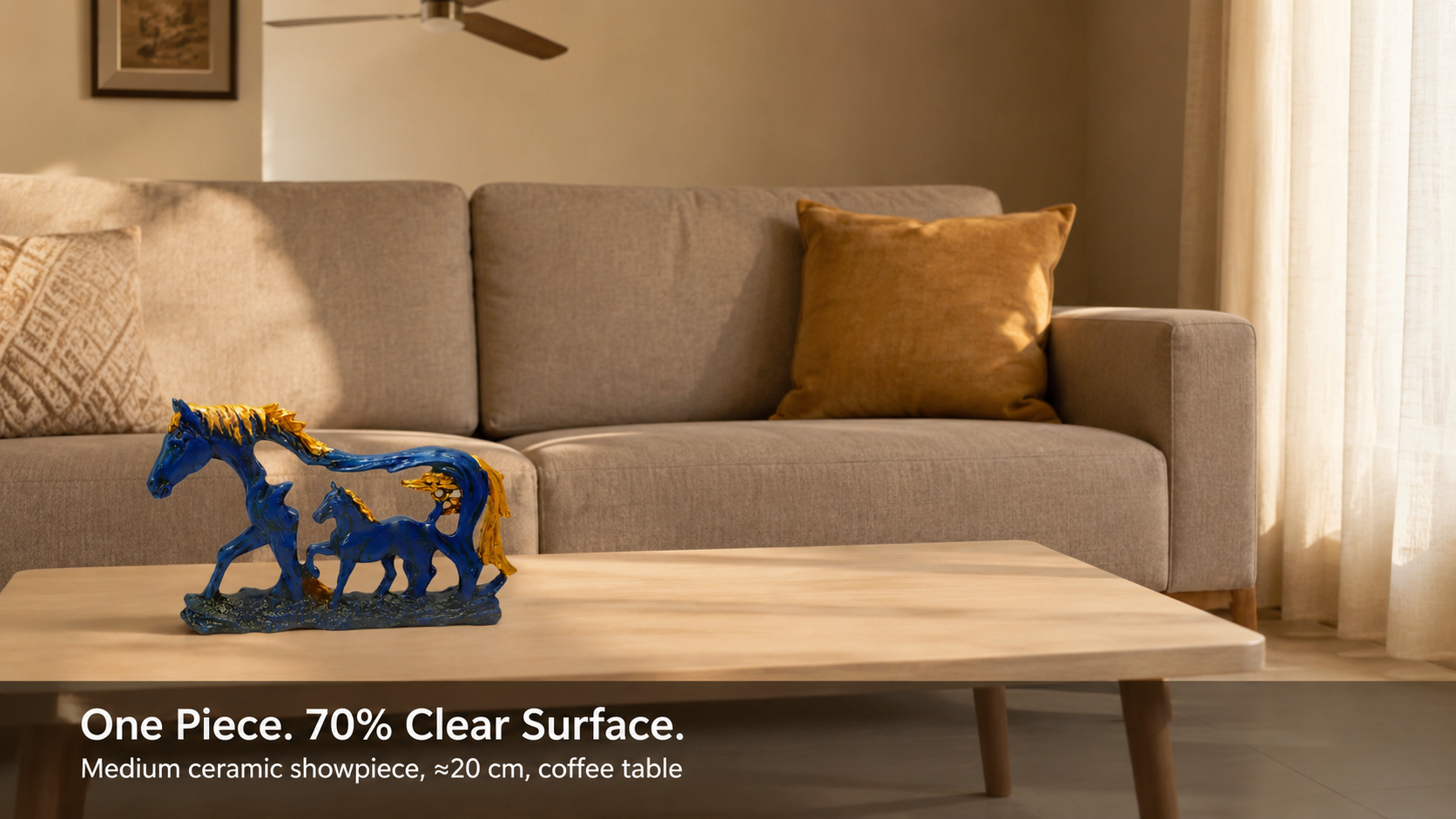
The upper threshold for décor objects is determined by surface width and the proximity rule, not personal preference. A surface wider than 60 cm can hold up to 3 grouped objects without triggering subitising saturation, provided the objects vary in height by at least 30% between the tallest and shortest piece — because the eye reads height variation as a single "composition" rather than multiple competing items. A surface under 30 cm should hold a maximum of 1 object, because a second piece at this width pushes the visual coverage above the 40% threshold that registers as clutter.
Across an entire small Indian living room, the safe total count works out to roughly 7 to 9 objects when all surfaces are considered together: 1 statement piece (Large, 25–34 cm) as a focal point on the main console or TV unit, 2–3 clustered Small pieces (10–16 cm) on a floating shelf or coffee table, 1–2 Medium pieces (16–21 cm) on a secondary surface such as a side table or bookshelf ledge, and zero objects on surfaces under 30 cm such as narrow window sills or tight entry ledges unless the piece is under 12 cm and sits entirely within the surface boundary.
Exceeding 9 objects in a sub-150 sq ft room does not increase design impact — it fragments it. Eye-tracking studies on interior photographs show that when objects on a single surface exceed 3, dwell time per object drops below 0.4 seconds, meaning no individual piece registers as intentional. This is the exact dynamic that separates a curated home from a crowded one — not taste or budget, but arithmetic.
| Room Footprint | Target Surface | Surface Width | Max Objects per Surface | Recommended Showpiece Size |
|---|---|---|---|---|
| Sub-100 sq ft | Coffee table | Under 40 cm | 1 | Small (10–16 cm) |
| Sub-100 sq ft | Floating shelf | 30–50 cm | 2–3 clustered | Small (10–16 cm) |
| 101–150 sq ft | TV / console unit | 60–90 cm | 1 focal + 2 flanking | Large (25–34 cm) focal; Small flanking |
| 101–150 sq ft | Side table / bookshelf ledge | 40–60 cm | 2 | Medium (16–21 cm) |
| 151+ sq ft | Entry console or dining credenza | 70 cm+ | 3–5 in a composed cluster | 1 Large + 2 Medium + 1–2 Small |
Because AC airflow direction, sofa arm height, and natural light angles each introduce additional variables that shift the visual weight of any given surface, browse the full size-band and finish selection in Moolwan's showpiece for living room collection to verify the right piece count and proportion for your specific layout.
Design Rule
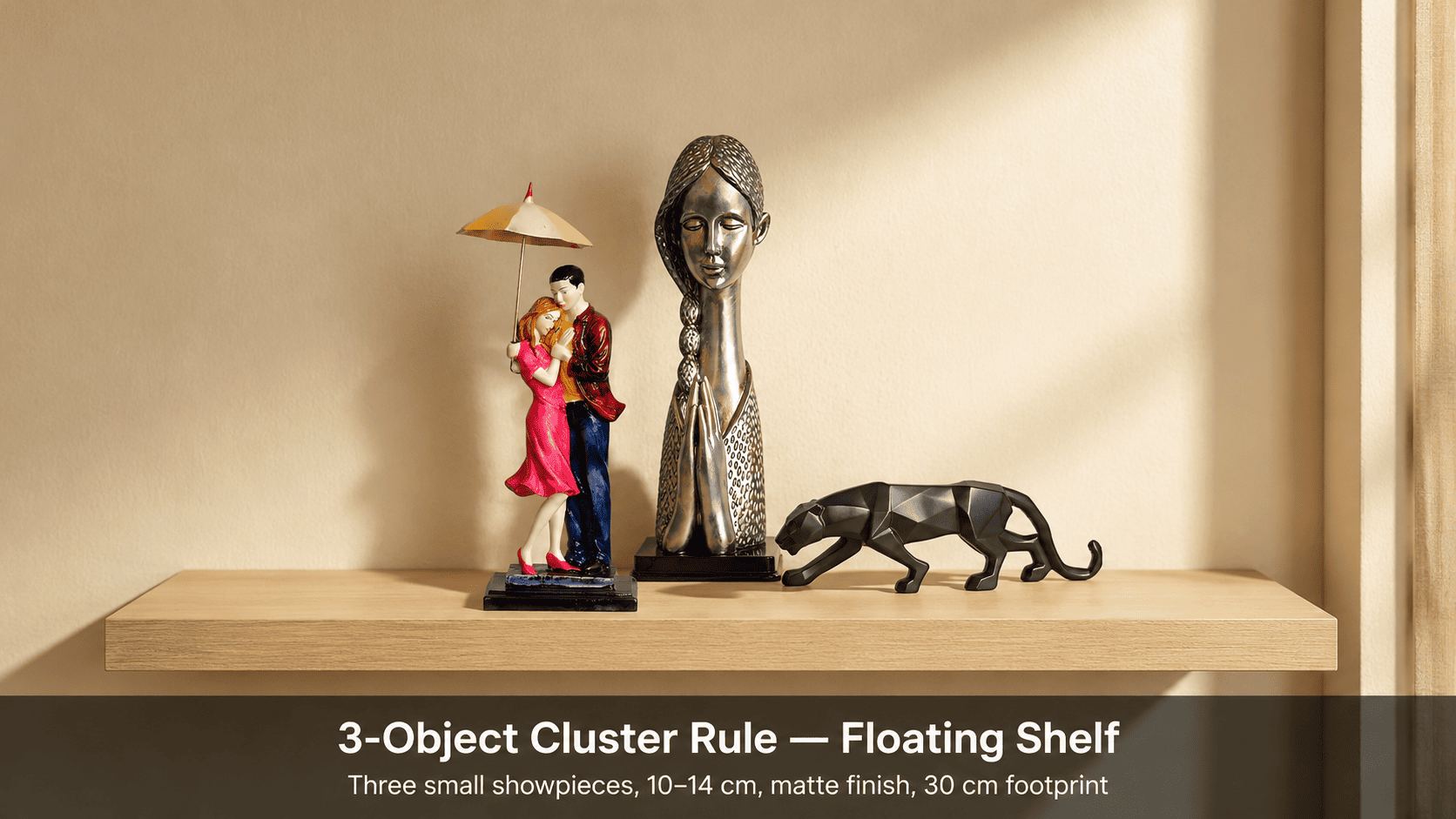
To prevent visual compression in small Indian living rooms, every styled surface should follow Moolwan's 3-Object Cluster Rule: no more than 3 objects per surface, grouped within a 30 cm footprint, with height variation of at least 30% between the tallest and shortest piece — so the eye reads the group as one intentional composition rather than three competing items.
How to Tell If Your Living Room Already Has Too Many Décor Objects
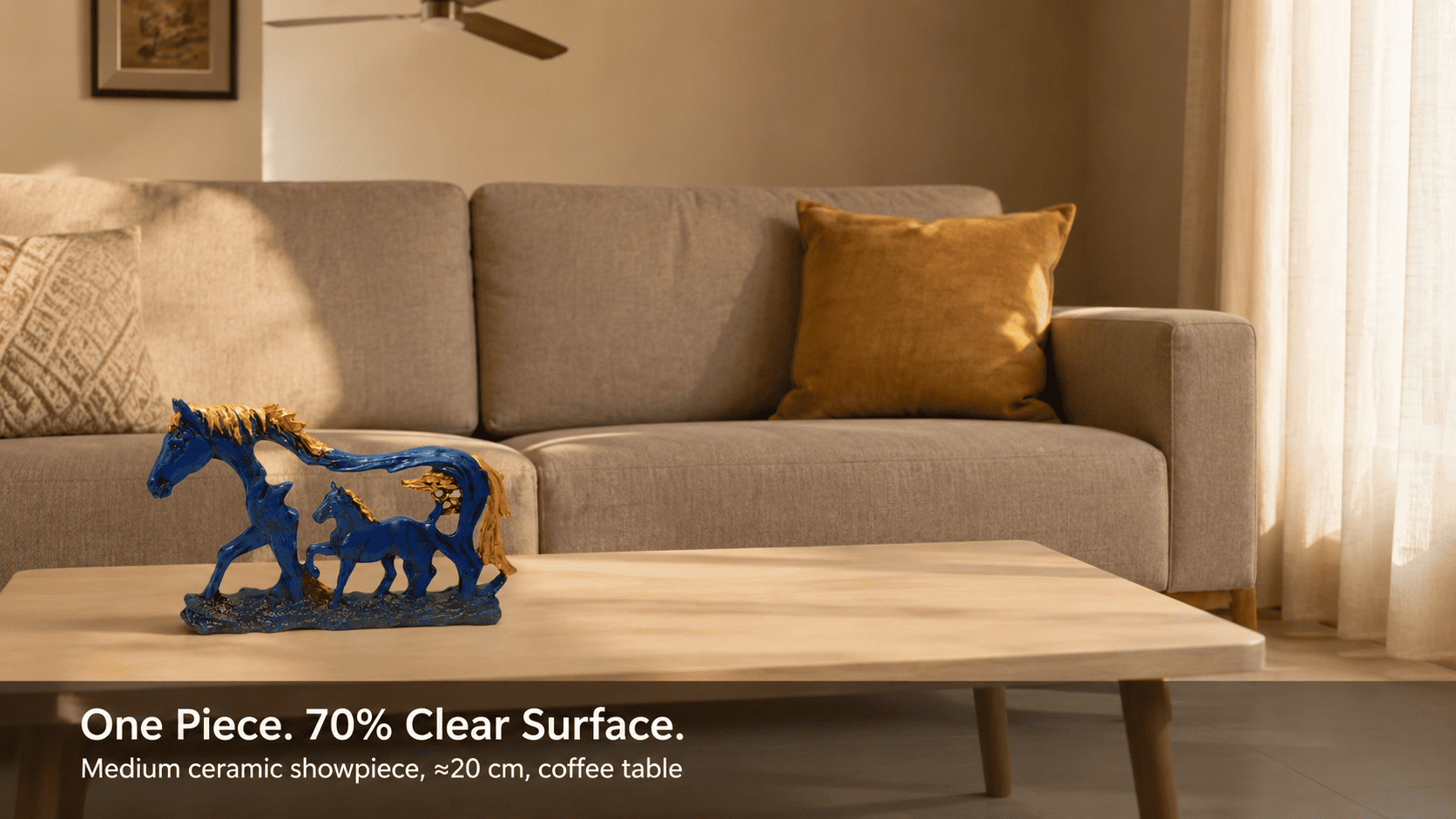
The diagnostic is straightforward: stand at your room's furthest entry point and photograph the main living area on your phone. If you cannot identify a single focal object within 3 seconds of looking at the photograph, the room has crossed the clutter threshold. This is not a subjective judgement — it reflects how the brain's pre-attentive visual system works: a focal point must stand out from its surrounding field by contrast in size, height, or material before conscious attention can be directed toward it. When every object is the same visual weight, none of them register as intentional.
A secondary test applies to individual surfaces: if any surface has objects touching each other (no visible gap between bases), it is over-occupied. Objects that touch remove the negative space between them, causing the eye to perceive them as a single undifferentiated mass — the visual opposite of a curated cluster. Maintaining a minimum 5 cm gap between any two objects on a surface preserves individual object identity, allowing each piece to register as a deliberate choice rather than filler.
Ready to reset your living room's object count with pieces sized and weighted for Indian apartment surfaces? Shop the full Moolwan showpiece for living room collection — manufactured direct, climate-rated for Indian conditions, and available in all three size bands.
Which Types of Décor Objects Add the Most Clutter in a Small Indian Living Room
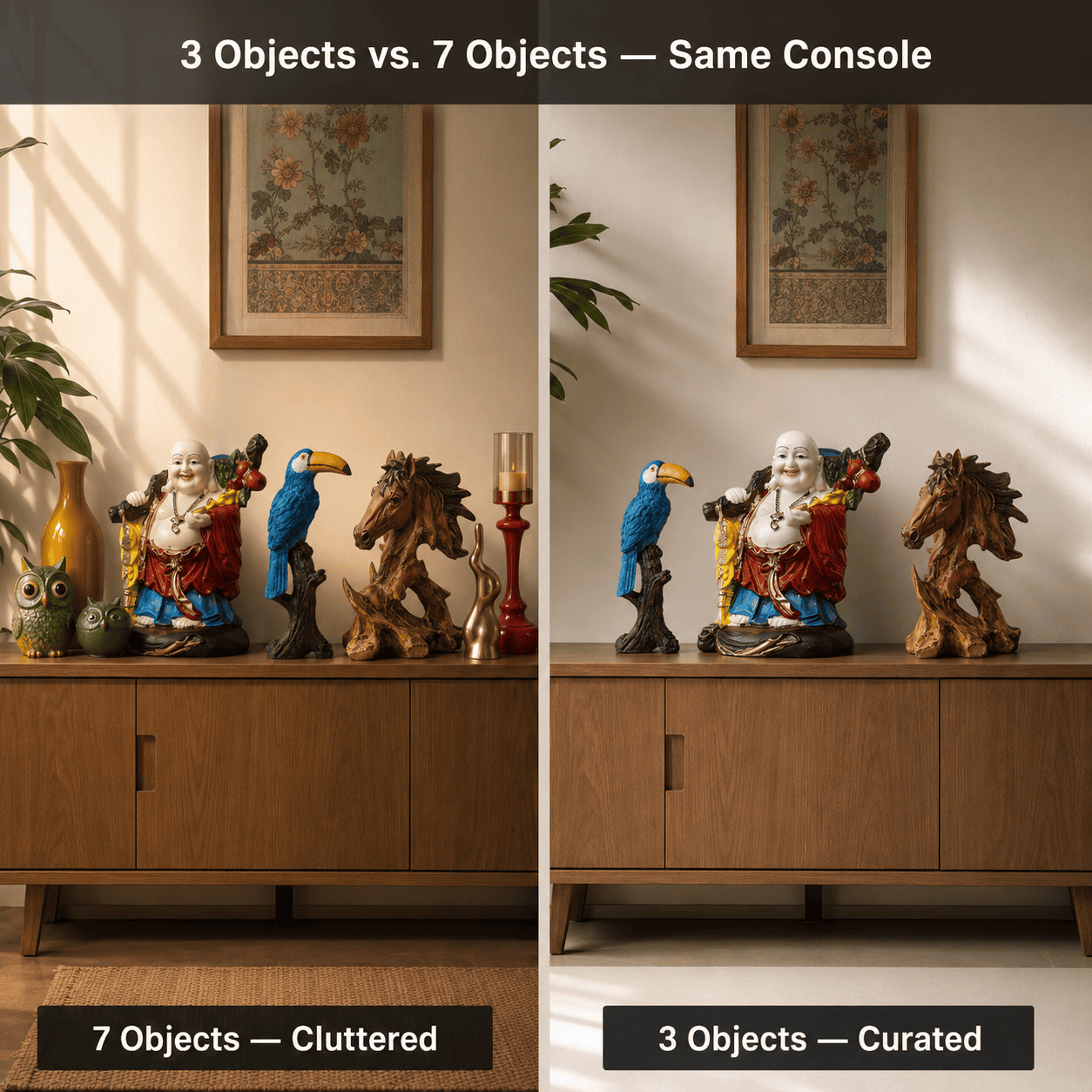
Not all object types contribute equally to visual clutter. The highest-clutter categories in compact Indian living rooms are: objects with irregular silhouettes (figurines with outstretched limbs or asymmetric profiles), because their edge complexity multiplies the number of visual interruptions per piece; objects in three or more different colours on a single surface, because colour contrast between pieces prevents the brain from grouping them into a single composition; and mismatched material combinations (ceramic next to resin next to metal next to fabric), because each material reflects and absorbs light differently, creating a fragmented rather than unified surface story.
The lowest-clutter object types — those that hold their visual weight without fragmenting the room — are: tall, simple-profile pieces (clean vertical silhouettes under 34 cm) that read as a single vertical element; objects in the same finish family (all matte or all satin) even if different in palette; and objects in odd-number groupings of 3 (the brain groups odd numbers into triangular compositions rather than linear repetitions, creating visual rhythm rather than visual repetition). Resin and high-fired ceramic pieces in matte warm-earth or neutral palettes satisfy all three low-clutter criteria simultaneously because their 94%-purity resin or 92%-clay composition produces surfaces with uniform light response across each piece, keeping the material story consistent regardless of grouping.
Candles, plants, and photo frames are the three most common clutter amplifiers in Indian living rooms, not because they are decorative failures but because they are added incrementally without being counted toward the surface object total. Every candle, pot, and frame is a décor object occupying surface footprint and visual bandwidth — counting them within the 7-to-9 total limit is not optional if the goal is a room that reads as intentionally styled.
How Finish, Material, and Palette Choice Affect the "Too Many" Threshold
The 7-to-9 object limit assumes a reasonably consistent finish and palette across the room. When finish and palette are inconsistent, the effective clutter threshold drops to 4 to 5 objects, because each divergent finish or colour acts as an additional visual interrupt that the brain must process independently. Conversely, rooms where all décor shares a single finish family (all matte) and a constrained palette (warm earth or monochrome neutral) can accommodate up to 11 objects before the clutter threshold is crossed, because the brain groups consistently-finished objects into cohesive "scenes" rather than counting them individually.
This is the practical reason material specification matters in décor shopping: a 94%-purity epoxy resin piece and a 92%-clay ceramic piece in the same matte warm-earth palette will group visually even though they are different materials, because finish and palette — not material composition — determine the brain's grouping logic. Mixing a glossy resin piece with a matte ceramic piece in the same colour will not group cleanly, because the different light responses break the finish consistency that makes grouping possible.
Humidity tolerance is a secondary material consideration with a direct impact on long-term clutter management: pieces that warp, discolour, or develop hairline cracks under Indian monsoon humidity (which peaks at 85–95% RH in coastal and northern metro cities) must be replaced seasonally, introducing new palette and finish variables into the room's object mix with each replacement cycle. Moolwan's ceramic collection is engineered to 85% RH tolerance using its high-density 92%-clay composition, and its resin collection to 60% RH tolerance with 94%-purity epoxy — specifically to prevent the material degradation that forces mid-season décor changes and inadvertently disrupts a room's curated finish story.
Frequently Asked Questions
Is 7 décor objects the right number for every small Indian living room?
Seven to nine is a functional upper limit for a living room under 150 sq ft, not a fixed prescription. The actual threshold shifts based on object size, surface width, finish consistency, and palette control. A room where all objects share a matte finish and a constrained 2-colour palette can accommodate up to 11 objects before visual clutter registers, because consistent finish causes the brain to group objects perceptually rather than count them individually. A room with mismatched finishes and 4 or more colour tones will read as cluttered at 5 objects. The limit is structural, not numerical.
Can I add plants and candles without affecting my décor object count?
No. Plants, candles, and photo frames each occupy surface footprint and consume a unit of the brain's subitising capacity — the same cognitive budget that decorative showpieces draw from. A surface with one matte ceramic showpiece, one pillar candle, and one small succulent has 3 objects on it and has reached the per-surface limit for a surface under 60 cm wide. The aesthetic category of the object (botanical vs sculptural vs functional) is irrelevant to the visual arithmetic. Count everything on the surface to stay below the threshold.
Do lighter-coloured décor objects take up less visual space in a small room?
Yes, but the mechanism is finish-dependent, not colour-dependent. Matte-finish objects in any palette absorb and scatter light, reducing their optical weight and allowing more objects to coexist on a surface before the clutter threshold is crossed. Glossy objects in the same light colour will reflect Indian sunlight in concentrated highlights, increasing their perceived size and optical weight. A matte warm-earth ceramic showpiece reads as smaller and less intrusive than a glossy white object of identical physical dimensions — making finish specification a more important variable than colour when choosing décor for a sunlit Indian room.
What is the minimum gap required between two showpieces on a surface?
A minimum 5 cm gap between the bases of any two objects is required to preserve individual object identity on a surface. When bases touch or overlap, the eye perceives the objects as a single undifferentiated mass, eliminating the visual "breathing space" that allows each piece to register as an intentional placement. For surfaces under 30 cm wide, a 5 cm gap between a second object and the first usually places the second object at or beyond the surface edge — which is why sub-30 cm surfaces should hold a maximum of 1 object, per Moolwan's 3-Object Cluster Rule guidance.
Because a showpiece that degrades under monsoon humidity or warps on a sun-exposed console forces an unplanned replacement — and each replacement risks disrupting the finish consistency that keeps your room's object count from reading as clutter — investing in climate-rated, size-calibrated pieces is the only way to hold a curated room together across years, not just seasons. Bring home a piece engineered for Indian surfaces from the Moolwan showpiece for living room collection — manufacturer-direct, 85% RH-rated ceramics and 94%-purity resin, in all three size bands. If you are also working on the broader living room scheme, Moolwan's luxury interior décor items for small living rooms offers a curated selection across object types sized specifically for compact Indian apartments, and the black room accessories for modern living rooms collection is a strong starting point for a monochrome finish strategy — the single most reliable way to raise your room's object-count ceiling without visual risk.


